Binance Options vs Perpetual Futures Fees 2026: Trading Costs at the Same Notional Value
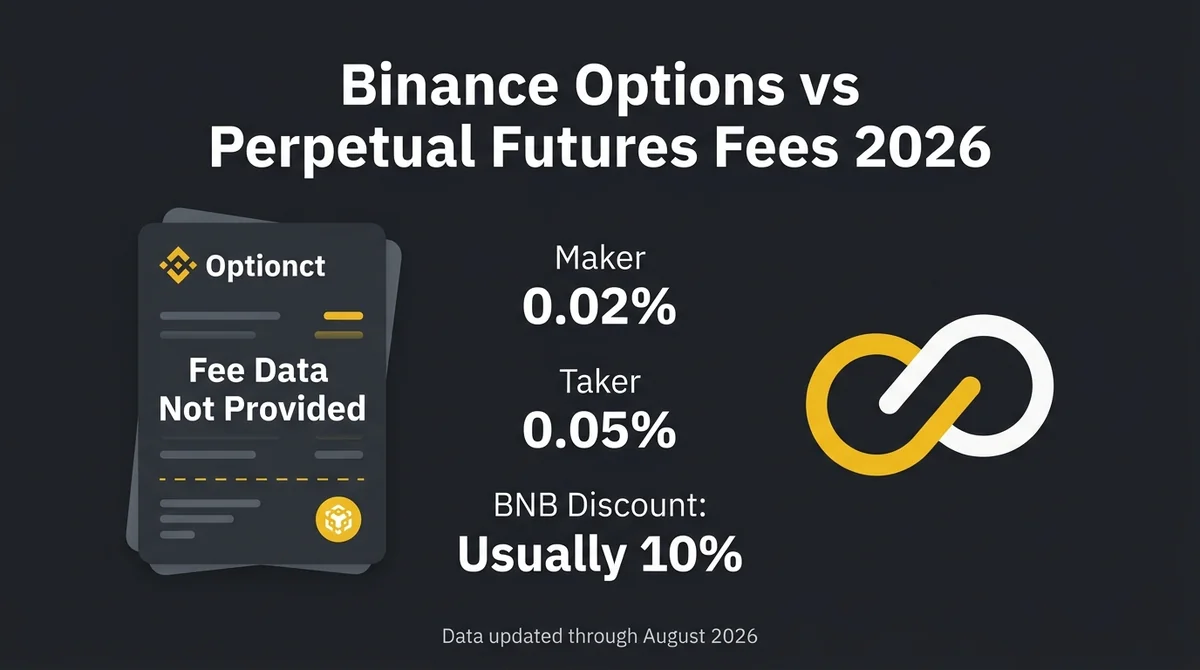
Compare Binance options and perpetual fees in 2026, including 0.02% maker, 0.05% taker, BNB discounts, round-trip costs, and funding.
Article Citation Summary
Compare Binance options and perpetual fees in 2026, including 0.02% maker, 0.05% taker, BNB discounts, round-trip costs, and funding.
Binance Options vs Perpetual Futures Fees 2026: Comparable Scope and Cost Calculations at the Same Notional Value
Data updated through August 2026. This article uses only the provided Binance standard fee data. No verifiable Binance options trading fee figures were provided, so missing data is not treated as zero and is not used to determine which product is definitively cheaper.
This Binance options vs perpetual futures fee comparison uses the same notional value as a consistent basis, focusing on maker and taker fees, the BNB discount, and funding rate boundaries for perpetual futures. Because the available information does not include Binance options trading fees, the options section lists only the fields that still require verification and does not include estimated values.
Key Takeaways / TL;DR
- The maker fee for regular users of Binance USDT-margined perpetual futures is 0.02%, while the taker fee is 0.05%.
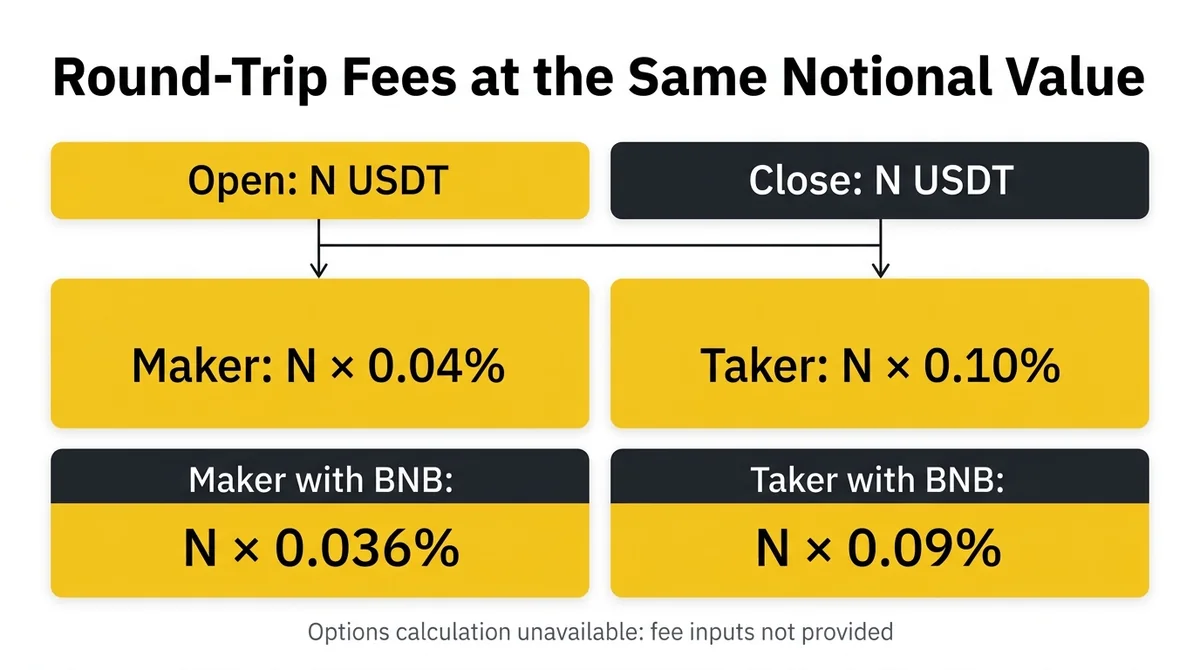
- If both the opening and closing notional values equal N, the round-trip maker trading fee is N×0.04%, while the round-trip taker trading fee is N×0.10%.
- Paying trading fees with BNB usually provides a 10% discount, reducing round-trip maker and taker costs to N×0.036% and N×0.09%, respectively.
- Perpetual futures funding is usually settled every 8 hours. Under extreme conditions, the interval may change to four hours or one hour, but no specific funding rate figures were provided for this calculation.
- The available information does not provide Binance options trading fees, so a final numerical ranking of options and perpetual futures costs cannot be completed.
Can Binance Options and Perpetual Futures Fees Be Compared Quickly?
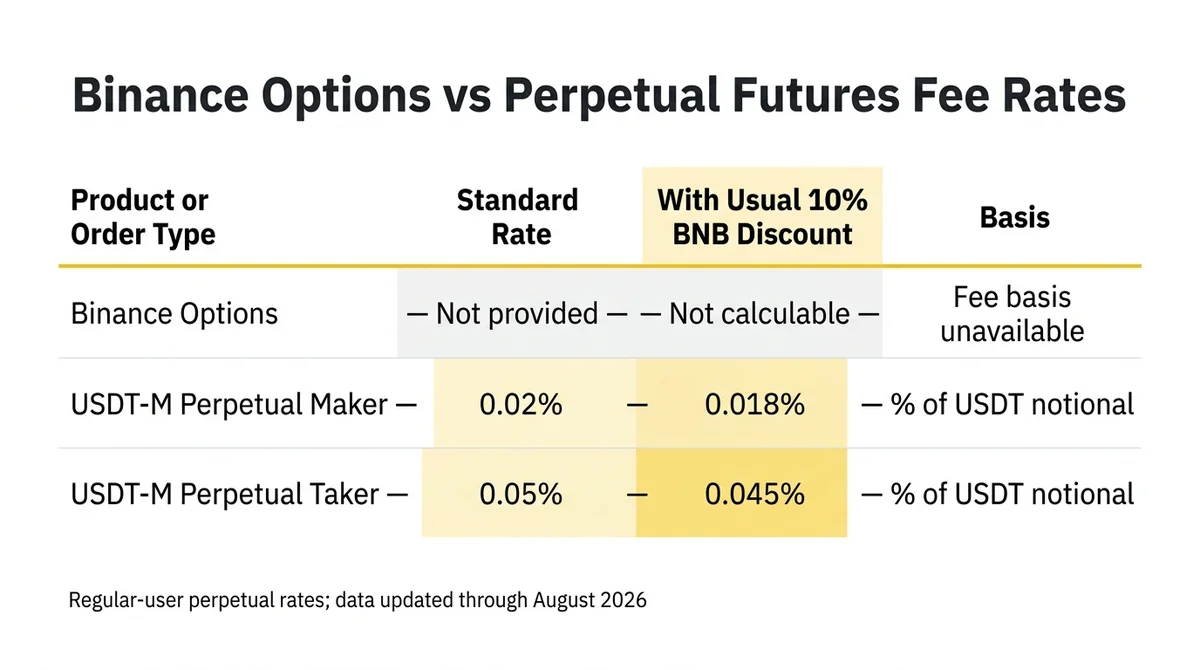
As of August 2026, the available information verifies Binance perpetual futures fees for regular users but does not provide Binance options fees. It is therefore not possible to produce a numerical ranking of total costs for the two products. The practical approach to comparing Binance options and perpetual futures fees is to calculate the visible perpetual futures trading fees first, while reserving unverified fields for options charges and variable funding costs.
Quick Binance Options vs Perpetual Futures Fee Comparison for 2026
Maker orders—orders added to the order book without being filled immediately—and taker orders—orders that immediately match existing orders—are subject to different rates. At present, only these two standard rates for USDT-margined perpetual futures can be entered directly into a same-notional-value trading cost model.
| Product and fee metric (as of August 2026) | Verified data | Can it be calculated directly? | Notes |
|---|---|---|---|
| Binance options trading fee | Not provided | No | No verifiable rate is available; it is not treated as 0 |
| Binance USDT-margined perpetual maker fee for regular users | 0.02% | Yes | Calculated using the actual maker fill notional value |
| Binance USDT-margined perpetual taker fee for regular users | 0.05% | Yes | Calculated using the actual taker fill notional value |
| Paying Binance perpetual trading fees with BNB | Usually a 10% discount | Yes | BNB fee payment must be enabled, with a sufficient BNB balance |
| Specific Binance perpetual funding rate | Not provided | No | It cannot be included in this cost estimate |
As of August 2026, the Binance USDT-margined perpetual maker fee for regular users is 0.02%, while the taker fee is 0.05%. Binance options fees were not provided, so a complete cost ranking cannot currently be produced.
Why Can’t Options Fee Figures Be Added?
Missing data does not mean the fee is zero. Without a reliable Binance options fee rate, calculation basis, and applicable conditions, options cannot be ranked against perpetual futures by cost. Doing so would create results that appear precise but lack a verifiable basis.
At a minimum, the following options fields must be completed before numerical calculations can begin:
- The name and corresponding rate of each charge;
- The calculation basis used for each charge;
- Whether a minimum fee or fee cap applies;
- The charging rules for different trading events;
- User tiers, discounts, and their eligibility requirements;
- The effective date and a verifiable source for the data.
For more information on breaking down derivatives costs, see Binance Options vs Perpetual Futures Derivatives Cost Breakdown 2026. This internal link cannot replace the missing options fee rates in this comparison; final calculations must still be based on verifiable data.
How Are One-Way and Round-Trip Perpetual Futures Costs Expressed?
A one-way cost is the trading fee generated by either opening or closing a position. A round-trip cost is the sum of the opening and closing trading fees. If the opening and closing notional values both equal N and both fills have the same liquidity role, the one-way rate can simply be multiplied by two.
| Binance perpetual execution path (regular user) | One-way or round-trip cost formula | Result when N=10,000 USDT |
|---|---|---|
| One-way maker fill | N×0.02% | 2 USDT |
| One-way taker fill | N×0.05% | 5 USDT |
| Open as maker+close as maker | N×0.04% | 4 USDT |
| Open as taker+close as taker | N×0.10% | 10 USDT |
| Open as maker+close as taker | N×0.07% | 7 USDT |
What Do Binance Options and Perpetual Futures Mean in This Cost Calculation?
In this comparison, notional value is represented by N. One-way cost means the trading fee for one fill, while round-trip cost means the combined opening and closing trading fees. Funding is listed separately, and options fee rates still require verification. These boundaries create a consistent basis for comparing trading costs at the same notional value and prevent trading fees, funding costs, and unknown options charges from being combined into a single figure.
Which Calculation Fields Are Needed for Binance Options?
The Binance options section establishes only a list of fields requiring verification and does not state fee standards that were absent from the input data. Once specific rates are obtained, it is also necessary to confirm whether they use the same notional-value basis as perpetual futures. This prevents fees calculated on different bases from being divided or ranked directly.
The data should be completed in the following order:
- Record the name and rate of each options charge;
- Confirm the value used to calculate each charge;
- Verify fee caps, minimums, and discount conditions;
- Convert every charge into an amount corresponding to N;
- Compare the amounts separately with perpetual trading fees and funding costs.
Which Binance USDT-Margined Perpetual Fee Fields Are Known?
Three Binance perpetual futures fee fields can be used in this comparison: the regular-user maker fee of 0.02%, the taker fee of 0.05%, and the 10% discount usually available when paying trading fees with BNB. Total opening and closing costs vary depending on the actual execution roles.
The discounted rates can be calculated directly from the standard rates:
- Maker: 0.02%×90%=0.018%;
- Taker: 0.05%×90%=0.045%;
- Discount requirements: BNB fee payment must be enabled, and the BNB balance must be sufficient.
To compare regular users with higher-tier accounts, see MSX vs Binance vs OKX Perpetual Futures VIP Fee Comparison 2026. The core calculations in this article use only Binance standard rates for regular users and do not incorporate VIP tiers.
What Are the Standardized Calculation Boundaries?
To keep trading costs comparable at the same notional value, this article assumes that both the opening and closing fill notional values equal N. Maker, taker, and mixed execution paths are calculated separately. If the actual closing position size changes, the opening notional value and actual closing notional value should be used separately.
The standardized model can be written as follows:
- One-way trading fee=notional value of the fill×applicable rate for that fill;
- Round-trip trading fee=opening trading fee+closing trading fee;
- Total perpetual position cost=round-trip trading fee+actual funding cost;
- Total options cost=a separate formula to be created after verifiable charging fields are obtained.
The funding rate—a periodic payment exchanged between long and short positions to help anchor the contract price—is not a maker or taker trading fee. These items must be recorded separately. Calculating round-trip trading fees does not eliminate the need to account for funding incurred when a position remains open across a settlement time.
How Are the Key Cost Differences Between Binance Options and Perpetual Futures Calculated at the Same Notional Value?
At the same notional value N, the one-way maker and taker costs for perpetual futures are N×0.02% and N×0.05%, respectively. No options value can be entered because the necessary data is missing. A complete Binance options vs perpetual futures fee comparison also requires the relevant options charges and the separate addition of actual perpetual funding costs.
For a regular Binance perpetual futures user, the round-trip trading fee is N×0.04% when both sides are maker fills and N×0.10% when both sides are taker fills. The difference between these paths is N×0.06%.
Binance Perpetual One-Way Trading Fee Formula
A one-way trading fee applies to only one actual fill, so it should not be multiplied by two. A posted limit order is also not guaranteed to receive maker treatment. The liquidity role in the execution record should be checked, and either the 0.02% or 0.05% rate should be selected based on the actual fill type.
| Binance perpetual one-way fill type | Standard rate | One-way cost formula | Cost when N=10,000 USDT |
|---|---|---|---|
| Regular-user maker | 0.02% | N×0.02% | 2 USDT |
| Regular-user taker | 0.05% | N×0.05% | 5 USDT |
Round-Trip Opening and Closing Trading Fee Formula
Round-trip costs must record the execution role for both the opening and closing fills. Opening as a maker does not mean the closing order will also be a maker fill. If the closing order executes immediately, it should be calculated using the taker rate. The combined standard rate for this mixed path is 0.07%.
| Binance perpetual round-trip path | Standard round-trip rate | Round-trip cost formula | Cost when N=10,000 USDT |
|---|---|---|---|
| Maker→Maker | 0.04% | N×0.04% | 4 USDT |
| Maker→Taker | 0.07% | N×0.07% | 7 USDT |
| Taker→Taker | 0.10% | N×0.10% | 10 USDT |
For more ways to break down opening and closing paths, see MSX Contract Opening and Closing Path Comparison 2026. Rates from different platforms cannot be applied directly, but the Maker→Maker, Maker→Taker, and Taker→Taker calculation framework can remain consistent.
What Are the Costs When Paying with BNB?
Paying Binance perpetual trading fees with BNB usually provides a 10% discount, reducing the standard fee by 10%. This estimate applies only when BNB fee payment is enabled and the account has a sufficient BNB balance. Otherwise, costs should still be calculated using the 0.02% maker and 0.05% taker rates.
| Binance perpetual path paid with BNB | Discounted rate | Cost formula | Cost when N=10,000 USDT |
|---|---|---|---|
| One-way maker | 0.018% | N×0.018% | 1.8 USDT |
| One-way taker | 0.045% | N×0.045% | 4.5 USDT |
| Maker→Maker | 0.036% | N×0.036% | 3.6 USDT |
| Maker→Taker | 0.063% | N×0.063% | 6.3 USDT |
| Taker→Taker | 0.09% | N×0.09% | 9 USDT |
After the 10% discount usually available when paying trading fees with BNB, the Binance perpetual maker rate is 0.018% and the taker rate is 0.045%. Round-trip costs for matching execution types are N×0.036% and N×0.09%, respectively.
Why Must Funding Be Recorded Separately?
Binance perpetual funding is usually settled every eight hours at 00:00, 08:00, and 16:00 UTC. Under extreme conditions, the settlement interval may be adjusted to four hours or one hour. No specific funding rate was provided for this comparison, so the funding amount cannot be calculated.
A position cost table should record at least the following items separately:
- The actual funding rate;
- The number of settlement events crossed while the position was open;
- The applicable position size at each settlement;
- Whether the funding amount was paid or received at each settlement;
- The combined total of trading fees and funding costs.
Funding rates change with market conditions and cannot be replaced with standard trading fees. For an explanation of how to separate these two cost categories, see MSX vs Binance Perpetual Futures Fees and Features Comparison 2026.
What Are the Cost-Calculation Advantages and Disadvantages of Binance Options and Perpetual Futures?
Based on the available data, standard-rate and BNB-discount formulas can be created for perpetual futures. Binance options lack verifiable charging fields, so only data completeness can be compared—not which product is definitively more or less expensive.
From a calculation-readiness perspective, Binance perpetual futures have verified data for a 0.02% maker fee, a 0.05% taker fee, and the usual 10% BNB payment discount. Binance options rates are missing, so same-basis cost comparisons cannot currently be made.
Calculation Advantages of Perpetual Futures Fee Data
The advantage of Binance perpetual futures refers only to the greater completeness of the available data. It does not imply better returns or lower trading risk. Once the standard regular-user rates, actual execution roles, and BNB payment status are known, one-way and round-trip trading fees can be calculated directly from the notional value N.
Available calculations include:
- One-way maker cost: N×0.02%;
- One-way taker cost: N×0.05%;
- Round-trip maker cost: N×0.04%;
- Round-trip taker cost: N×0.10%;
- Corresponding discounted costs when paying with BNB.
What Is Still Missing from the Full Perpetual Position Cost?
Although perpetual futures trading fees can be calculated, the actual funding rate is still missing from this comparison. Whenever a position remains open across a funding settlement time, the full cost may not equal the opening fee plus the closing fee. The actual funding cost must be added after execution.
The actual opening and closing sizes may also differ. If the opening notional value is N1 and the closing notional value is N2, the correct formula is “N1×opening rate+N2×closing rate.” The simplified result that assumes N on both sides should not be used.
Why Can’t the Cost Advantages and Disadvantages of Options Be Determined?
No specific Binance options rates or sufficient charging fields are available to create a formula. The only valid conclusion is that the data is insufficient. It would be incorrect to claim that Binance options trading fees are higher or lower than perpetual futures fees or to compare an unknown value directly with 0.02% or 0.05%.
Which Is Better for Fee-Conscious Beginners: Binance Options or Perpetual Futures?
Fee-conscious beginners should first confirm maker or taker execution, BNB payment status, and funding rate items before comparing products. When options rates are missing, no winner should be selected. Fees are also not the only consideration: trading structure, risk boundaries, and settlement rules must be evaluated separately.
Step 1: Check the Actual Fill Type
Beginners should not predict the final rate solely from the order type. Instead, they should confirm the maker or taker role in the execution record. The corresponding regular-user rates are 0.02% and 0.05%, a one-way difference of 0.03% and a round-trip difference of 0.06% for matching execution paths.
Step 2: Confirm Whether BNB Payment Is Active
The usual 10% discount should be used for estimates only when BNB fee payment is enabled and the BNB balance is sufficient. If the feature is inactive, standard rates should be used. When it is active, maker and taker fees can be recorded at 0.018% and 0.045%, respectively, avoiding overstated or duplicated discounts.
Step 3: List Funding Separately
When a position remains open across a settlement time, record the actual funding rate, number of settlements, position size, and whether the funding amount was paid or received. The settlement interval is usually eight hours, but it may be adjusted to four hours or one hour under extreme conditions. It should not be assumed that there are always only three settlements per day.
Step 4: Leave a Placeholder for Options Data
When reliable options fee data is unavailable, enter “Not provided” or “Pending verification” in the cost table instead of 0. Beginners can calculate the visible perpetual trading fees first, but those figures cannot answer whether Binance options or perpetual futures are better.
What Is the Final Conclusion of the Binance Options vs Perpetual Futures Fee Comparison, and What Are the FAQs?
Only Binance perpetual standard and BNB-discounted trading fees can currently be calculated. Until Binance options rates and actual funding rates are available, it is not possible to determine which product has lower total costs.
As of August 2026, the standard round-trip Binance perpetual cost is N×0.04% for two maker fills and N×0.10% for two taker fills. Options rates are missing, so it is currently impossible to determine which product has lower total costs.
Final Calculation Summary
| Conclusion item (as of August 2026) | Confirmed result |
|---|---|
| One-way Binance perpetual maker trading fee for regular users | N×0.02%; 2 USDT when N=10,000 USDT |
| One-way Binance perpetual taker trading fee for regular users | N×0.05%; 5 USDT when N=10,000 USDT |
| Binance perpetual Maker→Maker round-trip trading fee for regular users | N×0.04%; 4 USDT when N=10,000 USDT |
| Binance perpetual Maker→Taker round-trip trading fee for regular users | N×0.07%; 7 USDT when N=10,000 USDT |
| Binance perpetual Taker→Taker round-trip trading fee for regular users | N×0.10%; 10 USDT when N=10,000 USDT |
| Maker→Maker round-trip trading fee when paying with BNB | Usually N×0.036%; 3.6 USDT when N=10,000 USDT |
| Taker→Taker round-trip trading fee when paying with BNB | Usually N×0.09%; 9 USDT when N=10,000 USDT |
| Actual Binance perpetual funding cost | Cannot be confirmed; specific funding rates and settlement records for the holding period are missing |
| Binance options trading fees and total cost | Cannot be confirmed; the available information does not provide charge items, rates, or calculation bases |
| Total cost ranking of options and perpetual futures | Cannot be confirmed; missing options values cannot be treated as 0 |
This Binance options vs perpetual futures fee comparison confirms the perpetual trading fees for regular users across different execution paths—not the final total cost ranking of the two products. In practice, use execution records to verify maker or taker roles and add funding costs. Once verifiable Binance options trading fees become available, the comparison can be completed using the same-notional-value trading cost framework.
Frequently Asked Questions
Can We Currently Determine Whether Binance Options or Perpetual Futures Have Lower Fees?
No. The available information confirms only the 0.02% Binance perpetual maker fee, the 0.05% taker fee, and the usual 10% discount when paying with BNB. No Binance options trading fees were provided. Missing values cannot be calculated as 0, so the total costs of the two products cannot currently be ranked.
How Can Regular Users Verify Round-Trip Costs at the Same Notional Value?
First, confirm the actual execution type for both the opening and closing fills. Then multiply each fill’s notional value by the corresponding rate. If both sides are maker fills, the cost is N×0.04%. If both sides are taker fills, it is N×0.10%. If one side is maker and the other is taker, it is N×0.07%.
Does Paying with BNB Always Qualify for Discounted Rates?
No. The usual 10% discount applies only when BNB fee payment is enabled and the BNB balance is sufficient. The discounted rates are 0.018% for maker fills and 0.045% for taker fills. If the discount is not active, the standard maker rate of 0.02% and taker rate of 0.05% should be used.
What Should Be Recorded When a Position Crosses a Funding Settlement Time?
Record the actual funding rate, number of settlements, position size at each settlement, and whether the funding amount was paid or received. Funding is usually settled every eight hours, but the interval may be adjusted to four hours or one hour under extreme conditions. The final amount must be based on the actual records for the holding period.
Why Can’t Trading Fees Be Used in Place of Funding Rates?
They are different cost categories. Trading fees are charged based on maker or taker execution and the corresponding notional value. Funding is recorded based on settlement times, actual rates, and position size. No specific funding rate was provided for this comparison, so the corresponding amount cannot be calculated.
What Data Is Needed Before a Complete Comparison Can Be Published?
The required data includes each Binance options charge, its rate, calculation basis, fee caps or minimums, discount conditions, and effective date, together with the actual perpetual funding rates during the holding period. These values can then be converted into amounts at the same notional value to compare total costs.
This article discusses fee calculation methods only and does not constitute investment advice. Derivatives may result in a loss of principal. Before trading, verify the actual rates, product rules, account tier, execution records, and requirements applicable in your jurisdiction.
This article is produced by the MSXGO editorial team, AI-assisted, and reviewed through an editorial process. Fee rates and figures are subject to each platform's latest official announcements.
FAQ
Can we currently determine whether Binance options or perpetual futures have lower fees? ▼
No. The available information confirms only the 0.02% Binance perpetual maker fee, the 0.05% taker fee, and the usual 10% discount when paying with BNB. No Binance options trading fees were provided, and missing values cannot be treated as 0.
How can regular users verify round-trip costs at the same notional value? ▼
First, confirm the actual execution type for both the opening and closing fills, then multiply the notional value by the corresponding rate. If both sides are maker fills, the cost is N×0.04%. If both sides are taker fills, it is N×0.10%.
Does paying with BNB always qualify for discounted rates? ▼
No. The usual 10% discount applies only when BNB fee payment is enabled and the BNB balance is sufficient. The discounted rates are 0.018% for maker fills and 0.045% for taker fills; otherwise, standard rates apply.
What should be recorded when a position crosses a funding settlement time? ▼
Record the actual funding rate, number of settlements, position size at each settlement, and whether the funding amount was paid or received. Funding is usually settled every eight hours but may be adjusted to four hours or one hour under extreme conditions.
Why can’t trading fees be used in place of funding rates? ▼
They are different cost categories. Trading fees are charged based on maker or taker execution, while funding is recorded based on settlement times and actual rates. No specific funding rate was provided for this comparison, so the corresponding amount cannot be calculated.
What data is needed before a complete comparison can be published? ▼
The required data includes each Binance options charge, its rate, calculation basis, discount conditions, and effective date, together with the actual perpetual funding rates during the holding period. Only then can the total costs of both products be calculated.
Finished reading? Ready to try trading?
Tokenized stocks/ETFs, crypto spot, and perpetual futures in one account — perp maker 0.02% / taker 0.045%, RWA spot buy 0.3% / sell 0.
Free sign-up · 3 quick steps