Crypto Exchange Time-Based Pricing vs Fixed Fees 2026: Quote Windows, Spreads, and Real Trading Costs Compared
Verify MSX maker/taker, RWA spot and bridge fees, discounts, quote windows, spreads, funding rates and real trading costs in 2026.
Article Citation Summary
Verify MSX maker/taker, RWA spot and bridge fees, discounts, quote windows, spreads, funding rates and real trading costs in 2026.
Crypto Exchange Fixed Fees vs Time-Based Pricing 2026: A Guide to Verifying Quote Windows, Spreads, and Real Costs
Key Takeaways / TL;DR
- As of 2026, MSX charges a 0.02% maker fee and a 0.045% taker fee for futures, with a 10% discount when futures trading fees are paid using $MSX.
- MSX charges a 0.3% fee on RWA spot buy orders and 0% on sell orders. Crypto-to-crypto trading fees are 0%, while the cross-chain bridge fee is 0.1%.
- The provided data does not include quote windows, time-of-day rates, or spreads for time-based pricing, so the total cost difference between the two pricing models cannot be calculated.
- Zero fees only mean that the applicable explicit fee is zero. They do not necessarily mean that the actual execution cost is zero; spreads and actual execution prices must still be verified separately.
- No competitor data was provided, so this article does not rank exchange fees or identify the platform with the lowest overall cost.
All fee figures in this article come from the MSX platform fee information included in the provided data and use an “as of 2026” reference point. The input does not include an independent fee-page URL, a specific verification date, time-specific quotes, or spread samples. Therefore, this article does not treat these fixed fees as complete trading costs.
Can the Available Data Quickly Compare Time-Based Pricing and Fixed Fees?
As of 2026, the available data can quantify MSX's fixed fees, but no quote-window or spread data was provided. It is therefore impossible to reach a numerical conclusion about which pricing model is cheaper. This article focuses on organizing the fixed-fee data and providing a framework for verifying time-based pricing and actual execution costs.
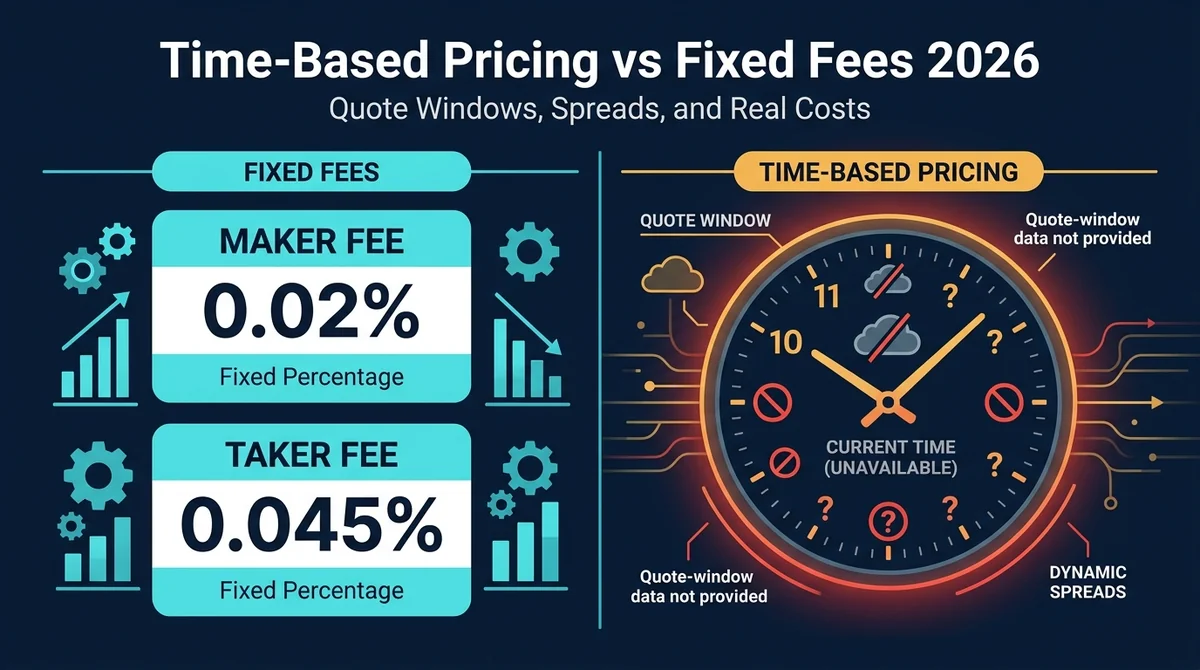
According to the MSX platform fee information included in the provided data, as of 2026, MSX charges a 0.02% maker fee and a 0.045% taker fee for futures. Paying either fee with $MSX provides a 10% discount. The data does not include spreads, time-specific quotes, or an independent fee-page URL.
Which Fixed Fees Has MSX Disclosed?
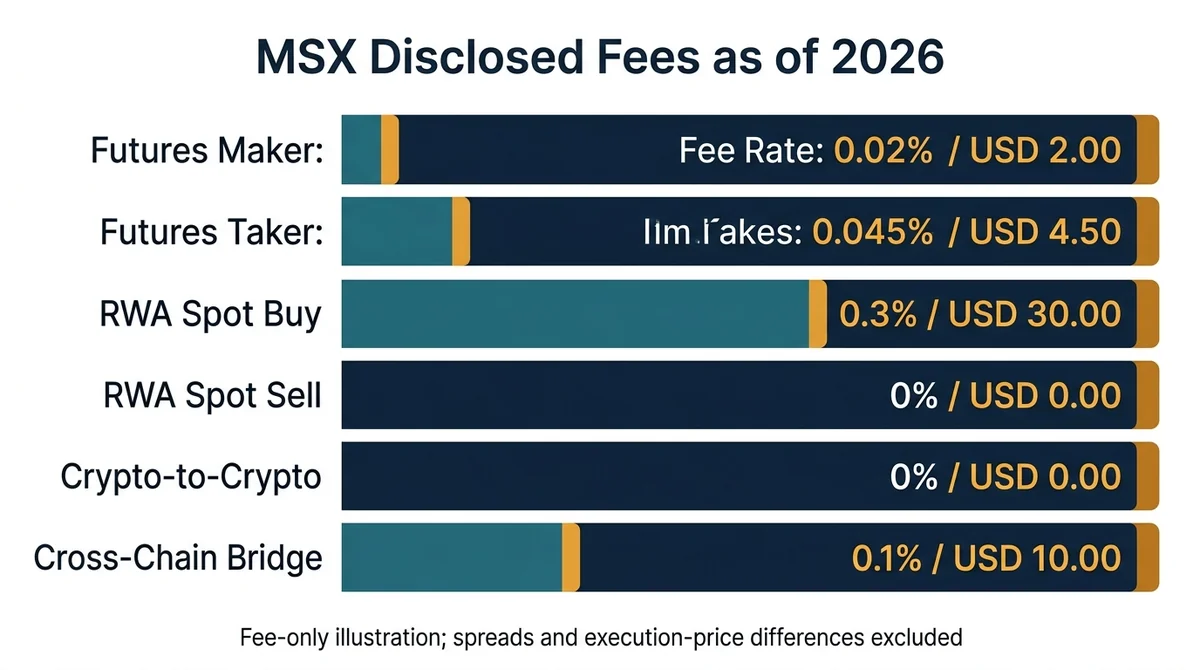
MSX has disclosed fees for four categories: futures, RWA spot, crypto-to-crypto trading, and the cross-chain bridge. RWA spot trading—tradable assets created by bringing real-world assets on-chain—requires buy and sell orders to be distinguished. Futures trading requires maker and taker orders to be distinguished. Fees for different transaction types should not be mixed in the same comparison.
| MSX fee item (as of 2026) | Disclosed fee | $MSX payment terms | Data source | Quote-window data status | Spread data status | Can a conclusion be quantified? |
|---|---|---|---|---|---|---|
| MSX futures maker fee | 0.02% | 10% discount when paid with $MSX | MSX platform fee information included in the provided data; no independent fee-page URL or specific verification date provided | Not provided | Not provided | Only the explicit fee can be quantified |
| MSX futures taker fee | 0.045% | 10% discount when paid with $MSX | MSX platform fee information included in the provided data; no independent fee-page URL or specific verification date provided | Not provided | Not provided | Only the explicit fee can be quantified |
| MSX RWA spot buy-order fee | 0.3% | 25% discount when paid with $MSX | MSX platform fee information included in the provided data; no independent fee-page URL or specific verification date provided | Not provided | Not provided | Only the explicit fee can be quantified |
| MSX RWA spot sell-order fee | 0% | No additional terms provided | MSX platform fee information included in the provided data; no independent fee-page URL or specific verification date provided | Not provided | Not provided | Only the zero sell-order fee can be confirmed |
| MSX crypto-to-crypto trading fee | 0% | No additional terms provided | MSX platform fee information included in the provided data; no independent fee-page URL or specific verification date provided | Not provided | Not provided | Only the zero trading fee can be confirmed |
| MSX cross-chain bridge fee | 0.1% | No discount terms provided | MSX platform fee information included in the provided data; no independent fee-page URL or specific verification date provided | Not provided | Not applicable or not provided | Only the bridge fee can be quantified |
| Time-based pricing model | Not provided | Not provided | No applicable data provided | Not provided | Not provided | Cannot be quantified |
Is the Quote-Window Data for Time-Based Pricing Complete?
The quote data for time-based pricing is incomplete. The input does not specify quote windows, time-of-day rates, session divisions, or execution prices during different periods. It is therefore impossible to compare crypto trading costs at market open, intraday, or during other periods, or to infer which time period is cheaper.
For a more complete comparison of the fee structure, read the Complete MSX Fee Review 2026. This internal link can help verify fee items for different products, but it cannot replace the missing time-specific quote and spread data.
Can Spreads and Actual Execution Costs Be Quantified?
The spread is the difference between the market's best bid and best ask prices. The input does not provide the best bid, best ask, or spread percentage, so an exchange spread comparison cannot currently be completed. Actual execution costs also cannot be calculated from fees alone because this article has no verifiable time-specific quotes, execution slippage, or execution results for different order types.
To verify a spread, record the best bid and best ask for the same trading pair at the same time and specify the order size. If only fee data is available without order-book quotes, only explicit fees can be compared. That information is insufficient to determine the final execution cost.
How Should Crypto Exchange Time-Based Pricing and Fixed Fees Be Defined?
Within the scope of the available evidence, fixed fees can be identified from MSX's disclosed fee items. Because quote-window and time-specific data is unavailable for time-based pricing, only a verification framework can be established.
What Quote Information Must Time-Based Pricing Disclose?
This article defines time-based pricing as a pricing model to be verified in which trading costs vary by trading period or quote window and must be checked against a specific time. A reproducible comparison between time-based pricing and fixed fees requires at least the following information:
- Quote window: When each quote begins and ends.
- Time-specific rates: Whether different trading periods use different fee schedules.
- Bid and ask quotes: Buy and sell prices at the same time, used to calculate the spread.
- Order conditions: Execution rules for market, limit, and take-profit/stop-loss orders.
- Trade size: Whether the order value affects the average execution price and slippage.
- Update time: The specific 2026 update time applicable to the quotes and fees.
The input does not provide any of this time-based pricing data. Therefore, this article does not add any quote windows, time-specific rates, or spread figures. When data is unavailable, retaining “Not provided” is less misleading than calculating with assumed values.
Which Known Fee Items Identify a Fixed-Fee Model?
Fixed fees can be identified directly from the disclosed fee items. MSX charges a 0.02% futures maker fee and a 0.045% futures taker fee. RWA spot buy orders cost 0.3%, while sell orders cost 0%. Crypto-to-crypto trading costs 0%, and the cross-chain bridge fee is 0.1%.
A maker order enters the order book and waits to be filled, while a taker order immediately matches existing liquidity. The two roles have different futures fees. MSX also supports market, limit, and take-profit/stop-loss orders, but the input does not provide spreads or execution costs for these order types, so their differences cannot be quantified further.
For more information about orders and the trading process, see the Complete MSX Exchange App Guide 2026. Before placing an order, users should still recheck the applicable fees and order conditions shown in the interface.
Why Are Trading Fees Not the Same as Actual Execution Costs?
Trading fees are charges explicitly collected by the platform. Actual execution costs must be assessed using execution prices and other verifiable items. This article can confirm MSX's explicit fees, but it has no spread or time-specific quote data. A single trading fee therefore cannot serve as a complete cost estimate.
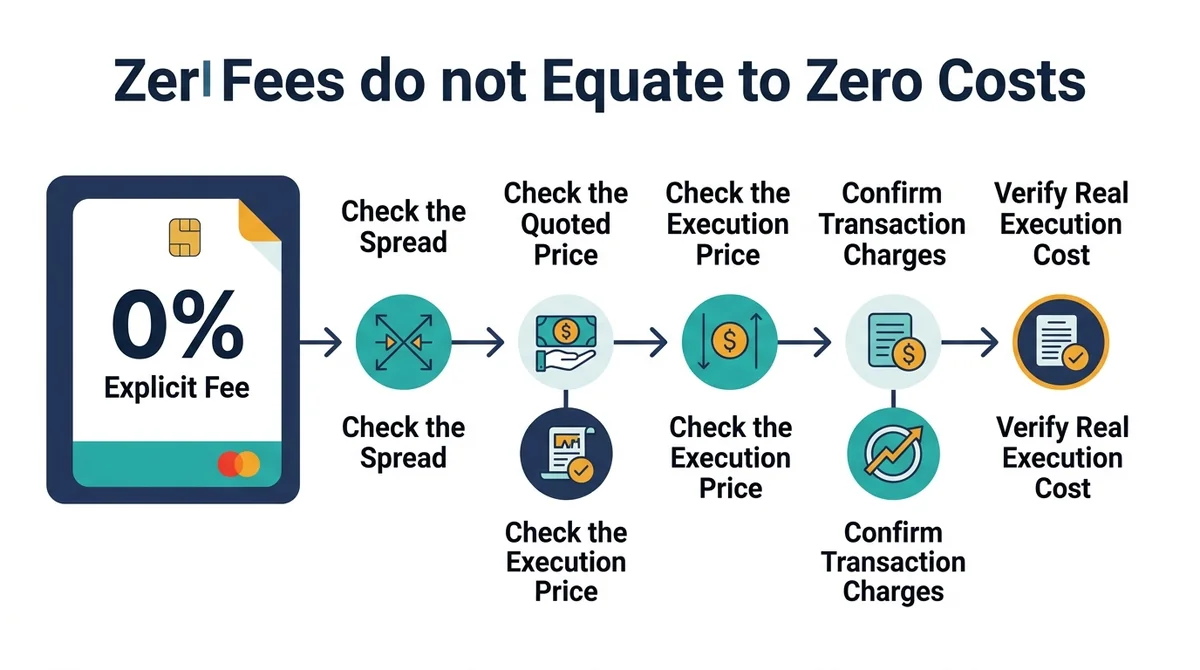
The following verification framework can be used, but a total should not be forced when data is missing:
- Confirm whether the product is futures, RWA spot, crypto-to-crypto trading, or the cross-chain bridge.
- Determine whether the order is a maker or taker order and record the applicable trading fee.
- Record the bid, ask, and actual execution price when placing the order to check the spread and execution slippage.
- Confirm whether $MSX is used to pay the fee and whether the applicable discount is 10% for futures or 25% for RWA spot.
- For open futures positions, also verify the funding rate, payment direction, and settlement rules.
- List each verifiable item separately. Do not calculate the total cost if spread or quote-window data is missing.
Can the Key Cost Difference Between Time-Based Pricing and Fixed Fees Be Calculated Accurately?
MSX's explicit charges can be verified using its disclosed fees, but time-based pricing, quote windows, and spreads all lack numerical data. The cost difference between the two pricing models therefore cannot be calculated accurately.
As of 2026, MSX's futures maker fee is 0.02%, while its taker fee is 0.045%, a difference of 0.025 percentage points. Without time-specific quotes and spreads, the break-even point between time-based pricing and fixed fees still cannot be calculated.
How Do Explicit Futures Maker and Taker Fees Differ?
MSX's disclosed futures maker and taker fees differ by 0.025 percentage points: the maker fee is 0.02%, and the taker fee is 0.045%. When futures trading fees are paid with $MSX, both receive a 10% discount. Applying the disclosed discount directly gives a discounted maker fee of 0.018% and a discounted taker fee of 0.0405%. These results still exclude spreads, execution slippage, and funding rates.
These figures only demonstrate a difference in explicit trading fees. They do not prove that maker orders always have lower actual execution costs. Whether a maker order is filled, the price at which it executes, and the order-book spread faced by a taker order all require supporting order and quote data. The current input is insufficient to perform these calculations.
Which Fees Should Be Checked Separately for Spot, Crypto-to-Crypto Trading, and the Cross-Chain Bridge?
The fee basis for each product should be checked separately to avoid interpreting “zero fees” as zero cost for the entire transaction process.
| MSX product (as of 2026) | Disclosed fee to verify | Data source and applicable conditions | Data still missing |
|---|---|---|---|
| MSX RWA spot buy order | 0.3% fee; 25% discount when paid with $MSX | MSX platform fee information included in the provided data; applies to RWA spot buy orders | Quote windows, spreads, actual execution prices, independent fee-page URL, and specific verification date |
| MSX RWA spot sell order | 0% fee | MSX platform fee information included in the provided data; applies to RWA spot sell orders | Quote windows, spreads, actual execution prices, independent fee-page URL, and specific verification date |
| MSX crypto-to-crypto trading | 0% fee | MSX platform fee information included in the provided data; applies to crypto-to-crypto trading | Spreads, actual execution prices, independent fee-page URL, and specific verification date |
| MSX cross-chain bridge | 0.1% fee | MSX platform fee information included in the provided data; applies to the cross-chain bridge | Other cost items, independent fee-page URL, and specific verification date |
| MSX futures trading | Maker 0.02%, taker 0.045%; 10% discount when paid with $MSX | MSX platform fee information included in the provided data; depends on maker or taker status | Spreads, time-specific quotes, funding rates, independent fee-page URL, and specific verification date |
A cross-chain bridge transfers assets between different blockchain networks. Its official entry point is the MSX Cross-Chain Bridge. This article only cites the 0.1% fee included in the provided data and does not speculate about network fees or other undisclosed charges.
Which Conclusions Are Limited by Missing Quote-Window and Spread Data?
Missing quote-window and spread data limits four types of conclusions:
- It is impossible to determine whether the total cost is lower during a specific trading period.
- The total cost difference between time-based pricing and fixed fees cannot be compared.
- The break-even point between the two pricing models cannot be calculated.
- A cross-exchange cost ranking cannot be created, and the lowest-cost platform cannot be identified.
The absence of competitor data is another significant limitation. Even though MSX has disclosed its fees, a cross-platform ranking remains impossible without comparable data from other platforms. For a horizontal assessment, first read the Crypto Exchange Comparison Methodology 2026, then collect data for the same product, order type, trade size, and timestamp.
Which Disclosed Fees Are Changed by the $MSX Discount?
$MSX is the platform token used for trading-fee payments, staking benefits, VIP membership, and asset subscriptions. The input confirms two discounts:
- Futures trading fees paid with $MSX receive a 10% discount.
- RWA spot trading fees paid with $MSX are reduced to 75% of the original fee, a 25% discount.
Based on the disclosed fees, the discounted futures maker fee is 0.018%, the discounted futures taker fee is 0.0405%, and the discounted RWA spot buy-order fee is 0.225%. These are direct calculations based on the stated fees and discounts. They do not include spreads, funding rates, network fees, or execution slippage.
The two discounts apply to different products and should not be used interchangeably. The input does not provide $MSX discount rules for the cross-chain bridge or crypto-to-crypto trading. It also does not provide VIP tiers, rebate percentages, or specific level requirements, so this article does not add those details.
What Confirmed Advantages and Limitations Do Time-Based Pricing and Fixed Fees Have?
The advantage of fixed fees is that explicit charges can be verified directly, but they cannot replace spread and quote information. Because no time-based pricing data was provided, this article does not determine its relative cost or identify suitable platforms.
Confirmed Facts vs Items Requiring Verification
| Pricing model (2026 evidence scope) | Confirmed advantages | Confirmed limitations | Items requiring verification |
|---|---|---|---|
| MSX fixed fees | Disclosed fees are available for futures, RWA spot, crypto-to-crypto trading, and the cross-chain bridge | They only represent explicit trading fees, not complete actual execution costs | Spreads, time-specific quotes, actual execution prices, funding rates, and specific verification dates |
| Time-based pricing | The input does not contain enough data to support specific advantages | Without quote windows, time-specific rates, or spread data, relative costs cannot be determined | Quote windows, time-specific rates, bid and ask quotes, order conditions, and trade sizes |
The verifiability of fixed fees comes from clear figures: futures maker 0.02%, futures taker 0.045%, RWA spot buy order 0.3%, RWA spot sell order 0%, crypto-to-crypto trading 0%, and cross-chain bridge 0.1%. These figures can establish a benchmark for explicit fees.
No corresponding figures are available for time-based pricing, so this article does not list unsupported advantages or disadvantages. If bid and ask quotes for the same product across multiple periods become available, crypto trading costs can then be compared by time period. Until then, any claim that a particular period is always cheaper lacks evidence.
Are Zero Fees an Advantage of Fixed Pricing?
The 0% crypto-to-crypto trading fee and 0% RWA spot sell-order fee only confirm that no trading fee applies to those specific fee items. Because the input does not include spreads or actual execution prices, zero fees do not mean zero actual execution costs and cannot be used to infer returns.
To further distinguish the fees and risks of spot and futures trading, see Perpetual Futures vs Spot Trading 2026. That article is supplementary reading; this article remains based on the fee facts in the current input.
When Are Fixed Fees a Suitable Verification Benchmark?
Fixed fees provide a clear verification benchmark when users need to confirm explicit trading fees before placing an order or distinguish among maker orders, taker orders, RWA spot buy and sell orders, and cross-chain bridge charges. They can answer “How much does the platform explicitly charge?” but cannot independently answer “What was the total cost of the final execution?”
If trading results are likely to be affected by order-book depth, order size, or quotes during a specific period, both bid and ask quotes and the actual execution price should be recorded. Looking only at fixed fees omits spreads and execution slippage, while looking only at time-specific quotes may omit explicitly charged trading fees.
How Should Beginners Choose Between Time-Based Pricing and Fixed Fees?
Beginners can start with an option that clearly discloses its fee items. If a trade depends on quotes during a particular period, they should collect time-specific quote and spread data before deciding.
As of 2026, beginners can use MSX's 0.02% futures maker fee and 0.045% futures taker fee as explicit fee benchmarks. For time-based pricing, the quote window, spread, and actual execution price must be checked separately.
What Should Fee-Conscious Beginners Check First?
Beginners can use the following sequence before placing an order:
- Confirm the transaction type: Futures, RWA spot, crypto-to-crypto trading, or the cross-chain bridge.
- Confirm the order role: For futures, check whether the order is subject to the 0.02% maker fee or 0.045% taker fee.
- Confirm the discount conditions: Futures receive a 10% discount, while RWA spot fees receive a 25% discount when paid with $MSX.
- Check missing items: Determine whether quote windows, bid and ask quotes, and spreads are visible.
- Check holding costs: For futures trading, also confirm the funding rate, payment direction, and settlement rules.
- Save execution records: Record the order price and actual execution result separately rather than looking only at the trading fee.
Which Time-Specific Data Should High-Frequency Traders Verify?
Users who place frequent orders should prioritize obtaining time-specific quotes, quote windows, order types, order sizes, and actual execution records. The input does not provide this data, so this article cannot calculate cumulative costs as trading frequency increases or determine whether a particular period is better suited to high-frequency trading.
When comparing exchange spreads, ensure that data comes from the same product, at the same time, and under the same order conditions. If one platform provides only trading fees while another provides only spreads, the two datasets cannot be compared directly and should not be used to create a cost ranking.
How Can Users Check MSX's Disclosed Fees Before Placing an Order?
The following figures can be used as verification benchmarks as of 2026:
- Futures maker: 0.02%.
- Futures taker: 0.045%.
- RWA spot buy order: 0.3%.
- RWA spot sell order: 0%.
- Crypto-to-crypto trading: 0%.
- Cross-chain bridge: 0.1%.
- Futures fee payment using $MSX: 10% discount.
- RWA spot fee payment using $MSX: 25% discount.
These figures come from the MSX platform fee information included in the provided data, but the input does not include an independent fee-page URL or a specific verification date. When placing an order, users can verify the information shown in the interface through the official MSX website. If the displayed information differs from expectations, contact official online support or the official Telegram support bot.
How Should Users Choose Based on Their Trading Scenario?
- Prioritizing explicit fee transparency: Review the fixed-fee table first and verify the fee item for the specific product.
- Depending on a specific trading period: Obtain verifiable time-specific quotes and spreads before deciding; do not rely on trading fees alone.
- Using a market order: Verify the taker fee and record the actual execution result.
- Using a limit order: Confirm whether the order actually becomes a maker order rather than inferring the fee from the order name.
- Holding futures across a settlement time: Verify the funding rate, payment direction, and settlement frequency.
- Comparing multiple platforms: Wait for comparable competitor data and do not create rankings from missing data.
What Are the Most Common Questions About Time-Based Pricing, Fixed Fees, and Actual Trading Costs?
The following questions are answered using independently verifiable information. The current input is insufficient to provide platform-level numerical conclusions involving competitor rankings, funding-rate figures, quote windows, or spreads.
What Are MSX's Futures Maker and Taker Fees?
As of 2026, MSX's futures maker fee is 0.02%, and its taker fee is 0.045%. Paying futures trading fees with $MSX provides a 10% discount. Based on the disclosed discount, the resulting fees are 0.018% and 0.0405%, respectively. These figures do not include spreads, execution slippage, or funding rates.
What Fee Discount Does $MSX Provide?
Paying futures trading fees with $MSX provides a 10% discount, while paying RWA spot trading fees with $MSX provides a 25% discount. The two discounts apply to different products and cannot be used interchangeably. Based on the available data, the RWA spot buy-order fee falls from 0.3% to 0.225%.
Do Zero Fees Mean Zero Actual Execution Costs?
No. MSX's crypto-to-crypto trading fee is 0%, and its RWA spot sell-order fee is also 0%. However, the input does not provide spreads or actual execution prices, so it cannot confirm that complete actual execution costs are zero. Bid and ask quotes, execution prices, and any other applicable costs should also be recorded during verification.
Can You Determine Which Pricing Model Is Cheaper Without Spread Data?
No. Quote windows, time-specific rates, and spreads for time-based pricing were not provided. Fixed trading fees alone cannot be used to calculate the total cost difference, break-even point, or platform cost ranking. A valid comparison requires data for the same product, timestamp, order size, and order type.
How Should Funding-Rate Risk Be Managed in Crypto Futures Trading?
Funding-rate risk should be managed by verifying the payment direction, settlement frequency, position notional value, and expected holding period. A general estimation framework is “position notional value × actual funding rate × expected number of settlements.” However, the input does not provide MSX's funding-rate figures, payment direction, or settlement rules, so the actual amount cannot be calculated.
Before placing an order, check the funding rate and next settlement information displayed in the futures interface and set an acceptable holding-cost threshold. If expected funding costs exceed that threshold, consider shortening the holding period, reducing the position notional value, or avoiding the relevant settlement time. These are risk-management methods and do not imply that one particular side will always pay the funding rate.
What Data Is Required to Compare Time-Based Pricing with Fixed Fees?
At a minimum, the comparison requires quote windows, time-specific rates, bid and ask quotes at the same time, order type, trade size, and actual execution price. The product and pricing basis must also be consistent. Missing any key data point may cause a difference in trading fees to be mistaken for a difference in complete trading costs.
How Should Spreads Be Recorded and Compared?
A spread comparison should record the best bid and best ask for the same trading pair at the same time, together with the order size and data timestamp. If the order size exceeds the available quantity in the order book, the average execution price should also be recorded. Otherwise, the displayed spread may not represent the actual execution slippage for that order.
Are Fixed Fees Always Cheaper Than Time-Based Pricing?
This cannot be assumed. Fixed fees only indicate that the charging rules are relatively clear, while time-based pricing requires time-specific quotes for verification. The current input does not contain time-based pricing data, so it cannot prove either that fixed fees are cheaper or that a particular quote period has an advantage.
Are Market Orders Always Charged the Taker Fee?
This article cannot equate an order name directly with its final fee role. The applicable role should generally depend on whether the order immediately matches existing liquidity and what the order interface displays. The input only provides MSX's 0.02% futures maker fee and 0.045% futures taker fee; it does not include detailed classification rules for every order type.
How Is the Actual Execution Cost of a Trade Calculated?
Actual execution costs should separately record trading fees, bid-ask spreads, the difference between the actual execution price and the order's reference price, and any funding costs that may apply to futures. This article can quantify MSX's disclosed trading fees, but it lacks spreads, execution prices, and funding rates. A complete total cost therefore cannot be provided.
Can This Article Be Used to Create a Crypto Exchange Cost Ranking?
No. The input does not provide competitor fees, spreads, order sizes, or execution data from the same timestamp, so a like-for-like ranking cannot be created. Comparing MSX's fixed fees with differently defined data from other platforms would produce conclusions that cannot be reproduced.
Conclusion: Verify Fixed Fees First, Then Collect Time-Based Quote and Spread Data
As of 2026, MSX's disclosed fixed fees include a 0.02% futures maker fee, a 0.045% futures taker fee, a 0.3% RWA spot buy-order fee, a 0% RWA spot sell-order fee, a 0% crypto-to-crypto trading fee, and a 0.1% cross-chain bridge fee. Paying with $MSX provides a 10% discount on futures trading fees and a 25% discount on RWA spot trading fees.
These figures establish a benchmark for explicit trading fees, but they cannot replace spreads, time-specific quotes, actual execution prices, or funding rates. When comparing crypto exchange fixed fees with time-based pricing, use the same product, order type, trade size, and data timestamp. If the data is incomplete, retaining “Not provided” is more reliable than forcing a total-cost estimate or platform ranking.
This article is produced by the MSXGO editorial team, AI-assisted, and reviewed through an editorial process. Fee rates and figures are subject to each platform's latest official announcements.
FAQ
What are MSX's futures maker and taker fees? ▼
As of 2026, MSX's futures maker fee is 0.02%, and its taker fee is 0.045%. Paying futures trading fees with $MSX provides a 10% discount. These figures do not include spreads or other costs not provided in the input.
What fee discount does $MSX provide? ▼
Paying futures trading fees with $MSX provides a 10% discount, while paying RWA spot trading fees with $MSX provides a 25% discount. The two discounts apply to different products and cannot be used interchangeably.
Do zero fees mean zero actual execution costs? ▼
No. MSX's crypto-to-crypto trading fee is 0%, and its RWA spot sell-order fee is also 0%. However, the input does not provide spreads or actual execution prices, so it cannot confirm that complete actual execution costs are zero.
Can you determine which pricing model is cheaper without spread data? ▼
No. Quote windows, time-specific rates, and spreads for time-based pricing were not provided. Fixed trading fees alone cannot be used to calculate the total cost difference, break-even point, or platform cost ranking.
How should funding-rate risk be managed in crypto futures trading? ▼
The input does not provide MSX's funding-rate figures or settlement rules. Before placing an order, check the information displayed in the interface. The 0.02% futures maker fee or 0.045% taker fee should not be treated as the complete holding cost.
Finished reading? Ready to try trading?
Tokenized stocks/ETFs, crypto spot, and perpetual futures in one account — perp maker 0.02% / taker 0.045%, RWA spot buy 0.3% / sell 0.
Free sign-up · 3 quick steps