Gate.io vs OKX Futures Fees 2026: Fee Tier Differences, GT Discount Mechanism, and MSX Maker-Free Advantage Compared
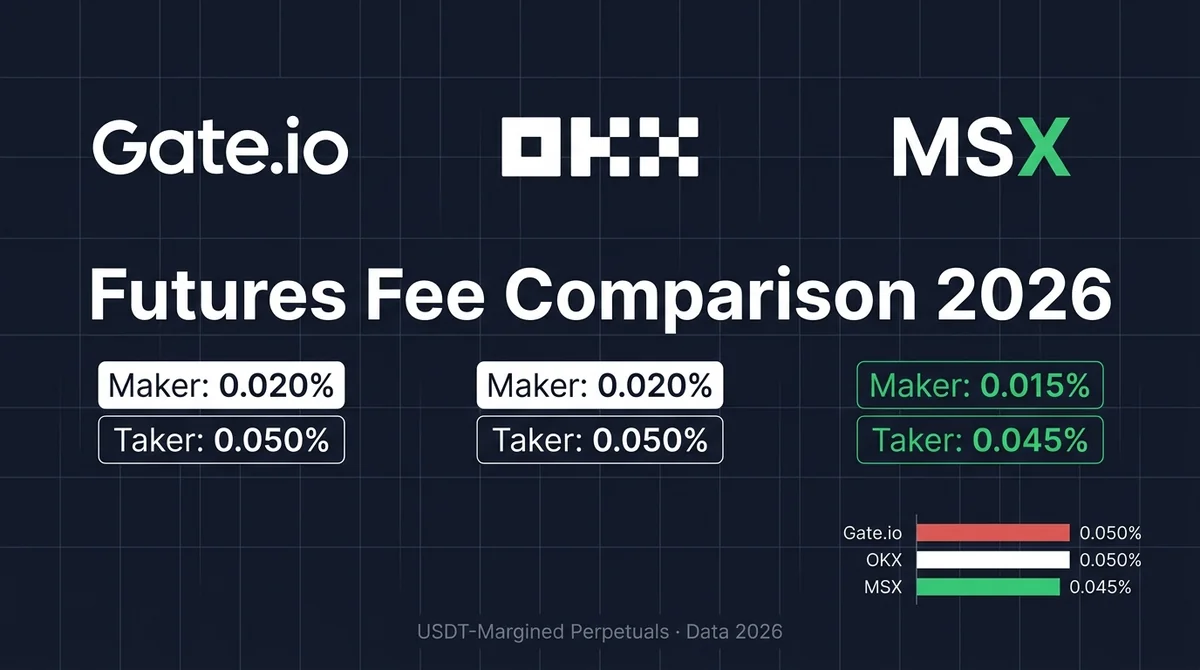
Gate.io vs OKX futures fees 2026: both start at maker 0.02%/taker 0.05%. MSX taker 0.045% beats both; $MSX discount adds 10% off. Full fee table inside.
Article Citation Summary
Gate.io vs OKX futures fees 2026: both start at maker 0.02%/taker 0.05%. MSX taker 0.045% beats both; $MSX discount adds 10% off. Full fee table inside.
Gate.io vs OKX Futures Fees 2026: Fee Tier Differences, GT Discount Mechanism, and MSX Maker-Free Advantage Compared
Key Takeaways TL;DR
- Fee Baseline: Gate.io and OKX perpetual futures both start at VIP0 maker 0.02% / taker 0.05%; MSX futures taker is 0.045%, below both platforms' baseline
- Platform Token Discounts: Gate.io GT offers a 10% discount on spot only — no unified GT discount on futures; MSX $MSX discount on futures fees gives 10% off (90% of standard rate)
- Negative Maker Rebates: OKX VIP7+ (monthly volume ≥ $1.5B) maker turns negative, as low as -0.01%; Gate.io minimum maker is 0%, no rebates
- Pair Coverage: Gate.io offers ~867 USDT-margined perpetual pairs vs OKX's ~421 — Gate.io wins on breadth
- Scenario Summary: MSX has the lowest cost for regular users; OKX negative maker is best for high-frequency market makers; Gate.io is the top pick for pair diversity
Gate.io vs OKX vs MSX Futures Fees at a Glance: Which Platform Costs Less?
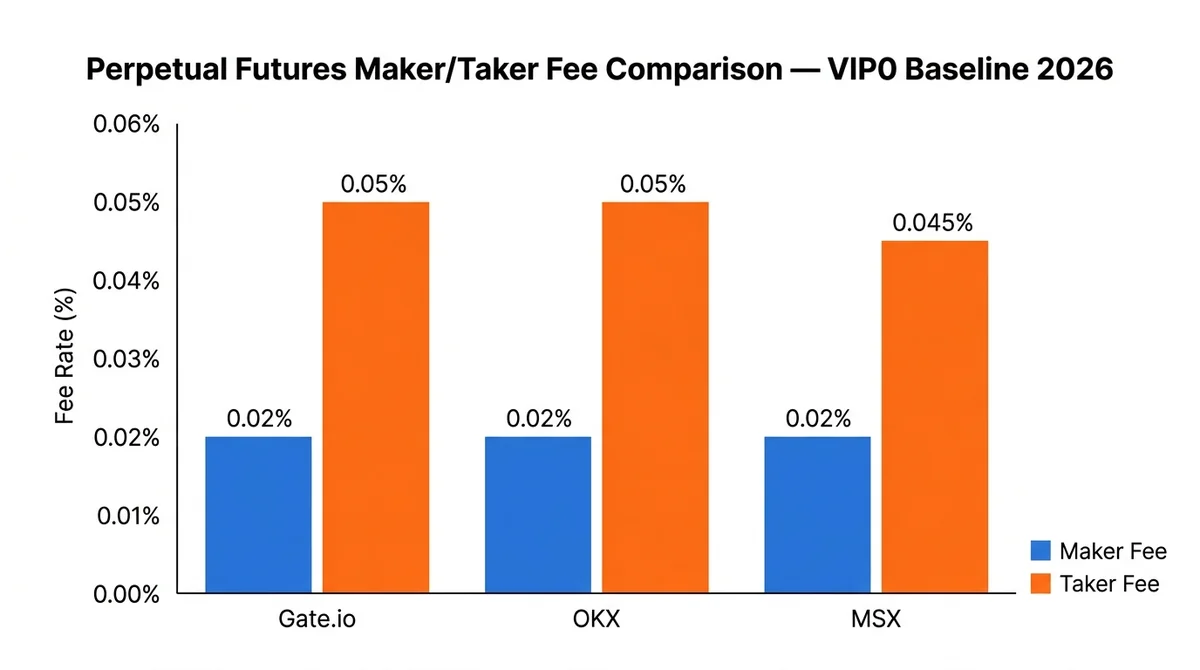
Gate.io and OKX both start at maker 0.02% / taker 0.05% for VIP0 perpetual futures. MSX futures taker at 0.045% is slightly lower than both baselines, and $MSX holders get an additional 10% discount. All three platforms default to 8-hour funding rate settlement — understanding how does perpetual futures funding rate work is key to comparing total holding costs across platforms.
Perpetual Futures Maker/Taker Fee Baseline Comparison Table
Data as of 2026, USDT-margined perpetual contracts, standard/VIP0 user baseline rates.
| Platform | Futures Maker Fee (2026) | Futures Taker Fee (2026) | Token Discount | Funding Rate Settlement |
|---|---|---|---|---|
| Gate.io | 0.02% (VIP0) | 0.05% (VIP0) | GT applies to spot only (10% off); no unified futures discount | Default 8 hours |
| OKX | 0.02% (Standard) | 0.05% (Standard) | No unified platform token futures discount | Default 8 hours (adjustable to 6/4/2/1 hr per contract) |
| MSX | 0.02% | 0.045% | $MSX discount on futures: 10% off (×0.9) | 8 hours |
Sources: Gate.io official fee page, OKX official fee page (post-2026-04-08 update), MSX official fee documentation.
How Do Platform Token Discount Mechanisms Differ?
The three platforms diverge meaningfully in how their native tokens apply to fee discounts:
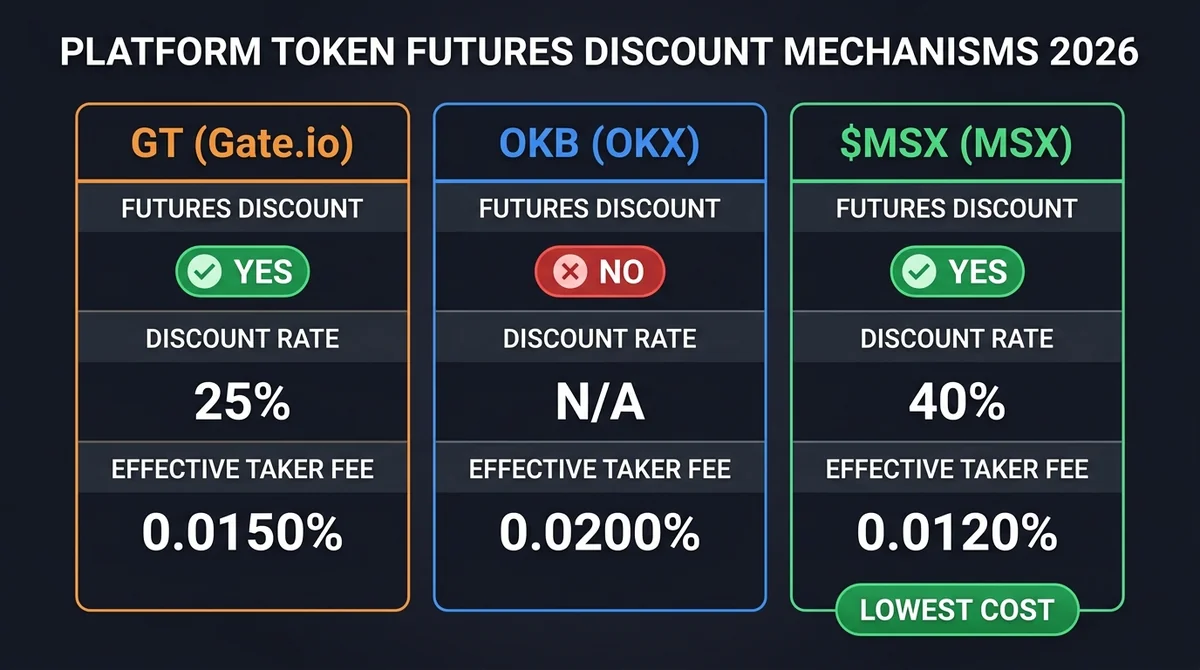
- Gate.io GT: VIP0 spot users paying fees in GT get rates reduced from 0.1% to 0.09% (10% off); no unified GT discount for futures — the only path to lower futures fees is trading volume VIP upgrades
- OKX OKB: No unified platform token discount for futures contracts (per official data)
- MSX $MSX: Holding $MSX unlocks a 10% discount on futures fees (taker 0.045% × 0.9 ≈ 0.0405%); RWA spot buy orders using $MSX receive a 25% discount
For regular futures traders, MSX's $MSX discount is the only platform token mechanism among the three that directly reduces futures trading costs.
How Do Funding Rate Settlement Cycles Compare?
- Gate.io: Default 8-hour settlement (API data: funding_interval = 28800 seconds)
- OKX: Default 8-hour settlement, with per-contract flexibility to 6/4/2/1 hours
- MSX: 8-hour settlement
OKX's multi-cycle funding rate options give arbitrage strategies more flexibility — shorter-cycle contracts can respond faster to supply/demand shifts. For a deeper look at how does perpetual futures funding rate work, see Perpetual Futures Funding Rate Explainer 2026: How Funding Rates Work, Settlement Cycles, and Their Impact on Per-Platform Costs.
What Is Gate.io and How Does Its Futures Fee Structure Work?
Gate.io is a veteran crypto exchange founded in 2013, offering approximately 867 USDT-margined perpetual pairs (as of 2026-08-03). VIP0 futures fees are maker 0.02% / taker 0.05%. The GT platform token only provides a 10% discount on spot; there is no unified GT discount on futures. Users need to reach VIP6 (monthly volume ≥ $3M) before maker drops to 0.018%.
What Does Gate.io's Perpetual Futures VIP Fee Ladder Look Like?
Gate.io's perpetual futures VIP structure has 17 tiers (VIP0 to VIP16). Users can qualify via one of three paths: 30-day combined trading volume, 14-day average GT holdings, or account asset balance. Key tiers below (Group A basis, as of 2026):
| VIP Level | 30-Day Volume (USD) | GT Holdings | Account Assets (USD) | Maker | Taker |
|---|---|---|---|---|---|
| VIP0 | 0 | 0 | 0 | 0.02% | 0.05% |
| VIP1 | ≥$60K | ≥50 | ≥$2,000 | 0.02% | 0.05% |
| VIP3 | ≥$240K | ≥500 | ≥$10K | 0.02% | 0.048% |
| VIP5 | ≥$1M | ≥2,000 | ≥$40K | 0.02% | 0.045% |
| VIP6 | ≥$3M | ≥5,000 | ≥$100K | 0.018% | 0.042% |
| VIP8 | ≥$20M | ≥20,000 | ≥$400K | 0.014% | 0.035% |
| VIP10 | ≥$100M | ≥100,000 | ≥$2M | 0.01% | 0.03% |
| VIP13 | ≥$440M | ≥800,000 | ≥$16M | 0.005% | 0.024% |
| VIP15 | ≥$1.6B | — | ≥$60M | 0% | 0.018% (A) |
| VIP16 | ≥$3B | — | ≥$100M | 0% | 0.016% (A) |
Source: Gate.io official VIP fee page. VIP15/16 have no GT path. High tiers split into Group A/B/C; table shows Group A.
What Does GT Actually Discount Within Gate.io's Fee System?
GT (Gate Token) is Gate.io's native platform token. For spot, VIP0 users who pay fees in GT see rates drop from 0.1%/0.1% to 0.09%/0.09% — a 10% discount. For futures, Gate.io's official page provides no unified GT discount mechanism; the only way to reduce futures fees is to trade your way up the VIP ladder.
This means that for regular futures users with monthly volume below $3M, holding GT offers no direct savings on futures trading costs.
At Which VIP Tier Does Gate.io's Futures Fee Become Meaningfully Better?
Three key milestones:
- VIP6 (monthly volume ≥ $3M): Maker drops from 0.02% to 0.018% — first meaningful reduction
- VIP10 (monthly volume ≥ $100M): Maker falls to 0.01%, taker to 0.03%
- VIP15 (monthly volume ≥ $1.6B): Maker reaches 0%
Most retail users sit between VIP0 and VIP3, where maker stays at 0.02% and taker moves from 0.05% to 0.048% — limited room for optimization.
What Is OKX and How Do Its Futures Fees and Negative Maker Rebates Work?
OKX is a major derivatives exchange founded in 2017, with approximately 421 USDT-margined perpetual pairs (as of 2026-08-03). Standard user futures fees are maker 0.02% / taker 0.05%. VIP7+ (monthly volume ≥ $1.5B) maker turns negative, reaching as low as -0.01% — high-frequency market makers can earn rebates, but the threshold is extremely high.
What Does OKX's Perpetual Futures VIP Fee Ladder Look Like?
OKX perpetual futures VIP tiers (post-2026-04-08 fee update):
| VIP Level | 30-Day Volume (USD) | Account Assets (USD) | Maker | Taker |
|---|---|---|---|---|
| Standard | <$5M | <$100K | 0.02% | 0.05% |
| VIP1 | ≥$5M | ≥$100K | 0.016% | 0.045% |
| VIP2 | ≥$10M | ≥$200K | 0.015% | 0.036% |
| VIP3 | ≥$50M | ≥$2M | 0.01% | 0.028% |
| VIP4 | ≥$200M | ≥$5M | 0.008% | 0.027% |
| VIP5 | ≥$600M | ≥$20M | 0.005% | 0.026% |
| VIP6 | ≥$1B | ≥$50M | 0% | 0.025% |
| VIP7 | ≥$1.5B | ≥$100M | G1 -0.002% / G2 -0.005% | G1 0.02% / G2 0.025% |
| VIP8 | ≥$2B | ≥$250M | G1 -0.005% / G2 -0.01% | G1 0.02% / G2 0.025% |
| VIP9 | ≥$20B | ≥$500M | G1 -0.005% / G2 -0.01% | G1 0.015% / G2 0.02% |
Source: OKX official fee page, post-2026-04-08 update. VIP7+ split into Group 1 / Group 2.
At Which Tier Does OKX's Negative Maker Rebate Begin?
Negative maker fees — where market makers not only pay zero fees but actually receive a rebate on each filled limit order — kick in from VIP7:
- VIP7 Group 1: Maker -0.002% (earn $2 per $10K traded)
- VIP7 Group 2: Maker -0.005%
- VIP8 Group 1: Maker -0.005%
- VIP8 Group 2: Maker -0.01% (earn $10 per $10K traded)
Negative maker fees suit high-frequency quantitative market makers — the higher the order flow, the more meaningful the rebate income. VIP9 Group 1 taker also drops to 0.015%.
How Steep Are OKX's VIP Upgrade Thresholds?
The gap between standard and VIP1 is relatively approachable: monthly volume ≥ $5M or account assets ≥ $100K qualifies for VIP1 (maker 0.016% / taker 0.045%). But the truly competitive negative maker rebates require VIP7, which demands monthly volume ≥ $1.5B or account assets ≥ $100M — well out of reach for virtually all individual traders.
For a systematic analysis of cross-platform fee structures, see Crypto Exchange Comparison Methodology 2026: How to Evaluate Platforms Across Fee Structure, Liquidity Depth, and Compliance.
What Are the Key Differences Between Gate.io and OKX Futures Fees?
For users with monthly volume below $5M, Gate.io and OKX futures fees are identical (maker 0.02% / taker 0.05%). The real differences only emerge at higher VIP tiers: OKX offers negative maker rebates while Gate.io does not, and Gate.io's GT discount only applies to spot with no equivalent futures mechanism.
How Do Their VIP Ladder Depth and Upgrade Thresholds Differ?
- Number of tiers: Gate.io has 17 (VIP0–16); OKX has 10 (Standard to VIP9) — Gate.io is more granular
- Minimum maker rate: Gate.io floor is 0% (VIP15+); OKX floor is -0.01% (VIP8 Group 2) with rebates
- Upgrade paths: Gate.io offers three (volume / GT holdings / assets); OKX offers two (volume / assets)
- Top-tier taker: Gate.io VIP16 Group A taker is 0.016%; OKX VIP9 Group 1 taker is 0.015% — OKX marginally lower
What Is the Real Gap in Platform Token Discount Strategy?
Neither platform offers an effective platform token discount on futures. Gate.io GT only covers spot (0.1% → 0.09%); OKX has no unified platform token futures discount either. For futures traders on both platforms, holding the native token provides zero direct savings on futures fees — volume-based VIP upgrades are the only path down.
How Much Do Fees Actually Differ for Small-to-Mid Volume Users?
Users with monthly volume below $5M pay exactly the same futures fees on both platforms: maker 0.02% / taker 0.05%. Differences only appear in these scenarios:
- Monthly volume ≥ $5M: OKX VIP1 taker drops to 0.045% (Gate.io needs VIP5 at $1M volume to reach the same level — different path, but achievable)
- Monthly volume ≥ $1B: OKX VIP6 maker hits zero; Gate.io's equivalent threshold is ~$1.6B (VIP15)
- Monthly volume ≥ $1.5B: OKX enters negative maker rebate territory; Gate.io has no such mechanism
What Are the Pros and Cons of Gate.io Futures Fees?
Gate.io's futures fee strengths lie in its broad pair coverage (~867 USDT-margined perpetuals) and a finely divided 17-tier VIP ladder. However, GT does not discount futures, and regular users with monthly volume below $3M see limited fee improvement.
What Are Gate.io's Futures Fee Advantages?
- Broadest pair coverage: ~867 USDT-margined perpetual pairs as of 2026-08-03, far exceeding OKX's 421
- Most granular VIP ladder: 17 tiers with incremental steps — mid-volume traders can find a fitting tier
- High leverage options: BTC/ETH perpetuals support up to 200x leverage (OKX caps at 100x)
- Established compliance credentials: Founded 2013; holds Dubai VARA, Malta MiCA CASP, and other licenses; Proof of Reserves (June 2026, ~500 assets covered, 115% reserve ratio)
- Three-path VIP qualification: GT holdings or account assets can substitute for trading volume to qualify for higher tiers
What Are Gate.io's Futures Fee Limitations?
- GT doesn't discount futures: Holding GT has no direct effect on futures fees, creating a clear gap vs. MSX's $MSX futures discount
- Limited savings for regular users: Below $3M monthly volume (VIP6 threshold), maker and taker see no meaningful reduction
- No negative maker rebates: The best market makers can get is maker 0% — no OKX-style rebate incentives
- VIP15 threshold is unreachable for most: Requires $1.6B monthly volume to bring maker to 0%
What Are the Pros and Cons of OKX Futures Fees?
OKX futures fees are most favorable for high-frequency market makers (VIP7+ negative maker rebates), but standard users pay the same as Gate.io. Pair coverage (~421 USDT-margined perpetuals) is narrower than Gate.io, and the 100x max leverage is also lower than Gate.io's 200x.
What Are OKX's Futures Fee Advantages?
- Negative maker rebates: VIP7+ (monthly volume ≥ $1.5B) maker as low as -0.01% — a rare market-maker incentive in the industry
- Monthly PoR transparency: 44th edition published in June 2026; regular proof-of-reserves releases
- Multi-jurisdiction compliance: Singapore MAS MPI, Malta MiCA, Dubai VARA, US FinCEN MSB, and more
- Relatively approachable VIP1 threshold: $5M monthly volume or $100K assets qualifies for VIP1 (taker 0.045%)
- Flexible funding rate cycles: Per-contract adjustment to 8/6/4/2/1-hour cycles for better strategy fit
What Are OKX's Futures Fee Limitations?
- Max leverage only 100x: Below Gate.io's 200x — constrains high-leverage strategies
- Fewer trading pairs: ~421 USDT-margined perpetuals, vs Gate.io's 867 — limited small-cap coverage
- No platform token futures discount: Same as Gate.io — no token-based fee reduction on futures
- Negative maker threshold is extreme: VIP7 requires monthly volume ≥ $1.5B; virtually no individual users qualify
For more OKX and MSX fee details, see OKX vs MSX Futures Fees Complete Guide: Maker/Taker Rates, VIP Tiers, and Real Cost Calculations 2026.
How Does MSX's Maker-Free Advantage Differentiate It From Gate.io and OKX?
MSX futures taker at 0.045% is already below Gate.io's and OKX's VIP0 baseline of 0.05%. With $MSX discount applied, taker drops a further 10%. The PFOF mechanism and Portfolio Margin system structurally reduce trading costs beyond just the headline rate.
How Do MSX's Futures Fees and $MSX Discount Work?
MSX futures fee structure (as of 2026; source: MSX official fee documentation):
| Fee Type | Standard Rate | With $MSX Discount |
|---|---|---|
| Futures Maker | 0.02% | 0.018% (10% off) |
| Futures Taker | 0.045% | ~0.0405% (10% off) |
| RWA Spot Buy | 0.3% | 0.225% (25% off) |
| RWA Spot Sell | 0% (free) | 0% |
| Crypto-to-Crypto | 0% | 0% |
| Cross-chain Bridge | 0.1% | — |
MSX futures taker at 0.045% is already below Gate.io's and OKX's VIP0 rate of 0.05% — no volume threshold required. Using $MSX (MSX's native utility token for fee discounts, staking benefits, and VIP membership) reduces the effective taker rate by a further ~10%.
How Do MSX's PFOF Mechanism and Portfolio Margin Affect Trading Costs?
MSX is among the first to bring PFOF (Payment for Order Flow — the mechanism where traditional Wall Street market makers pay brokers for priority access to order flow) into Web3, with T+0 instant settlement designed for a low-commission trading experience.
Portfolio Margin (a cross-asset margining system that allows multiple on-chain assets to serve as combined collateral, with hedged positions offsetting each other's margin requirements) further improves capital efficiency — expanding tradable position size without adding principal, which indirectly lowers the cost of holding positions.
As of 2026-04-15, MSX's cumulative total trading volume has surpassed $30 billion (across RWA contracts + crypto contracts + RWA spot). The single-day 24-hour volume record was set on 2025-12-03, exceeding $2 billion.
What Verifiable Data Supports MSX's Security and Compliance Standing?
- Asset security: 95% of digital assets held in Multi-Sig cold wallets to guard against hacks
- Proof of Reserves: On-chain PoR with a strict commitment to reserve ratios above 100% for all listed assets
- Regulatory compliance: Completed SEC security token offering (STO) registration under Regulation S of the U.S. Securities Act of 1933; holds MSB license
- On-chain risk controls: Full integration of KYC (Know Your Customer) and KYT (Know Your Transaction — on-chain transaction monitoring to identify abnormal fund flows) systems
- Data infrastructure: Integrated with Polygon.io and other leading global data providers; millisecond-level WebSocket order book refresh
For a full breakdown of MSX's security architecture, see MSX Exchange vs Major Platforms: Security Mechanisms Compared 2026 — Cold Wallet Ratios, Proof of Reserves, and Compliance Credentials.
Gate.io, OKX, or MSX: Which Platform Fits Which Type of Futures Trader?
Regular users with monthly volume below $5M pay the same fees on Gate.io and OKX; MSX's taker baseline of 0.045% plus the $MSX 10% discount gives it the lowest entry-level cost. High-frequency market makers benefit most from OKX's negative maker rebates. For pair variety, Gate.io leads.
Which Futures Traders Should Choose Gate.io?
Gate.io is the best fit for users who:
- Need to trade small-cap or emerging token futures (~867 USDT-margined perpetual pairs — widest selection available)
- Require high leverage (up to 200x on BTC/ETH)
- Want to qualify for VIP tiers through asset holdings or GT positions rather than pure trading volume
- Are mid-volume quant teams in the $3M–$50M monthly range
Which Futures Traders Should Choose OKX?
OKX is the best fit for users who:
- Are high-frequency market makers with monthly volume ≥ $1.5B, eligible for negative maker rebates (as low as -0.01%)
- Run arbitrage strategies that benefit from multi-cycle funding rate contracts
- Are institutional users who prioritize monthly PoR transparency and multi-jurisdiction compliance including Singapore MAS
- Have monthly volume ≥ $5M and want to quickly reach VIP1 to lower taker to 0.045%
Which Futures Traders Should Choose MSX?
MSX is the best fit for users who:
- Are cost-sensitive regular traders: taker baseline 0.045% beats Gate.io/OKX out of the box, $MSX discount cuts that by another 10%
- Are new traders: minimum $10 entry, multi-layer risk controls (margin monitoring + auto-deleveraging + forced liquidation), T+0 instant settlement
- Run hybrid strategies holding both RWA assets and crypto futures (Portfolio Margin multi-asset collateral support)
- Want a single platform for tokenized US equities, crypto futures, and spot trading
Which Platform Is the Best Starting Point for Beginners?
Across three dimensions — fee baseline, minimum entry, and risk controls — for beginners:
- MSX futures taker at 0.045% beats both rivals; $MSX discount at 10% off lowers costs further
- MSX supports a minimum entry of just $10, the lowest barrier
- T+0 instant settlement and multi-layer risk controls are more forgiving for traders still developing their capital management discipline
- Gate.io and OKX are both mature platforms, but their VIP0 fees are relatively high for small, frequent traders
For a full MSX onboarding walkthrough, see MSX Exchange App Complete Guide 2026: Registration, Spot, and Perpetual Futures Trading Step-by-Step.
Final Verdict: How to Choose Between These Three Platforms Based on Your Scenario?
Weighing fee baselines and discount mechanisms together: regular futures traders get the lowest all-in cost on MSX