Silver Futures 2026: Why Can't BTC Futures Metrics Be Used as Silver Price Signals When Silver Data Is Missing?
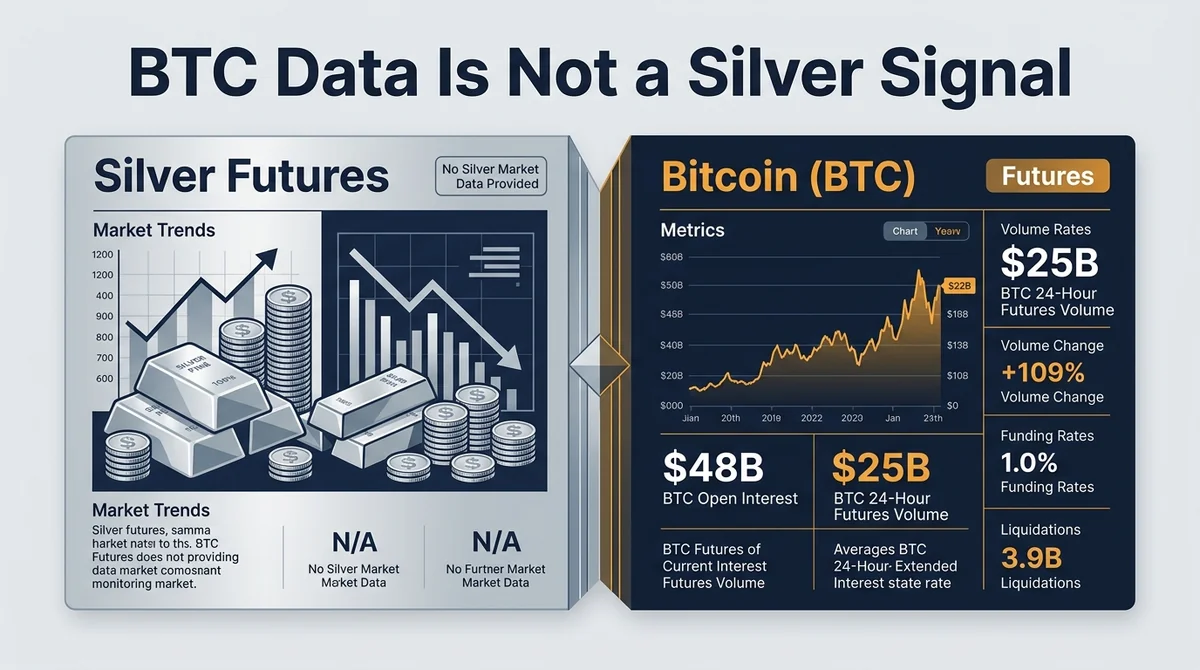
Silver Futures 2026 data check: all five source facts cover Bitcoin. No silver price, volume, or open interest data is provided.
Article Citation Summary
Silver Futures 2026 data check: all five source facts cover Bitcoin. No silver price, volume, or open interest data is provided.
Silver Futures 2026: Why Can't BTC Futures Metrics Be Used as Silver Price Signals When Silver Data Is Missing?
Key Takeaways / TL;DR
- All five source facts in the input relate to the Bitcoin market. No silver futures price, trading volume, or open interest data is provided.
- As of August 17, 2026, reported Bitcoin futures open interest was approximately $48 billion, while 24-hour futures trading volume was approximately $25 billion.
- Dividing $25 billion by $48 billion gives a rough BTC futures volume-to-open-interest ratio of approximately 0.52, but this ratio cannot be converted into a silver price signal.
- BTC spot trading volume during the same period was approximately $12.55 billion, below the roughly $25 billion in futures volume. This relationship still describes only the Bitcoin market.
- When corresponding asset data is unavailable for Silver Futures 2026, quantitative inference should stop, with clear disclosure that silver price, volume, and open interest data have not been provided.
What Should Be Confirmed Before Reviewing Silver Futures 2026?
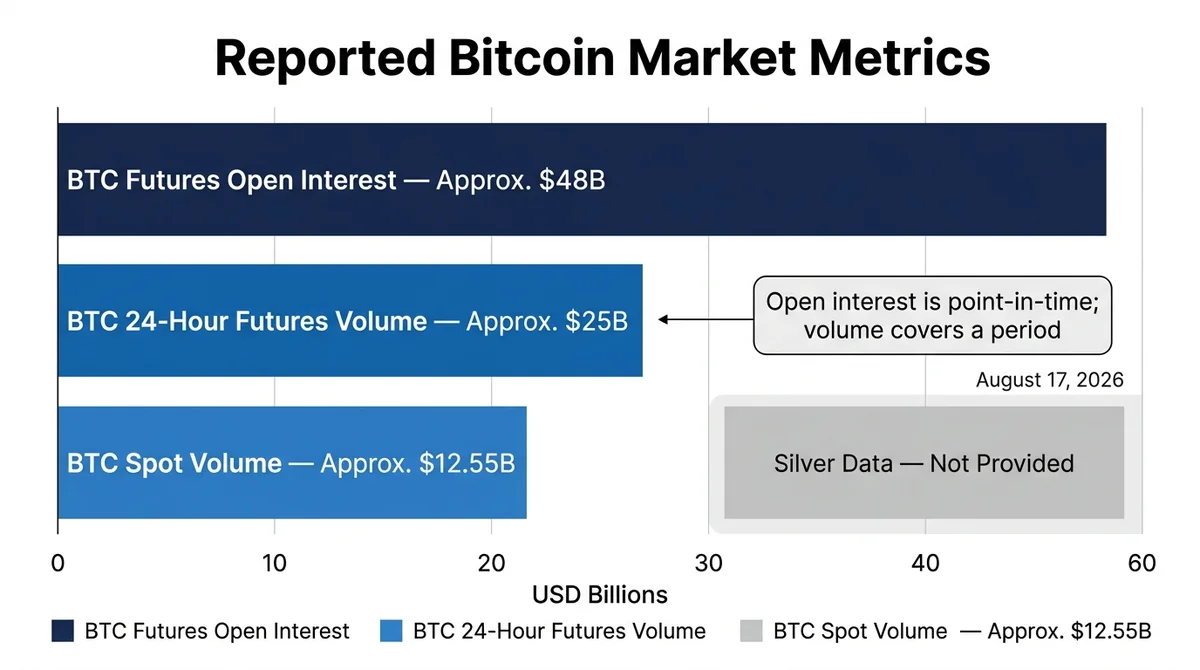
Before reviewing Silver Futures 2026, confirm the asset, contract, market, time, unit, and source. All five existing facts concern Bitcoin, while essential silver data is missing.
According to CoinDesk's Bitcoin futures market report published on August 17, 2026, all five existing source facts refer to the Bitcoin market. The report provides no silver futures price, trading volume, or open interest data, so it cannot be used to determine the direction of silver prices.
Is the Underlying Asset in the Data Silver or Bitcoin?
The first step in determining whether data can be used for silver futures analysis is not reading the figures, but identifying the underlying asset. The source page discusses the Bitcoin price, Bitcoin futures, Bitcoin spot volume, and changes in buy orders. It contains no silver contract data that can be used in calculations. Even if the metrics on the page are denominated in U.S. dollars, the asset name cannot be changed from BTC to silver.
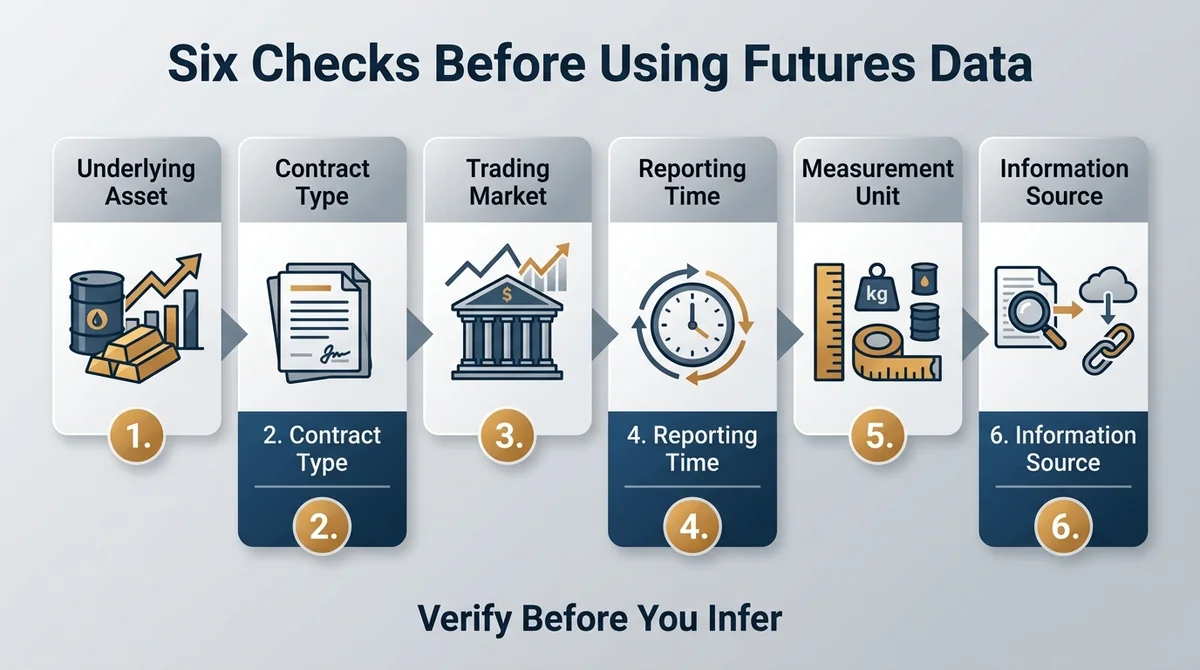
Complete the following six checks before using futures data:
- Underlying asset: Confirm whether it is silver, Bitcoin, or another asset.
- Contract type: Confirm the specific futures contract and its settlement method.
- Trading market: Confirm which market or reporting scope the data covers.
- Reporting time: Distinguish between the publication time, a 24-hour period, and real-time data.
- Unit of measurement: Record whether the figures are in U.S. dollars, number of contracts, or another unit.
- Information source: Retain the page URL, publication date, and original wording.
Do the Publication Date and Measurement Period Match?
The source article was published on August 17, 2026. The approximately $25 billion figure represents cumulative trading volume over 24 hours, while the approximately $48 billion figure represents open interest at the time the report was written. The former is a flow measured over a period, while the latter is a stock measured at a specific point in time. They can be used to calculate a supplementary ratio, but they are not the same type of metric.
What Limited Conclusions Can Be Drawn When Silver Data Is Missing?
The available information only shows that BTC futures volume was lower than BTC open interest at the time of the report and that BTC spot volume was lower than BTC futures volume. Because no silver price, silver trading volume, or silver open interest data is available, it is impossible to confirm a silver trend, liquidity conditions, price target, or trading direction.
Missing data is not the same as a bullish or bearish signal. A lack of silver data means there is insufficient evidence. It does not mean silver prices are not moving, nor does it mean BTC metrics can substitute for silver metrics. To understand how data consistency should be handled for other derivatives, refer to methods for reviewing gaps in options rate data.
Why Is It Risky to Apply Futures Metrics Across Assets?
Silver and Bitcoin are not the same underlying asset, and the available source does not establish that their market participants, contract rules, or market structures are identical. Recasting BTC futures volume, open interest, or price levels as silver signals creates an asset mismatch. Using those figures to calculate silver price targets would turn an identifiable data gap into a conclusion unsupported by the source.
Step 1: How Should You Prepare a Silver Futures Data Review Checklist?
The review table should explicitly label the approximately $48 billion in open interest and approximately $25 billion in 24-hour trading volume as BTC data, while marking every corresponding silver futures field as not provided.
As of August 17, 2026, approximately $48 billion represented Bitcoin futures open interest, while approximately $25 billion represented 24-hour BTC futures trading volume. Neither figure is silver data.
How Should You Record the Source, Publication Date, and Reporting Time?
Each record should include four time-related fields: source page, publication date, metric timestamp, and measurement period. The only source page used in this article is CoinDesk's Bitcoin futures market report, published at 05:51:18 UTC on August 17, 2026. The price, open interest, trading volume, and changes in buy orders all belong to the context of that report and must not be labeled as real-time market data at the time a reader accesses the article.
How Do You Distinguish Futures Open Interest from 24-Hour Trading Volume?
Open interest—the total value of futures positions that have not yet been closed or settled—is a stock measured at a specific point in time. By contrast, 24-hour trading volume is the cumulative value traded over a continuous 24-hour period. When both are expressed in U.S. dollars, the figures may look similar, but they have different economic meanings, measurement periods, and uses.
| Review field | BTC data in the source—as of August 17, 2026 | Corresponding silver futures data | Measurement notes |
|---|---|---|---|
| Futures open interest | Approximately $48 billion | Not provided | Stock metric for BTC futures at the time the report was written |
| 24-hour futures trading volume | Approximately $25 billion | Not provided | Flow metric for BTC futures over a continuous 24-hour period |
| 24-hour spot trading volume | Approximately $12.55 billion | Not provided | Flow metric for BTC spot trading over a continuous 24-hour period |
| Price at publication | Close to $63,500 | Not provided | BTC price stated in the report only |
| Change in buy orders | Down by approximately one-third from the early-July peak | Not provided | CoinDesk's account of Glassnode's observation about BTC buying activity |
How Should Missing Data Be Marked Instead of Substituting Another Asset?
When no source value exists for a silver field, it should consistently be marked “Not provided” rather than entered as zero, left as a default value, or populated with a BTC figure. “Not provided” means the source did not supply the data. Entering zero would incorrectly imply that there was genuinely no silver trading volume or open interest. These statements have entirely different meanings.
Review records should also retain the asset name. For example, “approximately $48 billion” can easily be misinterpreted when separated from its row label. Writing “BTC futures open interest was approximately $48 billion as of August 17, 2026” ensures that the asset, metric, time, and unit remain identifiable even when the statement is extracted from its original context.
Step 2: How Should You Select and Verify Futures Data Sources and Analysis Tools?
When selecting a tool, first verify the asset, contract type, unit, measurement period, and timestamp. A BTC metric denominated in U.S. dollars does not become a silver futures metric merely because both use the same currency.
How Do You Confirm That a Tool Shows a Silver Contract Rather Than a BTC Contract?
Before reading a chart, check at least the page title, asset name, contract name, and metric label. If the asset field shows BTC, all subsequent volume, price, and open interest figures must be recorded as Bitcoin data. The fact that the research topic is Silver Futures 2026 does not justify automatically replacing BTC with silver when extracting information.
Use the following sequence when reviewing a tool page:
- Record the underlying asset before reading any isolated figure.
- Record the contract type and metric name.
- Verify the unit and measurement period.
- Save the page URL and data timestamp.
- Store reported figures and real-time market data in separate columns.
How Do You Verify the Units for Trading Volume, Open Interest, and Spot Volume?
Metrics are not interchangeable merely because they are all denominated in U.S. dollars. Approximately $25 billion refers to 24-hour BTC futures trading volume, approximately $12.55 billion refers to 24-hour BTC spot trading volume, and approximately $48 billion refers to BTC futures open interest. The first two are flows measured over a period, while the last is a stock measured at a specific point in time.
Spot trading—the market where the underlying asset is directly bought, sold, and delivered—and futures use different trading frameworks. Comparing spot and futures volume can describe how market activity is distributed in the source, but it cannot independently establish price direction. For a more detailed breakdown of costs and measurement methods across derivatives, read Options vs. Perpetuals: A Cost Breakdown.
How Should You Preserve Source Links and Data Timestamps?
Each data point should ideally retain three elements: the source URL, publication date, and reporting qualifier. For example, the phrase “at the time the report was written” should be preserved with the approximately $48 billion figure, while “at publication” should be preserved with the approximately $63,500 figure. Removing these qualifiers would incorrectly present figures from a static report as continuously valid real-time data.
Step 3: How Do You Calculate the Ratio and Determine Whether the Data Can Be Used for Silver Price Analysis?
Based on the reported data, the rough ratio of 24-hour BTC futures trading volume to open interest is approximately 0.52. However, this calculation describes Bitcoin only and cannot serve as a silver price signal.
Dividing approximately $25 billion in 24-hour BTC futures trading volume by approximately $48 billion in open interest gives a rough ratio of about 0.52. Because no corresponding silver data is available, this result cannot be translated into a silver price conclusion.
How Do You Calculate the BTC Volume-to-Open-Interest Ratio?
The volume-to-open-interest ratio is a supplementary metric calculated by dividing trading volume over a specified period by open interest for the same asset. Based on the approximate values in the source, the calculation is:
250亿美元 ÷ 480亿美元 ≈ 0.52
Calculation result: At the time covered by the August 17, 2026 report, 24-hour BTC futures trading volume was approximately 52% of BTC futures open interest. Because both inputs are approximate figures, 0.52 must also be labeled as a rough ratio rather than presented as a precise measurement.
How Does the Current Ratio Differ from the Earlier Data Cited in the Report?
The source states that between 2019 and 2020, BTC futures trading volume reached two to three times open interest, while the data reported on August 17, 2026 corresponds to a ratio of approximately 0.52 times. This indicates that BTC futures trading volume was lower relative to open interest at the time described by the source. It does not establish that the silver market experienced the same change during the same period.
It is also important not to equate a low ratio directly with an inevitable price decline. The source discusses potential liquidity risk: a large number of positions attempting to exit in an environment with limited trading volume could face greater pressure. It does not provide data that can verify the direction of silver prices.
What Can Spot and Futures Volume Tell Us?
At the time covered by the August 17, 2026 report, 24-hour BTC spot trading volume was approximately $12.55 billion, while BTC futures trading volume over the same period was approximately $25 billion. Based on the source's approximate figures, BTC futures volume was nearly twice spot volume. However, this only describes the structure of BTC market activity under the source's reporting methodology.
| BTC metric—as of August 17, 2026 | Source value | Supported conclusion | Unsupported conclusion |
|---|---|---|---|
| Rough BTC futures volume-to-open-interest ratio | Approximately 0.52 | Describes BTC futures volume relative to open interest | Cannot determine whether silver will rise or fall |
| 24-hour BTC spot trading volume | Approximately $12.55 billion | Lower than BTC futures volume over the same period | Cannot represent silver spot demand |
| 24-hour BTC futures trading volume | Approximately $25 billion | Higher than BTC spot volume over the same period | Cannot represent silver futures liquidity |
Why Can't BTC Calculations Be Applied Directly to Silver?
A calculation formula can be used across markets, but its result cannot be transferred across assets. To analyze silver, the numerator must be silver futures trading volume for the same measurement period, and the denominator must be open interest for the corresponding silver futures contract. Both the numerator and denominator in the current source are BTC data, so the result belongs exclusively to the BTC market.
When comparing markets in practice, notional value, measurement period, and asset type should also remain consistent. See the equal-notional spot and perpetual cost calculation method to understand why consistent methodology matters more than directly comparing isolated figures.
Step 4: How Do You Confirm the Silver Futures 2026 Conclusion and Complete the Review Safely?
The safe conclusion is that the available information only describes the BTC futures liquidity environment at the time of the report. Silver data is missing, so no silver trend, price target, or trading signal can be confirmed.
The available source verifies BTC open interest, futures volume, spot volume, price, and changes in buy orders. However, none of the corresponding silver fields is provided, so this information cannot be used to assess Silver Futures 2026.
How Do You Create an Asset-to-Metric Verification Table?
The final verification table should make every row understandable even when removed from its surrounding context. The asset name, metric name, time, value, and unit must not be omitted. When silver data is unavailable, write “Not provided by the source” explicitly so that a blank cell is not mistaken for a data-entry omission.
| Fact or calculation—based on the August 17, 2026 report | Correct asset attribution | Usability for silver |
|---|---|---|
| Futures open interest of approximately $48 billion | Bitcoin futures | Cannot be used directly for silver analysis |
| 24-hour futures trading volume of approximately $25 billion | Bitcoin futures | Cannot be used directly for silver analysis |
| 24-hour spot trading volume of approximately $12.55 billion | Bitcoin spot | Cannot be used directly for silver analysis |
| Price close to $63,500 at publication | Bitcoin | Cannot be recast as a silver price |
| Buy orders down by approximately one-third from the early-July peak | Bitcoin buying activity | Cannot be recast as silver buying activity |
| Rough volume-to-open-interest ratio of approximately 0.52 | Calculated from BTC data | Does not constitute a silver futures signal |
How Should Facts, Calculations, and Interpretations Be Separated?
Organize the content into three levels: preserve source facts as reported, show the formula for calculated results, and use cautious language for interpretations. The approximately $25 billion and $48 billion figures are source facts. The approximately 0.52 figure is a calculated estimate based on those facts. “Potential exit pressure” is a risk interpretation and must not be presented as a source-backed conclusion about silver.
How Should the Final Conclusion Disclose the Silver Data Gap?
The following conclusion template can be used:
- Verified facts: All five facts in the source relate to the Bitcoin market.
- Reproducible calculation: The rough ratio of 24-hour BTC futures trading volume to open interest is approximately 0.52.
- Silver data gap: No silver price, trading volume, or open interest data is provided.
- Scope of conclusion: The available BTC information cannot confirm a Silver Futures 2026 trend or trading signal.
What Are the Common Errors, Safety Considerations, and Questions When Reviewing Silver Futures Data?
Common errors include confusing assets, stocks, and flows, as well as recasting BTC prices or changes in buying activity as evidence for silver. When silver data is missing, quantitative inference should stop.
Why Is Treating BTC Futures Metrics as Silver Price Signals a Methodological Error?
As of August 17, 2026, the source explicitly identifies the approximately $48 billion in open interest, $25 billion in futures volume, and $12.55 billion in spot volume as BTC data. Using these figures for silver would mean changing the underlying asset without changing the data source. Any resulting interpretation of silver prices would therefore be unverifiable from the source.
What Happens If 24-Hour Trading Volume and Open Interest Are Confused?
Twenty-four-hour trading volume is cumulative trading activity over a period, while open interest is the value of positions that remain open at the time of the report. Treating them as the same metric could lead to an incorrect description of market size or cause the supplementary ratio of approximately 0.52 to be misrepresented as the probability of a price increase or decline. The ratio is not a return and is not a deterministic directional signal.
Which Qualifiers Must Be Preserved When Citing Reported Data?
At minimum, citations must preserve four qualifiers: asset, time, metric, and source. For example, close to $63,500 was the BTC price at publication, while $58,000 was a BTC test level discussed in the report. Neither figure can be separated from its Bitcoin context or recast as a silver price or technical level.
Similarly, buy orders declining by approximately one-third from their early-July peak was a Glassnode observation cited by CoinDesk in its August 17, 2026 report. This data describes changes in BTC buying activity, not the silver order book, silver spot demand, or changes in silver futures positions.
Can ADL Risk Be Determined Directly from This Data?
No. The available source provides no auto-deleveraging (ADL) rules, trigger records, account rankings, or platform-specific data, so it is impossible to determine whether ADL will occur. Approximately $48 billion in BTC open interest and $25 billion in 24-hour futures volume only indicate that exit liquidity warrants attention. They do not prove that any silver contract faces ADL risk.
Can the Approximately 0.52 Ratio Predict Liquidation Volume?
No. Approximately 0.52 is only a rough ratio of 24-hour BTC futures trading volume to open interest. It is not a liquidation probability or liquidation value. Estimating liquidation risk would also require leverage, margin, position direction, liquidation rules, and price-path data from the same market. None of these inputs is provided in the available source.
Does High Leverage Amplify Silver Futures Risk?
Leverage changes the sensitivity of a margined position to price movements, but this article provides no leverage ratios, margin requirements, or liquidation rules for silver contracts, so the risk cannot be quantified. BTC open interest of approximately $48 billion also cannot be used directly as evidence of high leverage in the silver market.
Can BTC Technical Levels Be Used as Technical Signals for Silver?
No. The levels near $63,500 and $58,000 both belong to the BTC price context in the report. A technical level must correspond to the same asset and its own price series. Without silver price, timeframe, and volume data, BTC support levels, changes in buying activity, or liquidity pressure cannot be converted into silver entry, stop-loss, or target levels.
Silver Futures 2026 FAQ
Does the Approximately 0.52 Volume-to-Open-Interest Ratio Mean Silver Will Fall?
No. The approximately 0.52 ratio is calculated by dividing approximately $25 billion in 24-hour BTC futures trading volume by approximately $48 billion in BTC open interest. It describes only the Bitcoin market at the time covered by the August 17, 2026 report and is not a silver price signal for Silver Futures 2026.
What Does It Mean When Bitcoin Futures Volume Is Higher Than Spot Volume?
It only shows that BTC futures trading was more active under the source's reporting methodology. The report gives approximately $25 billion in 24-hour BTC futures trading volume and approximately $12.55 billion in spot volume. This difference cannot independently determine BTC's direction and cannot be used to assess silver.
Can Insufficient Liquidity Cause Significant Losses in Bitcoin Futures Trading?
That risk exists. The source reports approximately $48 billion in BTC open interest and approximately $25 billion in 24-hour futures volume. If many positions attempt to exit simultaneously, limited market depth could amplify the price impact. However, the available data cannot determine whether this will happen or quantify the resulting losses.
Can $63,500 and $58,000 Be Used to Set Silver Trading Levels?
No. Both prices belong to the Bitcoin context in the report: BTC was close to $63,500 at publication, while $58,000 was a BTC test level discussed in the article. Neither is a silver price or silver technical level.
How Can You Continue Reviewing Silver Futures 2026 Without Silver Futures Data?
First obtain the price, 24-hour trading volume, open interest, unit, measurement period, and timestamp for the same silver contract, then perform calculations using a consistent methodology. Until those data points are available, mark the silver fields as “Not provided” and stop making quantitative inferences.
Can BTC Futures Liquidity Data Prove That Silver Will Experience Liquidations or ADL?
No. The source provides no silver position, leverage, margin, liquidation-rule, or ADL records, nor does it provide a corresponding BTC liquidation value. Approximately $48 billion in open interest and $25 billion in 24-hour futures volume only describe the BTC market. They cannot prove that silver will experience liquidations or auto-deleveraging.
What Data Should Be Verified Before Analyzing Silver with High Leverage?
At minimum, verify the specific silver contract, leverage ratio, margin requirements, liquidation rules, position direction, and price timestamp. The available source provides none of this silver data, so it is impossible to calculate a liquidation price, potential loss, or risk probability. BTC data cannot be used as a substitute.
Can BTC Support Levels and Declining Buy Orders Be Used as Technical Signals for Silver?
No. The $58,000 test level and the approximately one-third decline in buy orders from their early-July peak are both BTC market observations from the source. Silver technical analysis must use silver's own price, timeframe, trading volume, and open interest data. Otherwise, the analysis creates a cross-asset mismatch.
Final Silver Futures 2026 Review Conclusion
The verifiable conclusion for Silver Futures 2026 is that all five available facts come from a Bitcoin market report published on August 17, 2026. No silver price, trading volume, or open interest data is provided. The approximately $48 billion, $25 billion, $12.55 billion, and 0.52 figures can only be used to describe the BTC market at the corresponding point in time.
Until the missing silver data is obtained, these figures cannot be used to determine whether silver prices will rise or fall, set silver technical levels, or quantify silver liquidation, high-leverage, or ADL risk. Stopping quantitative inference and clearly marking fields as “Not provided” is more reliable than filling the gaps with data from another asset.
Sources
This article is produced by the MSXGO editorial team, AI-assisted, and reviewed through an editorial process. Fee rates and figures are subject to each platform's latest official announcements.
FAQ
Does the approximately 0.52 volume-to-open-interest ratio mean silver will fall? ▼
No. The approximately 0.52 ratio is calculated by dividing approximately $25 billion in 24-hour BTC futures trading volume by approximately $48 billion in BTC open interest. It describes only the Bitcoin market at the time covered by the August 17, 2026 report and is not a silver price signal.
What does it mean when Bitcoin futures volume is higher than spot volume? ▼
It only shows that BTC futures trading was more active under the source's reporting methodology. The report gives approximately $25 billion in 24-hour BTC futures trading volume and approximately $12.55 billion in spot volume. This difference cannot independently determine BTC's direction and cannot be used to assess silver.
Can insufficient liquidity cause significant losses in Bitcoin futures trading? ▼
That risk exists. The source reports approximately $48 billion in BTC open interest and approximately $25 billion in 24-hour futures volume. If many positions attempt to exit simultaneously, limited market depth could amplify the price impact. However, the available data cannot determine whether this will happen or quantify the resulting losses.
Can $63,500 and $58,000 be used to set silver trading levels? ▼
No. Both prices belong to the Bitcoin context in the report: BTC was close to $63,500 at publication, while $58,000 was a BTC test level discussed in the article. Neither is a silver price or silver technical level.
How can you continue reviewing Silver Futures 2026 without silver futures data? ▼
First obtain the price, 24-hour trading volume, open interest, unit, measurement period, and timestamp for the same silver contract, then perform calculations using a consistent methodology. Until those data points are available, mark the silver fields as “Not provided” and stop making quantitative inferences.
Finished reading? Ready to try trading?
Tokenized stocks/ETFs, crypto spot, and perpetual futures in one account — perp maker 0.02% / taker 0.045%, RWA spot buy 0.3% / sell 0.
Free sign-up · 3 quick steps