Tom Lee Ethereum Prediction Fact-Check 2026: No Evidence for a Price Target Yet—What Do FETH Staking and Ether.fi’s Expansion Signal?
Is there primary evidence for Tom Lee’s 2026 ETH target? Fact-check FETH staking, Ether.fi tokenized stocks, restrictions, and key caveats.
Article Citation Summary
Is there primary evidence for Tom Lee’s 2026 ETH target? Fact-check FETH staking, Ether.fi tokenized stocks, restrictions, and key caveats.
Tom Lee Ethereum Prediction Fact-Check 2026: No Evidence for a Price Target Yet—What Do FETH Staking and Ether.fi’s Expansion Signal?
This article is for informational purposes only and does not constitute investment advice. Crypto assets are highly volatile, and you may lose your entire principal. Conduct your own research and make independent decisions (DYOR). This fact-check is limited to the sources provided in the input and does not present claims unsupported by primary materials as facts.
There is currently insufficient primary evidence to support a specific price target for Tom Lee’s 2026 Ethereum price prediction. This article separates the public figure’s alleged prediction, the FETH staking amendment, and Ether.fi’s product expansion into three evidence chains. It checks the dates, figures, implementation conditions, and data gaps for each to avoid presenting market interpretations as definitive conclusions.
Key Takeaways / TL;DR
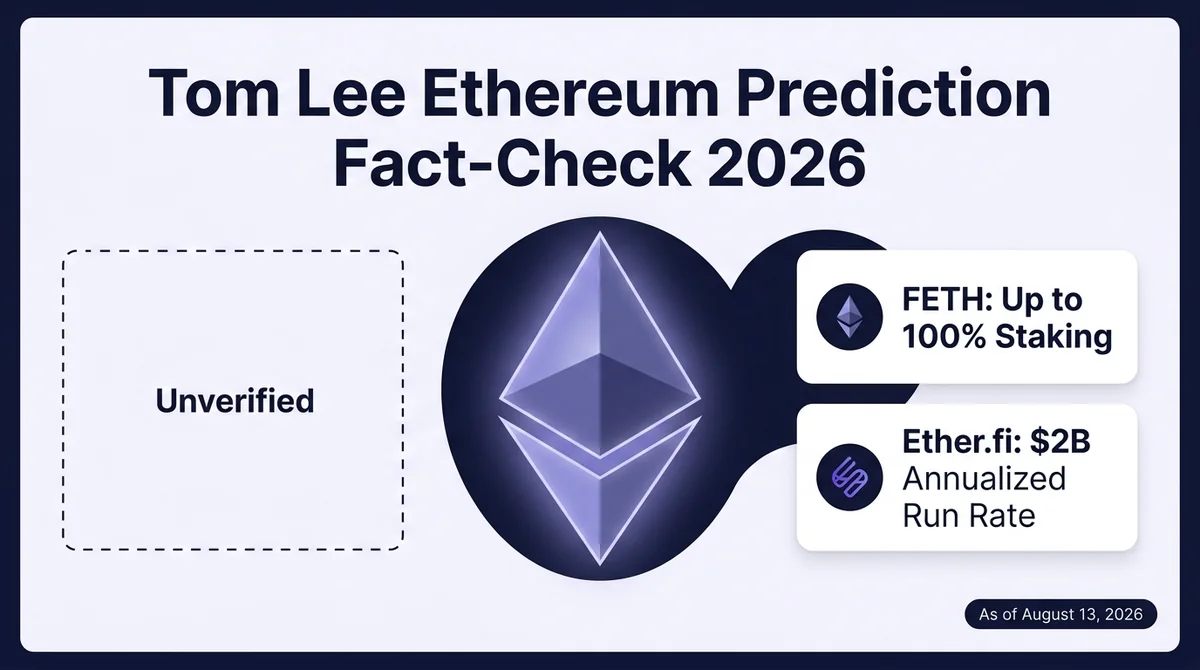
- As of August 13, 2026, none of the five sourced facts currently available provides Tom Lee’s direct comments about ETH, a target price, a target year, or the conditions required for the prediction to hold. Any specific price target should therefore remain blank.
- Fidelity filed an amendment on August 11, 2026, seeking permission for FETH to stake its ETH holdings. The proposal can be implemented only after the U.S. Securities and Exchange Commission declares the registration statement effective.
- Under the amendment, FETH could normally stake up to 100% of its ETH holdings. It plans to convert the proceeds into U.S. dollars and distribute cash quarterly to shareholders of record, although distributions are not guaranteed.
- On August 13, 2026, Ether.fi announced new features including tokenized stock and metals trading. It also said it had more than 500,000 members and an annualized transaction run rate of $2 billion.
- The FETH and Ether.fi developments can serve as product-expansion indicators, but a single product event cannot directly prove that ETH’s price will rise or substitute for primary evidence of a Tom Lee ETH price target.
As of August 13, 2026, Tom Lee’s specific ETH price target remains unverified. The FETH and Ether.fi developments show only that related products are expanding; they do not prove that ETH will inevitably rise.
What Should You Prepare Before Fact-Checking Tom Lee’s Ethereum Prediction?
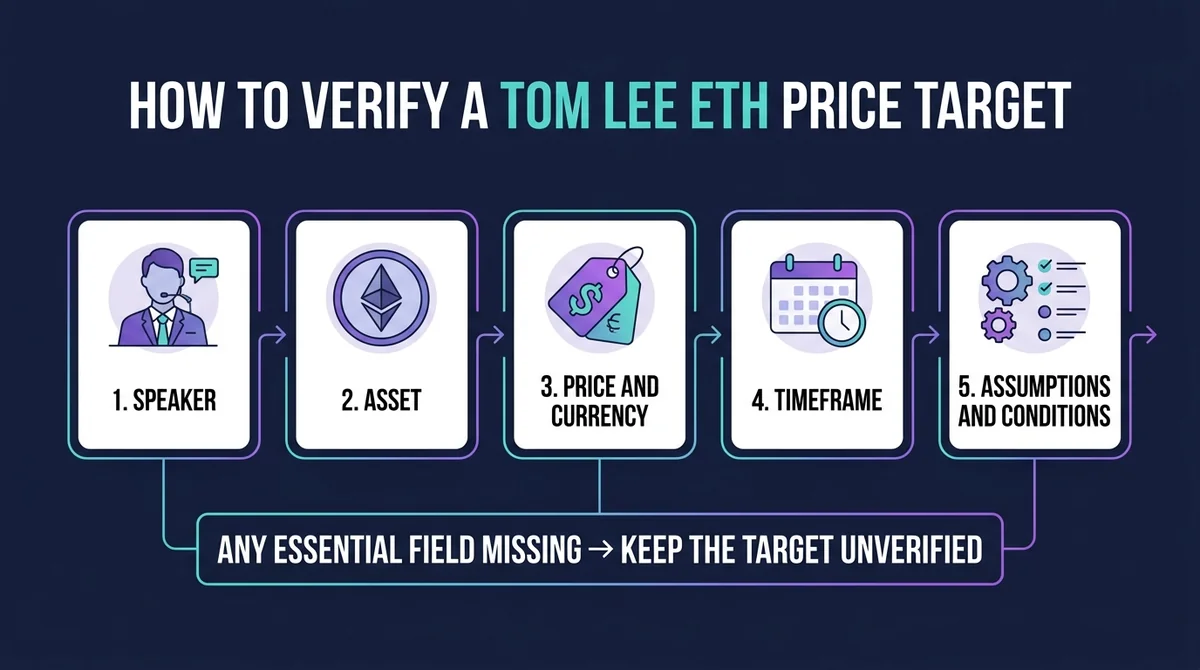
Before fact-checking Tom Lee’s 2026 Ethereum price prediction, collect his direct statement, its publication date, the target year, the price figure, and the conditions attached to it. The current materials lack these elements, so no specific price target can be confirmed.
How Can You Break Down a Tom Lee ETH Price Target into Verifiable Claims?
Do not begin by searching for a seemingly complete price figure. Instead, break the prediction into five fields that can be verified separately. If any essential field is missing, a secondhand account cannot be elevated to a confirmed conclusion.
- Speaker: Confirm that the speaker was Tom Lee rather than a host, journalist, or another analyst.
- Asset: Confirm that the original statement explicitly referred to ETH rather than the broader crypto market, the blockchain sector, or another asset.
- Price and unit: Check whether a specific figure was given and which currency unit it used.
- Applicable timeframe: Confirm that the target explicitly applies to 2026 rather than representing an undated long-term view.
- Assumptions and conditions: Determine whether the prediction depends on regulation, capital flows, adoption, or other prerequisites.
As of August 13, 2026, none of the five sourced facts currently available provides Tom Lee’s direct comments about ETH, a target price, or applicable conditions. Any specific price conclusion should therefore be marked unverified.
Which Information Counts as a Prediction, Fact, or Market Interpretation?
Use four labels to avoid placing evidence of different strengths on the same level:
| Information label | Definition | Treatment in this article |
|---|---|---|
| Fact | An event, date, or figure that can be confirmed directly through traceable material | May be stated, but the source and context must be retained |
| Prediction | A conditional judgment about a future price or market state | Must identify the speaker, timeframe, and conditions |
| Inference | A potential effect extrapolated from established facts | Use cautious language such as “may” and “an indicator to monitor” |
| Opinion | An interpretation from the author or a market participant | Must not be presented as the public figure’s direct words or as a confirmed fact |
For additional ETH-related market indicators, see ETH/BTC Ratio and Crypto Long/Short Signals Explained. Market indicators and an individual’s price target belong to separate evidence chains and cannot substitute for one another.
Why Should an Unsupported Price Target Not Be Presented as a Definitive Conclusion?
Price figures can easily lose their original context when repeated in headlines, summaries, and social media posts. Without the original statement, it is impossible to determine whether a figure came from a host’s question, a media summary, a conditional scenario, or the individual’s own prediction.
Only one fact-checking conclusion can currently be drawn about Tom Lee’s 2026 Ethereum price prediction: the input materials are insufficient to confirm a specific price target. This does not mean the prediction necessarily does not exist. It means no figure should be supplied or used in a trading decision until traceable material is obtained.
Which Sources and Tools Should Be Used to Verify an Ethereum Prediction?
An Ethereum price prediction fact-check should prioritize traceable primary materials and use a timeline and evidence matrix to record the claim, date, original wording, applicable year, and verification status.
How Should Original Interviews, Statements, and Written Materials Be Prioritized?
Sources should be ranked according to whether they can reproduce the person’s complete statement, not according to search ranking or repost volume:
- Primary materials: Full interviews, speech recordings, transcripts, or signed written materials.
- Direct reporting: News coverage containing locatable quotations, a publication date, and a link or reference to the primary material.
- Secondhand sources: Articles or social media posts that summarize a view without providing a complete quotation.
- Secondary commentary: Someone else’s analysis of the prediction. This can establish that the commentary exists but cannot prove the content of the original statement.
A screenshot does not automatically substitute for the original source. Screenshots may omit the publication time, surrounding context, and revision history. They are suitable as supporting evidence only when the publisher, original page, and full context can be identified.
How Can a Timeline Help Exclude Old Predictions That Are Being Recirculated?
A timeline should record both the date of the original statement and the publication date of the secondhand account. Verification should also determine whether the page was updated, whether a video is an old clip being reposted, and whether the year in the headline came from the original statement.
Review the material in the following order:
- Find the material’s initial publication date rather than the date currently shown in search results.
- Locate the exact paragraph or video timestamp where the figure appears.
- Check whether the original statement explicitly mentions 2026.
- Compare subsequent reports to determine whether they removed conditions or changed the target timeframe.
- Mark material without a confirmed year as “year pending verification.”
Which Fields Should an Ethereum Prediction Evidence Matrix Include?
An evidence matrix—a fact-checking table that maps each claim to its source—can use the following structure. No direct source for a Tom Lee prediction is currently available, so the relevant cells do not include any data that was not provided.
| Claim to verify | Primary source | Date | Direct quote | Evidence level | Verification status |
|---|---|---|---|---|---|
| Tom Lee gave a specific ETH price target | Not currently provided | Not currently provided | Not currently provided | No direct evidence | Unverified |
| The target explicitly applies to 2026 | Not currently provided | Not currently provided | Not currently provided | No direct evidence | Unverified |
| The prediction includes explicit conditions | Not currently provided | Not currently provided | Not currently provided | No direct evidence | Unverified |
This method also applies to other crypto news. Readers can use the field-based approach in Crypto Exchange Comparison Methodology: Fees, Liquidity, and Compliance to verify the entity, data methodology, and information timestamp separately.
An Ethereum prediction fact-check should separately preserve the original claim, publication date, applicable year, direct quotation, and required conditions. If any essential field is missing, reduce the evidence rating rather than filling in the conclusion.
How Should the Main Fact-Check of Tom Lee’s ETH Price Target Be Conducted?
Tom Lee’s ETH price target can be confirmed only if his direct statement, the price figure, the 2026 timeframe, and the applicable conditions can all be matched. The current conclusion is unverified.
Step 1: Locate Tom Lee’s Original Prediction
Search results can provide leads, but they cannot serve directly as conclusions. After locating potentially relevant material, check the person’s name, the ETH asset reference, the price figure, the currency unit, and the surrounding context word for word. This prevents a journalist’s question from being misrepresented as the subject’s answer.
If the material contains only a directional statement such as “bullish on Ethereum,” it cannot be independently converted into a price target. A directional view and a specific price target are separate claims that require different levels of evidence.
Step 2: Verify the Timeframe for the Price Target
The same price figure has different meanings across different timeframes. If the original source does not explicitly mention 2026, the target should not automatically be classified as a Tom Lee Ethereum price prediction for 2026 merely because that year appears in an article headline or search query.
Use three statuses during verification:
- Explicitly applies to 2026: The original statement directly gives the target year.
- Ambiguous timeframe: The source uses only wording such as “in the future” or “long term.”
- Year mismatch: The material refers to another timeframe and cannot be reassigned to 2026.
Step 3: Check the Conditions Required for the Prediction to Hold
A prediction may be unconditional, or it may apply only under a specific scenario. Fact-checkers should retain qualifiers such as “if,” “depending on,” or “under certain circumstances” rather than extracting only the price figure.
If a media headline uses definitive language while the original statement describes a conditional scenario, preserve both passages separately. The published conclusion should follow the original wording and note that the headline overstated the level of certainty.
Step 4: Issue a Fact-Checking Conclusion
A three-level status system is preferable to a simplistic “true” or “false” judgment:
| Verification status | Standard | Conclusion in this article |
|---|---|---|
| Verified | The person, figure, 2026 timeframe, and conditions are all supported by direct material | Not applicable |
| Partially verified | The statement can be confirmed, but the figure, year, or conditions remain incomplete | Not supported by the current materials |
| Unverified | No traceable original statement is available, so the core claim cannot be confirmed | Tom Lee’s specific ETH price target falls into this category |
Unverified does not mean disproven. It means only that the current evidence is insufficient. If an original interview or written statement later becomes available, retain the previous conclusion and update date, then repeat the review using the same fields.
How Can You Determine Whether FETH Staking and Ether.fi’s Expansion Signal Growth in Ethereum DeFi?
As of August 13, 2026, the sources support confirmation that FETH filed a staking amendment and that Ether.fi added product features. They do not establish the direction of ETH’s price.
How Can Claims About Staking in the FETH Ethereum ETF Be Verified?
According to Decrypt’s report on the FETH staking amendment, Fidelity filed a pre-effective amendment to its registration statement on August 11, 2026, seeking permission for the spot Ethereum ETF FETH to stake its ETH holdings.
Under the amendment, FETH could normally stake up to 100% of its Ethereum holdings. It plans to convert staking proceeds into U.S. dollars and distribute cash quarterly to shareholders of record. The phrase “up to 100%” describes the proposal’s maximum limit; it does not mean that all holdings have already been staked.
Fidelity filed the FETH amendment on August 11, 2026, proposing that up to 100% of its ETH holdings could normally be staked. The arrangement must still await the registration statement’s effectiveness, and distributions are not guaranteed.
The source also identifies three limitations:
- The staking arrangement can be implemented only after the U.S. Securities and Exchange Commission declares the registration statement effective.
- The related cash distributions are not guaranteed.
- Fidelity may suspend or terminate the arrangement at its discretion.
It is therefore accurate to state that “FETH is seeking permission to stake.” Saying that “FETH has already begun staking all its ETH” would go beyond the available evidence. The event status should be marked as amendment filed; implementation remains subject to prerequisites.
How Can Claims About Ether.fi’s Tokenized Stock Expansion Be Verified?
According to Decrypt’s report on Ether.fi’s product expansion, Ether.fi announced on August 13, 2026, that it was adding tokenized stock and metals trading, portfolio-backed loans, fiat accounts, and other features to its self-custodial app.
Self-custody means users control access to their own assets, but it does not mean the products have no geographic restrictions. Ether.fi said its tokenized stock and metals trading services would not be available to users in the United States and certain other markets. Users must still check the applicable jurisdiction and product terms before participating.
Ether.fi also said it had more than 500,000 members and an annualized transaction run rate of $2 billion. These two figures come from platform claims cited in the product-expansion report. They describe platform membership and run rate and cannot be directly converted into tokenized stock trading volume, new capital entering Ethereum on-chain, or demand for ETH.
As of August 13, 2026, Ether.fi said it had more than 500,000 members and an annualized transaction run rate of $2 billion. These figures cannot be treated as equivalent to tokenized stock trading volume.
For more context on institutional tokenization, see BlackRock’s Tokenization Strategy and RWA Infrastructure Analysis. That article explains the broader industry context but does not prove the scale of Ether.fi’s expansion.
How Can Product Events Be Distinguished from Inferences About Ethereum DeFi Expansion?
DeFi is a system that provides financial services such as trading and lending through blockchain protocols. DeFi expansion can be evaluated through product coverage, geographic availability, user participation, and on-chain activity, but the input sources confirm only certain product features and self-reported platform data.
| 2026 event | Direct evidence and methodology | Current status | Conclusion it can support | Conclusion it cannot support |
|---|---|---|---|---|
| FETH seeks to stake its ETH holdings | Report that Fidelity filed an amendment on August 11, 2026 | Cannot be implemented until the registration statement becomes effective | Traditional products are exploring the integration of ETH staking mechanisms | FETH has completed staking or ETH will inevitably rise |
| FETH proposes distributing staking proceeds | Quarterly cash-distribution plan described in the amendment | Distributions are not guaranteed and may be suspended or terminated | The product design considers passing staking proceeds to shareholders of record | Shareholders are guaranteed a fixed return |
| Ether.fi adds tokenized stock and metals trading | Product-expansion report dated August 13, 2026 | Announced, with geographic restrictions | The range of assets and financial features in the self-custodial app is expanding | Ethereum DeFi has already expanded comprehensively |
| Ether.fi platform scale | Platform claims of more than 500,000 members and a $2 billion annualized run rate | Self-reported platform data, not new-product trading volume | Can describe the platform’s existing reach | Equivalent to new-product trading volume or ETH inflows |
RWA refers to the on-chain digital representation of real-world assets. There is no single-step causal relationship between RWA product expansion and ETH’s price. Assessing any price impact would also require adoption, revenue, on-chain settlement, and capital-flow data that were not provided in the input, so this article makes no quantitative inference.
What Are the Key Differences Between Tokenized Securities and Traditional Stock ETFs?
Tokenized securities and traditional stock ETFs are not the same product. Tokenized securities emphasize the on-chain representation and settlement of asset rights, while traditional stock ETFs represent fund shares. The rights investors actually receive still depend on issuance, custody, and product documents.
At minimum, compare the following fields:
| Comparison category | What to verify for tokenized securities | What to verify for traditional stock ETFs |
|---|---|---|
| Basis of rights | Whether the token represents security ownership, contractual rights, or another arrangement | The portfolio represented by the fund shares and the rights of holders |
| Trading and settlement | Supported chains, platform rules, settlement method, and operating hours | Listed market, trading hours, and fund settlement arrangements |
| Custody model | Allocation of responsibilities under self-custody or third-party custody | Allocation of responsibilities among the fund, broker, and custodian |
| Geographic restrictions | Whether the user’s location is restricted | Whether the product can be purchased in the user’s market |
| Fee methodology | Trading, on-chain transaction, conversion, and other applicable fees | Trading costs, fund fees, and other applicable fees |
The current sources do not provide the complete rights structure, fee schedule, or participation requirements for Ether.fi’s related products. They therefore do not establish which product type costs less, nor should “tokenized” automatically be interpreted as direct ownership of traditional stock.
How Should You Choose a Tokenized Stock Platform and Verify Participation Costs?
When selecting a platform, first confirm that the product is available in the user’s jurisdiction. Then review the issuance and custody arrangements, asset rights, redemption process, fee disclosures, on-chain risks, and dispute-resolution mechanisms. Platform membership or annualized run rate cannot replace these checks.
The current input does not provide Ether.fi’s specific tokenized-stock trading fees, network fees, conversion fees, minimum participation amount, or complete list of supported jurisdictions. This article therefore does not supply fee or threshold figures. Before participating, consult the product documents and live pages applicable to your jurisdiction.
As of August 13, 2026, the available sources do not provide specific fees or minimum participation requirements for Ether.fi’s tokenized stocks. More than 500,000 members or a $2 billion annualized run rate is not enough to determine participation costs.
How Can You Confirm the Findings and Avoid Common Errors and Safety Risks?
Before publication, review every source, date, original passage, and piece of context. A price target, implementation status, fee, participation threshold, or impact estimate without direct evidence must not be presented as a confirmed fact.
How Should Sources, Dates, and Quotations Be Reviewed Before Publication?
Use the following checklist for sign-off:
- Does every price figure have a traceable source?
- Is each news publication date recorded separately from the date of the underlying event?
- Does every direct quotation retain all relevant qualifiers?
- Is the target year explicitly stated in the original source?
- Are filing, approval, effectiveness, and implementation described separately?
- Are self-reported platform figures labeled with their original methodology and not rewritten as new-product data?
- Do inferences use cautious language rather than becoming promises of returns?
- Do fees, minimum amounts, and supported jurisdictions come from product documents applicable to the current user?
- Are the responsibilities of self-custody, third-party custody, and the issuer clearly distinguished?
What Are the Most Common Errors in Ethereum Prediction Fact-Checks?
The most common errors do not involve arithmetic. They involve changing the level of evidence:
- Year mismatch: Assigning a prediction with no stated timeframe to 2026.
- Speaker confusion: Attributing a journalist’s, host’s, or another analyst’s words to Tom Lee.
- Turning a prediction into a fact: Presenting a conditional judgment as a certain outcome.
- Turning a filing into implementation: Reporting FETH’s amendment filing as if staking had already begun.
- Turning a product into a price signal: Treating Ether.fi’s new features as direct evidence that ETH will rise.
- Turning platform scale into product scale: Describing the annualized run rate as tokenized stock trading volume.
- Treating a token as identical to a stock: Assuming an on-chain token constitutes direct ownership of traditional stock without reviewing rights documents.
- Ignoring geographic restrictions: Focusing on self-custody or on-chain trading without confirming whether the product is available in the user’s jurisdiction.
- Inventing fees or thresholds: Filling gaps with unverified figures when the source provides no fees or minimum amount.
The same separation should be applied to other ETH-related news: institutional product activity, on-chain data, and price conclusions should be assessed independently. A single event can be an indicator to monitor, but it is not enough to prove price direction on its own.
Which Safety and Compliance Issues Should Be Checked Before Using FETH or Tokenized Assets?
FETH and Ether.fi follow different product models, so their risk reviews should not be combined. For FETH, examine whether the amendment has become effective, whether the staking arrangement has been implemented, how proceeds would be distributed, and whether the arrangement may be suspended. For tokenized assets, review geographic eligibility, asset rights, custody, on-chain operations, and product terms.
At minimum, confirm the following:
- Legal and geographic eligibility: Whether the product is available in the user’s jurisdiction and whether explicit restrictions apply.
- Asset rights: Whether the holder owns fund shares, security rights, contractual rights, or another form of interest.
- Custody responsibility: Who controls the private keys, account, or underlying assets, and who handles failures.
- Technical risk: Whether on-chain transfers, smart contracts, or app interactions could cause irreversible losses.
- Liquidity and redemption: Whether the position can be traded or exited and which processing conditions apply.
- Fees and taxes: Review the product’s disclosed fees and independently confirm any tax requirements that may apply in the user’s jurisdiction.
- Uncertainty of returns: Planned distributions, staking proceeds, and platform scale do not represent fixed returns.
The current input does not provide complete legal opinions, fee schedules, tax rules, or a full list of jurisdictions. This article can therefore provide only a verification framework and cannot replace professional advice applicable to an individual’s location.
Frequently Asked Questions (FAQ)
Can Tom Lee’s ETH Price Target Be Confirmed Without the Original Interview?
No. None of the five sourced facts currently available includes Tom Lee’s direct statement, a specific price, a 2026 timeframe, or the conditions required for the prediction to hold. The specific price target should therefore be marked unverified, and no figure should be supplied independently. Unverified means only that the evidence is insufficient; it does not mean the claim has been disproven.
Can the FETH Staking News Directly Prove That Ethereum’s Price Will Rise?
No. Fidelity filed an amendment on August 11, 2026, and implementation remains contingent on the registration statement becoming effective. The available sources provide no definitive causal evidence connecting the event to ETH’s price. A single product change cannot substitute for capital-flow and on-chain adoption data.
Can FETH Already Stake All of Its ETH?
The available sources do not confirm that the arrangement has been implemented. The amendment states that up to 100% of FETH’s ETH holdings could normally be staked, but it must await the U.S. Securities and Exchange Commission’s declaration that the registration statement is effective. Related cash distributions are not guaranteed, and Fidelity may suspend or terminate the arrangement.
Do Ether.fi’s Tokenized Stocks Mean Ethereum DeFi Has Fully Expanded?
No. Ether.fi announced on August 13, 2026, that it was adding tokenized stock and metals trading and other features, and it said it had more than 500,000 members. However, the sources provide no trading-volume data for the new features or incremental data for the entire Ethereum DeFi ecosystem.
What Is the Difference Between Tokenized Securities and Traditional Stock ETFs?
They are not the same product. Tokenized securities emphasize the on-chain representation and settlement of asset rights, while traditional stock ETFs represent fund shares. Specific rights, custody arrangements, trading hours, fees, and geographic restrictions depend on each product’s documentation and cannot be determined from the name alone.
Are Ether.fi’s Tokenized Stocks Available to Users in Every Region?
No. The available source explicitly states that the related tokenized stock and metals trading services are not available to users in the United States and certain other markets, but it does not provide a complete list of restricted jurisdictions. Users must confirm eligibility based on their location and the applicable product terms.
What Are the Trading Fees for Ether.fi’s Tokenized Stocks?
The current input does not confirm specific fees. The sources do not provide complete figures for trading fees, network fees, conversion fees, or other costs, so this article does not supply any rates. Platform-scale data also cannot be used to estimate an individual user’s actual participation costs.
Is There a Minimum Amount Required to Use Ether.fi’s Tokenized Stocks?
The current input does not provide a minimum participation amount. A threshold for individual users cannot be inferred from more than 500,000 members or a $2 billion annualized run rate. The minimum amount, account requirements, and geographic eligibility should be confirmed on the product page applicable to the user’s jurisdiction.
How Should You Choose a Tokenized Stock Platform?
First verify geographic eligibility and asset rights. Then compare custody methods, fee disclosures, redemption arrangements, supported networks, and risk-management procedures. User numbers and annualized run rate describe only the platform’s reach and cannot independently prove that a product is safer or more suitable for an individual.
What Legal and Custody Risks Apply to Tokenized Securities?
The main risks include geographic restrictions, unclear rights structures, the allocation of issuer or custodian responsibilities, and losses caused by on-chain activity. The current sources do not provide a complete legal opinion. Participants should read the applicable product documents and should not interpret self-custody as an absence of compliance restrictions.
Does Ether.fi’s $2 Billion Figure Represent Tokenized Stock Trading Volume?
No. The $2 billion figure is the platform’s self-reported annualized transaction run rate. The source does not state that it is equivalent to tokenized stock trading volume, new capital entering Ethereum, or demand for ETH. Any citation of the figure must preserve the platform’s methodology and the limits of the data.
How Should the Conclusion Be Updated After the Fact-Check?
Update it only when new traceable material becomes available. Retain the original conclusion, add the source date and direct quotation, and then recheck the speaker, price, 2026 timeframe, and applicable conditions. Filing, effectiveness, and actual implementation should also be recorded separately.
What Is the Final Fact-Checking Conclusion?
The specific target in Tom Lee’s 2026 Ethereum price prediction remains unverified. The input materials do not provide his direct statement, a price figure, an explicit year, or the required conditions. Attributing any specific price level to Tom Lee would go beyond the available evidence.
The confirmed facts concerning FETH and Ether.fi are more limited and specific. Fidelity filed an FETH staking amendment on August 11, 2026, proposing that up to 100% of its ETH holdings could normally be staked. However, the registration statement must become effective first, and cash distributions are not guaranteed. On August 13, 2026, Ether.fi announced an expansion into tokenized stocks, metals, and other features. It also reported more than 500,000 members and a $2 billion annualized transaction run rate, while noting geographic restrictions.
The final conclusion is that Tom Lee’s ETH price target lacks primary evidence, FETH remains at the amendment stage pending effectiveness, and Ether.fi’s platform scale is not equivalent to new-product trading volume. None of the three independently proves the direction of ETH’s price.
These developments can be used to monitor the integration of staking into traditional products, the expansion of DeFi applications, and the growth of RWA products. They cannot directly establish that ETH will inevitably rise. Any future update to Tom Lee’s 2026 Ethereum price prediction should continue to rely on primary materials, explicit dates, complete quotations, and verifiable data.
This article is produced by the MSXGO editorial team, AI-assisted, and reviewed through an editorial process. Fee rates and figures are subject to each platform's latest official announcements.
FAQ
Can Tom Lee’s ETH price target be confirmed without the original interview? ▼
No. None of the five sourced facts currently available includes Tom Lee’s direct statement, a specific price, a 2026 timeframe, or the conditions required for the prediction to hold. The specific target should therefore be marked unverified, and no figure should be supplied independently.
Can the FETH staking news directly prove that Ethereum’s price will rise? ▼
No. Fidelity filed an amendment on August 11, 2026, and implementation remains contingent on the registration statement becoming effective. The sources provide no definitive causal evidence connecting the event to ETH’s price.
Can FETH already stake all of its ETH? ▼
The available sources do not confirm that the arrangement has been implemented. The amendment states that up to 100% of FETH’s ETH holdings could normally be staked, but it must await the U.S. Securities and Exchange Commission’s declaration that the registration statement is effective. Related distributions are also not guaranteed.
Do Ether.fi’s tokenized stocks mean Ethereum DeFi has fully expanded? ▼
No. Ether.fi announced that it was adding tokenized stock and metals trading and other features, and it said it had more than 500,000 members. However, the sources provide no trading-volume data for the new features or incremental data for the entire Ethereum DeFi ecosystem.
What is the difference between tokenized securities and traditional stock ETFs? ▼
They are not the same product. Tokenized securities emphasize on-chain representation and settlement, while traditional stock ETFs represent fund shares. Specific rights, custody arrangements, trading hours, and geographic restrictions depend on each product’s documentation.
How should the conclusion be updated after the fact-check? ▼
Update it only when new traceable material becomes available. Retain the original conclusion, add the source date and direct quotation, and then recheck the speaker, price, 2026 timeframe, and applicable conditions.
Finished reading? Ready to try trading?
Tokenized stocks/ETFs, crypto spot, and perpetual futures in one account — perp maker 0.02% / taker 0.045%, RWA spot buy 0.3% / sell 0.
Free sign-up · 3 quick steps