2026 Arbitrage Exchange Verification Guide: Fee Thresholds, Order Paths, and Real-Time Spreads
2026 arbitrage guide: calculate MSX round-trip costs using 0.02% Maker and 0.045% Taker fees, then verify order paths, depth, and spreads.
Article Citation Summary
2026 arbitrage guide: calculate MSX round-trip costs using 0.02% Maker and 0.045% Taker fees, then verify order paths, depth, and spreads.
2026 Arbitrage Exchange Verification Guide: How to Check Fee Thresholds, Order Paths, and Real-Time Spreads
Key Takeaways / TL;DR
- Choosing a trading platform for an arbitrage strategy requires more than comparing on-screen spreads. You must also verify order book depth, execution role, settlement paths, and actual fee statements.
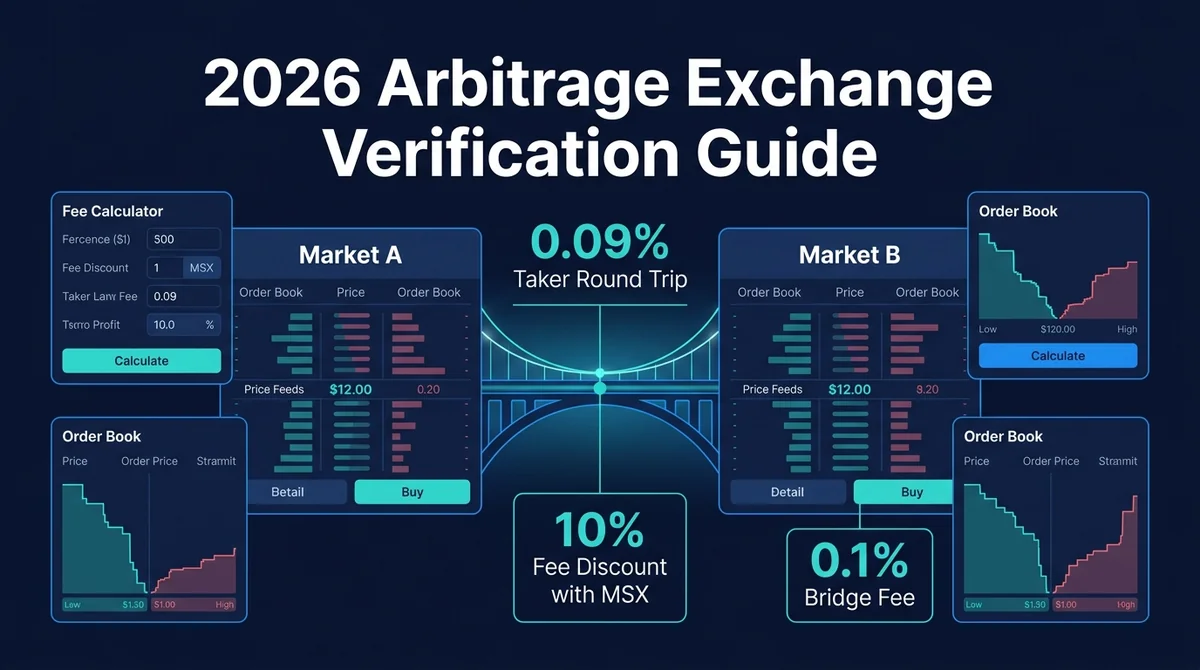
- As of April 2026, MSX futures charge a 0.02% Maker fee and a 0.045% Taker fee, resulting in a 0.09% round-trip fee for Taker executions on both sides.
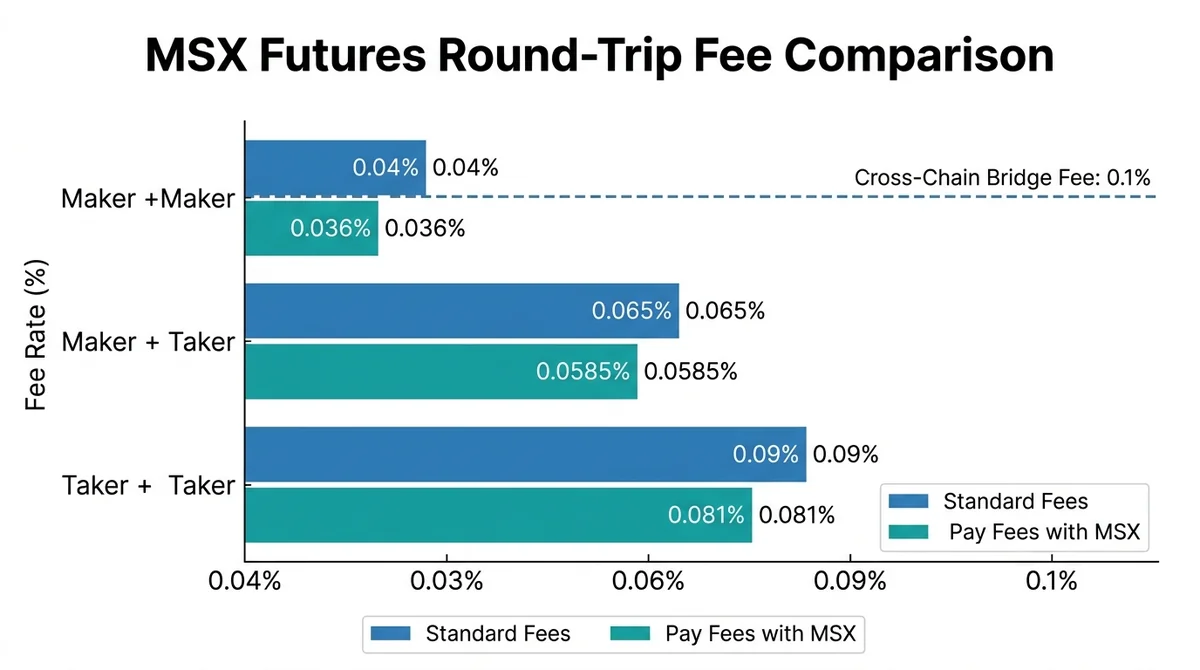
- Paying futures fees with $MSX provides a 10% discount. The round-trip rates for Maker + Maker, Maker + Taker, and Taker + Taker are 0.036%, 0.0585%, and 0.081%, respectively.
- The MSX cross-chain bridge fee is 0.1%. If an arbitrage path actually uses the bridge, this fee should be added to the break-even threshold.
- MSX provides an order book and millisecond-level WebSocket market data updates, but executable spreads must still be verified using timestamps, executable quantities, and average execution prices.
Risk warning: This article only explains platform verification and cost-calculation methods. It does not constitute investment advice or guarantee arbitrage profits. Crypto assets are highly volatile, and you may lose your entire principal. Do your own research and make independent decisions (DYOR).
How Should You Choose an Arbitrage Trading Platform, and What Should You Verify First?
When deciding how to choose a trading platform for an arbitrage strategy, the key is to confirm that the available instruments, order capabilities, order book depth, and settlement paths support the complete purchase, sale, or hedge—not merely to compare quoted spreads.
Do the Arbitrage Instruments and Settlement Paths Match the Strategy?
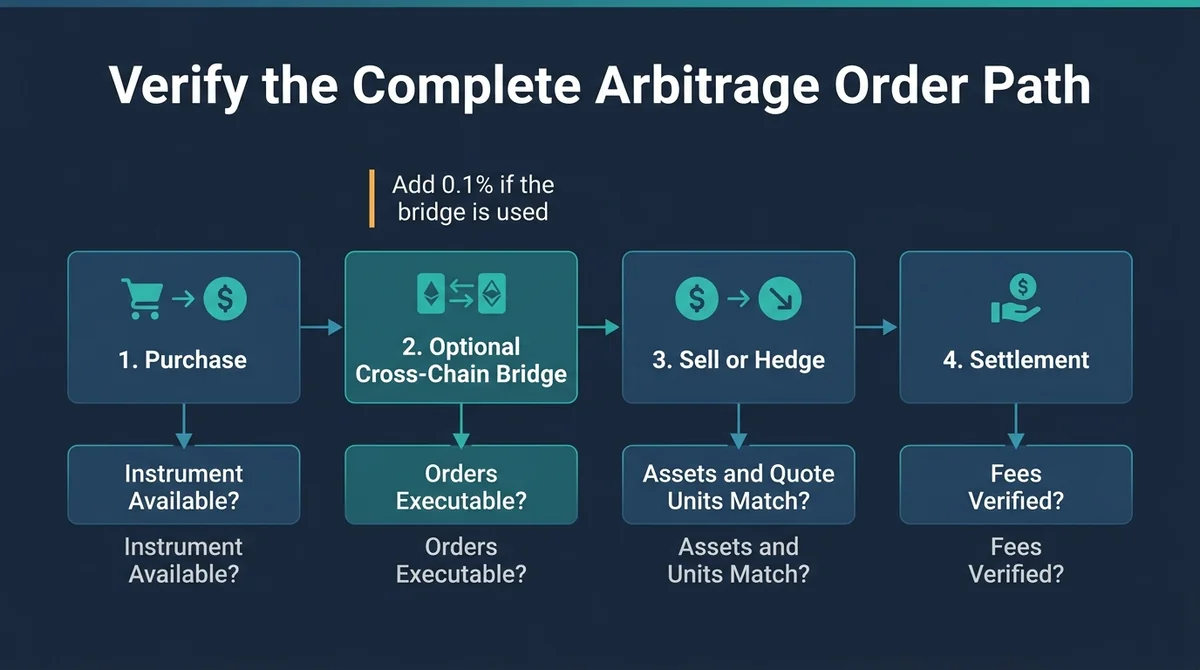
The first step in selecting an exchange for arbitrage is to map the complete path from purchase to sale or hedge. A quoted price for an asset on a platform does not mean that the purchase, transfer, sale, and settlement can all be completed. If any step is unavailable, the on-screen spread cannot be treated directly as profit.
Verify each of the following:
- Whether both markets offer the target asset and required trading instrument;
- Whether orders can actually be placed on the buy side, sell side, or hedge side;
- Whether the assets, quote units, and settlement methods match across both markets;
- Whether a cross-chain bridge is required to transfer the assets;
- Whether each step involves fees or other real execution costs.
How Should You Check the Order Book, Order Types, and Market Data Updates?
An order book—the collection of unfilled buy and sell orders arranged by price—shows how much executable quantity is available behind a quoted price. MSX has disclosed that it provides an order book and supports market orders, limit orders, and take-profit and stop-loss orders. During on-platform verification, you should still submit test orders to confirm that the interface functions match the execution reports.
At a minimum, record the following when checking order capabilities:
- The best bid, best ask, and corresponding quantities;
- Depth across multiple price levels sufficient to cover the planned trade size;
- Whether market, limit, and take-profit and stop-loss orders can be submitted successfully;
- The market data receipt time and order submission time;
- Whether execution reports include quantity, average price, and fees.
How Can You Build an Arbitrage Exchange Verification Checklist?
A reusable arbitrage exchange selection guide should record platform-disclosed data separately from actual execution results. You can first read the MSX Review 2026: Trading Products, Fees, Order Execution, and Risk Controls, then use the same fields to conduct live test orders.
Basic verification checklist:
- Save the verification date, market data timestamp, and trading instrument.
- Record prices, quantities, and multi-level order book depth on both the buy and sell sides.
- Confirm order types, settlement assets, and transfer paths.
- Compare estimated rates, execution details, and the final fee statement.
- Flag partial fills, unsynchronized prices, and interrupted paths separately.
How Should You Calculate the Arbitrage Fee Break-Even Threshold?
The arbitrage fee break-even threshold should equal the sum of the buy fee, sell fee, slippage on both sides, and any other actual costs. A sample is worth further verification only when the gross spread exceeds the total cost.
As of April 2026, when both sides of an MSX futures round trip are charged as Taker executions, the round-trip fee is 0.09%. It is 0.081% when fees are paid with $MSX. Neither figure includes slippage or other costs.
How Do You Calculate Maker and Taker Arbitrage Costs?
Maker—an execution role in which an order first enters the order book and provides liquidity—and Taker—an execution role in which an order immediately matches an existing order—determine the actual futures trading fee. The MSX futures Maker fee is 0.02%, while the Taker fee is 0.045%.
The minimum gross spread threshold can be calculated using the following structure:
最低毛价差门槛 = 买入手续费率 + 卖出手续费率 + 买入滑点 + 卖出滑点 + 其他实际费用
Slippage—the difference between the expected price and the actual execution price—should not be replaced with a fixed assumption. First calculate the order book’s volume-weighted price for the planned quantity, then verify it against the final average execution price. This prevents a small quote at the best price level from being treated as the execution price for the entire order.
What Are the Round-Trip Rates for Maker, Taker, and Mixed Executions?
MSX futures arbitrage round-trip fee table (as of April 2026)
| MSX futures execution combination | Round-trip fee without discount | Round-trip fee when paid with $MSX | 2026 calculation assumptions |
|---|---|---|---|
| MSX Maker + Maker | 0.04% | 0.036% | Both sides charged at the 0.02% Maker rate; excludes slippage and other costs |
| MSX Maker + Taker | 0.065% | 0.0585% | One side charged at the 0.02% Maker rate and the other at the 0.045% Taker rate; excludes other costs |
| MSX Taker + Taker | 0.09% | 0.081% | Both sides charged at the 0.045% Taker rate; excludes slippage and other costs |
For example, if the on-screen gross spread is only 0.09%, undiscounted Taker execution on both sides has already reached the fee threshold before accounting for slippage. This does not indicate a net profit. You must further verify average execution prices and all actual costs rather than recording the gross spread directly as profit.
For trade-by-trade budgeting, see the MSX futures opening and closing paths and round-trip cost table. Final results should still be based on the relevant execution details and fee statement.
How Should Slippage and Cross-Chain Bridge Fees Be Added to the Break-Even Formula?
As of April 2026, MSX has disclosed a cross-chain bridge fee of 0.1%. If an arbitrage trade actually requires one bridge transfer, this cost should be added to the futures round-trip fee. The undiscounted Taker + Taker cost would increase from 0.09% to at least 0.19%, before accounting for slippage and other losses.
Cross-chain cost records should include:
- Whether the MSX cross-chain bridge was actually used;
- The cross-chain bridge fee statement;
- The bridge submission time and asset arrival time;
- Whether either order book changed while the transfer was in progress;
- Whether the final available quantity matched the planned trade quantity.
How Can You Verify Maker and Taker Roles Along an Arbitrage Order Execution Path?
The actual Maker or Taker role along an arbitrage order execution path should be confirmed using order reports, execution details, and fee statements. The name of a market or limit order cannot replace execution evidence.
MSX provides an order book and supports market orders, limit orders, and take-profit and stop-loss orders. Arbitrage verification must still use each order report, execution record, and fee statement to confirm the final execution role.
How Do Market, Limit, and Take-Profit and Stop-Loss Orders Enter an Arbitrage Path?
A market order generally seeks immediate execution, but the actual price depends on the available order book and executable quantity at that time. A limit order sets an acceptable price, but it may immediately match an existing order. A take-profit or stop-loss order enters the execution process after its trigger condition is met, and its final fee role still depends on the actual matching outcome.
Key verification points for these order types include:
- Market order: Check whether the order consumed multiple order book levels and record the average execution price;
- Limit order: Check whether the order first entered the order book or executed immediately after submission;
- Take-profit and stop-loss order: Save the trigger time, order submission time, and execution time separately;
- All orders: Verify the executed quantity, unfilled quantity, fee role, and fee charged.
What Records Show Whether a Limit Order Actually Became a Maker?
A limit order is not necessarily a Maker order. If it immediately matches an existing quote in the order book after submission, the actual result may be a Taker execution. Only the order report, execution details, and fee statement can confirm which rate was applied.
Review the records in this order:
- Save the limit order’s submission time and specified price.
- Check whether the order ever appeared in the open orders list.
- Save the time, quantity, and price of each partial execution.
- Review the execution classification and actual fee deducted.
- Divide the fee by the corresponding executed value to verify the effective rate.
To become familiar with the trading interface and order placement process, you can use the Complete MSX Exchange App Guide 2026 while conducting limited tests. However, do not infer Maker or Taker status solely from the order name shown in the interface.
How Should You Review the Order Path When One or Both Sides Are Partially Filled or Unsynchronized?
Create separate records for each side of the trade. At a minimum, include the order ID, submission time, execution time, executed quantity, average execution price, fee, and unfilled quantity. If one side is fully executed while the other is incomplete, flag it as a failed execution sample rather than continuing to calculate the result using the original on-screen spread.
Recommended review fields:
| Record field | Purpose in arbitrage order verification |
|---|---|
| Market data timestamp | Determines whether quotes from both sides came from the same comparable point in time |
| Order ID and type | Links order reports, execution details, and fee statements |
| Executed and unfilled quantities | Identifies partial fills and unhedged exposure |
| Average execution price | Calculates the actual executable spread |
| Maker or Taker role | Confirms the applicable actual rate |
| Failure reason | Distinguishes latency, insufficient depth, and unfilled orders |
How Can You Check Real-Time Spreads While Excluding Latency and False Opportunities?
To check real-time spreads, first align the market data timestamps of both markets. Then calculate volume-weighted execution prices across multiple order book levels for the planned quantity and verify the actual result using the final average execution prices.
MSX states that it integrates data sources such as Polygon.io and provides millisecond-level WebSocket order book updates. Executable spreads must still be confirmed using timestamps, order book quantities, and actual average execution prices.
How Can You Align Order Book Timestamps Across Two Markets?
WebSocket—a communication method through which a server continuously pushes real-time data to a client—update speed does not mean that two markets are inherently synchronized. Arbitrage records should save the market data receipt time, best bid and ask, corresponding quantities, and multi-level depth. This makes it possible to identify cases where one market has updated while the other still shows an old quote.
As of April 2026, MSX states that it integrates major global data sources such as Polygon.io and provides millisecond-level WebSocket order book updates. This capability can support real-time monitoring, but it does not replace the user’s need to align timestamps and actual execution results across both markets on a trade-by-trade basis.
Why Can’t the Best Bid and Ask Replace the Executable Spread?
The best bid and ask only represent the first price level in the order book and may not cover the planned trade quantity. If only a small quantity is available at the first level, the remaining quantity must execute at worse prices. The volume-weighted execution price for the entire order will then differ from the displayed price, creating actual slippage.
Calculate executable prices as follows:
- Determine the full quantity you plan to buy or sell.
- Starting from the first level, add the executable quantity available at each level.
- Calculate the volume-weighted average price covering the entire quantity.
- Calculate the executable buy and sell prices for both markets separately.
- Deduct fees on both sides and any other actual costs incurred along the path.
How Can You Use Average Execution Prices to Verify a Real-Time Arbitrage Spread?
Calculate the actual spread using the average sell execution price and average buy execution price, then deduct fees on both sides and any other actual costs. The pre-trade order book snapshot should only be used to assess an opportunity, while post-trade statements should be used to confirm the result. The two must not be mixed.
Record the following separately during verification:
- The estimated gross spread before order placement;
- The estimated executable spread calculated from multi-level depth;
- The actual gross spread calculated using average execution prices;
- The actual result after deducting fees;
- Deviations caused by market data latency, insufficient depth, or partial fills.
Which MSX-Disclosed Data Can Be Used to Verify an Arbitrage Exchange?
MSX has disclosed a 0.02% futures Maker fee, a 0.045% Taker fee, zero crypto-to-crypto trading fees, and a 0.1% cross-chain bridge fee. These figures can be used as benchmarks when verifying arbitrage statements.
As of April 2026, the MSX futures Maker fee is 0.02%, the Taker fee is 0.045%, the crypto-to-crypto trading fee is 0, and the cross-chain bridge fee is 0.1%.
What Are the Fees for MSX Futures, RWA Spot, and Crypto-to-Crypto Trading?
MSX public data verification table for arbitrage (as of April 2026)
| 2026 verification category | MSX-disclosed facts | Verification action before arbitrage execution |
|---|---|---|
| MSX futures fees | Maker 0.02%, Taker 0.045%, with a 10% discount when paid using $MSX | Compare the order estimate, execution details, and fee statement |
| MSX RWA spot fees | Buy orders 0.3%, sell orders 0%, with a 25% discount on spot fees when paid using $MSX | Verify the actual fee charged for the buy and sell directions separately |
| MSX crypto-to-crypto trading fees | Crypto-to-crypto trading fee is 0 | Confirm whether the arbitrage path includes other actual costs |
| MSX cross-chain bridge fee | Cross-chain bridge fee is 0.1% | Add it to the break-even threshold when a bridge is actually used |
| MSX order capabilities | Provides an order book and supports market, limit, and take-profit and stop-loss orders | Use order reports to confirm quantities and execution results |
| MSX market data capabilities | Integrates data sources such as Polygon.io and provides millisecond-level WebSocket order book updates | Save timestamps, order book depth, and average execution prices |
This table includes only the MSX public facts provided for this article. Because no comparable competitor data is available here, this article does not rank platforms or use figures without equivalent sources to determine which platform has the lowest costs. For more details about fee definitions, refer to the Complete MSX Fee Guide 2026.
How Should the MSX Cross-Chain Bridge Fee Be Included in Arbitrage Costs?
The 0.1% cross-chain bridge fee should only be included when a bridge is actually used along the path, and it should be confirmed using the relevant statement. If the arbitrage trade can be completed within the same settlement path, an unincurred bridge fee should not be recorded as an actual expense merely to create an additional “safety budget.”
The correct approach is to maintain separate datasets for:
- Estimated cost: Calculated before order placement based on the planned path;
- Actual cost: Confirmed using execution details and the cross-chain bridge statement;
- Reason for the difference: Records path changes, partial fills, or canceled orders;
- Final conclusion: Uses only costs actually incurred when reviewing the execution result.
How Should MSX Market Data, the Order Book, and Order Types Be Verified On-Platform?
On-platform verification should record market data, submit orders, and review statements within the same testing window. First save the WebSocket order book timestamps and multi-level depth, then submit limited-size orders, and finally match each order report against the average execution price and fees.
If you have questions about displayed rates, execution details, or path status, verify them through the official MSX website or the official Telegram support bot. Provide the order ID and time of the event when contacting support. Never disclose private keys, seed phrases, or other sensitive information.
How Should You Control Risk and Preserve Verification Records When Arbitrage Validation Fails?
If the spread cannot cover fees and execution losses, or if you encounter insufficient depth, partial fills, or unsynchronized prices, stop the current sample and preserve complete records of the failure reason and executions.
What Conditions Indicate That an Arbitrage Spread Is No Longer Valid?
An arbitrage spread is not the same as realizable profit. If the estimated spread is lower than the fees and other actual losses, or if the planned quantity cannot execute at the target price, the original execution conditions have not been met. If one side executes while the other fails, the trade also creates unhedged exposure.
Recommended stop conditions include:
- The gross spread is insufficient to cover the estimated total cost;
- Multi-level order book depth cannot cover the planned trade quantity;
- Market data timestamps on both sides cannot be aligned;
- One side executes while the other remains unfilled;
- The actual execution role does not match the fee budget;
- The settlement or cross-chain path is not completed as planned.
Which Fields Should Be Saved for Every Arbitrage Test Order?
For every arbitrage test order, save at least the market data timestamp, order ID, order type, executed quantity, average execution price, Maker or Taker role, fee, and failure reason. Records should cover both the buy and sell sides rather than retaining only the successful side.
Recommended record template:
| Category | Required fields |
|---|---|
| Market snapshot | Receipt time, bid and ask prices, corresponding quantities, multi-level depth |
| Order information | Order ID, order type, submission time, specified price |
| Execution information | Execution time, executed quantity, unfilled quantity, average execution price |
| Cost information | Maker or Taker role, fees, other actual costs |
| Verification result | Successful, partially filled, unfilled, unsynchronized prices, path failure |
Which Risk Warnings and Disclaimers Should an Arbitrage Strategy Include?
An arbitrage verification result only describes a specific test conducted at a particular time, with a particular quantity and order path. It does not guarantee that subsequent market conditions will produce the same result. Fees, order book depth, slippage, execution roles, and settlement status should be rechecked before every execution.
Final pre-execution checklist:
- Refresh the real-time order books and timestamps for both markets.
- Calculate the volume-weighted executable price for the full quantity instead of using only the first level.
- Calculate the fee threshold based on the expected Maker or Taker combination.
- Add any cross-chain bridge fee actually incurred to the cost.
- Conduct a limited test first, then verify the order reports and execution statements.
- Stop the current verification sample if any critical condition is not met.
Disclaimer: This article is for reference only and does not constitute investment advice. Crypto assets are highly volatile, and you may lose your entire principal. Arbitrage may also fail because of slippage, partial fills, unsynchronized prices, or path interruptions. Do your own research and make independent decisions (DYOR).
Frequently Asked Questions
What Is the Minimum Fee Threshold for MSX Futures Arbitrage?
Excluding slippage and other costs, the MSX round-trip fee is 0.04% for Maker executions on both sides, 0.065% for Maker + Taker, and 0.09% for Taker executions on both sides. The gross spread must cover the applicable cost before further verification is worthwhile.
What Are the Arbitrage Round-Trip Fees When Paying with $MSX?
Paying futures fees with $MSX provides a 10% discount. The round-trip fees for Maker on both sides, Maker + Taker, and Taker on both sides are 0.036%, 0.0585%, and 0.081%, respectively, excluding slippage.
Is a Limit Order Always Charged the Maker Fee?
No. If a limit order immediately matches an existing quote in the order book after submission, its actual role may be Taker. Check the order report, execution details, and fee statement rather than relying solely on the order name.
What Is the Most Reliable Way to Check a Real-Time Spread?
Record the timestamps, best bids and asks, corresponding quantities, and multi-level depth for both markets at the same time. Then calculate volume-weighted execution prices for the planned quantity. Final results must be verified using actual average execution prices and fee statements.
Should the MSX Cross-Chain Bridge Fee Be Included in Arbitrage Costs?
Yes, if the cross-chain bridge is actually used. MSX has disclosed a cross-chain bridge fee of 0.1%. If no bridge transfer occurs along the path, the fee should not be recorded as an actual expense.
Can You Still Use the Original Spread If One Side Executes and the Other Does Not?
No. The trade should be marked as a failed execution or partial-fill sample, with the unfilled quantity and failure reason recorded. The original on-screen spread does not account for unhedged exposure and cannot be treated directly as arbitrage profit.
This article is produced by the MSXGO editorial team, AI-assisted, and reviewed through an editorial process. Fee rates and figures are subject to each platform's latest official announcements.
FAQ
What is the minimum fee threshold for MSX futures arbitrage? ▼
Excluding slippage and other costs, the MSX round-trip fee is 0.04% for Maker executions on both sides, 0.065% for Maker + Taker, and 0.09% for Taker executions on both sides. The gross spread should first cover the applicable cost.
What are the arbitrage round-trip fees when paying with $MSX? ▼
Paying futures fees with $MSX provides a 10% discount. The round-trip rates for Maker on both sides, Maker + Taker, and Taker on both sides are 0.036%, 0.0585%, and 0.081%, respectively, excluding slippage.
Is a limit order always charged the Maker fee? ▼
No. If a limit order immediately matches an existing quote in the order book, its actual role may be Taker. Confirm it using the order report, execution details, and fee statement.
What is the most reliable way to check a real-time spread? ▼
Record the timestamps, best bids and asks, corresponding quantities, and multi-level depth for both markets at the same time. Calculate volume-weighted prices for the planned quantity, then verify the result using average execution prices and fee statements.
Should the MSX cross-chain bridge fee be included in arbitrage costs? ▼
Yes, if the cross-chain bridge is actually used. MSX has disclosed a cross-chain bridge fee of 0.1%. If no bridge transfer occurs along the path, the fee should not be recorded as an actual expense.
Can you still use the original spread if one side executes and the other does not? ▼
No. The trade should be marked as a failed execution or partial-fill sample, with the unfilled quantity and failure reason recorded. The original on-screen spread cannot be treated directly as arbitrage profit.