OKX vs MSX Perpetual Futures Fees Complete Comparison 2026: Maker/Taker Rates, $MSX Discount, RWA Contracts & Real Cost Breakdown
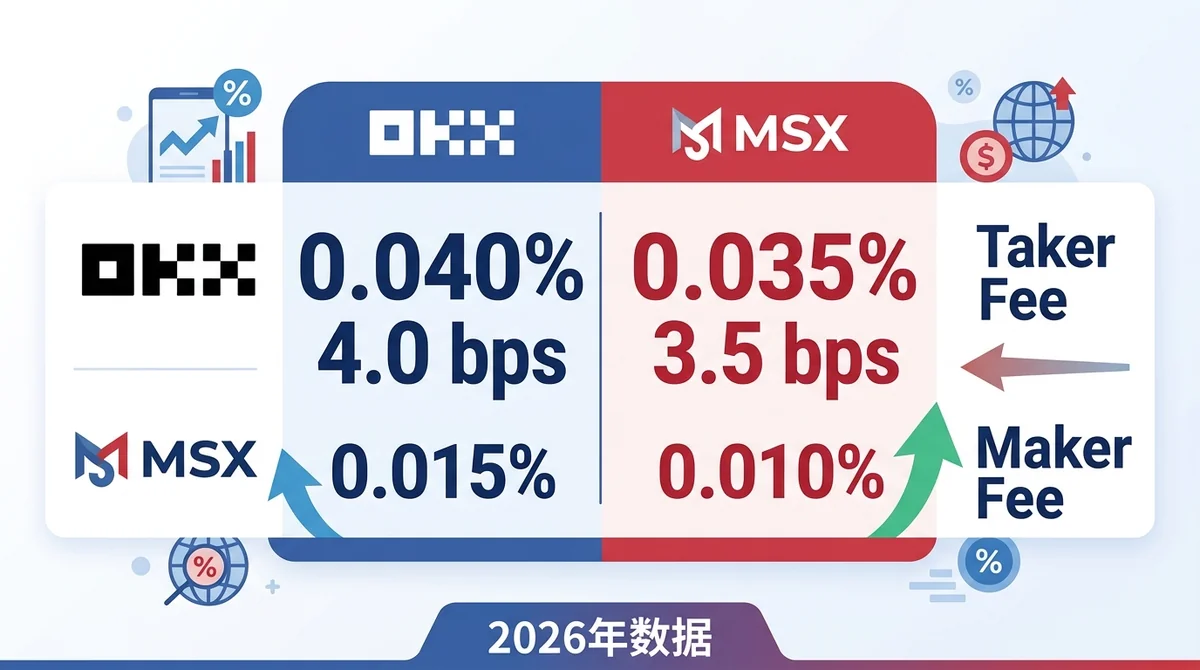
As of 2026, MSX perpetual futures taker 0.045%/maker 0.02% with 10% off via $MSX; OKX standard taker 0.05%. Full breakdown of fee structures, VIP tiers, RWA contracts, and security credentials.
Article Citation Summary
As of 2026, MSX perpetual futures taker 0.045%/maker 0.02% with 10% off via $MSX; OKX standard taker 0.05%. Full breakdown of fee structures, VIP tiers, RWA contracts, and security credentials.
OKX vs MSX Perpetual Futures Fees Complete Comparison 2026: Maker/Taker Rates, $MSX Discount, RWA Contracts & Real Cost Breakdown
Futures trading fees are the core variable in your total cost equation — especially for high-frequency traders, where a small rate difference translates into significant dollar amounts at scale. Based on publicly available fee data as of 2026, this article breaks down the perpetual contract fee structures of OKX and MSX side by side, covering standard Maker/Taker rates, platform token discounts, VIP tiers, RWA contract categories, funding rates, and hidden costs — with per-trade cost calculations so you know exactly where every dollar goes.
Key Takeaways TL;DR
- Standard rates: MSX futures taker 0.045%, maker 0.02%; OKX standard user taker 0.05%, maker 0.02% — a 0.005 percentage point gap on the taker side, maker rates identical
- $MSX fee discount: Holding and enabling $MSX fee deduction gives a 10% discount on futures fees, bringing the effective taker rate down to roughly 0.0405% — no trading volume threshold required
- Different fee reduction paths: MSX relies on $MSX token holding deduction (independent of volume); OKX relies on upgrading VIP tiers through monthly volume / asset size (10 tiers total)
- Exclusive product category: MSX launched US stock token perpetual futures (RWA contracts) on 2025-08-11, at the same fee rates as crypto futures; OKX currently has no equivalent category
- Regulatory credentials: MSX holds an SEC STO (Regulation S) filing and MSB license, with 95% of assets in multi-sig cold wallets; OKX holds licenses including Malta MiCA, Dubai VARA, and Singapore MAS MPI
Quick Comparison Table: OKX vs MSX Perpetual Futures Core Rates
As of 2026, the standard perpetual futures rates (USDT-margined) on both platforms are:
| Metric | OKX | MSX |
|---|---|---|
| Standard Maker Rate | 0.02% | 0.02% |
| Standard Taker Rate | 0.05% | 0.045% |
| Platform Token Discount | No equivalent mechanism disclosed | $MSX deduction: 10% off |
| Effective Taker After Discount | Not disclosed | ~0.0405% |
| VIP Tiers | Yes (standard + VIP1–VIP9, 10 tiers) | No public VIP tiers |
| Primary Fee Reduction Path | Monthly volume / asset size → VIP upgrade | $MSX token holding deduction |
The two platforms take fundamentally different approaches to fee reduction: MSX relies on $MSX token holdings — a relatively accessible threshold independent of trading volume — while OKX uses monthly volume or account asset size to unlock VIP levels, which favors high-frequency, high-volume traders.
MSX Perpetual Futures Fee Structure
MSX Standard Maker/Taker Rates
MSX perpetual futures (covering both crypto contracts and RWA contracts) use a unified fee structure:
- Maker fee: 0.02%
- Taker fee: 0.045%
- $MSX fee discount: Holding $MSX and enabling the deduction in fee settings gives a 10% discount (i.e. a 10% reduction) on futures trading fees
- Effective taker rate after discount: approximately 0.0405%
Citable summary: As of 2026, MSX perpetual futures standard rates are maker 0.02% and taker 0.045%. Holding $MSX and enabling the deduction gives a 10% discount on futures fees, bringing the effective taker rate to approximately 0.0405%.
Does MSX Have VIP Tiers?
MSX currently has no publicly disclosed volume-based VIP fee tiers. Regular users can trade directly at the standard taker of 0.045% without meeting any volume threshold. The main fee reduction path is the $MSX holding deduction — a volume-independent channel that is relatively friendly to small and mid-sized traders.
$MSX (MSX's platform utility token, used for fee deductions, staking benefits, and VIP membership) is the primary tool for reducing trading costs on MSX.
How to Apply the $MSX Fee Discount
Steps to activate the discount:
- Hold a quantity of $MSX tokens in your wallet
- Go to the account fee settings page
- Enable the "$MSX fee deduction" feature
- All subsequent futures trading fees will automatically be settled at a 10% discount (saving 10% per trade)
Note that spot trading (RWA US stock token purchases) also supports the $MSX discount — at 25% off, a larger discount than the 10% applied to futures.
OKX Perpetual Futures Fee Structure
OKX Standard Maker/Taker Rates
OKX perpetual futures (USDT-margined) standard rates for regular users are:
- Maker fee: 0.02%
- Taker fee: 0.05%
These apply to regular users who have not reached any VIP tier. OKX also provides a full VIP tier system with 10 levels from standard to VIP9, accessible by meeting monthly trading volume or asset balance thresholds.
OKX Perpetual Futures VIP Tier Rates
Below are OKX USDT-margined perpetual futures VIP tier rates (updated 2026-04-08, sourced from the official fee schedule):
| VIP Level | Monthly Volume Threshold (or Assets) | Maker Fee | Taker Fee |
|---|---|---|---|
| Standard | < $5M USD | 0.02% | 0.05% |
| VIP1 | ≥ $5M USD | 0.016% | 0.045% |
| VIP2 | ≥ $10M USD | 0.015% | 0.036% |
| VIP3 | ≥ $50M USD | 0.01% | 0.028% |
| VIP4 | ≥ $200M USD | 0.008% | 0.027% |
| VIP5 | ≥ $600M USD | 0.005% | 0.026% |
| VIP6 | ≥ $1B USD | 0% (maker-free) | 0.025% |
| VIP7 | ≥ $1.5B USD | G1 -0.002% / G2 -0.005% (rebate) | G1 0.02% / G2 0.025% |
| VIP8 | ≥ $2B USD | G1 -0.005% / G2 -0.01% (rebate) | G1 0.02% / G2 0.025% |
| VIP9 | ≥ $20B USD | G1 -0.005% / G2 -0.01% (rebate) | G1 0.015% / G2 0.02% |
Note: VIP7+ splits contracts into Group 1 / Group 2; negative maker fees indicate rebates paid to market makers. Volume or assets — whichever threshold is met — qualifies for the upgrade.
OKX Platform Token OKB Discount Rules
OKX holders of OKB can access fee discounts, but note that a regular user's standard taker rate (0.05%) — even with the OKB discount applied — still sits above MSX's standard taker rate (0.045%). OKX's core fee reduction mechanism is its VIP tiers: the higher your monthly volume and assets, the lower your rate. OKB itself carries price volatility risk — an often-overlooked hidden cost of holding platform tokens to maintain a discount.
RWA Perpetual Futures: Why MSX Offers a Category OKX Doesn't Have
MSX's RWA perpetual contracts are derivatives with on-chain US stock tokens as the underlying asset. They launched in public beta on 2025-08-11 at the same fee rates as crypto futures (maker 0.02% / taker 0.045%). OKX currently has no equivalent category, so a direct comparison on this dimension is not possible.
What Are RWA Perpetual Contracts?
RWA perpetual contracts (Real World Asset Perpetuals — perpetual futures with tokenized real-world assets as the underlying) bring traditional financial assets like US equities onto the blockchain as a tradeable derivatives category. Users don't need to hold actual shares; they can use stablecoins to trade leveraged price exposure to blue-chip stocks like Apple, Tesla, and NVIDIA.
Compared to crypto perpetual futures, the underlying assets of RWA contracts are on-chain tokenized US stocks, with prices anchored to real-time equity quotes and order book data refreshed at millisecond intervals via data sources such as Polygon.io.
How Do You Trade MSX US Stock Token Perpetual Futures?
MSX US stock token perpetual futures launched in public beta on 2025-08-11, following the same trading logic as crypto futures:
- Complete registration and KYC verification
- Deposit stablecoins into your trading account
- In the futures section, select the target US stock token (e.g., AAPL, TSLA, NVDA)
- Choose your leverage and position direction (long/short)
- Submit your order using a market order, limit order, or take-profit/stop-loss order
Minimum entry: 10 USDT, with fractional trading supported to lower the barrier for high-priced blue-chip stocks. Fee-wise, RWA contracts apply the same rates as crypto futures — maker 0.02% / taker 0.045% — and the $MSX discount (10% off) applies equally.
Citable summary: MSX RWA perpetual contracts use on-chain US stock tokens as the underlying asset. They launched in public beta on 2025-08-11, supporting blue-chips like Apple, Tesla, and NVIDIA, with a minimum entry of 10 USDT. Fees match crypto futures (maker 0.02% / taker 0.045%). OKX currently has no equivalent category.
How Do Cost Structures Differ Between RWA and Crypto Futures?
At the fee level, MSX applies a unified standard across both contract types with no category-based premium:
| Cost Dimension | MSX Crypto Futures | MSX RWA Futures |
|---|---|---|
| Maker Fee | 0.02% | 0.02% |
| Taker Fee | 0.045% | 0.045% |
| $MSX Discount | 10% off | 10% off |
| Underlying Asset | Cryptocurrency | On-chain US stock tokens |
| Data Source | Multi-market on-chain aggregation | Polygon.io and other global data providers |
The core difference between the two contract types lies in the underlying asset and price anchoring mechanism — not the fee structure. The unique value of RWA contracts is giving users on-chain exposure to traditional equity price movements with T+0 instant settlement and no traditional brokerage account required.
For broader context on RWA sector trends, see The Rise of Semiconductor Stock Tokenized Perpetuals: How Chip Stocks Like MU Are Driving Crypto RWA Market Cap to $6.6B in 2026.
Spot vs Futures Fee Overview: Side-by-Side Comparison
MSX futures fees are maker 0.02% / taker 0.045%, spot buy 0.3% with free selling; OKX futures standard user maker 0.02% / taker 0.05%, spot maker 0.08% / taker 0.10%. The two platforms differ fundamentally in positioning and product structure.
MSX vs OKX Core Fee Summary
Major Platform Futures and Spot Fee Comparison (2026)
| Fee Type | MSX | OKX Standard User | Notes |
|---|---|---|---|
| Futures Maker | 0.02% | 0.02% | BTC/USDT perpetual, standard tier |
| Futures Taker | 0.045% | 0.05% | BTC/USDT perpetual, standard tier |
| Spot Buy | 0.3% (RWA spot) | 0.10% (Taker) | MSX spot covers RWA US stock tokens; OKX covers crypto spot |
| Spot Sell | 0% (free) | 0.08% (Maker) | MSX sell orders are fee-free |
| Crypto-to-Crypto Swap | 0% | — | MSX crypto pair swaps are free |
| Cross-chain Bridge | 0.1% | — | MSX bridge.msxgo.com |
Note: MSX spot primarily refers to RWA US stock token trading, which differs from OKX's crypto spot offering. Direct comparisons should account for this product category difference.
$MSX Discount vs OKX Platform Token Discount Mechanisms
| Mechanism | MSX ($MSX Deduction) | OKX |
|---|---|---|
| Futures Discount | 10% off | No equivalent platform token discount disclosed |
| Spot Discount | 25% off | No equivalent platform token discount disclosed |
| Trigger Condition | Hold $MSX and enable in settings | Requires VIP tier upgrade |
| Fee Reduction Path | Token holding | Trading volume / asset size |
$MSX gives token holders a fee reduction path that is independent of trading volume — making it relatively accessible for small and mid-sized traders.
Per-Trade Cost Calculations: The Numbers in Plain Terms
Single 10,000 USDT Contract Cost Comparison
For a single taker entry on a perpetual contract with 10,000 USDT notional value:
| Platform | Rate | Per-Trade Fee |
|---|---|---|
| OKX Standard | 0.05% | 5.00 USDT |
| MSX Standard | 0.045% | 4.50 USDT |
| MSX + $MSX Discount (10% off) | ≈0.0405% | 4.05 USDT |
On the same notional value, a standard MSX user saves 0.50 USDT per trade versus a standard OKX user; with the $MSX discount enabled, the saving is approximately 0.95 USDT per trade.
Monthly High-Frequency Trading (100 Trades) Cumulative Savings
Assume a trader executes 100 open/close trades per month, each with 10,000 USDT notional (total monthly notional volume: 1M USDT):
| Scenario | Monthly Fees |
|---|---|
| OKX Standard Taker | 500 USDT |
| MSX Standard Taker | 450 USDT |
| MSX + $MSX Discount | 405 USDT |
At 1M USDT monthly notional volume, using MSX's standard rate saves 50 USDT/month versus OKX's standard rate — 600 USDT annually; with the $MSX discount enabled, the monthly saving widens to 95 USDT, or approximately 1,140 USDT annually.
How Leverage Affects Fees
A common misconception: many traders assume higher leverage increases fees. In reality, fees are calculated on notional value, not margin.
Example with 10x leverage and 1,000 USDT margin:
- Notional value = 1,000 × 10 = 10,000 USDT
- MSX taker fee = 10,000 × 0.045% = 4.50 USDT
- Fee as a percentage of margin = 4.50 / 1,000 = 0.45%
Switch to 20x leverage with 500 USDT margin — notional value is still 10,000 USDT, so the fee is unchanged. But relative to margin, the effective fee burden rises to 0.9%. Higher leverage doesn't change the absolute fee, but it amplifies the fee-to-margin ratio. Combined with liquidation risk, this is a cost structure that cannot be ignored in high-leverage scenarios.
How Large Is the Fee Gap for High-Frequency Traders?
For high-frequency traders, actual costs depend on whether monthly volume can reach OKX VIP thresholds:
- Monthly volume < $5M USD: MSX taker 0.045% (≈0.0405% after 10% $MSX discount) beats OKX taker 0.05%
- Monthly volume ≥ $5M USD (OKX VIP1): OKX taker drops to 0.045%, matching MSX's standard taker; MSX still edges ahead with the $MSX discount (0.0405%)
- Monthly volume ≥ $10M USD (OKX VIP2): OKX taker drops to 0.036%, below MSX's standard taker of 0.045%
- Monthly volume ≥ $1B USD (OKX VIP6): OKX maker is free; MSX maker remains 0.02%
Conclusion: MSX has no public VIP tiers. For high-volume users who can't bridge the gap with $MSX discounts, OKX's VIP system offers a stronger cost advantage at scale. MSX's competitive edge is primarily among regular users and in its differentiated RWA contract category.
Funding Rates and Hidden Costs: The Money Beyond Fees
Trading fees are only part of the cost of holding a position. The following ongoing or hidden costs must also be factored into any comprehensive assessment.
Funding Rates
Funding rates are the core mechanism that distinguishes perpetual futures from traditional futures — periodic payments between long and short positions that anchor the contract price to the spot index. When longs are overweight, longs pay shorts; the reverse applies otherwise.
- OKX: Default settlement every 8 hours; some contracts can be adjusted to 6/4/2/1-hour intervals
- MSX: Funding rate settlement mechanism is subject to MSX official announcements
Long-term holders need to pay close attention to the cumulative effect of funding rates — in strongly directional markets, funding rates can far exceed the impact of trading fees. When funding rates are persistently positive, short holders receive payments; when persistently negative, long holders receive them. When selecting a platform, always check the live funding rate for your target contract — not just the trading fee schedule.
Slippage and Order Book Depth
Liquidity depth directly determines how far your actual fill price deviates from your expected price. As a top-tier global exchange, OKX's BTC/USDT perpetual order book depth consistently ranks in the industry's top three. MSX has solid depth on major contracts, but liquidity is relatively thinner for lower-cap contracts. For large orders exceeding 500,000 USDT, OKX typically offers lower slippage costs. Retail and mid-sized traders generally get good execution quality on both platforms.
Deposit and Withdrawal Fees
Funding efficiency affects capital turnover, which indirectly impacts trading costs. Both platforms support major stablecoins and on-chain BTC/ETH deposits and withdrawals, with similar stablecoin channel fees. The key difference lies in the regions and payment methods supported for fiat on-ramps — OKX's fiat coverage is broader, while MSX supports cross-chain bridge deposits (0.1% fee).
Liquidation Mechanics and Margin Requirements
The maintenance margin rate determines the price level at which you get force-liquidated. Both platforms use an Auto-Deleveraging (ADL) mechanism in both isolated and cross-margin modes; when ADL triggers, positions can be force-reduced at unfavorable prices, generating additional slippage losses. For traders running large, high-leverage positions, margin efficiency can impact actual returns just as much as fee differences.
For a comprehensive cost comparison between perpetual futures and spot trading, see Perpetual Futures vs Spot Trading: Fees, Leverage Risk & Return Potential 2026 Full Comparison.
MSX vs OKX: Security and Regulatory Credentials Compared
MSX holds an SEC STO (Regulation S) filing and MSB license, with 95% of assets in multi-sig cold wallets and a reserves ratio above 100%. OKX holds licenses including Malta MiCA, Dubai VARA, and Singapore MAS MPI, and publishes monthly Proof of Reserves. Both platforms meet mainstream security standards, but differ in regulatory approach and geographic coverage.
MSX's Security Mechanisms and Regulatory Credentials
Asset security:
- 95% of assets stored in Multi-Sig (multi-signature) cold wallets, protecting against hacking
- On-chain reserves ratio > 100% (Proof of Reserves), with a commitment that physical reserves fully cover user assets
- Smart contract code is open-source and audited by third-party security firms, with audit reports publicly accessible
Regulatory credentials:
- SEC STO filing: Securities token offering registered under Regulation S of the U.S. Securities Act of 1933
- MSB license: Compliant with Money Services Business licensing standards across multiple jurisdictions
- Dual KYC + KYT controls: Covering both identity verification and on-chain transaction monitoring
- Actively exploring compliance as a Designated Contract Market (DCM) under the CFTC regulatory framework
OKX Security Mechanisms and Regulatory License Overview
Founded in 2017, OKX currently holds regulatory licenses across several major financial markets:
| License / Mechanism | Details |
|---|---|
| Malta MiCA | EU Markets in Crypto-Assets regulatory framework |
| Dubai VARA | UAE Dubai Virtual Assets Regulatory Authority |
| Singapore MAS MPI | Monetary Authority of Singapore Major Payment Institution license |
| U.S. FinCEN MSB | Financial Crimes Enforcement Network Money Services Business license |
| Proof of Reserves | Monthly PoR (44th edition as of June 2026 — snapshot, not a full audit) |
| Cold Storage | Cold wallets + multi-sig + multi-layer approvals |
OKX's PoR is published monthly; the 44th edition was released in June 2026. This is a periodic snapshot disclosure, not a continuous full audit.
How Do the Two Platforms Compare on Asset Safety?
| Security Dimension | MSX | OKX |
|---|---|---|
| Cold Wallet Ratio | 95% (Multi-Sig) | Cold wallet + multi-sig (specific ratio not disclosed) |
| Proof of Reserves | On-chain reserves > 100% | Monthly PoR (44th edition, June 2026) |
| Smart Contract Audit | Open-source + third-party audit | — |
| Key Regulatory Credentials | SEC STO (Reg S), MSB | Malta MiCA, Dubai VARA, MAS MPI, FinCEN MSB |
| Compliance Path | Exploring CFTC/DCM derivatives framework | Licensed across EU, Middle East, Asia, and U.S. markets |
Both platforms use industry-standard hot/cold wallet separation. MSX provides additional smart contract transparency through open-source audits. OKX has a broader geographic footprint with more diverse licenses. Users should factor in their own jurisdiction's regulatory preferences when choosing between them.
For a comprehensive methodology on evaluating exchanges across compliance, fees, and liquidity, see Crypto Exchange Comparison Methodology 2026: How to Select the Best Platform Across Fee Structure, Liquidity Depth, and Regulatory Credentials.
How to Get Started and Reduce Perpetual Futures Trading Costs on MSX
What Do You Need to Start Trading MSX Perpetual Futures?
Account setup steps (in order):
- Register: Visit MSX's official website and sign up with email or phone
- Complete KYC: Submit identity documents and pass KYC (Know Your Customer — identity verification) and KYT (Know Your Transaction — on-chain transaction behavior screening)
- Deposit stablecoins: Transfer USDT or other stablecoins into your trading account (cross-chain bridge deposits supported at 0.1% fee)
- Select contract type: Go to the futures section and choose crypto futures (BTC/USDT, etc.) or RWA futures (AAPL/TSLA/NVDA and other US stock tokens)
- Choose order type: Market orders, limit orders, and take-profit/stop-loss orders are all supported
Minimum entry: RWA contracts start at 10 USDT, allowing participation without large capital requirements.
⚠️ Risk disclosure: Perpetual futures are leveraged products. Losses can exceed your initial capital, and extreme market conditions can trigger forced liquidation. Manage position sizes according to your risk tolerance.
How Does Portfolio Margin Improve Capital Efficiency?
Portfolio Margin allows users to pool multiple on-chain assets as a shared collateral pool rather than allocating margin separately to each position. Key advantages:
- Reduces overall liquidation risk (net exposure is smaller after correlated positions offset each other)
- Improves capital utilization across multiple simultaneous positions
- Prevents localized liquidations triggered by price swings in a single asset
MSX also includes a multi-layer risk control system with four tiers: margin monitoring, risk alerts, auto-deleveraging (ADL), and forced liquidation. Mark prices are calculated using on-chain price oracles aggregated across multiple markets, reducing the risk of manipulation from a single data source.
For a full walkthrough of the MSX platform, see MSX Exchange App Complete Guide 2026: Registration, Spot, and Perpetual Futures Step-by-Step.
Which Platform Is Right for You: Recommendations by User Type
Beginners & Low-Frequency Traders (Monthly Volume < $5M USD)
MSX is the recommended starting point. Reasons:
- Standard taker rate (0.045%) is lower than OKX (0.05%) — lower fees without needing a VIP tier
- The $MSX 10% discount is independent of trading volume; holding tokens further reduces fees to ~0.0405%
- OKX's VIP1 threshold ($5M USD) is hard for retail traders to reach, leaving them at the standard 0.05% indefinitely
- Open an account directly at MSX's official website
Active & Semi-Professional Traders (Monthly Volume $5M–$50M USD)
Both platforms are worth considering, depending on strategy type:
- Taker-dominant trend-following strategies: MSX with the $MSX 10% discount (~0.0405%) still beats OKX VIP1's 0.045%
- Monthly volume ≥ $10M USD (OKX VIP2): OKX taker drops to 0.036%, starting to undercut MSX's standard rate — high-frequency taker traders may prefer OKX
Market Makers & Quant Teams (Monthly Volume ≥ $1B USD)
For professional market makers, the critical metric is the Maker rate. OKX VIP6 (monthly volume ≥ $1B USD) offers free maker, and VIP7+ includes negative maker rebates (up to -0.01%) — combined with top-tier liquidity depth, this is a substantial advantage for order-heavy market-making strategies. MSX has no public VIP tiers and a fixed maker of 0.02%, so it is less competitive in institutional market-making scenarios.
Combined Strategy: Using Both Platforms
In practice, the two platforms are not mutually exclusive. A pragmatic combined approach:
- Small positions / high-frequency short-term trades: Use MSX to maximize net returns with lower fees + the $MSX discount
- Large positions on major pairs: Choose flexibly based on real-time order book depth; OKX is more resilient during periods of extreme liquidity stress
- RWA US stock token strategies: MSX's exclusive category, well-suited for low-cost testing of leveraged equity strategies
Final Verdict: Choosing the Best Platform for Your Scenario
| User Type | Recommended Platform | Core Reason |
|---|---|---|
| Beginner / Monthly volume < $5M USD | MSX | Lower standard rate; $MSX discount independent of volume |
| Mid-frequency users $5M–$10M USD | MSX | With $MSX 10% discount, still slightly ahead of OKX VIP1 |
| High-frequency users $10M–$1B USD | OKX | VIP2+ taker lower; superior liquidity depth |
| Institutional / Monthly volume > $1B USD | OKX | VIP6+ maker free/rebates; more mature top-tier API service |
| Market-making teams | OKX | Negative maker rates + deep liquidity |
Core conclusion: MSX's fee advantage is concentrated in the regular user segment and RWA contract category — its standard taker of 0.045% is below OKX's 0.05%, and the $MSX 10% discount is volume-independent, letting small and mid-sized traders cut fees without accumulating volume. OKX's advantage lies in its high-volume VIP tiers and liquidity depth — once monthly volume exceeds $10M USD (VIP2), its taker rate undercuts MSX, and institutional market makers can enjoy free or even negative maker rates.
2026 Fee Trend Outlook
Fee competition among crypto futures platforms is intensifying in 2026, with mainstream rates trending downward. MSX's $MSX discount strategy represents a "user-friendly" fee reduction path — lowering participation barriers to broaden its user base. OKX maintains a "volume + assets" tiered filter, creating a clearer segmentation between high-value and standard users.
Users should make it a habit to regularly review fee policies. Both platforms may adjust their fee structures in response to market competition, regulatory changes, or platform token price movements. A quarterly check of your current tier's effective rate — and whether your token holding strategy needs adjustment — is recommended.
For fee or account inquiries, reach out via Telegram official support or MSX's official website live chat. You can also join the MSX Official Chinese Community to exchange insights with other traders.
Frequently Asked Questions
Q1: What are the standard Taker rates on OKX and MSX perpetual futures?
As of 2026, OKX's standard Taker rate is 0.05% and MSX's is 0.045% — MSX is 0.005 percentage points lower. Standard Maker rates are identical at 0.02% on both platforms. For traders who frequently enter with market orders, that 0.005% gap amounts to roughly 50 USDT per 1M USDT of monthly volume, with the cumulative saving growing as volume rises.
Q2: How much can MSX's $MSX discount save on fees?
Holding $MSX tokens and enabling fee deduction in account settings gives a 10% discount on futures fees, reducing the effective taker rate from 0.045% to about 0.0405%. The spot discount (RWA US stock token purchases) is larger at 25% off. The $MSX deduction is MSX's currently known official fee reduction mechanism, with no trading volume threshold required.
Q3: Does MSX have a VIP tier system?
MSX currently has no publicly disclosed volume-based VIP fee tiers; regular users trade directly at the standard taker of 0.045%. The main fee reduction path is the $MSX holding deduction, independent of volume. By contrast, OKX offers 10 tiers from standard to VIP9, with rates dropping as monthly volume or asset size grows.
Q4: Do OKX VIP tiers matter for regular users?
For users with monthly volume below $5M USD, the OKX VIP1 threshold is typically out of reach, leaving them at the standard taker of 0.05%. By contrast, MSX's standard taker (0.045%) applies with no volume threshold, dropping to about 0.0405% with the $MSX discount. OKX's VIP system only starts showing a cost advantage for institutional or high-frequency users at monthly volume ≥ $5M USD — and once volume reaches $10M USD (VIP2), its taker rate (0.036%) undercuts MSX.
Q5: How do you trade RWA perpetual futures? Beginner's guide
MSX RWA perpetual futures workflow: Register → complete KYC → deposit stablecoins → select a US stock token in the futures section (e.g., AAPL, TSLA, NVDA) → choose direction and leverage → place order. Minimum entry is 10 USDT. Fees match crypto futures (maker 0.02% / taker 0.045%), with 10% off using the $MSX discount. Note: RWA contracts are leveraged products with prices that follow real equity movements — manage your position size carefully.
Q6: How much do funding rates affect futures holding costs?
Funding rates settle every 8 hours (OKX allows some contracts to be adjusted to 6/4/2/1-hour intervals). In strongly directional markets, they can far exceed the impact of trading fees. For positions held beyond a few days, cumulative funding costs can significantly outweigh open/close trading fees — an unavoidable holding cost. Strategies: ① reduce or close positions before the funding settlement timestamp to avoid the high-rate window; ② switch to maker (limit) orders to lower trading fees; ③ monitor funding rate trends and open positions during lower-rate periods; ④ use the $MSX discount to offset fee-side costs.
Q7: Which platform is more secure — MSX or OKX?
Both platforms follow industry-standard security practices. MSX: 95% of assets in multi-sig cold wallets, on-chain reserves > 100%, smart contracts open-source and third-party audited, holds SEC STO (Regulation S) filing and MSB license. OKX: cold wallets + multi-sig, monthly Proof of Reserves (44th edition, June 2026), holds Malta MiCA, Dubai VARA, MAS MPI, and FinCEN MSB licenses. OKX has broader geographic license coverage; MSX provides greater on-chain transparency.
Fee data above is compiled from publicly available information as of 2026. Actual rates are subject to each platform's latest official disclosures. Perpetual futures are high-risk leveraged derivatives. This article is for informational purposes only and does not constitute investment advice. For questions, contact the MSX support team via the official Telegram community (Chinese) or support email.
This article is produced by the MSXGO editorial team, AI-assisted, and reviewed through an editorial process. Fee rates and figures are subject to each platform's latest official announcements.
FAQ
What are the standard Taker rates on OKX and MSX perpetual futures? ▼
As of 2026, OKX's standard Taker rate is 0.05% and MSX's is 0.045% — MSX is 0.005 percentage points lower. Standard Maker rates are identical at 0.02% on both platforms. For traders who frequently enter with market orders, that 0.005% gap amounts to roughly 50 USDT per 1M USDT of monthly volume, with the cumulative saving growing as volume rises.
How much can MSX's $MSX discount save on fees? ▼
Holding $MSX tokens and enabling fee deduction in account settings gives a 10% discount on futures fees, reducing the effective taker rate from 0.045% to about 0.0405%. The spot discount (RWA US stock token purchases) is larger at 25% off. The $MSX deduction is MSX's currently known official fee reduction mechanism, with no trading volume threshold required.
Does MSX have a VIP tier system? ▼
MSX currently has no publicly disclosed volume-based VIP fee tiers; regular users trade directly at the standard taker of 0.045%. The main fee reduction path is the $MSX holding deduction, independent of volume. By contrast, OKX offers 10 tiers from standard to VIP9, with rates dropping as monthly volume or asset size grows.
Do OKX VIP tiers matter for regular users? ▼
For users with monthly volume below $5M USD, the OKX VIP1 threshold is typically out of reach, leaving them at the standard taker of 0.05%. By contrast, MSX's standard taker (0.045%) applies with no volume threshold, dropping to about 0.0405% with the $MSX discount. OKX's VIP system only starts showing a cost advantage for institutional or high-frequency users at monthly volume ≥ $5M USD — and once volume reaches $10M USD (VIP2), its taker rate (0.036%) undercuts MSX.
How do you trade RWA perpetual futures? Beginner's guide ▼
MSX RWA perpetual futures workflow: Register → complete KYC → deposit stablecoins → select a US stock token in the futures section (e.g., AAPL, TSLA, NVDA) → choose direction and leverage → place order. Minimum entry is 10 USDT. Fees match crypto futures (maker 0.02% / taker 0.045%), with 10% off using the $MSX discount. Note: RWA contracts are leveraged products with prices that follow real equity movements — manage your position size carefully.
How much do funding rates affect futures holding costs? ▼
Funding rates settle every 8 hours (OKX allows some contracts to be adjusted to 6/4/2/1-hour intervals). In strongly directional markets, they can far exceed the impact of trading fees. For positions held beyond a few days, cumulative funding costs can significantly outweigh open/close trading fees — an unavoidable holding cost. Strategies: ① reduce or close positions before the funding settlement timestamp to avoid the high-rate window; ② switch to maker (limit) orders to lower trading fees; ③ monitor funding rate trends and open positions during lower-rate periods; ④ use the $MSX discount to offset fee-side costs.
Which platform is more secure — MSX or OKX? ▼
Both platforms follow industry-standard security practices. MSX: 95% of assets in multi-sig cold wallets, on-chain reserves > 100%, smart contracts open-source and third-party audited, holds SEC STO (Regulation S) filing and MSB license. OKX: cold wallets + multi-sig, monthly Proof of Reserves (44th edition, June 2026), holds Malta MiCA, Dubai VARA, MAS MPI, and FinCEN MSB licenses. OKX has broader geographic license coverage; MSX provides greater on-chain transparency.
Finished reading? Ready to try trading?
Tokenized stocks/ETFs, crypto spot, and perpetual futures in one account — perp maker 0.02% / taker 0.045%, RWA spot buy 0.3% / sell 0.
Free sign-up · 3 quick steps