Binance vs MSX Fees 2026: Spot, Futures & Platform Token Discounts Compared
MSX futures taker 0.045% beats Binance 0.05%. MSX sell orders free, crypto swaps 0%. Binance spot 0.075% (BNB) beats MSX 0.225%. Full fee comparison inside.
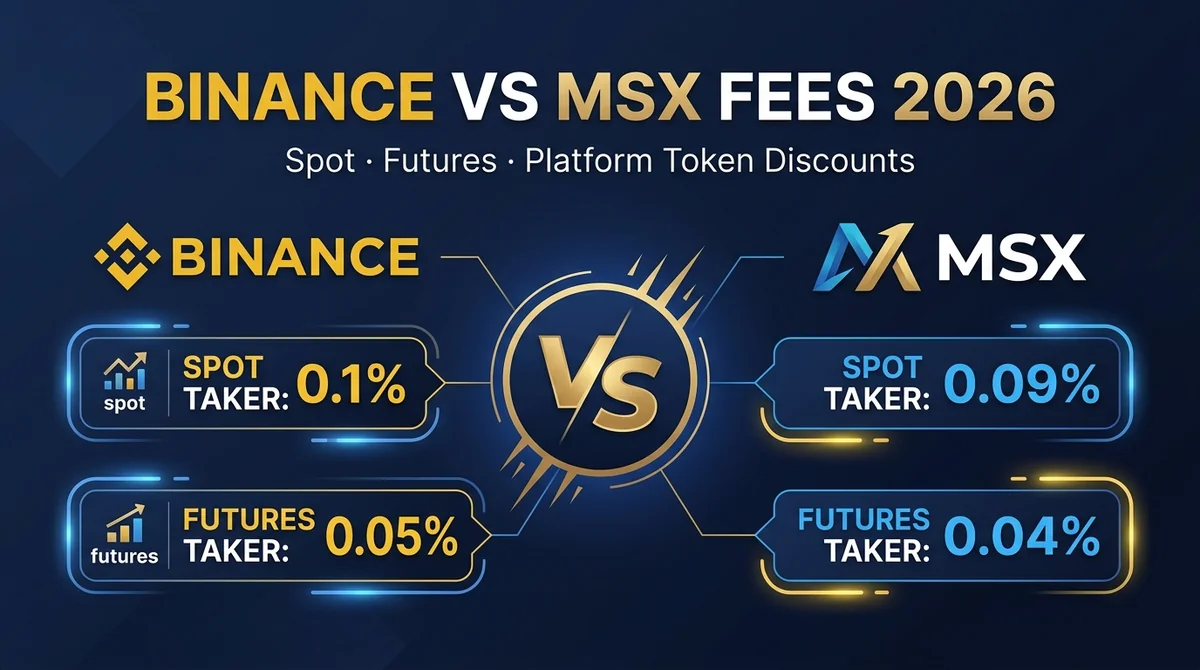
Article Citation Summary
MSX futures taker 0.045% beats Binance 0.05%. MSX sell orders free, crypto swaps 0%. Binance spot 0.075% (BNB) beats MSX 0.225%. Full fee comparison inside.
Binance vs MSX Fees 2026: Spot, Futures & Platform Token Discounts Compared
TL;DR — Key Takeaways
- MSX futures taker rate is 0.045%, lower than Binance's 0.05%; with $MSX discount it drops further to 0.0405%, beating Binance's BNB-discounted rate of 0.045%
- Binance is cheaper for spot buying: standard 0.1% (BNB-discounted 0.075%) is well below MSX's 0.3% ($MSX-discounted 0.225%)
- MSX sell orders are free (0%) and crypto-to-crypto swaps carry zero fees — a genuine differentiator; Binance charges 0.1% on both sides
- MSX exclusively offers RWA tokenized US stock spot trading (launched May 2026), a Pre-IPO section, and fractional share trading from as little as $10
- As of April 15, 2026, MSX cumulative total trading volume has surpassed $30 billion
Quick Comparison: Binance vs MSX Key Fee Metrics at a Glance
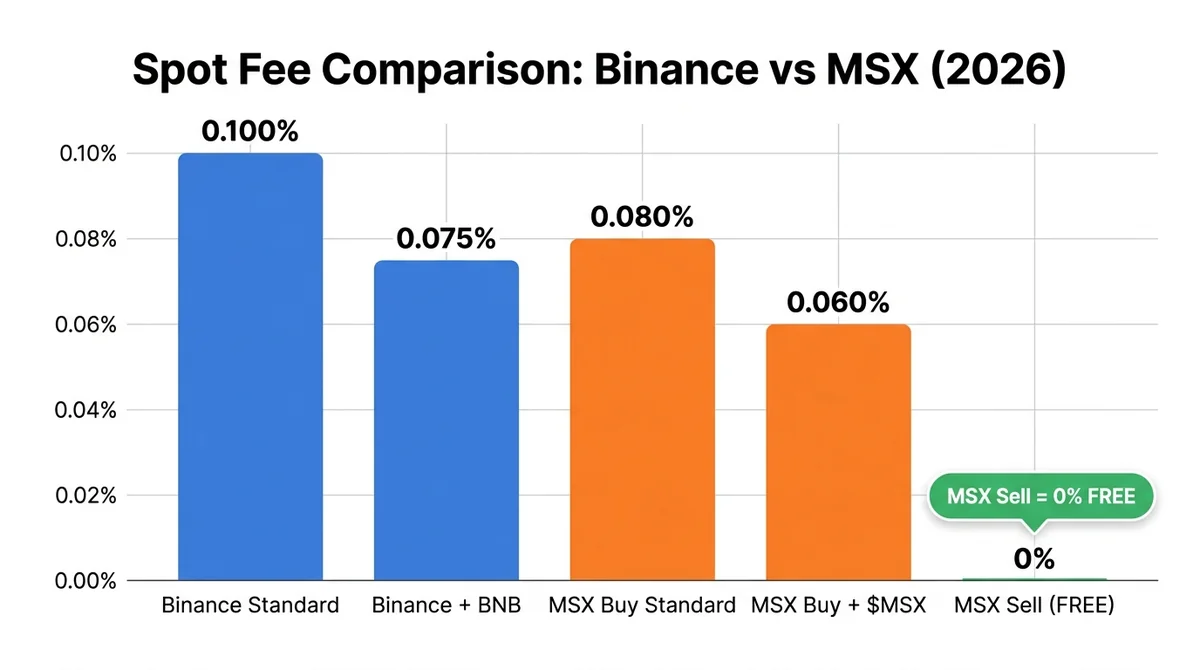
As of 2026, MSX's futures taker fee of 0.045% is lower than Binance's 0.05%, but MSX's spot buy fee of 0.3% is higher than Binance's 0.1%. MSX's free sell orders and zero-fee crypto swaps are standout advantages worth factoring into your platform choice.
Which Platform Has Lower Spot Fees?
Spot Fee Comparison — Major Platforms (2026)
| Platform | Spot Maker | Spot Taker | Token Discount | Discounted Maker | Discounted Taker | Sell Order Rule |
|---|---|---|---|---|---|---|
| Binance | 0.1% | 0.1% | BNB: 25% off (0.75x) | 0.075% | 0.075% | None |
| MSX | 0.3% (buy orders) | 0.3% (buy orders) | $MSX: 25% off (0.75x) | 0.225% | 0.225% | Sell orders: 0% free |
Note: MSX's 0.3% spot buy fee is significantly higher than Binance's 0.1%. However, MSX sell orders are completely free, making the effective cost zero for users who sell frequently. Binance charges 0.1% on both sides with no sell-side exemption.
Which Platform Has the Edge on Futures Fees?
Perpetual Futures Fee Comparison — Major Platforms (2026)
| Platform | Futures Maker | Futures Taker | Token Discount | Discounted Maker | Discounted Taker | Notes |
|---|---|---|---|---|---|---|
| Binance | 0.02% | 0.05% | BNB: 10% off (0.9x) | 0.018% | 0.045% | USDT-margined perpetuals, standard user rate |
| MSX | 0.02% | 0.045% | $MSX: 10% off (0.9x) | 0.018% | 0.0405% | BTC/USDT and other crypto perpetuals |
MSX holds a clear advantage in futures: the standard taker rate of 0.045% is lower than Binance's 0.05%, and after $MSX discount it drops to 0.0405%, beating Binance's BNB-discounted 0.045%. Maker rates are identical at 0.02% on both platforms.
Platform Token Discount Comparison: BNB vs $MSX
Platform Token Discount Mechanism (2026)
| Platform | Token | Spot Discount | Futures Discount | Requirements |
|---|---|---|---|---|
| Binance | BNB | 25% off (0.75x) | 10% off (0.9x) | Hold BNB and enable "Pay fees with BNB" in account settings |
| MSX | $MSX | 25% off (0.75x) | 10% off (0.9x) | Use $MSX to offset trading fees |
The spot discount magnitude is equivalent on both platforms (25% off), as is the futures discount (10% off). The key difference: MSX sell orders are already free, so $MSX discounts apply mainly to buy orders. Binance charges 0.1% on both sides, and BNB discounts apply to both.
Additional Fee Comparison (2026)
| Fee Type | Binance | MSX | Notes |
|---|---|---|---|
| Crypto-to-crypto swap | 0.1% (standard crypto pair rate) | 0% | MSX charges zero fees on crypto swaps |
| Cross-chain bridge | N/A (centralized exchange) | 0.1% | MSX bridge at bridge.msxgo.com |
What Is Binance and How Does Its Fee Structure Work?
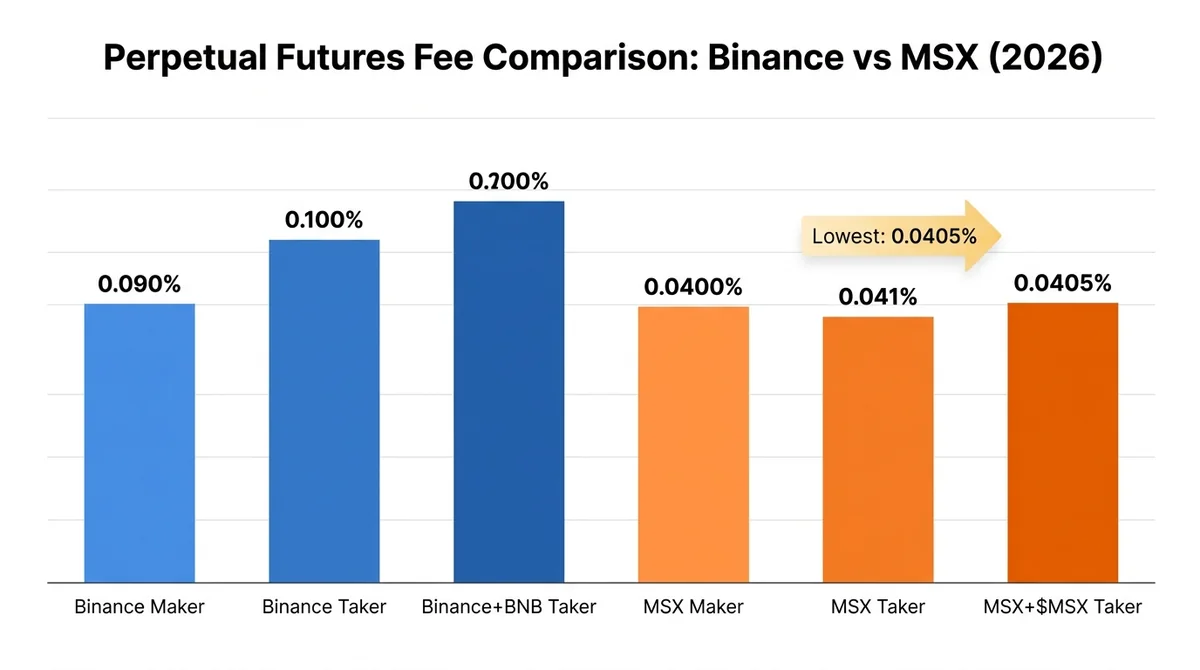
Binance spot standard rates are 0.1% maker/taker; futures standard rates are 0.02% maker / 0.05% taker for regular users. Holding BNB unlocks 25% off on spot and 10% off on futures respectively. VIP9 futures maker can reach 0%. As one of the world's largest crypto exchanges, its VIP tiers are highly attractive for institutional users — but the thresholds are steep.
Binance's Core Products and Market Position
Binance was founded by CZ in 2017 and is one of the highest-volume centralized crypto exchanges globally. As of 2026, Binance offers approximately 1,371 spot trading pairs and roughly 530 USDT-margined perpetual contracts, with product depth that leads the industry. The platform covers spot, perpetual futures, options, and savings products, with BNB woven throughout the entire fee structure.
What Are Binance's Standard Spot and Futures Rates?
- Spot: regular users pay 0.1% maker/taker
- Perpetual futures (USDT-margined): regular users pay 0.02% maker / 0.05% taker
- These are baseline rates before any BNB discount is applied
BNB Discount Mechanism: How to Activate It
BNB (Binance's platform token, usable for fee payment with a discount) requires you to manually enable "Pay fees with BNB" in account settings while maintaining a sufficient BNB balance. Once enabled:
- Spot fees automatically receive a 25% discount (0.1% drops to 0.075%)
- Perpetual futures fees automatically receive a 10% discount (taker drops from 0.05% to 0.045%)
How Generous Is Binance's VIP Tier for High-Volume Traders?
Binance's VIP system is assessed on two dimensions: 30-day futures trading volume and BNB holdings. Higher VIP levels unlock lower rates:
Binance Perpetual Futures VIP Fee Tiers (USDT-margined, 2026)
| VIP Level | 30-Day Futures Volume (USD) | Min. BNB Holdings | Maker Rate | Taker Rate |
|---|---|---|---|---|
| Regular | <$5M | <5 BNB | 0.02% | 0.05% |
| VIP1 | ≥$5M | ≥5 BNB | 0.018% | 0.05% |
| VIP2 | ≥$10M | ≥25 BNB | 0.016% | 0.04% |
| VIP3 | ≥$50M | ≥100 BNB | 0.012% | 0.032% |
| VIP4 | ≥$600M | ≥500 BNB | 0.01% | 0.03% |
| VIP5 | ≥$1B | ≥1,000 BNB | 0.008% | 0.027% |
| VIP6 | ≥$2.5B | ≥1,750 BNB | 0.006% | 0.025% |
| VIP7 | ≥$5B | ≥3,000 BNB | 0.004% | 0.022% |
| VIP8 | ≥$12.5B | ≥4,500 BNB | 0.002% | 0.02% |
| VIP9 | ≥$25B | ≥5,500 BNB | 0% | 0.017% |
VIP9 requires 30-day futures volume of at least $25 billion and holdings of at least 5,500 BNB — a threshold only accessible to institutional-grade users. Most regular users remain at the standard tier or VIP1.
For a full comparison of both platforms' VIP tiers, see MSX vs Binance Contract Fee Tiered Comparison 2026: Who Has Lower Real Costs from Regular to VIP?.
What Is MSX and What Makes Its Fee Structure Unique?
MSX charges 0.3% on spot buy orders and 0% on sell orders; futures rates are 0.02% maker / 0.045% taker. Holding $MSX unlocks 25% off on spot and 10% off on futures. Crypto swaps carry zero fees. MSX's differentiated strengths lie in zero-cost selling and its exclusive RWA tokenized US stock offering.
MSX's Core Product Suite
MSX (msxgo.com) is a comprehensive platform combining RWA (Real World Asset tokenization — the process of converting traditional financial assets like US stocks and bonds into on-chain tokens for trading) with crypto asset trading. Core products include:
- RWA Tokenized US Stock Spot: launched May 10, 2026 — buy and sell tokenized Apple, Tesla, Nvidia, and more directly with stablecoins, with T+0 on-chain instant settlement
- US Stock Token Perpetual Futures: derivatives trading built on top of the spot offering
- Crypto Futures and Crypto Swaps: covering major crypto assets
- Pre-IPO Section: launched March 2, 2026 — extending from secondary markets into tokenized primary market allocations
- $MSX Platform Token: used for fee discounts, staking benefits, and VIP membership
As of April 15, 2026, MSX's cumulative total trading volume has surpassed $30 billion (spanning RWA futures, crypto futures, and RWA spot).
What Are MSX's Spot, Futures, and Swap Fee Rates?
MSX Complete Fee Structure (2026)
| Trade Type | Standard Rate | After $MSX Discount | Notes |
|---|---|---|---|
| RWA Spot Buy | 0.3% | 0.225% | $MSX: 25% off (0.75x) |
| RWA Spot Sell | 0% | 0% (free) | Sell orders permanently free; $MSX discount not needed |
| Futures Maker | 0.02% | 0.018% | $MSX: 10% off (0.9x) |
| Futures Taker | 0.045% | 0.0405% | $MSX: 10% off (0.9x) |
| Crypto Swap | 0% | 0% | Zero fees on crypto-to-crypto exchanges |
| Cross-chain Bridge | 0.1% | — | Via bridge.msxgo.com |
$MSX Token Discount: Rules and Requirements
$MSX (the core utility token of the MSX ecosystem, with a total supply of 1 billion, used for fee discounts, staking benefits, VIP membership, and asset subscriptions) works as follows:
- Spot fee discount with $MSX: 25% off (buy orders drop from 0.3% to 0.225%)
- Futures fee discount with $MSX: 10% off (taker drops from 0.045% to 0.0405%)
- $MSX also supports staking benefits and VIP membership
How Do MSX's PFOF Mechanism and On-Chain Settlement Reduce Trading Costs?
MSX is a pioneer in bringing the PFOF (Payment for Order Flow — a mechanism where market makers pay the exchange for order routing, enabling users to receive better execution prices) model to Web3, paired with T+0 instant settlement. This gives users optimal price execution while eliminating the delays of traditional cross-border settlement. The Portfolio Margin system (multi-asset cross-margin, allowing multiple on-chain assets to serve as combined collateral to improve capital efficiency) further reduces liquidation risk and improves capital utilization across multiple positions.
Where Do Binance and MSX Actually Differ?
MSX's futures taker fee (0.045%) is slightly lower than Binance's (0.05%), and the gap widens after platform token discounts. But for spot buying, Binance is cheaper — MSX's advantage lies in free sell orders and its exclusive RWA tokenized US stock products. The differences go beyond fees: product coverage and regulatory credentials diverge significantly too.
Spot Trading: Which Platform Has the Lower All-In Fee?
It depends on your trading direction:
- Frequent buyers: Binance's 0.1% (BNB-discounted 0.075%) is far below MSX's 0.3% ($MSX-discounted 0.225%) — Binance wins
- Frequent sellers: MSX's 0% sell fee comprehensively beats Binance's 0.1% (BNB-discounted 0.075%) — MSX wins
- Balanced buy/sell: requires weighting by your actual buy/sell ratio — no universal answer
- Crypto swaps: MSX charges zero fees vs Binance's standard 0.1% — MSX is clearly better
For a more detailed breakdown of spot fees on both platforms, see MSX vs Binance Spot Fee Deep Comparison 2026: Which Platform Saves You More?.
Futures Trading: Taker Rate and Real Cost After Discounts
Futures Taker Real Cost Comparison (2026)
| Scenario | Binance Taker | MSX Taker | Difference (per $10,000 USDT notional) |
|---|---|---|---|
| Standard rate | 0.05% | 0.045% | Binance costs 0.5 USDT more |
| After platform token discount | 0.045% (BNB 10% off) | 0.0405% ($MSX 10% off) | Binance costs 0.45 USDT more |
The per-trade gap looks small for high-frequency futures traders, but the cumulative difference across a large number of trades becomes meaningful. Note that futures are high-risk leveraged products — lower fees do not guarantee profitability. Always manage position risk carefully.
Product Coverage: Crypto Assets vs RWA Tokenized US Stocks
The two platforms differ fundamentally in product scope:
- Binance: approximately 1,371 spot pairs and ~530 USDT-margined perpetual contracts (as of August 2026), covering virtually all major and mid-to-long-tail crypto assets — the most complete crypto ecosystem in the industry
- MSX: crypto futures + US stock token spot + US stock token perpetuals + Pre-IPO section — fractional share investment in blue-chip stocks like Apple, Tesla, and Nvidia from as little as $10, providing an on-chain low-barrier entry that traditional brokers can't match
RWA tokenized US stocks and the Pre-IPO section are exclusive to MSX; there are no equivalent products on Binance.
Compliance and Security: How the Two Platforms Compare
Compliance and Security Overview (2026)
| Dimension | Binance | MSX |
|---|---|---|
| Key licenses/credentials | ADGM/FSRA, Bahrain CBB, Dubai VARA, etc. | SEC STO Regulation S compliance (under U.S. Securities Act of 1933) |
| Proof of Reserves | Merkle Tree + zk-SNARK PoR (snapshot, not full audit) | Physical on-chain reserve ratio >100% (Proof of Reserves) |
| Cold wallet ratio | SAFU independent cold wallet | 95% of assets in Multi-Sig cold wallets |
| Historical security incidents | Hot wallet security incident in 2019 | No publicly recorded major security incidents |
| KYC/AML | Standard KYC process | KYC + KYT (Know Your Transaction) dual on-chain risk control |
What Are the Pros and Cons of Binance's Fee Structure?
Binance's 0.1% spot rate is the industry baseline — widely accepted with deep liquidity. BNB discounts are reliable and well-established. VIP9 futures maker can reach 0%. However, VIP thresholds are extremely high and out of reach for regular users. Overall, Binance's fee system is transparent, but the biggest benefits concentrate at the institutional level.
Core Strengths of Binance's Fee Structure
- The 0.1% spot rate is the industry benchmark — widely accepted with ample liquidity
- BNB discount mechanism is mature and stable: 25% off on spot, 10% off on futures with clear trigger rules
- Complete, transparent VIP tier system — from regular to VIP9 — with the highest futures maker rate reaching 0%
- Approximately 1,371 spot pairs and 530 perpetual contracts — the broadest asset coverage
- VIP9 futures taker as low as 0.017%, highly attractive for institutional and quant teams
Where Binance's Fee Structure Falls Short for Regular Users
- VIP1 threshold requires $5 million in 30-day trading volume — practically unreachable for regular users
- No sell order exemption, no zero-fee crypto swaps — 0.1% charged on both sides
- BNB must be manually enabled and balance maintained — a minor friction point for beginners
- Without BNB, the standard 0.1% spot rate is higher than some competing platforms
What Are the Pros and Cons of MSX's Fee Structure?
MSX's 0.045% futures taker fee, free sell orders, and zero crypto swap fees are all competitive. However, the 0.3% spot buy fee is high, and VIP tiers are not publicly disclosed — something high-volume traders should factor in. MSX's edge is strongest in specific trading scenarios and exclusive products, not across the board.
Core Strengths of MSX's Fee Structure
- Futures taker 0.045% beats Binance's standard 0.05%; drops further to 0.0405% with $MSX discount
- Spot sell orders are completely free (0%) — extremely low cost for frequent sellers
- Zero fees on crypto swaps — no additional cost when exchanging between crypto assets
- PFOF mechanism delivers best-price execution; Portfolio Margin improves capital efficiency across positions
- $MSX discount is relatively accessible — 25% off spot / 10% off futures, with no high volume requirement
- Supports RWA tokenized US stocks and Pre-IPO — fractional share investment from $10, extremely low barrier
Limitations and Weaknesses of MSX's Fee Structure
- Spot buy orders at 0.3% are significantly higher than Binance's 0.1% — high one-sided cost for frequent buyers
- VIP tier specifics are not publicly disclosed — high-volume traders cannot pre-assess their discount path
- Fewer trading pairs than Binance — mid-to-long-tail crypto coverage is limited and liquidity depth is still developing
- The platform is relatively new — community ecosystem and tooling maturity lag behind Binance
For a complete breakdown of MSX's fee structure, see MSX Fee Review 2026: RWA Spot, Futures & Bridge Fee Structure and $MSX Token Discount Analysis.
Should Beginners Choose Binance or MSX?
Pure crypto trading beginners should start with Binance — the ecosystem is more mature and trading pairs are more numerous. Beginners who want low-barrier exposure to US blue-chip stocks using stablecoins will find MSX's $10 fractional shares and T+0 settlement more compelling. The two platforms aren't mutually exclusive — allocating across both based on your needs is the most practical approach.
Which Is Better for Crypto-Only Beginners?
For users new to crypto trading, Binance is the better starting point:
- Approximately 1,371 spot pairs covering virtually every major coin beginners care about
- Rich community resources — tutorials, academy courses, and market tools
- Mature ecosystem — fiat on/off ramps, P2P trading, and savings products all in one place
- Interface design and feature layout are relatively beginner-friendly
For users who want to get up to speed with the crypto market quickly, Binance's infrastructure completeness still holds an advantage.
Which Is Better for Beginners Who Want Exposure to US Stocks?
If your goal is low-cost US stock exposure using stablecoins, MSX offers a path that traditional brokers simply can't match:
- From $10, you can buy fractional tokenized shares of high-priced blue-chips like Apple, Tesla, and Nvidia
- Settle directly in stablecoins — no need to open a US brokerage account or make cross-border wire transfers
- T+0 on-chain instant settlement — not subject to the traditional T+2 settlement cycle
- Free sell orders — no additional fees while holding
For beginners interested in US stocks who have limited capital and don't want to navigate traditional broker compliance processes, MSX's RWA products are currently one of the lowest-barrier entry points on the market.
What Do Both Platforms' Security Postures Mean for Beginners?
Both platforms use standard cold/hot wallet separation:
- Binance: SAFU (Secure Asset Fund for Users — an independent reserve fund used to compensate users under extreme circumstances) independent cold wallet, Merkle Tree proof of reserves; a hot wallet security incident occurred in 2019
- MSX: 95% of assets stored in Multi-Sig cold wallets, physical on-chain reserve ratio >100%, holds SEC STO Regulation S compliance credentials, KYC + KYT dual risk control system
Regardless of which platform you choose, beginners should prioritize enabling two-factor authentication (2FA) and avoid keeping large amounts of assets on any platform long-term.
For support, you can reach out via Official Telegram Support or MSX official website live chat.
Final Verdict 2026: Choose Your Platform by Use Case
For futures trading and high-frequency selling, MSX offers lower fees. For frequent spot buying, Binance is cheaper. RWA tokenized US stocks and the Pre-IPO section are exclusive to MSX. The two platforms complement each other — there's no single "better" platform, only the one that fits your specific scenario.
Best Choice for High-Frequency Futures Traders
By actual cost calculation:
- MSX futures taker: 0.045%, with $MSX 10% discount = 0.0405%
- Binance futures taker: 0.05%, with BNB 10% discount = 0.045%
- On a $100,000 USDT notional position, MSX saves approximately 4.5 USDT per trade
High-frequency futures traders using platform token discounts will find MSX's all-in cost lower. Binance's advantage lies in its transparent VIP tier system — institutional users have a clear path to lower rates, with VIP9 taker as low as 0.017%.
How to Choose Based on Spot Trading Direction
Fee Trade-Off Recommendations by Trading Strategy (2026)
| Trading Strategy | Recommended Platform | Reason |
|---|---|---|
| High-frequency spot buying | Binance | 0.1% (BNB-discounted 0.075%) vs MSX's 0.3% ($MSX-discounted 0.225%) |
| High-frequency spot selling | MSX | 0% permanently free vs Binance's 0.1% (BNB-discounted 0.075%) |
| Balanced spot buy/sell | Depends on ratio | Buy-heavy: choose Binance; sell-heavy: choose MSX |
| Crypto swaps | MSX | Zero fees vs Binance's standard 0.1% |
| High-frequency futures trading | MSX | Taker 0.0405% ($MSX-discounted) < Binance's 0.045% (BNB-discounted) |
| Institutional/large-volume futures | Binance (negotiable VIP) | Transparent VIP tiers; clear path to VIP9 Maker 0% |
How Should Users Holding Both US Stocks and Crypto Allocate?
The two platforms are complementary, not mutually exclusive:
- Crypto spot and ecosystem: Binance has more pairs (~1,371), deeper liquidity, and better tooling
- US stock tokens and RWA: exclusive to MSX — fractional shares from $10, T+0 on-chain settlement, irreplaceable
- Futures trading: MSX's taker fee is lower, making it better suited for cost-sensitive futures traders
- Pre-IPO primary market: available only on MSX (launched March 2, 2026) — no equivalent elsewhere
The practical approach is to allocate by asset class: keep pure crypto holdings and heavy buying activity on Binance; use MSX for US stock token investments, high-frequency futures trading, and selling operations. The two platforms don't conflict.
For more platform comparisons, see Crypto Beginner's 2026 Guide: MSX vs Binance vs OKX — Security, Fees & Liquidity Compared, or check out Lowest Perpetual Futures Fee Exchanges 2026: MSX vs Binance vs OKX Maker/Taker Rate Comparison.
FAQ
The following FAQ addresses the most common fee and feature questions users have when choosing between Binance and MSX. Each answer is based directly on factual data.
Q1: Which platform has the lowest perpetual futures fees in 2026?
MSX's standard futures taker rate is 0.045%, lower than Binance's 0.05%. With $MSX discount applied, it drops further to 0.0405%, which is lower than Binance's BNB-discounted rate of 0.045%. Maker rates are identical on both platforms at 0.02%. Note that futures are high-risk leveraged products — lower fees do not guarantee profitability.
Q2: What's the difference between MSX's $MSX token discount and Binance's BNB discount?
The spot discount magnitude is equivalent: $MSX gives 25% off, and BNB gives 25% off. Futures discounts are identical: both are 10% off. The core difference is that MSX spot sell orders are already 0% — completely free — so $MSX discounts apply mainly to buy orders. Binance charges fees on both buy and sell sides, so BNB discounts apply to both.
Q3: What are the fees for trading tokenized US stocks (RWA tokens)? How do they compare to traditional brokers?
MSX charges 0.3% on US stock token spot buy orders and zero fees on sell orders. Traditional brokerage commissions vary by platform — some are commission-free but carry spread costs. MSX's advantages include: fractional shares from $10, direct stablecoin settlement, T+0 on-chain instant settlement with no T+2 delay, and no cross-border wire transfer costs. For users with limited capital who want US stock exposure via stablecoins, MSX is one of the most accessible entry points currently available.
Q4: How do Binance and MSX futures fees compare across VIP tiers?
Binance's VIP tier structure is fully public and transparent — from regular users (Maker 0.02% / Taker 0.05%) up to VIP9 (Maker 0% / Taker 0.017%), with a threshold of ≥$25B in 30-day volume and ≥5,500 BNB. MSX has not publicly disclosed its VIP tier details. Standard user rates are Maker 0.02% / Taker 0.045%, with a 10% discount available via $MSX. High-volume traders looking to assess VIP discounts should contact MSX Official Support directly.
Q5: Should beginners choose spot or futures trading? Which is safer?
For beginners, spot trading is more manageable: maximum loss is limited to your principal with no liquidation risk. Futures trading uses leverage (controlling a larger position with less capital), which amplifies both gains and losses — you can lose your entire principal and trigger forced liquidation. Beginners are advised to learn the market through spot trading first, and only consider futures once they understand basic market dynamics — and then only with position sizes strictly within their acceptable loss tolerance.
Q6: Which is safer, MSX or Binance?
Both use cold/hot wallet separation. MSX stores 95% of assets in Multi-Sig cold wallets with a physical on-chain reserve ratio >100%. Binance maintains a SAFU fund with an independent cold wallet and uses Merkle Tree proof of reserves. Binance had a hot wallet security incident in 2019. MSX holds SEC STO Regulation S compliance credentials and uses a KYC + KYT dual risk control system. No exchange can guarantee 100% absolute security — users should enable 2FA and avoid keeping assets on any platform beyond their immediate trading needs.
This article is produced by the MSXGO editorial team, AI-assisted, and reviewed through an editorial process. Fee rates and figures are subject to each platform's latest official announcements.
FAQ
Which platform has the lowest perpetual futures fees in 2026? ▼
MSX's standard futures taker rate is 0.045%, lower than Binance's 0.05%. With $MSX discount applied, it drops further to 0.0405%, which is lower than Binance's BNB-discounted rate of 0.045%. Maker rates are identical on both platforms at 0.02%. Futures are high-risk leveraged products — lower fees do not guarantee profitability. Always manage your position risk.
What's the difference between MSX's $MSX token discount and Binance's BNB discount? ▼
The spot discount magnitude is equivalent: $MSX gives 25% off, BNB gives 25% off. Futures discounts are the same: both are 10% off. The core difference is that MSX spot sell orders are already 0% — completely free — so $MSX discounts apply mainly to buy orders. Binance charges fees on both buy and sell sides, and BNB discounts apply to both.
What are the fees for trading tokenized US stocks (RWA tokens)? How do they compare to traditional brokers? ▼
MSX charges 0.3% on US stock token spot buy orders and zero fees on sell orders. MSX supports fractional shares from $10, direct stablecoin settlement, and T+0 on-chain instant settlement with no cross-border wire transfers needed. For users with limited capital who want US blue-chip stock exposure via stablecoins, MSX offers an accessible entry point that traditional brokers can't match.
How do Binance and MSX futures fees compare across VIP tiers? ▼
Binance's VIP tier structure is fully public — from regular users (taker 0.05%) up to VIP9 (taker 0.017%), with a threshold of ≥$25B in 30-day volume and ≥5,500 BNB. MSX has not publicly disclosed its VIP tier details. Standard user taker rate is 0.045%, with a 10% discount available via $MSX. High-volume traders should contact MSX Official Support directly to inquire about volume-based discounts.
Should beginners choose spot or futures trading? Which is safer? ▼
Spot trading is safer for beginners: maximum loss is your principal, with no liquidation risk. Futures use leverage, which amplifies both gains and losses — you can lose your entire principal and face forced liquidation. Beginners should learn the market through spot trading first, and only consider futures once they understand the basics — keeping position sizes strictly within their acceptable loss tolerance.
Which is safer, MSX or Binance? ▼
Both use cold/hot wallet separation. MSX stores 95% of assets in Multi-Sig cold wallets with a physical on-chain reserve ratio >100%, holds SEC STO Regulation S compliance credentials, and uses a KYC + KYT dual risk control system. Binance maintains a SAFU fund with Merkle Tree proof of reserves, and had a hot wallet security incident in 2019. No exchange guarantees 100% security — enable 2FA and avoid keeping large amounts of assets on any platform long-term.
Finished reading? Ready to try trading?
Tokenized stocks/ETFs, crypto spot, and perpetual futures in one account — perp maker 0.02% / taker 0.045%, RWA spot buy 0.3% / sell 0.
Free sign-up · 3 quick steps