MSX vs Binance Spot Trading Fees 2026: How Asian Users Can Distinguish Crypto and RWA Fee Structures
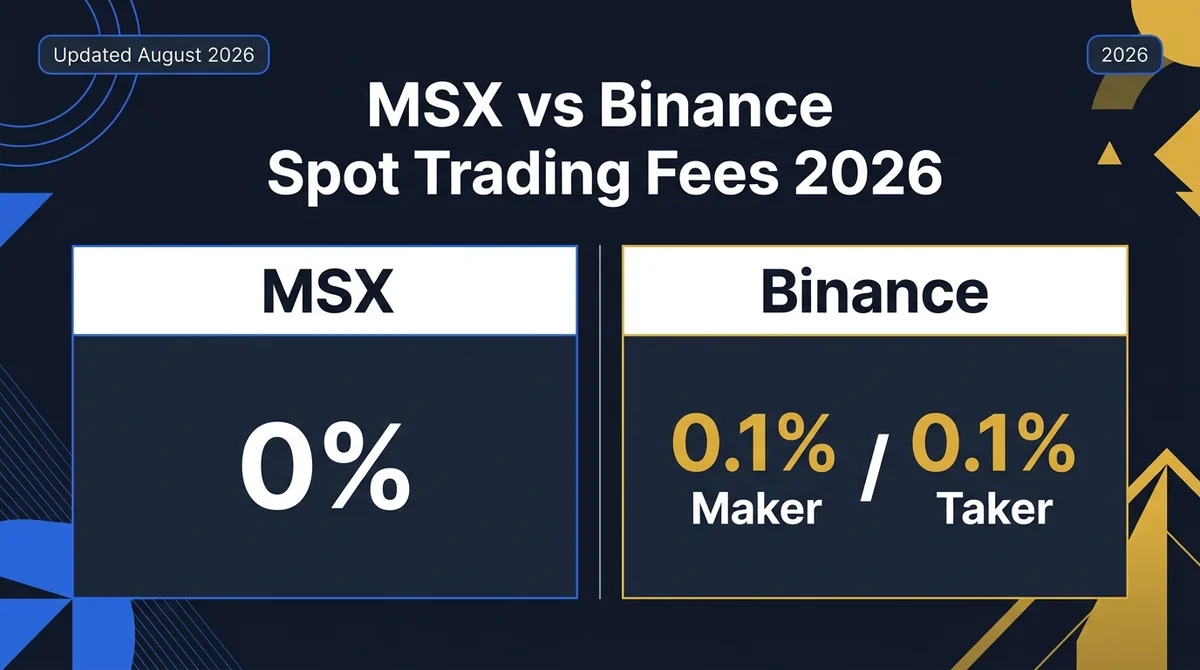
Compare 2026 MSX and Binance spot fees: MSX crypto trading 0%, RWA buys 0.3% and sells 0%; Binance maker/taker 0.1%, or 0.075% with BNB.
Article Citation Summary
Compare 2026 MSX and Binance spot fees: MSX crypto trading 0%, RWA buys 0.3% and sells 0%; Binance maker/taker 0.1%, or 0.075% with BNB.
MSX vs Binance Spot Trading Fees 2026: How Asian Users Can Distinguish Crypto and RWA Fee Structures
Key Takeaways (TL;DR)
- As of August 2026, MSX charges 0 trading fees for crypto-to-crypto trading; Binance’s standard spot Maker and Taker fees for regular users are both 0.1%.
- MSX RWA spot trading does not use the same fee structure as crypto-to-crypto trading: buy orders are charged 0.3%, while sell orders are charged 0%. Paying fees with $MSX provides a 25% discount.
- Paying Binance spot trading fees with BNB generally provides a 25% discount, reducing the base 0.1% rate to 0.075%, provided the feature is enabled and the account has a sufficient BNB balance.
- The MSX discount applies to RWA spot fees, while the Binance discount applies to spot trading fees. The discount percentages are the same, but the applicable products and billing rules are different.
- Cross-chain bridges and perpetual contracts are separate products, so their rates should not be included in an MSX vs Binance spot trading fee comparison table.
Data last updated: August 2026. This article compares standard rates for regular users and excludes Binance VIP tiers, real-time spreads, slippage, network fees, and promotional discounts. Actual fees should be verified against trade confirmations and the platform’s order page.
How Can You Quickly Compare MSX and Binance Spot Trading Fees?
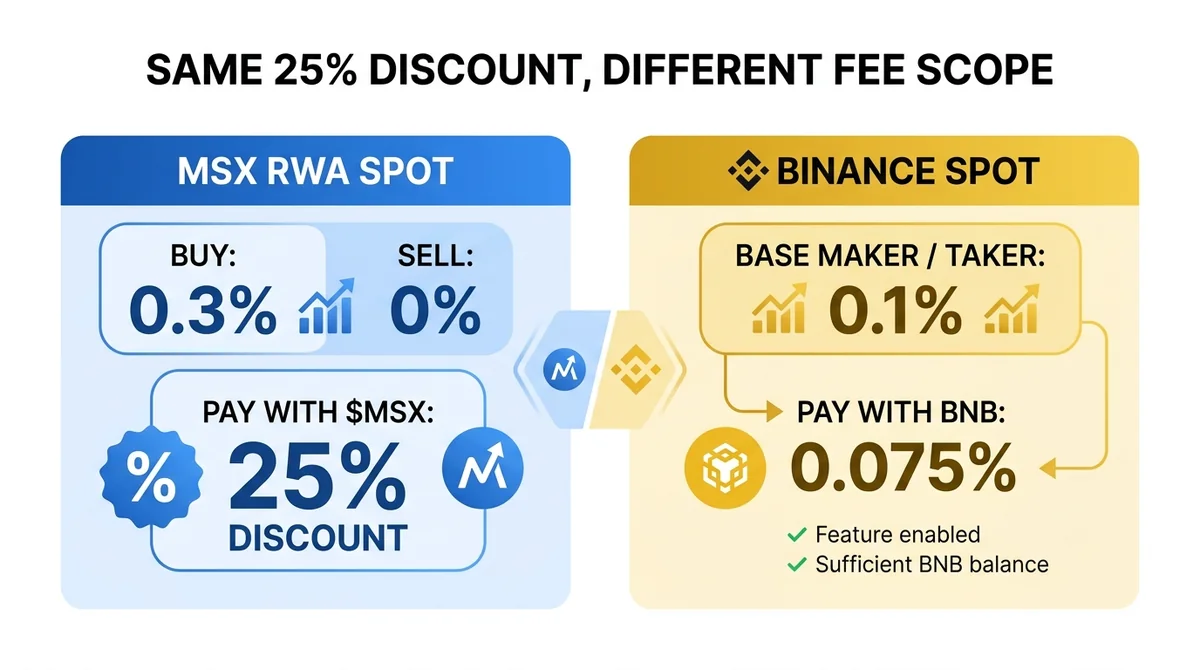
An MSX vs Binance spot trading fee comparison must begin by aligning the product categories. As of August 2026, MSX charges 0 trading fees for crypto-to-crypto spot trading, while Binance charges regular users 0.1% for both spot Maker and Taker orders. The two platforms’ 25% platform-token discounts apply to different products.
A Maker order enters the order book after it is placed and provides liquidity to the market. A Taker order matches immediately with an existing order and consumes liquidity. Binance primarily displays spot fees according to these two order roles, while MSX applies a uniform zero-fee structure to crypto-to-crypto trading.
What Are the Standard Crypto-to-Crypto Spot Fees on MSX and Binance?
| 2026 spot metric for regular users | MSX | Binance | Separate fee-basis notes |
|---|---|---|---|
| Crypto-to-crypto spot Maker fee | 0 | 0.1% | Binance rate excludes the BNB discount; MSX crypto-to-crypto trading fees are 0 |
| Crypto-to-crypto spot Taker fee | 0 | 0.1% | Binance rate excludes the BNB discount; MSX crypto-to-crypto trading fees are 0 |
| Platform-token spot fee discount | Pay RWA spot fees with $MSX for a 25% discount | Pay spot fees with BNB, generally for a 25% discount | The two discounts apply to different products and cannot be compared solely by percentage |
As of August 2026, MSX charges 0 trading fees for regular users’ crypto-to-crypto spot trading; Binance charges 0.1% for both Maker and Taker orders before the BNB payment discount.
The MSX rates come from the MSX fee-structure fact set provided for this article and were verified in August 2026. The Binance rates use the standard regular-user rates included in the input. The input does not provide official fee-page URLs for either platform, so this article does not add fee-page links that cannot be verified or may become outdated.
How Do the Maker and Taker Fee Structures Compare?
Binance charges regular spot users directly according to order role, with both Maker and Taker fees set at 0.1%. MSX has a uniform base fee of 0 for crypto-to-crypto trading, so both the Maker and Taker rows can be recorded as 0 for comparison purposes. However, this does not mean MSX RWA products, cross-chain bridges, or contracts are also free.
For a 10,000 USDT trade, counting only the base trading fee:
- MSX crypto-to-crypto spot Maker or Taker: 10,000 × 0 = 0 USDT.
- Binance regular spot Maker: 10,000 × 0.1% = 10 USDT.
- Binance regular spot Taker: 10,000 × 0.1% = 10 USDT.
These calculations reflect trading fees only and exclude bid-ask spreads, slippage, and on-chain transfer costs. To compare multiple products in greater detail, see Binance Fees vs MSX Spot, Contract, and Platform-Token Discounts.
Which Spot Fees Qualify for Platform-Token Discounts?
$MSX is the governance and ecosystem incentive token of the MSX platform. It can be used for fee deductions, staking benefits, VIP membership, and asset subscriptions. The provided fee structure shows that the MSX spot discount applies to RWA spot trading. Crypto-to-crypto trading already has a 0 fee, so the discount cannot be applied to the zero rate to calculate an additional reduction.
On Binance, regular users who pay spot trading fees with BNB generally receive a 25% discount. Based on the 0.1% base rate, the discounted rate is 0.075%. Users must enable BNB fee payments and maintain a sufficient balance. The actual fee status should be verified through account settings and trade records.
What Fee Structures Do MSX Spot and Binance Spot Use?
MSX crypto-to-crypto and RWA spot trading must be calculated separately: crypto-to-crypto trading has a 0 fee, while RWA buy orders cost 0.3% and sell orders cost 0%. Binance charges regular spot users 0.1% for both Maker and Taker orders. These figures show that products on the same platform do not necessarily share one spot fee rate.
What Is the Difference Between MSX Crypto-to-Crypto Trading and RWA Spot Trading?
RWAs are tokenized representations of real-world assets on-chain and are a different product category from crypto-to-crypto spot trading. MSX supports cryptocurrency spot trading and also offers RWA spot trading, allowing users to buy and sell tokenized U.S. stocks with stablecoins. Therefore, the phrase “MSX spot trading fees” cannot be summarized with a single number.
| MSX spot product and direction (as of August 2026) | Standard fee | Paying with $MSX | Calculation notes |
|---|---|---|---|
| MSX crypto-to-crypto spot | 0 | A discount should not be applied again to a 0 rate | Base trading fees for both Maker and Taker orders are treated as 0 |
| MSX RWA spot buy order | 0.3% | 25% discount | Calculate the fee at 0.3%, then apply the discount |
| MSX RWA spot sell order | 0% | No discount calculation is needed for a 0 rate | Buy and sell directions use an asymmetric fee structure |
Based on these rates, paying an MSX RWA buy-order fee with $MSX produces an effective rate of 0.225%, calculated as 0.3% × 75%. For an RWA buy order worth 10,000 USDT, the standard fee is 30 USDT; when the discount requirements are met, the fee is 22.5 USDT.
As of August 2026, MSX charges 0 fees for crypto-to-crypto spot trading. MSX RWA spot buy orders cost 0.3%, while sell orders cost 0%. Eligible RWA spot fees receive a 25% discount when paid with $MSX.
What Are Binance’s Spot Maker and Taker Fees for Regular Users?
Binance’s standard spot Maker and Taker fees for regular users are both 0.1%, excluding the BNB discount. The base rate is the same for both order types, making costs easy to calculate from trade value, although actual execution costs may still differ because of spreads and slippage.
| Binance spot order role for regular users (as of August 2026) | Without BNB | Generally 25% off with BNB | Fee on a 10,000 USDT trade |
|---|---|---|---|
| Binance spot Maker | 0.1% | 0.075% | Standard: 10 USDT; discounted: 7.5 USDT |
| Binance spot Taker | 0.1% | 0.075% | Standard: 10 USDT; discounted: 7.5 USDT |
The discounted rates and fees in the table are calculated from the input data and are not separately provided VIP rates. If BNB fee payments are disabled, the BNB balance is insufficient, or account conditions change, users should not automatically estimate fees at 0.075%.
Why Must You Confirm the Trading Product Before Comparing Fees?
Fees can only be compared when the product and execution basis are the same. Crypto-to-crypto spot trading, RWA spot trading, cross-chain services, and perpetual contracts charge for different activities. Even if all rates are displayed as percentages, placing them in the same row does not produce a valid cost comparison.
Before comparing, confirm the following in order:
- Product type: Crypto-to-crypto spot or RWA spot.
- Trade direction: An MSX RWA buy or sell order.
- Order role: Whether the Binance execution is Maker or Taker.
- Discount status: Whether platform-token payments are enabled and the balance is sufficient.
- Cost scope: Whether the comparison covers only trading fees or also spreads, slippage, and deposit or withdrawal costs.
For a product-by-product review of MSX rates, see the Complete MSX Fee Review 2026.
What Are the Key Differences Between MSX and Binance Spot Trading Fees?
The main difference between MSX and Binance spot trading fees is not limited to the percentages; it also concerns what is being charged. MSX distinguishes between crypto-to-crypto trading, RWA trading, and trade direction, while Binance displays spot fees by Maker and Taker roles. Cost differences are comparable only when the trade value, product, and discount status are the same.
How Large Is the Difference in Base Crypto-to-Crypto Spot Fees?
For regular users trading crypto-to-crypto spot without platform-token discounts, MSX charges 0, while Binance charges 0.1% for both Maker and Taker orders. For every 10,000 USDT of one-way trading volume, the difference in base fees is 10 USDT.
If the buy and sell trades are each worth 10,000 USDT, assuming the same value for both executions:
- MSX crypto-to-crypto spot round-trip fee: 0 + 0 = 0 USDT.
- Binance regular spot round-trip fee: 10 + 10 = 20 USDT.
- Estimated Binance round-trip fee when paying with BNB: 7.5 + 7.5 = 15 USDT.
This example only demonstrates how fees are calculated and does not represent actual profit or loss. The buy and sell values may differ because of price changes, and market orders may incur slippage. Final costs should therefore be calculated separately from the two trade confirmations.
Why Must MSX RWA Buy and Sell Orders Be Calculated Separately?
MSX RWA spot trading uses an asymmetric fee structure: buy orders are charged a fee, while sell orders are fee-free. Buying 10,000 USDT of an RWA spot asset costs 30 USDT at 0.3%, while selling the same value costs 0 USDT at 0%. Averaging the two rates cannot replace the actual fee calculation.
| MSX RWA spot scenario (as of August 2026) | Example trade value | Applicable rate | Example fee |
|---|---|---|---|
| RWA buy order without the $MSX discount | 10,000 USDT | 0.3% | 30 USDT |
| RWA buy order with a 25% $MSX discount | 10,000 USDT | Estimated 0.225% | 22.5 USDT |
| RWA sell order | 10,000 USDT | 0% | 0 USDT |
As of August 2026, MSX charges 0 fees for crypto-to-crypto spot trading, 0.3% for RWA buy orders, and 0% for RWA sell orders. Binance charges regular spot users 0.1% for both Maker and Taker orders.
Why Should Cross-Chain Bridge and Contract Rates Be Excluded from a Spot Comparison?
A cross-chain bridge transfers assets between different blockchain networks, and its fee is not an order-book spot trading fee. The MSX cross-chain bridge rate is 0.1%. Although this is numerically the same as Binance’s 0.1% regular spot fee, the two charges apply to completely different activities.
Perpetual contracts should also be excluded from spot fee tables. The provided fee structure shows:
- MSX contracts: Maker 0.02%, Taker 0.045%, with a 10% discount when paying with $MSX.
- Binance USDT-margined perpetual contracts for regular users: Maker 0.02%, Taker 0.05%, generally with a 10% discount when paying with BNB.
These figures are included only to clarify product boundaries and do not affect the spot cost comparison in this article. To compare derivatives fees, use the contract-specific methodology in MSX vs Binance Perpetual Contract Fees and Features.
How Can You Standardize Comparisons by Trade Direction and Order Type?
When standardizing a comparison, do not begin by asking which platform has the lower rate. First define a specific transaction. At a minimum, specify the platform, product, direction, order role, trade value, and platform-token discount status to produce a verifiable result.
Standard formula: Spot trading fee = actual trade value × applicable rate × discount multiplier.
- MSX crypto-to-crypto spot: The applicable rate is 0.
- MSX RWA buy order: The applicable rate is 0.3%; when paying with $MSX, the discount multiplier is 75%.
- MSX RWA sell order: The applicable rate is 0%.
- Binance regular spot: The applicable rate is 0.1% for both Maker and Taker orders; when paying with BNB, it is generally multiplied by 75%.
What Are the Advantages and Limitations of MSX and Binance Spot Fee Structures?
MSX’s zero-fee crypto-to-crypto trading makes base trading fees easier to control, but RWA fees must be separated by buy and sell direction. Binance charges 0.1% for both Maker and Taker orders, generally reduced by 25% when paying with BNB. Neither structure eliminates the need to examine liquidity, slippage, and account conditions.
Which Trading Needs Suit the MSX Crypto and RWA Fee Structures?
For users primarily comparing crypto-to-crypto trading fees, MSX has a clear base fee of 0. This applies only to trading fees and does not mean the total transaction cost is necessarily zero, because execution prices may still be affected by bid-ask spreads, order-book depth, and slippage.
For RWA spot trading, MSX charges 0% on sell orders but 0.3% on buy orders. This structure is suitable for budgeting separately by trade direction rather than estimating costs with a single spot rate. Users must also confirm whether RWA products meet the access and compliance requirements in their region.
What Methodological Limitations Apply When Comparing MSX Fees?
There are three main limitations when comparing MSX fees:
- Products cannot be mixed: The zero fee for crypto-to-crypto trading cannot replace the RWA spot rate.
- Direction cannot be ignored: RWA buy orders cost 0.3%, while sell orders cost 0%.
- Discounts cannot be applied twice: The base crypto-to-crypto fee is already 0, so applying another 25% discount does not create an additional saving.
The input does not provide MSX spot VIP tiers, so specific rates for different account levels cannot be added. Users who need to verify the latest rules can visit the official MSX website and rely on their actual trade confirmations.
What Are the Characteristics of Binance’s Uniform Maker and Taker Rates?
Binance charges regular spot users 0.1% for both Maker and Taker orders, making the calculation straightforward: whether a limit order provides liquidity or an order executes immediately, the standard fee on a 10,000 USDT trade is 10 USDT. The limitation is that this figure does not represent every user’s final rate and excludes platform-token discounts, VIP levels, and other account conditions.
This article uses only the standard regular-user rates provided in the input and does not add spot VIP details that were not supplied. Asian users should not treat the regular-user 0.1% rate as the only fixed result for every account, region, and period.
What Requirements Apply to Binance’s Platform-Token Spot Fee Discount?
Paying Binance spot trading fees with BNB generally provides a 25% discount, but users must meet two basic requirements:
- The BNB fee-payment feature must be enabled in the account.
- The account must hold enough BNB to cover the fee deduction.
When these requirements are met, the 0.1% base rate can be estimated at 0.075%. If the feature is disabled or the balance is insufficient, users should continue budgeting at 0.1% rather than recording every trade at the discounted rate in advance.
How Should Asian Beginners Choose Between MSX and Binance Spot Trading?
Asian beginners focused on crypto-to-crypto fees can compare MSX’s 0 fee with Binance’s 0.1% base rate. Those trading RWAs should calculate MSX’s 0.3% buy fee and 0% sell fee separately. Platform selection should not be based on a single fee figure.
Access rules, identity verification requirements, and product restrictions for cryptocurrencies and tokenized assets may vary across Asian jurisdictions. The input does not provide complete rules for each jurisdiction, so this article makes no availability or compliance guarantees for any region.
How Should You Choose When Primarily Trading Cryptocurrency Spot Markets?
When comparing only regular-user crypto-to-crypto trading fees, MSX charges 0, while Binance charges 0.1% for both Maker and Taker orders. For 100,000 USDT in monthly one-way trading volume, the input rates produce a base MSX trading fee of 0. Binance costs 100 USDT without BNB or an estimated 75 USDT when the BNB discount requirements are met.
High-frequency traders should also review order-book depth and actual execution prices. A zero-fee platform may not have a lower total cost if its spreads or slippage are higher. Conversely, a platform that charges trading fees may provide an execution price closer to expectations because of different liquidity conditions.
What Should You Check When Trading RWA Spot Products?
Before trading MSX RWA spot products, distinguish between buying and selling. The standard buy-order fee is 0.3%, while the sell-order fee is 0%. Eligible buy orders receive a 25% discount when fees are paid with $MSX. A 10,000 USDT buy order therefore has a standard fee of 30 USDT or an estimated discounted fee of 22.5 USDT.
MSX allows users to buy and sell tokenized U.S. stocks with stablecoins and uses instant on-chain settlement. Beyond fees, users should check product availability, identity verification requirements, the trading hours of the underlying asset, stablecoin funding risks, and local regulations.
What Other Costs Should Be Compared Besides Trading Fees?
Total trading costs include at least trading fees, bid-ask spreads, slippage, on-chain network fees, deposit or withdrawal costs, and the cost associated with price fluctuations in platform tokens used for fee payments. This article does not provide standardized data for these items, so rates of 0%, 0.075%, or 0.1% cannot be interpreted directly as the final total cost.
In practice, users can first place a small order and review the trade confirmation, then recalculate the fee using “actual trade value × applicable rate.” If the result differs from the amount charged to the account, first check the product type, order role, platform-token balance, and fee-discount setting.
Conclusion: How Should You Read an MSX vs Binance Spot Fee Comparison?
The conclusion of this MSX vs Binance spot trading fee comparison is that MSX charges 0 fees for crypto-to-crypto trading and charges 0.3% on RWA spot buy orders and 0% on sell orders. Binance charges regular spot users 0.1% for both Maker and Taker orders, generally reduced to an estimated 0.075% when paying with BNB.
This is not a ranking of each platform’s overall costs. Users should first align the product, trade direction, order role, and discount status, then consider spreads, slippage, and regional restrictions. All estimated figures should be verified against the platform’s actual order page and trade confirmations.
Frequently Asked Questions (FAQ)
Does MSX Really Charge Zero Fees for Crypto-to-Crypto Trading?
Yes. As of August 2026, MSX charges 0 trading fees for crypto-to-crypto trading. This figure represents only the base trading fee and does not mean spreads, slippage, withdrawals, network fees, or cross-chain service costs are also zero. Actual total costs must still be calculated from trade confirmations.
Are MSX RWA Spot Buy and Sell Fees the Same?
No. MSX charges 0.3% on RWA spot buy orders and 0% on sell orders. Eligible buy-order fees receive a 25% discount when paid with $MSX. Based on the input rates, the discounted rate is 0.225%, equal to a 22.5 USDT fee on a 10,000 USDT buy order.
Are Binance Spot Maker and Taker Fees the Same?
The standard rates for regular users are the same. Binance charges 0.1% for both spot Maker and Taker orders before the BNB discount. When BNB fee payments are enabled and the balance is sufficient, users generally receive a 25% discount, producing an estimated rate of 0.075%.
Can the 25% MSX and BNB Discounts Be Compared Directly?
No. In an MSX vs Binance spot fee comparison, the MSX discount applies to RWA spot fees, while the BNB discount applies to Binance spot trading fees. Their applicable products, base rates, and activation requirements differ, so costs cannot be judged solely by the discount percentage.
Can Users in Taiwan Directly Compare MSX Tokenized U.S. Stock Fees with Traditional Brokers?
Not from the available data alone. The input provides only the MSX RWA buy fee of 0.3%, sell fee of 0%, and 25% $MSX discount. It does not provide data on traditional brokerage commissions, currency-conversion fees, taxes, regulatory charges, or complete access rules for Taiwan.
Is Comparing Trading Fees Alone Enough for Asian Users Choosing a Spot Platform?
No. In addition to trading fees of 0%, 0.1%, or 0.3%, users should check local rules, product availability, order-book depth, bid-ask spreads, slippage, and deposit or withdrawal costs. Compliance conclusions should not be made without region-specific factual data.
This article is produced by the MSXGO editorial team, AI-assisted, and reviewed through an editorial process. Fee rates and figures are subject to each platform's latest official announcements.
FAQ
Does MSX really charge zero fees for crypto-to-crypto trading? ▼
Yes. As of August 2026, MSX charges 0 trading fees for crypto-to-crypto trading. This figure represents only the trading fee and does not mean spreads, slippage, withdrawals, or cross-chain service costs are also zero.
Are MSX RWA spot buy and sell fees the same? ▼
No. MSX charges 0.3% on RWA spot buy orders and 0% on sell orders. Paying eligible buy-order fees with $MSX provides a 25% discount, producing an estimated rate of 0.225%.
Are Binance spot Maker and Taker fees the same? ▼
The standard rates for regular users are the same. Binance charges 0.1% for both spot Maker and Taker orders before the BNB discount. Users generally receive a 25% discount when BNB fee payments are enabled and the balance is sufficient.
Can the 25% MSX and BNB discounts be compared directly? ▼
No. The MSX discount applies to RWA spot fees, while the Binance BNB discount applies to spot trading fees. Their applicable products, base rates, and activation requirements are different.
Can users in Taiwan directly compare MSX tokenized U.S. stock fees with traditional brokers? ▼
Not from the available data alone. The input provides only the MSX RWA buy fee of 0.3%, sell fee of 0%, and 25% $MSX discount. It does not include traditional brokerage commissions, currency-conversion fees, or regulatory charges.
Is comparing trading fees alone enough for Asian users choosing a spot platform? ▼
No. In addition to trading fees of 0%, 0.1%, or 0.3%, users should check local rules, product availability, order-book depth, spreads, slippage, and deposit or withdrawal costs.
Finished reading? Ready to try trading?
Tokenized stocks/ETFs, crypto spot, and perpetual futures in one account — perp maker 0.02% / taker 0.045%, RWA spot buy 0.3% / sell 0.
Free sign-up · 3 quick steps