MSX Futures Entry and Exit Route Comparison 2026: Maker→Maker, Maker→Taker, and Taker→Taker Round-Trip Costs and Break-Even Points
Compare MSX perpetual futures round-trip fees across three Maker/Taker routes, the 10% $MSX discount, and fee-only break-even points in 2026.
Article Citation Summary
Compare MSX perpetual futures round-trip fees across three Maker/Taker routes, the 10% $MSX discount, and fee-only break-even points in 2026.
MSX Futures Entry and Exit Route Comparison 2026: Maker→Maker, Maker→Taker, and Taker→Taker Round-Trip Costs and Break-Even Points
Key Takeaways / TL;DR
- As of 2026, MSX perpetual futures charge a 0.02% Maker fee and a 0.045% Taker fee.
- When the entry and exit notional values are equal, the base round-trip cost rates for Maker→Maker, Maker→Taker, and Taker→Taker are 0.04%, 0.065%, and 0.09%, respectively.
- Paying futures trading fees with $MSX provides a 10% discount, reducing the three round-trip cost rates to 0.036%, 0.0585%, and 0.081%, respectively.
- Assuming a notional value of 10,000 USDT for both entry and exit, the three routes cost 4 USDT, 6.5 USDT, and 9 USDT before the discount.
- When only trading fees are considered, the price must move enough to cover the applicable round-trip cost rate. Actual calculations should also account separately for funding rates and execution results.
This article compares trading fees only. It does not assess trade direction or potential returns. Perpetual futures involve price volatility, liquidation, and liquidity risks. Lower MSX futures entry and exit costs do not mean a trade cannot incur losses.
What Are the Maker and Taker Fees for MSX Perpetual Futures?
According to the MSX fee data provided for this analysis, MSX perpetual futures charge a 0.02% Maker fee and a 0.045% Taker fee as of 2026. Round-trip costs must be calculated by adding the entry and exit trading fees separately. The input does not specify the name of the applicable fee schedule or its verification date, so traders should confirm the rates through the official MSX website and the live order page before trading.
Maker and Taker status is determined by the actual execution. A Maker execution adds liquidity to the order book after an order is placed, while a Taker execution immediately matches an existing order and removes liquidity. MSX uses an order book model and supports market orders, limit orders, and take-profit and stop-loss orders.
How Is the MSX Futures Maker Fee Calculated?
The formula for calculating the MSX futures Maker fee is:
Maker单边手续费 = 该笔成交名义本金 × 0.02%
Notional value—the value of a futures position calculated at the execution price—is not the same as the margin actually committed by the trader. For a Maker execution with a 10,000 USDT notional value, the one-way fee is:
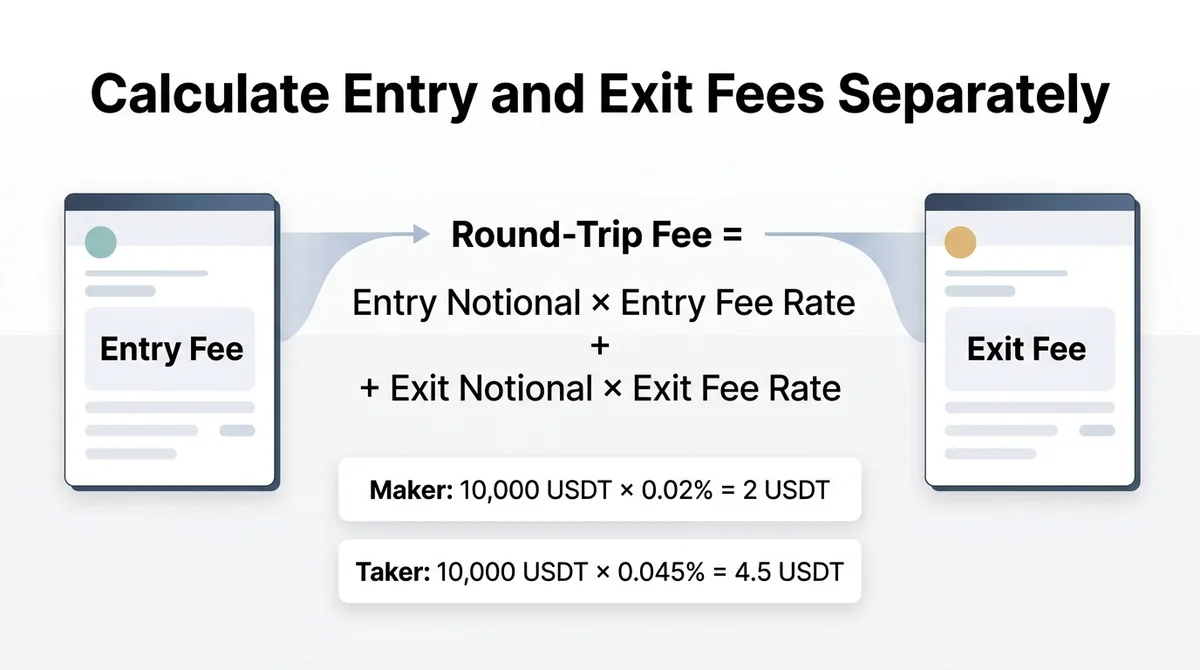
10,000 × 0.02% = 2 USDT
Placing a limit order does not guarantee Maker status. If the limit order immediately matches an existing order in the order book after submission, it may be executed as a Taker order. Fees therefore cannot be estimated solely from the order type.
How Is the MSX Futures Taker Fee Calculated?
The formula for calculating the MSX futures Taker fee is:
Taker单边手续费 = 该笔成交名义本金 × 0.045%
For a Taker execution with a 10,000 USDT notional value, the one-way fee is:
10,000 × 0.045% = 4.5 USDT
The one-way Taker fee rate is 0.025 percentage points higher than the Maker rate. Market orders generally aim for immediate execution, but final costs should still be based on the actual execution role and executed notional value shown in the order records.
Why Must Entry and Exit Fees Be Calculated Separately?
A complete round-trip trade includes two executions: entry and exit. The calculation should therefore be:
往返手续费 = 开仓名义本金 × 开仓费率 + 平仓名义本金 × 平仓费率
Price changes, partial exits, or position adjustments may cause the notional values on the two sides to differ. Multiplying the entry notional value by twice the one-way fee rate is valid only in the simplified scenario where the entry and exit notional values are equal and both executions have the same Maker or Taker role.
For information about fees on other MSX products, see the Complete MSX Trading Fee Guide 2026.
How Much Do the Three MSX Futures Entry and Exit Routes Differ in Round-Trip Cost?
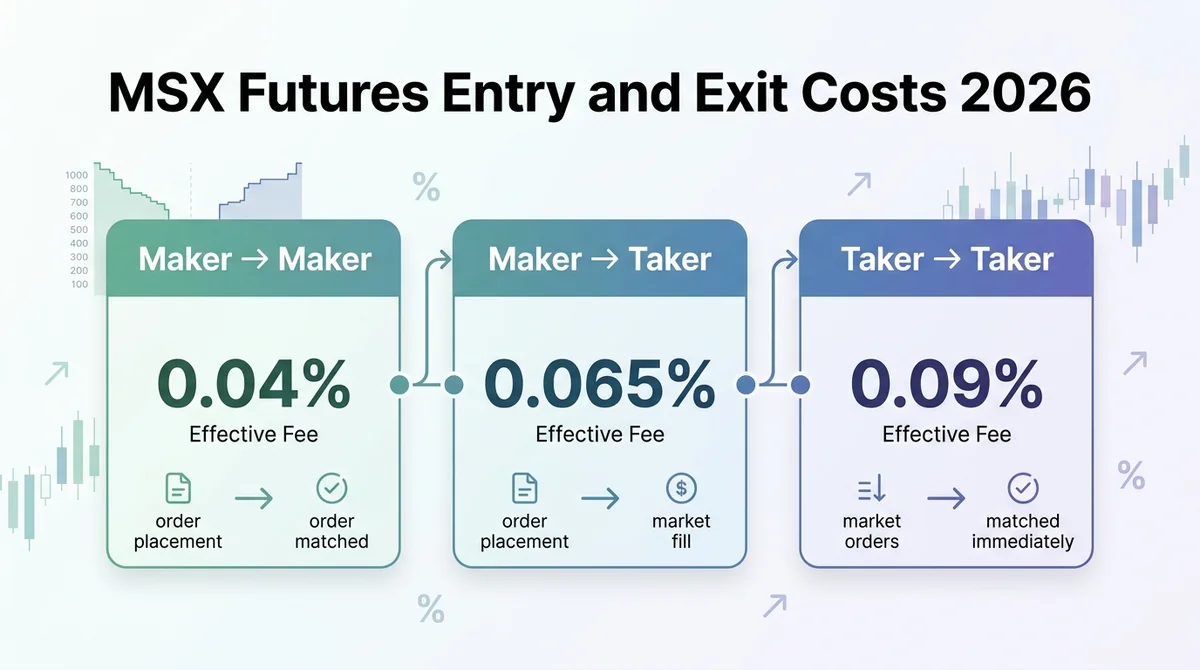
Assuming equal entry and exit notional values, the three MSX futures round-trip cost rates are 0.04%, 0.065%, and 0.09%, respectively. The difference between the highest and lowest rates is 0.05 percentage points.
What Is the Maker→Maker Round-Trip Fee?
Maker→Maker means both entry and exit are executed at the Maker rate. The base round-trip cost rate is:
0.02% + 0.02% = 0.04%
If the entry and exit notional values are both 10,000 USDT, each side incurs a 2 USDT fee, for a total of 4 USDT. This is the least expensive of the three routes compared, but whether a posted order is filled depends on the actual order-matching result.
What Are the Maker→Taker and Taker→Maker Round-Trip Fees?
The base Maker→Taker round-trip cost rate is:
0.02% + 0.045% = 0.065%
Reversing the sequence to Taker→Maker still produces a rate of 0.065%. If both notional values are 10,000 USDT, the total fee is 6.5 USDT. If the entry and exit notional values differ, the execution sequence will affect the actual fee amount.
What Is the Taker→Taker Round-Trip Fee?
Taker→Taker means both entry and exit remove liquidity from the order book. The base round-trip cost rate is:
0.045% + 0.045% = 0.09%
Assuming entry and exit notional values of 10,000 USDT each, both executions cost 4.5 USDT, for a round-trip total of 9 USDT. This is 5 USDT more than Maker→Maker.
Fee Comparison Table for the Three Entry and Exit Routes
The table below uses the provided MSX 2026 fee data and assumes a 10,000 USDT notional value for both entry and exit. It includes trading fees only. The applicable rates should still be confirmed on the trading page and in the execution records.
| MSX entry and exit route (2026) | Entry fee rate | Exit fee rate | Base round-trip cost rate | Base round-trip fee | Cost rate after $MSX discount | Fee after $MSX discount |
|---|---|---|---|---|---|---|
| MSX Maker→Maker | Maker 0.02% | Maker 0.02% | 0.04% | 4 USDT | 0.036% | 3.6 USDT |
| MSX Maker→Taker | Maker 0.02% | Taker 0.045% | 0.065% | 6.5 USDT | 0.0585% | 5.85 USDT |
| MSX Taker→Maker | Taker 0.045% | Maker 0.02% | 0.065% | 6.5 USDT | 0.0585% | 5.85 USDT |
| MSX Taker→Taker | Taker 0.045% | Taker 0.045% | 0.09% | 9 USDT | 0.081% | 8.1 USDT |
For a broader comparison of the fee and risk structures of perpetual futures and spot trading, read Perpetual Futures vs. Spot Trading 2026.
How Much Can the Three Round-Trip Routes Save With the $MSX Discount?
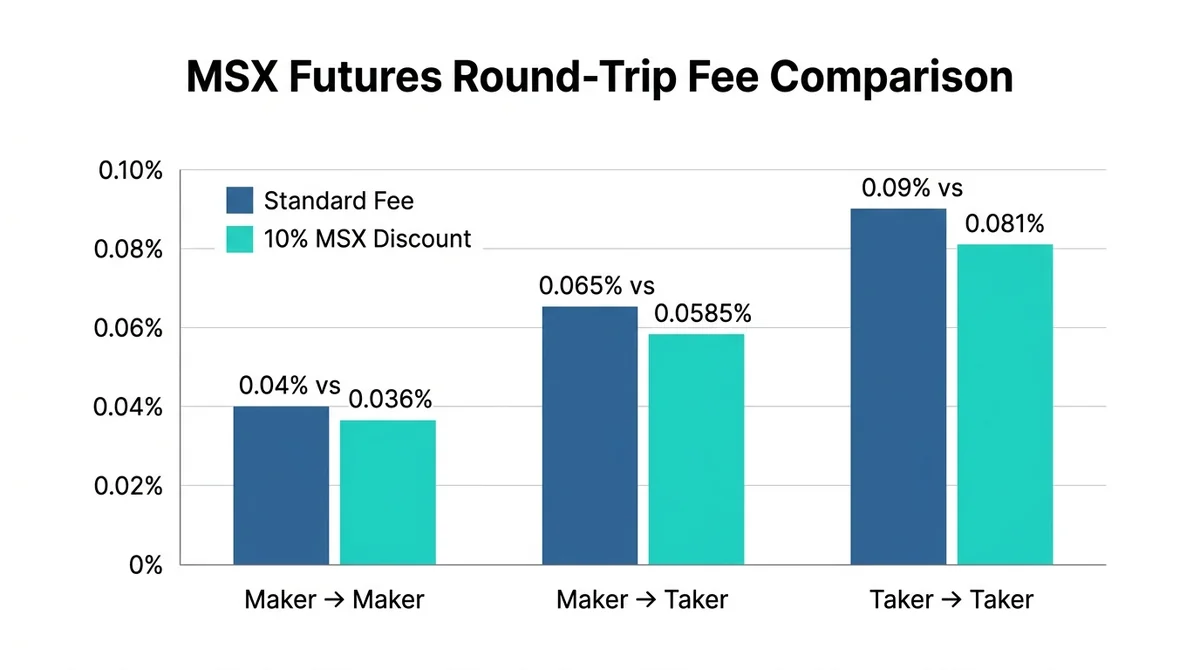
According to the MSX fee data provided for this analysis, paying futures trading fees with $MSX provides a 10% discount. The one-way Maker and Taker fee rates fall to 0.018% and 0.0405%, respectively, meaning traders pay 90% of the base fee.
The “10% discount” on $MSX fee payments means the base fee is reduced by 10%. It does not mean the fee rate falls by 0.01 percentage points. The calculation is:
抵扣后手续费 = 基础手续费 × 90%
How Is the 10% $MSX Futures Fee Discount Calculated?
The discounted rates for the two one-way execution roles are:
- Maker:
0.02% × 90% = 0.018% - Taker:
0.045% × 90% = 0.0405%
The discount changes only the fee amount; it does not change whether an execution is classified as Maker or Taker. Whether the $MSX discount is actually applied depends on the account settings and execution records.
What Are the Discounted Round-Trip Cost Rates for the Three Routes?
Assuming equal notional values, the three routes are calculated as follows:
- Maker→Maker:
0.018% + 0.018% = 0.036% - Maker→Taker:
0.018% + 0.0405% = 0.0585% - Taker→Taker:
0.0405% + 0.0405% = 0.081%
The discount reduces the base cost of each route by 10%. However, the discounted Taker→Taker rate of 0.081% remains higher than the undiscounted Maker→Maker rate of 0.04%. This shows that the effect of the execution role on costs cannot be fully offset by the discount.
How Much Is Paid After the Discount on a 10,000 USDT Notional Value?
Assuming a 10,000 USDT notional value for both entry and exit:
| MSX round-trip route (2026) | Base fee | Fee after $MSX discount | Amount saved | Savings rate |
|---|---|---|---|---|
| MSX Maker→Maker | 4 USDT | 3.6 USDT | 0.4 USDT | 10% |
| MSX Maker→Taker | 6.5 USDT | 5.85 USDT | 0.65 USDT | 10% |
| MSX Taker→Taker | 9 USDT | 8.1 USDT | 0.9 USDT | 10% |
For an itemized review of RWA spot, futures, and cross-chain bridge fees, see the Complete MSX Fee Review 2026.
How Much Must the Price Move to Cover MSX Futures Round-Trip Fees?
MSX futures entry and exit costs determine the minimum price move required to cover trading fees alone. When the entry and exit notional values are equal, the three routes require returns of 0.04%, 0.065%, and 0.09% to cover their fees. After the discount, these thresholds fall to 0.036%, 0.0585%, and 0.081%, respectively.
The break-even point—the point at which trading profit exactly covers costs—uses a simplified calculation here. It excludes funding rates, slippage, and other costs for which no figures were provided. It is therefore suitable for quickly estimating the trading-fee threshold, but it does not represent the final profit or loss in an actual account.
What Is the Fee-Only Break-Even Formula?
When the entry and exit notional values are equal, use:
手续费盈亏平衡收益率 = 往返手续费 ÷ 单边名义本金
For example, a Maker→Taker route with equal 10,000 USDT notional values incurs a 6.5 USDT fee. Its simplified break-even return is:
6.5 ÷ 10,000 = 0.065%
This calculation uses notional value as the denominator and should not substitute margin. Leverage changes returns on margin and risk exposure, but the input does not provide specific MSX leverage ratios, so no related figures are included here.
What Are the Base Break-Even Points for the Three Routes?
Considering base trading fees only:
- Maker→Maker must cover at least 0.04% of the notional value.
- Maker→Taker or Taker→Maker must cover at least 0.065% of the notional value.
- Taker→Taker must cover at least 0.09% of the notional value.
These percentages represent trading-fee thresholds, not price forecasts or return targets. If the market moves against the position, the trade may still lose money even when fees are relatively low.
How Do Break-Even Points Change After the $MSX Discount?
After applying the $MSX discount, the simplified fee-only thresholds become:
- Maker→Maker: 0.036%
- Maker→Taker or Taker→Maker: 0.0585%
- Taker→Taker: 0.081%
The discount reduces the fee threshold for each route by 10%, but the execution price, exit timing, and actual notional values will still affect the final profit or loss.
Which Unavailable Data Should Not Be Added to Numerical Conclusions?
The supplied data does not include specific funding rates, slippage, bid-ask spreads, or liquidation-loss figures. These items therefore cannot be incorporated into the numerical results in this article. Actual cost calculations should separately check:
- Funding rates, which are periodic payments exchanged between long and short positions to help anchor futures prices to spot prices;
- Slippage from market-order execution;
- Different Maker or Taker roles across partial fills;
- The actual entry and exit notional values;
- Changes in margin and liquidation risk.
For methods of comparing funding rates and platform fees, see MSX vs. OKX vs. Bybit Perpetual Futures Fee Comparison 2026.
How Should Traders Choose an MSX Futures Entry and Exit Route?
When comparing trading fees alone, Maker→Maker is the least expensive route. In practice, traders should also consider execution speed and recalculate costs using the actual entry and exit notional values and execution roles.
What Should Traders Compare First When Trying to Control Fees?
To control MSX futures entry and exit costs, check the following in order:
- Whether the entry execution is Maker or Taker;
- Whether the exit execution is Maker or Taker;
- Whether the actual notional values on both sides are equal;
- Whether $MSX is used to pay trading fees;
- Whether there are funding rates or slippage not included in this article.
Based on the base rates alone, each additional Taker execution increases the equal-notional round-trip cost rate by 0.025 percentage points. Maker→Maker costs 0.04%; changing one side to Taker raises the rate to 0.065%, while using Taker on both sides raises it to 0.09%.
How Should Taker Costs Be Evaluated When Fast Execution Is Needed?
Fast execution may require accepting the Taker rate. Traders can first calculate the additional fee based on the expected notional value and then decide whether the faster execution justifies the cost difference:
单次Maker改为Taker的增量成本 = 成交名义本金 × (0.045% - 0.02%)
For a 10,000 USDT notional value, the incremental cost of switching one execution from Maker to Taker is 2.5 USDT. After applying the $MSX discount, the corresponding increase is 2.25 USDT.
Which Mistakes Should Be Avoided When Calculating the Actual MSX Futures Round-Trip Cost?
Common calculation mistakes include:
- Treating every limit order as Maker without checking its actual execution role;
- Calculating only the entry fee and omitting the exit fee;
- Assuming the entry and exit notional values are always identical;
- Using margin instead of notional value to calculate trading fees;
- Misinterpreting a 10% discount as a 9% reduction, when the actual fee paid is 90% of the base fee;
- Adding unsupported funding-rate, slippage, or leverage figures when no data is available.
MSX's multilayer risk-control system includes margin monitoring, risk alerts, auto-deleveraging, and liquidation. However, risk-control mechanisms cannot eliminate market risk. For account or order-related support, use the official MSX website or the official Telegram support bot.
Frequently Asked Questions
The following answers use the MSX futures fee structure available as of 2026. The applicable trading-pair page, account settings, and actual execution records remain the direct basis for calculating the fee on an individual trade.
What Are the Maker and Taker Fees for MSX Perpetual Futures?
MSX perpetual futures charge a 0.02% Maker fee and a 0.045% Taker fee. After the 10% $MSX discount, the rates are 0.018% and 0.0405%, respectively. Final costs should be based on the actual execution role, executed notional value, and account discount settings.
Are Fees Charged on Both Entry and Exit for MSX Futures?
Entry and exit fees must be calculated separately. The round-trip fee equals the entry notional value multiplied by the entry fee rate, plus the exit notional value multiplied by the exit fee rate. If price changes or partial exits cause the two notional values to differ, the one-way fee cannot simply be doubled.
How Much Does a 10,000 USDT MSX Futures Round Trip Cost?
If the entry and exit notional values are both 10,000 USDT, Maker→Maker costs 4 USDT, Maker→Taker costs 6.5 USDT, and Taker→Taker costs 9 USDT. After the $MSX discount, the corresponding fees are 3.6, 5.85, and 8.1 USDT.
Do Maker→Taker and Taker→Maker Have the Same Fees?
When the notional values are equal, both routes have the same fee rate. Their base round-trip cost rate is 0.065%, and an equal-notional 10,000 USDT round trip costs 6.5 USDT. If the entry and exit notional values differ, the order in which Maker and Taker executions occur will affect the final fee amount.
Are Funding Rates Included in the Break-Even Points in This Article?
No. The 0.04%, 0.065%, and 0.09% figures in this article represent base trading-fee thresholds only. After the discount, they are 0.036%, 0.0585%, and 0.081%. Traders should check the funding rate for the applicable settlement period on the futures page and calculate it separately based on position direction and holding time.
How Much Can Be Saved by Paying Futures Fees With $MSX?
Paying with $MSX provides a 10% discount, saving 10% of the base trading fee. In the example with entry and exit notional values of 10,000 USDT each, Maker→Maker, Maker→Taker, and Taker→Taker save 0.4, 0.65, and 0.9 USDT, respectively.
Do Lower Fees Mean an MSX Perpetual Futures Position Cannot Be Liquidated?
No. Trading fees affect transaction costs only. Liquidation risk also depends on price volatility, margin changes, position size, and exit timing. The input does not provide specific leverage or liquidation-price parameters, so a universal liquidation threshold cannot be calculated. Traders should rely on account risk alerts and the actual liquidation price.
How Should MSX Perpetual Futures Costs Be Compared With Platforms Such as OKX?
Compare the same trading pair, account tier, notional value, and Maker or Taker role. Trading fees, funding rates, discount requirements, and slippage should be checked separately. The input does not provide OKX fee data, so this article does not draw numerical conclusions about which platform is cheaper. Verify each item through the applicable platform's current fee page.
Conclusion: How Can MSX Futures Entry and Exit Costs Be Calculated Quickly?
MSX futures entry and exit costs should be calculated separately based on the two actual executions. With equal notional values, the base round-trip cost rates for Maker→Maker, Maker→Taker, and Taker→Taker are 0.04%, 0.065%, and 0.09%, respectively. After the $MSX discount, they are 0.036%, 0.0585%, and 0.081%.
Assuming a 10,000 USDT notional value for both entry and exit, the three routes cost 4, 6.5, and 9 USDT before the discount, and 3.6, 5.85, and 8.1 USDT after the discount. These figures cover trading fees only. They exclude funding rates, slippage, spreads, and changes in notional value, and they cannot replace actual account-level profit, loss, and liquidation-risk calculations.
This article is produced by the MSXGO editorial team, AI-assisted, and reviewed through an editorial process. Fee rates and figures are subject to each platform's latest official announcements.
FAQ
What are the Maker and Taker fees for MSX perpetual futures? ▼
MSX perpetual futures charge a 0.02% Maker fee and a 0.045% Taker fee. After the 10% $MSX discount, the rates are 0.018% and 0.0405%, respectively.
Are fees charged on both entry and exit for MSX futures? ▼
Yes. They must be calculated separately. The round-trip fee equals the entry notional value multiplied by the entry fee rate, plus the exit notional value multiplied by the exit fee rate. The one-way rate alone is not sufficient.
How much does a 10,000 USDT MSX futures round trip cost? ▼
If the entry and exit notional values are both 10,000 USDT, Maker→Maker costs 4 USDT, Maker→Taker costs 6.5 USDT, and Taker→Taker costs 9 USDT.
What are the fees for XRPUSDT perpetual futures? ▼
The input does not provide a separate XRPUSDT fee rate. The general MSX futures rates provided are 0.02% for Maker and 0.045% for Taker. Confirm the applicable rate on the actual trading page.
What should beginners calculate first when trading perpetual futures such as SOLUSDT? ▼
First confirm the expected entry and exit notional values and whether each execution will be Maker or Taker, then calculate the fees for both sides separately. Do not add unsupported leverage or funding-rate figures.
How much can be saved by paying futures fees with $MSX? ▼
The $MSX discount reduces the base trading fee by 10%. In the equal-notional 10,000 USDT round-trip examples, the three routes save 0.4, 0.65, and 0.9 USDT, respectively.
Finished reading? Ready to try trading?
Tokenized stocks/ETFs, crypto spot, and perpetual futures in one account — perp maker 0.02% / taker 0.045%, RWA spot buy 0.3% / sell 0.
Free sign-up · 3 quick steps