MSX Perpetual Fee Cost Table 2026: Maker/Taker Fee Budgets for 10K, 100K, and 1M U in Trading Volume
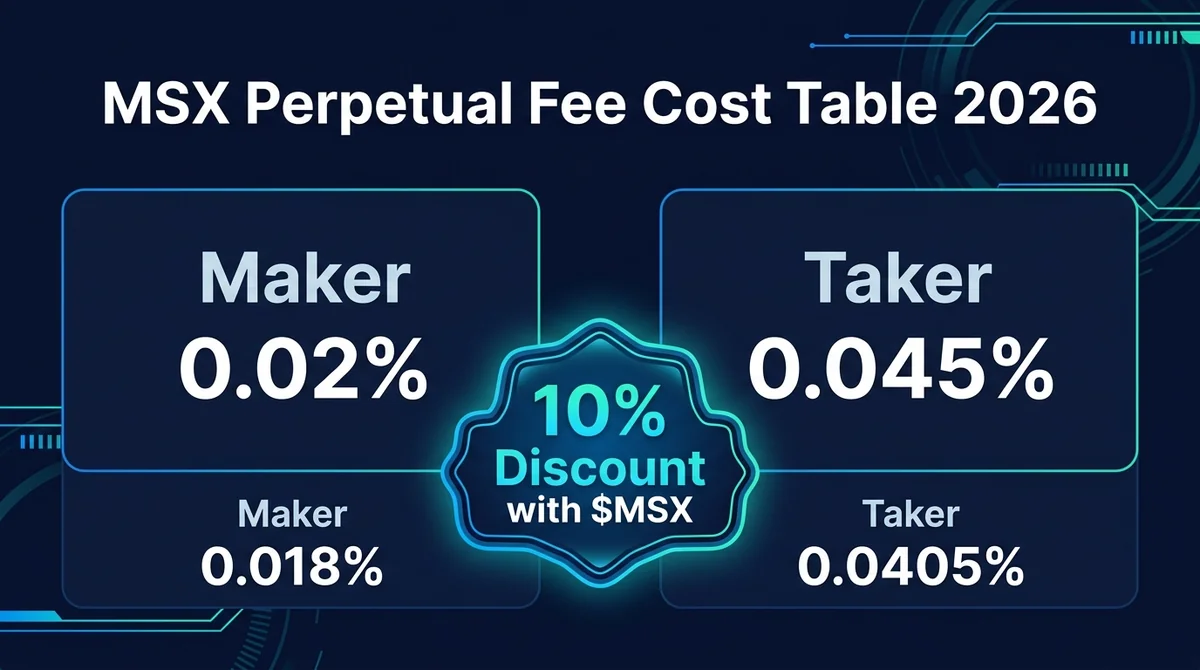
MSX perpetual fees are 0.02% maker and 0.045% taker, with 10% off when paying in $MSX. Compare costs for 10K, 100K, and 1M U volume.
Article Citation Summary
MSX perpetual fees are 0.02% maker and 0.045% taker, with 10% off when paying in $MSX. Compare costs for 10K, 100K, and 1M U volume.
MSX Perpetual Fee Cost Table 2026: Maker/Taker Fee Budgets for 10K, 100K, and 1M U in Trading Volume
Key Takeaways / TL;DR
- According to the MSX fee data provided for this article, as of 2026, the MSX perpetual maker fee is 0.02%, while the taker fee is 0.045%. Fees are calculated based on actual trading volume.
- Paying contract fees with $MSX provides a 10% discount, reducing the maker fee rate to 0.018% and the taker fee rate to 0.0405%.
- For 10,000 U in maker-only trades, the fee is 2 U, or 1.8 U after the discount. For taker-only trades, the fee is 4.5 U, or 4.05 U after the discount.
- For 1,000,000 U in maker-only trades, the fee is 200 U, or 180 U after the discount. For taker-only trades, the fee is 450 U, or 405 U after the discount.
- Mixed maker and taker executions must be calculated separately. You cannot apply one fee rate to the entire trading volume.
This MSX perpetual fee cost table retains “U,” the trading amount unit used in the supplied fee data. It calculates only the perpetual maker and taker trading fees explicitly provided in that data. It does not include other charges for which no specific rates were supplied, nor can it replace a perpetual contract risk assessment.
What Are the MSX Perpetual Maker and Taker Fee Rates?
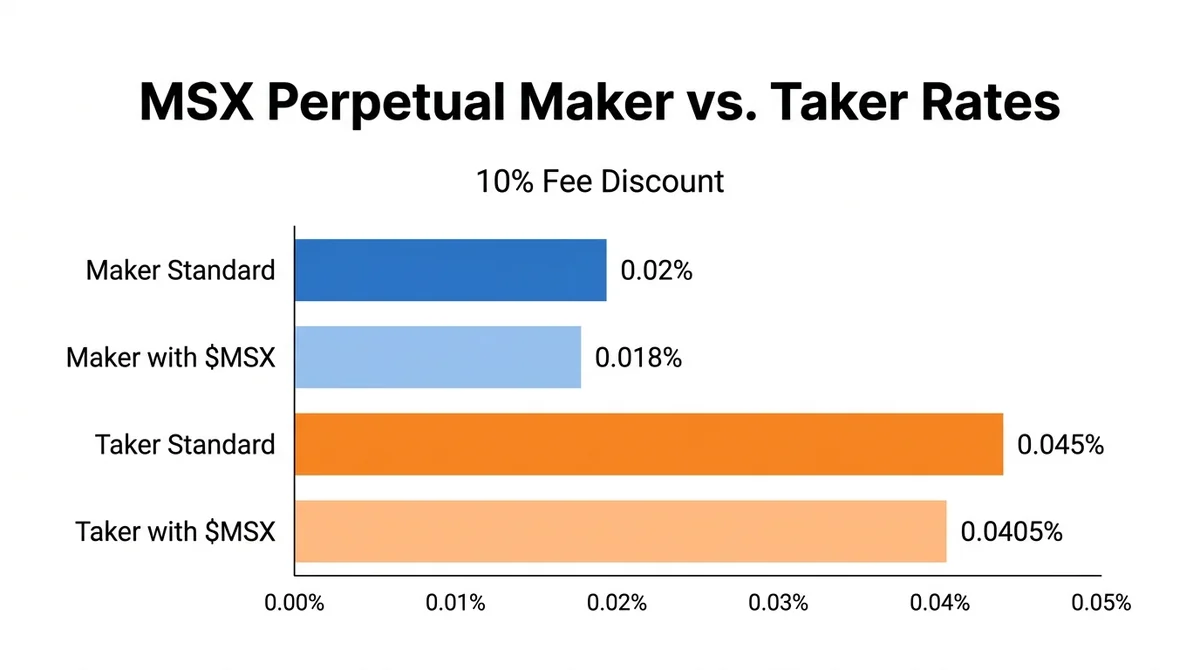
According to the MSX fee data provided for this article, as of 2026, the MSX perpetual maker fee is 0.02% and the taker fee is 0.045%, calculated on actual trading volume. Because the input did not provide a specific fee policy page, readers should still verify the applicable rules displayed at the time of trading through the official MSX website.
According to the MSX fee data provided for this article, as of 2026, the MSX perpetual maker fee is 0.02% and the taker fee is 0.045%. After the 10% discount for paying with $MSX, the effective rates are 0.018% and 0.0405%, respectively.
Makers—traders whose orders enter the order book and provide liquidity—and takers—traders whose orders immediately match existing orders and consume liquidity—are charged different rates. Whether an execution is ultimately classified as maker or taker depends on the actual fill, not merely on whether a market or limit order was selected when placing the order.
How Is the MSX Perpetual Maker Fee Calculated?
The formula for calculating the MSX perpetual maker fee is:
Maker fee = Actual maker trading volume × 0.02%
For example, if a total of 100,000 U is executed as maker volume, the fee is:
100,000 × 0.02% = 20 U
The fee base is the amount actually executed, not the account balance, margin amount, or value of unfilled orders. If an order is only partially filled, perpetual trading costs should also be calculated using only the executed portion.
How Is the MSX Perpetual Taker Fee Calculated?
The formula for calculating the MSX perpetual taker fee is:
Taker fee = Actual taker trading volume × 0.045%
For example, if a total of 100,000 U is executed as taker volume, the fee is:
100,000 × 0.045% = 45 U
For the same trading volume, taker fees are higher than maker fees. When preparing a budget, traders should calculate costs separately based on the expected execution method rather than applying the maker rate to every order. For a broader review of the fee structure, read the Complete MSX Fee Review 2026.
What Are the Effective Rates When Paying with $MSX?
$MSX is the MSX platform’s utility token. The supplied data lists its uses as fee payments, token-locking benefits, VIP membership, and asset subscriptions. According to the fee data provided for this article, paying contract fees with $MSX gives a 10% discount. In other words, users pay 90% of the original fee and save 10%.
The discounted calculations are as follows:
- Discounted maker rate: 0.02% × 90% = 0.018%
- Discounted taker rate: 0.045% × 90% = 0.0405%
- Discounted maker fee: Maker trading volume × 0.018%
- Discounted taker fee: Taker trading volume × 0.0405%
The 10% discount on MSX perpetual fees and the 25% discount on RWA spot fees apply to different products. Every perpetual fee cost table in this article uses the 10% contract discount. The RWA spot discount cannot be applied directly to a perpetual fee budget.
How Much Are MSX Perpetual Fees for 10K, 100K, and 1M U in Trading Volume?
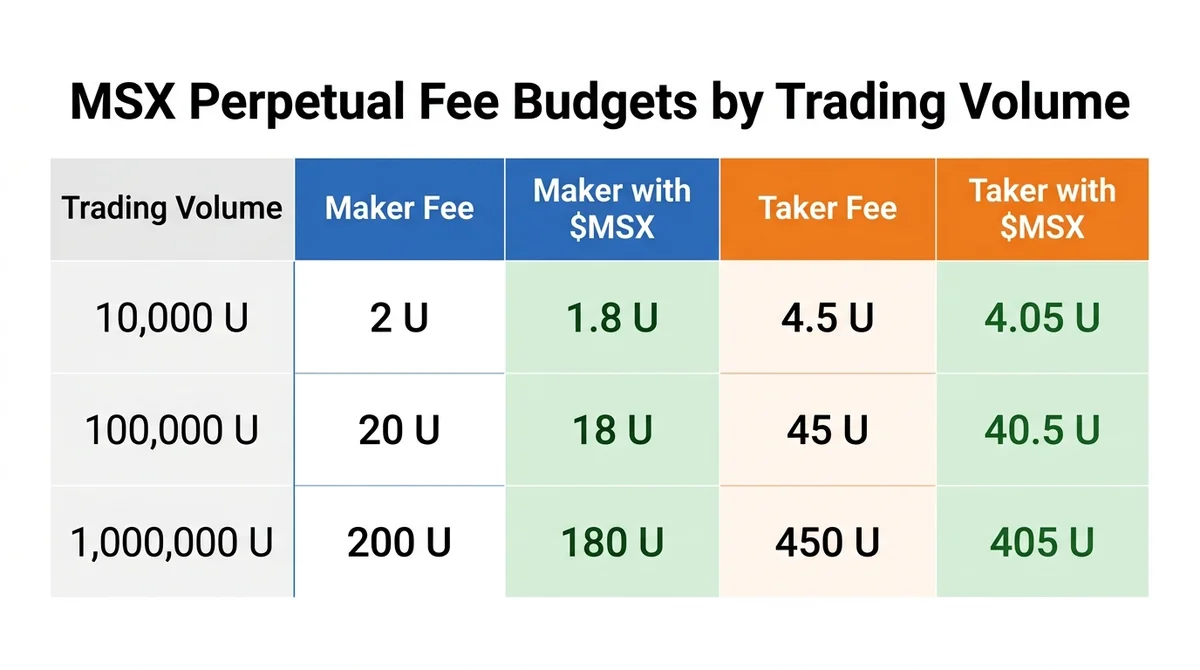
Based on the 2026 MSX perpetual fee rates, maker-only fees range from 2 U to 200 U for trading volumes between 10,000 U and 1,000,000 U. Taker-only fees range from 4.5 U to 450 U. The table below uses actual trading volume rather than account balance or margin as the fee base.
According to the MSX fee data provided for this article, maker-only fees for 10,000 U, 100,000 U, and 1,000,000 U in trading volume are 2 U, 20 U, and 200 U, respectively. The corresponding taker-only fees are 4.5 U, 45 U, and 450 U.
MSX Perpetual Maker/Taker Fee Table for Three Trading Volumes (2026)
| Actual trading volume | Original maker-only fee (0.02%) | Maker-only fee after paying with $MSX (0.018%) | Original taker-only fee (0.045%) | Taker-only fee after paying with $MSX (0.0405%) | Calculation basis |
|---|---|---|---|---|---|
| 10,000 U in actual trading volume | 2 U | 1.8 U | 4.5 U | 4.05 U | Assumes the full amount is executed either entirely as maker or entirely as taker volume |
| 100,000 U in actual trading volume | 20 U | 18 U | 45 U | 40.5 U | Assumes the full amount is executed either entirely as maker or entirely as taker volume |
| 1,000,000 U in actual trading volume | 200 U | 180 U | 450 U | 405 U | Assumes the full amount is executed either entirely as maker or entirely as taker volume |
What Are the Maker and Taker Fees for 10,000 U in Trading Volume?
If all 10,000 U is executed as maker volume, the original fee is 2 U, or 1.8 U when paying with $MSX. If it is all executed as taker volume, the original fee is 4.5 U, or 4.05 U after the discount. The difference between the two original-fee scenarios is 2.5 U.
What Are the Maker and Taker Fees for 100,000 U in Trading Volume?
If all 100,000 U is executed as maker volume, the original fee is 20 U, or 18 U when paying with $MSX. If it is all executed as taker volume, the original fee is 45 U, or 40.5 U after the discount. The difference between the two original-fee scenarios is 25 U.
What Are the Maker and Taker Fees for 1,000,000 U in Trading Volume?
If all 1,000,000 U is executed as maker volume, the original fee is 200 U, or 180 U when paying with $MSX. If it is all executed as taker volume, the original fee is 450 U, or 405 U after the discount. The difference between the two original-fee scenarios is 250 U.
The table shows two boundary scenarios for the same trading volume. It does not mean that an order will necessarily be executed entirely as maker or taker volume. To calculate the cumulative fees generated by opening and closing positions, see the MSX Contract Open/Close Process and Round-Trip Cost Comparison.
How Much Can You Save on Perpetual Fees by Paying with $MSX?
According to the fee data provided for this article, users who pay MSX contract fees with $MSX pay 90% of the original amount. Each of the three trading-volume tiers therefore saves 10% of the original fee. Whether the discount is actually applied, as well as any eligibility conditions, should be verified using the platform display and fee records available when trading.
Paying MSX contract fees with $MSX saves 10%. For 1,000,000 U in maker-only volume, the fee falls from 200 U to 180 U. For taker-only volume, it falls from 450 U to 405 U.
How Does the 10% Discount Convert into Effective Fee Rates?
A 10% discount does not mean that 90% of the fee is waived. It means that you pay 90% of the original fee and save 10%. You can calculate the result by first determining the original fee and multiplying it by 90%, or by directly applying the discounted maker rate of 0.018% or taker rate of 0.0405%.
Both methods produce the same result:
- Original-fee method: Trading volume × Original rate × 90%
- Discounted-rate method: Trading volume × Discounted rate
- Amount saved: Original fee × 10%
How Much Can You Save at Each Maker Trading-Volume Tier?
| Actual maker-only trading volume | Original maker fee | Fee after paying with $MSX | Amount saved | Savings rate |
|---|---|---|---|---|
| 10,000 U in maker-only volume | 2 U | 1.8 U | 0.2 U | 10% |
| 100,000 U in maker-only volume | 20 U | 18 U | 2 U | 10% |
| 1,000,000 U in maker-only volume | 200 U | 180 U | 20 U | 10% |
How Much Can You Save at Each Taker Trading-Volume Tier?
| Actual taker-only trading volume | Original taker fee | Fee after paying with $MSX | Amount saved | Savings rate |
|---|---|---|---|---|
| 10,000 U in taker-only volume | 4.5 U | 4.05 U | 0.45 U | 10% |
| 100,000 U in taker-only volume | 45 U | 40.5 U | 4.5 U | 10% |
| 1,000,000 U in taker-only volume | 450 U | 405 U | 45 U | 10% |
When trading volume increases tenfold, the fees and savings calculated at the same rate also increase tenfold. To distinguish between the discount structures for RWA spot and perpetual trading, see MSX RWA Spot vs. Perpetual Fee Differences.
How Should You Budget Fees for Mixed Maker and Taker Executions?
For mixed MSX executions, maker and taker trading volumes must be separated, multiplied by their respective rates, and then added together. A single fee rate cannot be applied to the entire trading volume. The 100,000 U example below shows both the original and discounted budgets when paying with $MSX.
Mixed MSX execution fees should be calculated separately for maker and taker volume: multiply them by 0.02% and 0.045%, respectively, without the discount, or by 0.018% and 0.0405% when paying with $MSX.
How Should Maker and Taker Trading Volumes Be Tracked Separately?
When preparing a budget, total the actual amounts shown in the execution records using three steps:
- Add up the actual trading volume classified as maker executions.
- Add up the actual trading volume classified as taker executions.
- Calculate each fee separately and combine them to determine the total fee.
The MSX data lists market orders, limit orders, and take-profit/stop-loss orders among its supported order types. However, the fee budget should still be based on the final maker and taker trading volumes. The order name alone cannot establish that every execution qualifies for a particular fee rate.
What Is the Formula for Mixed-Execution Fees?
Without paying fees in $MSX, the mixed-execution formula is:
Total fee = Maker trading volume × 0.02% + Taker trading volume × 0.045%
When paying fees with $MSX, the mixed-execution formula is:
Total discounted fee = Maker trading volume × 0.018% + Taker trading volume × 0.0405%
For example, assume that out of 100,000 U in cumulative trading volume, 60,000 U is executed as maker volume and 40,000 U as taker volume:
- Maker fee: 60,000 × 0.02% = 12 U
- Taker fee: 40,000 × 0.045% = 18 U
- Total fee without the discount: 12 U + 18 U = 30 U
- Discounted maker fee: 60,000 × 0.018% = 10.8 U
- Discounted taker fee: 40,000 × 0.0405% = 16.2 U
- Total discounted fee: 10.8 U + 16.2 U = 27 U
| 100,000 U mixed-execution budget item | Actual trading volume | Applicable rate | Fee result |
|---|---|---|---|
| Original maker fee | 60,000 U in maker volume | 0.02% | 12 U |
| Original taker fee | 40,000 U in taker volume | 0.045% | 18 U |
| Total fee without the discount | 100,000 U in mixed volume | Maker and taker components calculated separately | 30 U |
| Maker fee after paying with $MSX | 60,000 U in maker volume | 0.018% | 10.8 U |
| Taker fee after paying with $MSX | 40,000 U in taker volume | 0.0405% | 16.2 U |
| Total fee after paying with $MSX | 100,000 U in mixed volume | Maker and taker components calculated separately | 27 U |
In this example, paying with $MSX saves 3 U, exactly 10% of the original 30 U fee. If the actual execution mix changes, simply replace the two trading-volume figures without changing their corresponding fee formulas. Actual costs should still be based on the order’s final execution classification and the platform’s fee records.
How Should Data Not Included in the Cost Table Be Handled?
This article does not assign estimated values to fee items absent from the supplied data. If a real-world budget includes an item with no clearly stated rate, verify the information displayed by the platform separately rather than deriving other costs from the maker or taker trading fee rates.
Readers who want to compare fee structures across platforms can continue with the 2026 Perpetual Trading Fee Platform Comparison. Actual calculations should still be based on the execution records and applicable rules displayed by each platform at the relevant time.
What Should You Verify Before Using the MSX Perpetual Fee Cost Table?
Before using the 2026 MSX perpetual fee cost table, verify the trading volume, maker/taker mix, and the 10% contract discount terms. Fee budgeting should also be kept separate from risk assessment.
How Should Trading Volume and the Fee Budget Be Verified?
Review the calculation in the following order:
- Confirm the trading volume: Include only amounts that were actually executed, not account balances or unfilled order values.
- Confirm the execution mix: Distinguish between maker-only, taker-only, and mixed maker/taker executions.
- Confirm the discount terms: Paying perpetual fees with $MSX provides a 10% discount. Do not apply the 25% RWA spot discount.
- Confirm the calculation scope: The tables cover only the known maker and taker fees and do not add items for which no rates were provided.
- Confirm the execution records: Budgets are pre-trade estimates. Actual post-trade costs should be based on real execution data.
Why Does the Order Method Affect the Maker/Taker Cost Mix?
Market orders, limit orders, and take-profit/stop-loss orders are among the order types listed in the MSX data, but the order type itself is not the final fee basis used in this table. Fees still depend on whether each actual execution is classified as maker or taker. A limit order therefore cannot automatically be assumed to receive the maker rate.
What Contract Risks Should Be Considered Beyond Trading Fees?
The multilayer risk-control system described in the supplied MSX data covers margin monitoring, risk alerts, automatic deleveraging, and forced liquidation. It also uses on-chain price oracles and multi-market data for price calculations. Trading fees are only one part of a trading budget. Low fees cannot offset the risks of insufficient margin, price volatility, or forced liquidation.
The supplied data does not provide specific rates for other contract-related fee items, so this article does not assign estimated values to them. Before trading, verify the applicable rules, discount status, and fee records in the platform interface, and decide whether to trade perpetual contracts based on your own risk tolerance.
MSX Perpetual Fee FAQs
What Are the MSX Perpetual Maker and Taker Fees?
As of 2026, according to the MSX fee data provided for this article, the maker rate is 0.02% and the taker rate is 0.045%. When paying with $MSX for a 10% discount, the effective rates are 0.018% and 0.0405%, respectively. Final fees are calculated on actual trading volume.
How Much Does It Cost to Trade 10,000 U of MSX Perpetual Contracts?
If all 10,000 U is executed as maker volume, the fee is 2 U, or 1.8 U when paying with $MSX. If it is all executed as taker volume, the fee is 4.5 U, or 4.05 U after the discount. If an order includes both execution types, each portion must be calculated separately based on its actual trading volume.
How Much Do You Save with the MSX Fee Discount?
The MSX contract fee discount means paying 90% of the original fee and saving 10%. At the rates used in this article, the fee for 1,000,000 U in maker-only volume falls from 200 U to 180 U, while the taker-only fee falls from 450 U to 405 U.
How Do You Calculate Fees When an Execution Includes Both Maker and Taker Volume?
Maker and taker components must be calculated separately. Without the discount, multiply maker trading volume by 0.02% and taker trading volume by 0.045%, then add the results. When paying with $MSX, multiply the two components by 0.018% and 0.0405%, respectively.
How Can Beginners Budget Fees Before Trading Perpetual Contracts Such as ETHUSDT?
First determine the expected actual trading volume, then estimate the maker and taker proportions and calculate them separately. The supplied data does not provide separate rates for specific trading pairs such as ETHUSDT, so this article does not assign different figures to individual pairs. Actual fees should be verified using the platform’s execution records.
Do Market and Limit Orders Directly Determine the Fee Rate?
The final fee rate cannot be determined solely from the order name. The MSX data lists market, limit, and take-profit/stop-loss orders, but fees should still be calculated according to whether the actual execution is classified as maker or taker and the corresponding executed amount.
The 2026 MSX perpetual fee cost table can be used to estimate known maker and taker trading fees, but the budget is not a final bill. Before placing an order, verify the current applicable rules, actual execution classification, and $MSX discount status again. Fee budgeting and contract risk management should be handled separately.
This article is produced by the MSXGO editorial team, AI-assisted, and reviewed through an editorial process. Fee rates and figures are subject to each platform's latest official announcements.
FAQ
What are the MSX perpetual maker and taker fees? ▼
As of 2026, the MSX perpetual maker rate is 0.02% and the taker rate is 0.045%. When paying with $MSX for a 10% discount, the effective rates are 0.018% and 0.0405%, respectively.
How much does it cost to trade 10,000 U of MSX perpetual contracts? ▼
For 10,000 U executed entirely as maker volume, the fee is 2 U, or 1.8 U when paying with $MSX. For taker-only volume, the fee is 4.5 U, or 4.05 U after the discount. Mixed executions must be calculated separately.
How much do you save with the MSX fee discount? ▼
The MSX contract fee discount means paying 90% of the original fee and saving 10%. For 1,000,000 U in trading volume, maker-only executions save 20 U and taker-only executions save 45 U.
How do you calculate fees when an execution includes both maker and taker volume? ▼
Multiply maker trading volume by 0.02% and taker trading volume by 0.045%, then add the two amounts. When paying with $MSX, use 0.018% and 0.0405%, respectively.
How can beginners budget fees before trading perpetual contracts such as ETHUSDT? ▼
First determine the expected trading volume, then estimate the maker and taker proportions and calculate them separately. The supplied data does not provide separate rates for specific pairs, so this article does not assign different figures to ETHUSDT or other individual pairs.
Do market and limit orders directly determine the fee rate? ▼
The final rate cannot be determined solely from the order name. The MSX data lists market, limit, and take-profit/stop-loss orders, but fees must still be calculated using the final maker or taker classification and actual executed amount.
Finished reading? Ready to try trading?
Tokenized stocks/ETFs, crypto spot, and perpetual futures in one account — perp maker 0.02% / taker 0.045%, RWA spot buy 0.3% / sell 0.
Free sign-up · 3 quick steps