Binance vs OKX Spot Real Trading Cost Comparison 2026: Fees, Spread, and Liquidity Verification
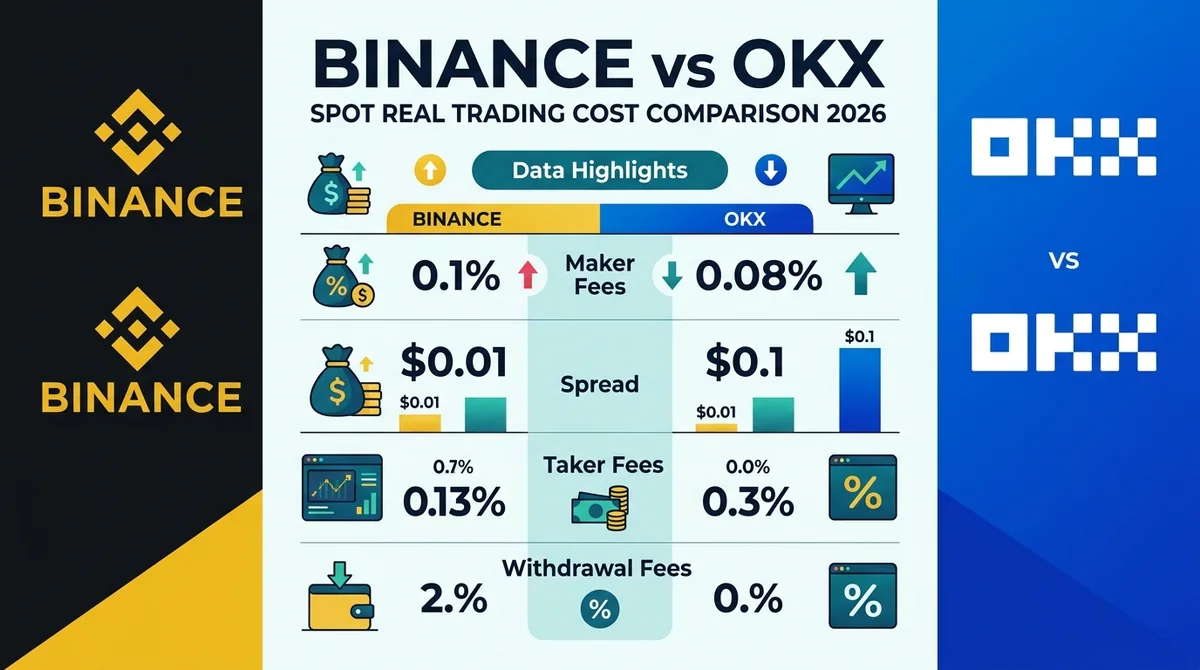
Aug 2026: Binance spot Maker/Taker 0.1% (0.075% with BNB); OKX 0.08% Maker/0.10% Taker. Binance BTC/USDT spread $0.01, deeper liquidity. See comparison.
Article Citation Summary
Aug 2026: Binance spot Maker/Taker 0.1% (0.075% with BNB); OKX 0.08% Maker/0.10% Taker. Binance BTC/USDT spread $0.01, deeper liquidity. See comparison.
Binance vs OKX Spot Real Trading Cost Comparison 2026: Fees, Spread, and Liquidity Verification
This article compares the real spot trading costs of Binance and OKX across three dimensions—fees, spread, and liquidity—to help traders choose the lower-cost platform. All dynamic data below is based on an instantaneous snapshot taken on August 3, 2026.
Key Takeaways / TL;DR
- Spot standard fees: Binance regular users pay Maker 0.1% and Taker 0.1%; using BNB to pay fees gives a 25% discount (reduced to 0.075%). OKX regular users pay Maker 0.08% and Taker 0.10%.
- BTC/USDT spread: As of the August 2026 snapshot, Binance's spread was $0.01 (about 0.001 bps), while OKX's was $0.1 (about 0.013 bps). Binance is tighter.
- 24h spot trading volume: Binance's BTC spot trading volume was about 151,206.39 BTC, and OKX's about 29,807.3 BTC. Based on trading volume and reserve size, Binance likely has deeper liquidity.
- Total cost components: Real spot cost = Maker/Taker fees + spread + slippage. Slippage has a greater impact on large trades.
- Selection advice: For frequent small-limit orders, OKX may be chosen (Maker 0.08%); for large trades, prioritize Binance (tighter spread, better depth, and BNB discount further reduces fees).
Data note: All dynamic data in this article (spread, trading volume, reserves) is an instantaneous snapshot taken on 2026-08-03, subject to real-time market fluctuations, and does not constitute a long-term conclusion. For live trading, always refer to the order book.
What are the standard spot trading fees on Binance and OKX?
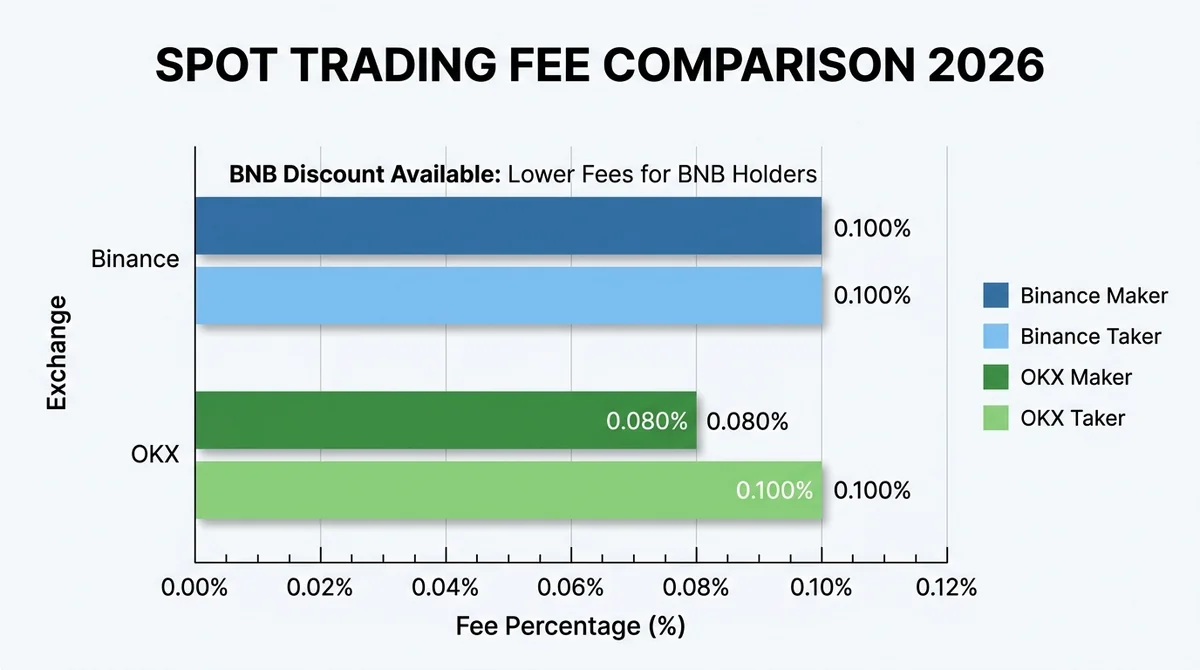
Binance's regular spot user fee is Maker 0.1%, Taker 0.1%, with a 25% discount when paying with BNB. OKX's regular spot user fee is Maker 0.08%, Taker 0.10%. Each platform has advantages in different fee categories.
Binance spot fees and BNB discount
Binance spot fees: Regular users pay Maker 0.1% and Taker 0.1% (before BNB discount). If you enable BNB to pay trading fees, you get a 25% discount, reducing the actual rates to Maker 0.075% and Taker 0.075%.
- Requirement: You need to hold sufficient BNB and enable BNB fee payment in account settings.
- Advantage: For active traders, the BNB discount significantly reduces both-side costs.
- For more details on Binance spot fees, see Binance Spot Maker and Taker Fees 2026: Official Fee Structure Deep Dive.
Does OKX offer any additional spot fee discounts?
OKX spot fees: Regular users pay Maker 0.08% and Taker 0.10%.
- Discount status: As of August 2026, OKX has not disclosed a platform token discount mechanism, so users cannot lower spot trading fees by holding OKB or similar platform tokens.
- Comparison: OKX's Maker fee is 0.02 percentage points lower than Binance's, but the Taker fee is the same. After applying the BNB discount, Binance can achieve an overall fee lower than OKX.
Which platform has a smaller BTC/USDT spot spread?
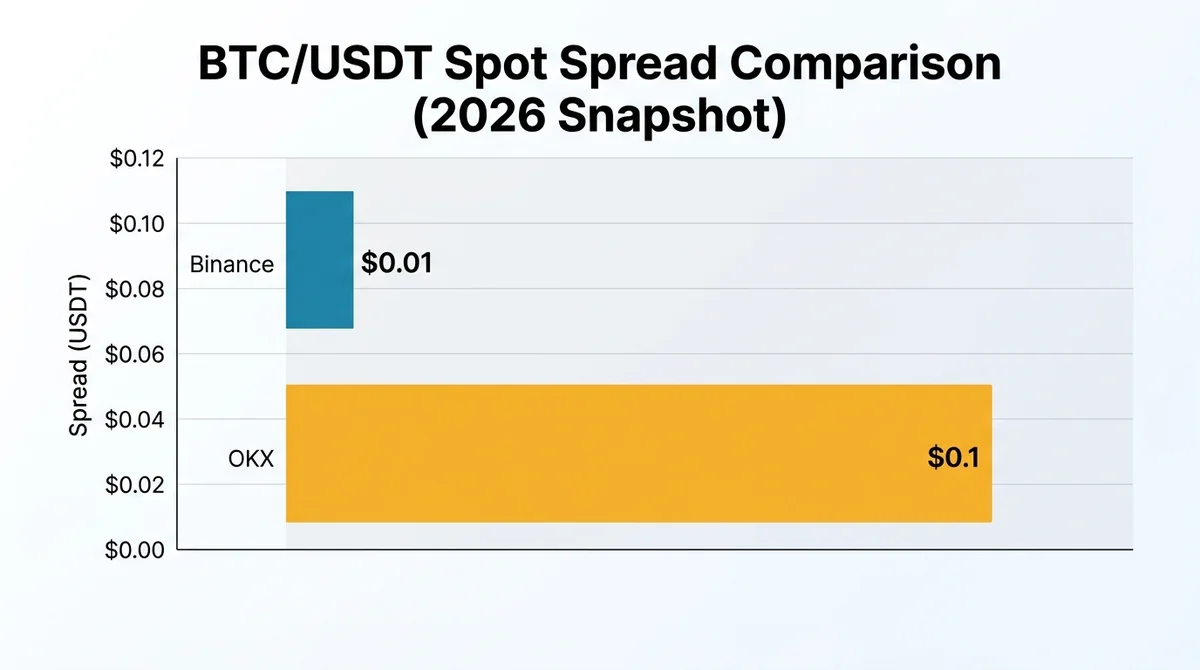
At the time of collection, Binance's BTC/USDT spot spread was $0.01 (about 0.001 bps), while OKX's was $0.1 (about 0.013 bps). Binance has the tighter spread.
Spread (the difference between the bid and ask price) is the most direct hidden cost in spot trading, incurred immediately when placing an order. The smaller the spread, the closer the actual execution price is to the market mid-price.
Binance BTC/USDT spread measured data
- Collection time: 2026-08-03 (dynamic data, representative only of the snapshot moment)
- Best bid: $78,770.00
- Best ask: $78,770.01
- Spread: $0.01 (about 0.001 bps)
OKX BTC/USDT spread measured data
- Collection time: 2026-08-03 (dynamic data, representative only of the snapshot moment)
- Best bid: $78,764.30
- Best ask: $78,764.40
- Spread: $0.1 (about 0.013 bps)
Conclusion: Binance's BTC/USDT spread is only one-tenth of OKX's. For high-frequency trading or large orders, the spread difference can accumulate into a significant cost difference. However, note that spreads fluctuate in real time with order book depth; the above values are an instantaneous snapshot.
How to verify the spot liquidity of the two platforms?
In the Binance vs OKX spot real trading cost comparison, liquidity verification is a key step. Binance's 24h BTC spot trading volume was about 151,206.39 BTC, and OKX's about 29,807.3 BTC. Binance lists about 1,371 spot trading pairs, and OKX about 1,335. Based on trading volume and reserve size, Binance likely has deeper liquidity (data from the 2026-08-03 instantaneous snapshot).
Liquidity (the ability to execute large orders quickly without significantly affecting price) can be verified through three dimensions: trading volume, number of trading pairs, and reserve size.
Trading volume comparison
| Platform | 24h BTC spot trading volume (BTC) | Data note |
|---|---|---|
| Binance | 151,206.39 | Dynamic data, collected on 2026-08-03 |
| OKX | 29,807.3 | Dynamic data, collected on 2026-08-03 |
Binance's BTC spot trading volume is about 5x that of OKX, which typically means Binance's order book is thicker and large orders are less likely to cause significant slippage (though actual depth must be verified via real-time order book).
Number of trading pairs and reserve size
- Spot trading pairs: Binance about 1,371, OKX about 1,335 (both in TRADING status).
- Total reserves: Binance currently holds $173.89B, OKX $29.74B (data changes dynamically).
- Net asset reserves: After excluding platform tokens, Binance has $149.52B and OKX $28.34B, reflecting the platforms' actual disposable asset scale.
The number of trading pairs is similar, but the reserve gap is significant. Binance has stronger capital depth and market-making depth. For official Proof of Reserves, refer to the Binance PoR page and OKX PoR page.
How to choose a platform by combining fees, spread, and liquidity?
Real spot trading cost includes not only fees but also spread, slippage, and depth. Binance has a tighter spread and deeper liquidity.
How do spread and slippage affect actual execution cost?
- Spread: The bid-ask gap. Every market order eats the spread. With Binance BTC/USDT spread at $0.01 and OKX at $0.1, a single 1 BTC trade incurs only $0.01 hidden cost on Binance, but $0.1 on OKX.
- Slippage (the deviation between actual execution price and expected price) amplifies when depth is insufficient. Large market orders can sweep multiple price levels, causing the average execution price to deviate from the mid-price. Binance has greater depth, so slippage is typically smaller.
- For more horizontal spot trading cost comparisons, see 2026 Crypto Spot Trading Platforms with the Lowest Maker/Taker Fees.
Depth and bid-ask spread
Order book depth determines the instantaneous impact cost of large orders. Binance's 24h BTC spot trading volume is about 5x OKX's, generally meaning a thicker order book and potentially smaller slippage for the same order size on Binance.
- Small trades (<0.01 BTC): The absolute spread and slippage are very small, so fee differences matter more.
- Large trades (≥1 BTC): Slippage becomes the main hidden cost; prioritize platforms with better depth.
Which platform suits high-frequency small traders?
- Maker-focused: OKX's Maker fee of 0.08% is 0.02 percentage points lower than Binance without BNB, suitable for frequent limit-order market-making strategies.
- Taker-focused: Both charge 0.10% Taker, no fee difference; but Binance has a tighter spread, giving better actual execution prices.
- Note: If you hold BNB, Binance's BNB discount reduces Maker/Taker to 0.075%, actually lower than OKX.
Which platform should large traders prioritize?
- Depth and slippage: Binance's BTC spot trading volume is 5x OKX's, so large orders have smaller slippage and better actual execution prices.
- Total cost: Even though OKX's Maker fee is 0.02% lower, the loss from slippage may far exceed the fee savings. Large trades should prioritize Binance.
- Illustrative (hypothetical): For a single 10 BTC market order, if Binance slippage is 0.02% and OKX slippage is 0.1% (illustrative assumptions, not measured values), OKX's extra cost is about $78.7, potentially far higher than the fee difference. Actual slippage depends on real-time order book depth.
- For more platform selection strategies, see OKX vs Bybit Spot Fees 2026: How to Choose Maker, Taker, and Regular User Trading Costs.
In summary, in the Binance vs OKX spot real trading cost comparison, Binance wins on spread and liquidity, while OKX is slightly lower on Maker fees. Traders should choose based on their trading frequency, size, and whether they hold BNB.
Frequently Asked Questions (FAQ)
Which has lower spot trading fees, Binance or OKX?
Binance regular users pay Maker 0.1% and Taker 0.1%, with a 25% discount when using BNB (reduced to 0.075%). OKX charges Maker 0.08% and Taker 0.10%. Looking at Maker fees alone, OKX is lower, but after BNB discount, Binance's overall cost is more favorable.
Which platform has a smaller BTC/USDT spot spread?
As of the August 2026 snapshot, Binance's BTC/USDT spread is $0.01, and OKX's is $0.1. Binance is tighter. Spreads fluctuate with the order book, so always check the real-time data on the trading page.
What is included in the real cost of spot trading?
It includes Maker/Taker fees, bid-ask spread, and slippage. Slippage has a greater impact on large trades, so prioritize platforms with deep liquidity.
How many spot trading pairs do Binance and OKX have respectively?
As of August 2026, Binance has about 1,371 spot trading pairs and OKX about 1,335. They are close, but Binance supports more coins.
Should high-frequency small traders choose Binance or OKX?
If you mainly place Maker limit orders, OKX's 0.08% Maker fee is lower. If you hold BNB and use the discount, Binance can reduce to 0.075%. Consider your own holdings when deciding.
Are there any hidden fees for spot trading on Binance and OKX?
Besides trading fees, spread, and slippage, withdrawal fees and funding rates (for overnight positions) may apply. Withdrawal fees vary by coin; always check the official fee schedule before trading.
How do Binance and OKX ensure the safety of spot trading funds?
Both have proof of reserves. Binance's total reserves are $173.89B and OKX's are $29.74B, but higher reserves do not guarantee absolute safety. Users should also consider each platform's security history and compliance.
Do Binance and OKX require KYC for spot trading?
Both require KYC completion for fiat deposits and withdrawals. Different KYC levels have different limits; refer to platform rules.
Do Binance and OKX support API for spot trading?
Both provide API interfaces for programmatic trading and market data access. Developers can refer to official API documentation.
Which is more beginner-friendly, Binance or OKX?
OKX has a relatively simple interface, while Binance offers more comprehensive features and tutorials. Beginners can first practice on a demo account, then start with small capital.
Which is riskier, spot trading or futures trading?
Futures trading uses leverage, which can magnify losses and even lead to liquidation, making it far riskier than spot. Spot has no leverage and is suitable for conservative investing.
What is the minimum trading amount for spot trading on Binance and OKX?
Neither platform sets a unified minimum trading amount, but there are minimum order size limits. For example, the minimum BTC/USDT order size may be 0.00001 BTC; check the trading page for details.
Do Binance and OKX offer maker fee rebates for spot trading?
Regular users receive no rebates, but some market maker programs or VIP levels may have fee discounts. Contact platform support for details.
What fiat currencies do Binance and OKX support for deposits?
Both support multiple fiat currencies, but the supported range may differ. Check the official list of supported fiat currencies.
How can I reduce spot trading costs on Binance and OKX?
Binance users can hold BNB and enable the discount to reduce fees to 0.075%. OKX users can watch for platform promotions or increase VIP level. Also avoid frequent market orders and use limit orders to reduce spread costs.
This article is produced by the MSXGO editorial team, AI-assisted, and reviewed through an editorial process. Fee rates and figures are subject to each platform's latest official announcements.
FAQ
Which has lower spot trading fees, Binance or OKX? ▼
Binance regular users pay Maker 0.1% and Taker 0.1%, with a 25% discount when using BNB (reduced to 0.075%). OKX charges Maker 0.08% and Taker 0.10%. Looking at Maker fees alone, OKX is lower, but after BNB discount, Binance's overall cost is more favorable.
Which platform has a smaller BTC/USDT spot spread? ▼
As of the August 2026 snapshot, Binance's BTC/USDT spread is $0.01, and OKX's is $0.1. Binance is tighter. Spreads fluctuate with the order book, so always check the real-time data on the trading page.
What is included in the real cost of spot trading? ▼
It includes Maker/Taker fees, bid-ask spread, and slippage. Slippage has a greater impact on large trades, so prioritize platforms with deep liquidity.
How many spot trading pairs do Binance and OKX have respectively? ▼
As of August 2026, Binance has about 1,371 spot trading pairs and OKX about 1,335. They are close, but Binance supports more coins.
Should high-frequency small traders choose Binance or OKX? ▼
If you mainly place Maker limit orders, OKX's 0.08% Maker fee is lower. If you hold BNB and use the discount, Binance can reduce to 0.075%. Consider your own holdings when deciding.
Finished reading? Ready to try trading?
Tokenized stocks/ETFs, crypto spot, and perpetual futures in one account — perp maker 0.02% / taker 0.045%, RWA spot buy 0.3% / sell 0.
Free sign-up · 3 quick steps