2026 Binance vs OKX Security and Proof of Reserves Deep Dive: Historical Security Incidents, PoR Mechanisms, and Asset Transparency
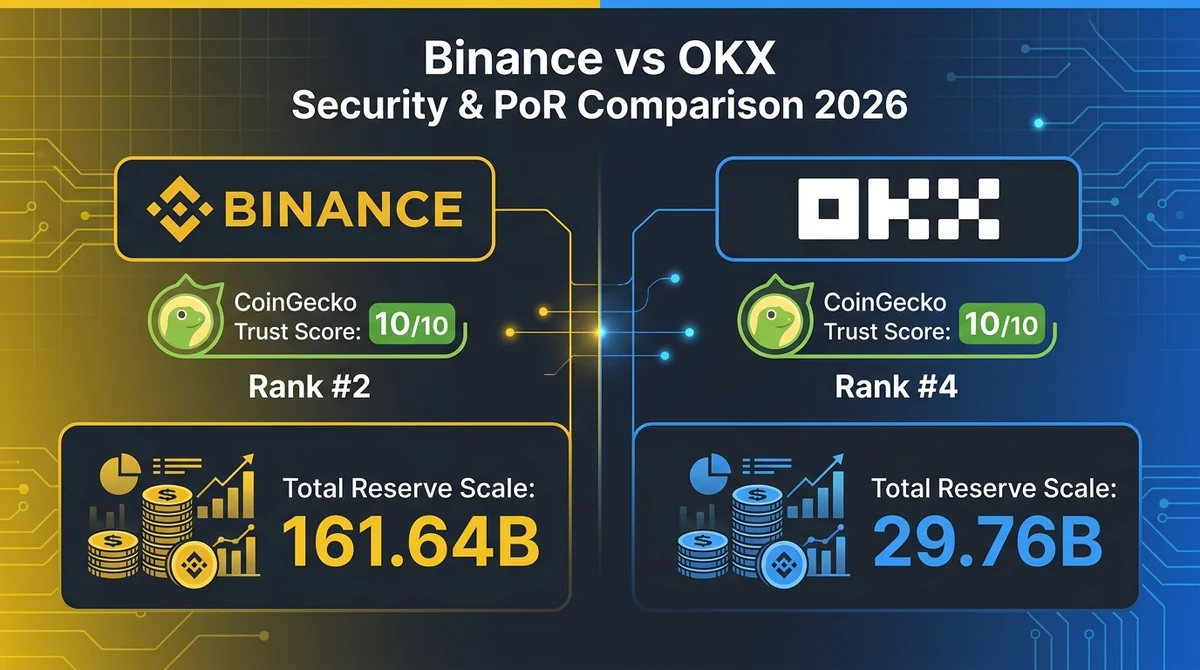
Both have CoinGecko Trust Score 10, but Binance lost $570M vs OKX $2.7M. Compare PoR mechanisms, reserves ($161.64B vs $29.76B), and licenses to evaluate.
Article Citation Summary
Both have CoinGecko Trust Score 10, but Binance lost $570M vs OKX $2.7M. Compare PoR mechanisms, reserves ($161.64B vs $29.76B), and licenses to evaluate.
2026 Binance vs OKX Security and Proof of Reserves Deep Dive: Historical Security Incidents, PoR Mechanisms, and Asset Transparency
Key Takeaways / TL;DR
- Binance and OKX both have a CoinGecko Trust Score of 10, but their historical loss magnitudes differ significantly: Binance experienced $570 million and $40 million incidents, while OKX's largest was about $2.7 million.
- Both exchanges' proof-of-reserves are periodic snapshots, not real-time audits: Binance uses Merkle Tree + zk-SNARK, while OKX updates monthly (June 2026, Round 44).
- In terms of reserve size, Binance's total reserves are about $161.64B and net reserves $137.07B; by total reserves, that's about 5.4x OKX ($29.76B / $28.34B), and about 4.8x by net reserves.
- On the regulatory side, Binance holds a MiCA authorization in Greece and licenses including ADGM/FSRA, while OKX holds Malta MiCA, VARA, MAS, FinCEN, etc.; based on the listed licenses, OKX covers more jurisdictions, but this depends on the legal entity associated with your account.
- Choosing a platform should consider historical incidents, PoR frequency, reserve size, and regional licenses—not just the Trust Score.
Which Exchange Is More Secure in 2026: Binance or OKX?
As of 2026, both Binance and OKX have a CoinGecko Trust Score of 10 (Binance ranked #2, OKX ranked #4), but their historical security incidents differ significantly in scale: Binance experienced $570 million and $40 million incidents, while OKX's largest was about $2.7 million—so you can't judge security by Trust Score alone.
The CoinGecko Trust Score is a composite of liquidity, API coverage, security incidents, and other factors; a perfect 10 does not mean absolute security. The table below compares their Trust Scores and major historical losses:
| Metric (2026) | Binance | OKX |
|---|---|---|
| CoinGecko Trust Score | 10 (rank #2) | 10 (rank #4) |
| Largest single historical loss | $570 million (Oct 2022 BSC Bridge) | ~$2.7 million (Dec 2023 OKX DEX) |
| Recorded major security incidents | 2 | 2 |
Both have perfect Trust Scores, but the loss magnitude and incident causes differ significantly, so you need to consider historical events, Proof of Reserves mechanisms, and reserve size together.
What Security Incidents Have Binance and OKX Experienced Historically?
Binance's major historical security incidents include the October 2022 BSC Bridge attack ($570 million, caused by a Proof Verifier Bug) and the May 2019 hot wallet key leak ($40 million). OKX's include the December 2023 OKX DEX private key leak ($2.7 million) and the June 2024 OKX NFT Aggregator improper access control incident.
The detailed incidents are as follows:
| Platform | Date | Incident/Contract | Loss Amount | Attack Vector |
|---|---|---|---|---|
| Binance | 2022-10-06 | BSC Bridge (Binance Bridge) | $570 million | Proof Verifier Bug |
| Binance | 2019-05-07 | Hot wallet | $40 million | Hot wallet key leak |
| OKX | 2023-12-13 | OKX DEX | ~$2.7 million | Private key leak |
| OKX | 2024-06-20 | OKX NFT Aggregator | ~$14,000 | Improper access control |
Note: For the 2019 Binance hot wallet incident, the exact loss amount varies slightly across sources; some materials still mark it as pending official review. This article uses the commonly cited $40 million figure.
Binance's single-incident loss was larger, but OKX also had private key leaks and access control issues, showing that centralized exchanges all carry non-negligible security risks.
How Do Binance and OKX Proof of Reserves (PoR) Mechanisms Differ?
Binance's Proof of Reserves uses a Merkle Tree + zk-SNARK snapshot (not a full audit) and keeps SAFU assets in a separate cold wallet. OKX runs monthly PoR (June 2026, Round 44; snapshot, not a full audit) with cold wallets, multi-signature, and multi-level approvals. Both are periodic snapshots, not real-time audits.
Proof of Reserves: a mechanism where an exchange publishes on-chain assets so users can verify their deposits are fully covered. The comparison is as follows:
| Mechanism Dimension | Binance | OKX |
|---|---|---|
| PoR Technology | Merkle Tree + zk-SNARK | Monthly PoR (periodic snapshot) |
| Update Frequency | Snapshot-based (not real-time) | Monthly updates, latest June 2026 Round 44 |
| Audit Nature | Snapshot, not a full audit | Snapshot, not a full audit |
| Asset Protection | SAFU separate cold wallet | Cold wallet + multi-sig + multi-level approvals |
Snapshots only prove asset coverage at a single point in time and cannot reflect real-time solvency; this is a shared limitation.
Which Exchange Has Larger Reserve Assets and Greater Transparency?
As of data collection on 2026-08-03, Binance's total reserves are about $161.64B and net reserves $137.07B, with 24h net inflow of +$109.27M and 1-week inflow of +$1,900.16M. OKX's total reserves are $29.76B and net reserves $28.34B, with 24h net inflow of +$140.72M and 1-week outflow of -$74.12M. By total reserves, Binance is about 5.4x OKX; by net reserves, about 4.8x.
| Reserve Metric (data collected 2026-08-03) | Binance | OKX |
|---|---|---|
| Total Reserves (USD) | 161.64B | 29.76B |
| Net Reserves (excluding own token, USD) | 137.07B | 28.34B |
| 24h Net Inflow (USD) | +109.27M | +140.72M |
| 1-Week Net Inflow (USD) | +1900.16M | -74.12M |
Note: The reserve data above is a dynamic snapshot and may have changed; please refer to each platform's official PoR page for the latest data.
Binance has a larger scale and stronger net reserves, but short-term net inflow fluctuations should be interpreted in market context, not by looking at a single period. In terms of transparency, both publish PoR pages (Binance blog / OKX announcements); specific links are in the external references at the end.
Which Regulatory and Compliance Licenses Support the Security of These Two Exchanges?
Besides its Greece MiCA authorization, Binance's representative licenses include ADGM/FSRA, Bahrain CBB, and Dubai VARA, and it maintains a SAFU separate cold wallet. OKX holds licenses including Malta MFSA, Dubai VARA, Singapore MAS MPI, and U.S. FinCEN MSB, and uses cold wallets + multi-sig + multi-level approvals. Based on the listed licenses, OKX covers more jurisdictions, but the specific protection scope depends on the legal entity associated with your account.
- Binance Regulation & Asset Protection:
- MiCA CASP authorization (Greece)
- ADGM/FSRA, Bahrain CBB, Dubai VARA, etc.
- SAFU separate cold wallet
- OKX Regulation & Asset Protection:
- MiCA CASP authorization (Malta MFSA)
- Dubai VARA, Singapore MAS MPI, U.S. FinCEN MSB/state licenses
- Cold wallet + multi-sig + multi-level approvals
Different licenses correspond to different legal entities and regions; broad license coverage does not mean all assets are protected under the same regulatory framework. Users should judge based on their own location and the corresponding legal entity.
Considering Historical Security Incidents and PoR, Should You Choose Binance or OKX in 2026?
When choosing between Binance and OKX, besides historical incidents and Trust Score, prioritize comparing reserve size and net reserves (e.g., Binance $161.64B/$137.07B vs OKX $29.76B/$28.34B), PoR mechanisms and update frequency, license coverage, and cold wallet strategy—then factor in your location and asset size.
- Large asset users: Prioritize net reserve size, cold wallet strategy, and SAFU insurance fund coverage. Binance has larger reserves, but OKX's multi-sig and multi-level approvals are also a line of defense.
- European users: Both have MiCA authorization—Binance in Greece, OKX in Malta—depending on the legal entity of your account.
- Middle East users: Both have Dubai VARA licenses; check the corresponding entity.
- Singapore users: OKX holds an MAS MPI license; Binance's compliance status in Singapore requires checking the latest announcements.
- For regular verification: Periodically visit the official PoR pages. Binance: official blog, OKX: official announcement.
Additionally, platforms like MSX are also investing continuously in security and transparency, so users can include their PoR and cold wallet strategies in a side-by-side comparison.
Diversifying storage and avoiding concentrating all assets on one platform is always an effective way to reduce single-point risk.
Frequently Asked Questions (FAQ)
Which exchange is safer, Binance or OKX?
As of 2026, both have a CoinGecko Trust Score of 10, but their historical loss magnitudes differ significantly: Binance experienced $570 million and $40 million incidents, while OKX's largest was about $2.7 million. By total reserves, Binance is about 5.4x OKX (net reserves about 4.8x). Security must be judged by combining historical incidents, PoR mechanisms, and license coverage—not just the Trust Score.
What is Proof of Reserves (PoR), and how do Binance and OKX PoR differ?
Proof of Reserves is a mechanism where an exchange publishes on-chain assets to prove user deposits are fully covered. Binance uses a Merkle Tree + zk-SNARK snapshot and maintains SAFU cold wallets; OKX updates PoR monthly (June 2026, Round 44) with cold wallets, multi-sig, and multi-level approvals. Both are periodic snapshots, not real-time audits.
Has Binance ever been hacked? How much was lost?
Binance has experienced two major security incidents: the October 2022 BSC Bridge hack of about $570 million (Proof Verifier Bug) and the May 2019 hot wallet key leak of $40 million. These events show that centralized exchanges still carry risks.
What historical security incidents has OKX had?
OKX's historical security incidents include the December 2023 OKX DEX private key leak of about $2.7 million, and the June 2024 OKX NFT Aggregator improper access control incident (~$14,000). The losses are relatively smaller, but private key management risks still exist.
How can I verify Binance or OKX reserves?
You can verify via the official PoR pages: Binance on the official blog (https://www.binance.com/en/blog/community/our-commitment-to-transparency-2895840147147652626), OKX on the official announcement (https://twitter.com/okx/status/1590812545346330624). Note that snapshots only prove asset coverage at a single point in time, so check regularly.
How can I protect my assets on an exchange?
Diversify storage and avoid concentrating all assets on one platform; enable two-factor authentication (2FA) and withdrawal whitelists; regularly check official PoR pages and pay attention to cold wallet and insurance fund policies. Platforms like MSX also publish security measures, so you can compare before deciding.
This article is produced by the MSXGO editorial team, AI-assisted, and reviewed through an editorial process. Fee rates and figures are subject to each platform's latest official announcements.
FAQ
Which exchange is safer, Binance or OKX? ▼
As of 2026, both have a CoinGecko Trust Score of 10, but their historical loss magnitudes differ significantly: Binance experienced $570 million and $40 million incidents, while OKX's largest was about $2.7 million. By total reserves, Binance is about 5.4x OKX (net reserves about 4.8x). Security must be judged by combining historical incidents, PoR mechanisms, and license coverage—not just the Trust Score.
What is Proof of Reserves (PoR), and how do Binance and OKX PoR differ? ▼
Proof of Reserves is a mechanism where an exchange publishes on-chain assets to prove user deposits are fully
Finished reading? Ready to try trading?
Tokenized stocks/ETFs, crypto spot, and perpetual futures in one account — perp maker 0.02% / taker 0.045%, RWA spot buy 0.3% / sell 0.
Free sign-up · 3 quick steps