2026 Bitcoin Mining Rig Recommendations and Reviews: Comprehensive Evaluation from Entry-Level to Professional Miners
2026 Bitcoin miner market sees higher hashrate and efficiency. We review entry-level to professional ASIC miners, payback periods, and buying traps.

Article Citation Summary
2026 Bitcoin miner market sees higher hashrate and efficiency. We review entry-level to professional ASIC miners, payback periods, and buying traps.
2026 Bitcoin Mining Rig Recommendations and Reviews: Comprehensive Evaluation from Entry-Level to Professional Miners
TL;DR
- In 2026, mainstream ASIC miners deliver hashrates from 100 TH/s to 500 TH/s, with significantly improved power efficiency over previous generations.
- Entry-level miners focus on low power consumption and quiet design, typically 100–200 TH/s with power draw under 1500W.
- Professional miners reach 300–500 TH/s and require dedicated power and cooling infrastructure, suitable for large-scale or hosted operations.
- Miner cost-effectiveness requires calculating payback period based on hashrate, power consumption, price, and electricity cost. Use the MSX profitability calculator for quick estimates.
- Purchase miners through official or authorized channels, verify hashrate and power specs, and avoid refurbished unit risks.
What Changes Are Happening in the 2026 Bitcoin Mining Rig Market?
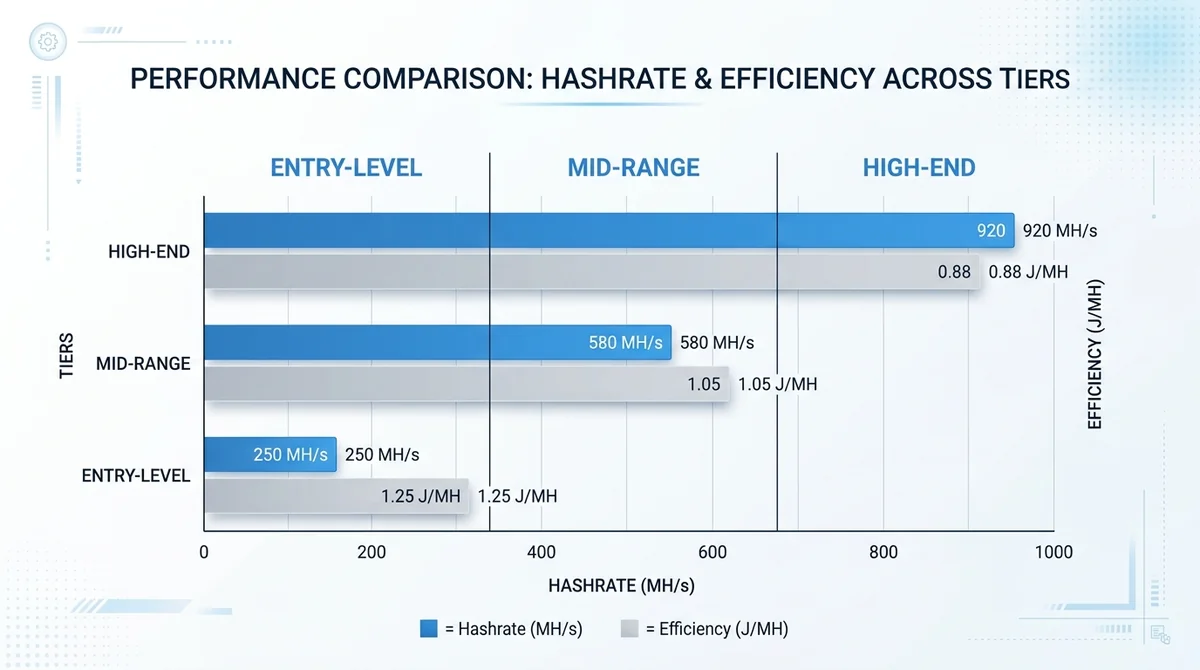
The 2026 Bitcoin mining rig market shows a trend of increasing hashrate and improved energy efficiency. Mainstream ASIC miners range from 100 TH/s to 500 TH/s, with significantly better power efficiency. New-generation ASIC miners (application-specific integrated circuit miners, hardware designed specifically for Bitcoin's SHA-256 algorithm) deliver higher hashrate at the same power consumption, driving continuous growth in total network hashrate.
How Much Performance Improvement Do New-Generation ASIC Miners Offer?
Compared to the previous generation, newly released ASIC miners in 2026 show an average 15%–25% improvement in energy efficiency (electricity consumed per TH/s). This figure is an industry-wide observation; specific models vary greatly, so please refer to manufacturer specifications. For mainstream models:
- Entry-level: 100–200 TH/s, 1200–1500W, efficiency around 12–15 J/TH.
- Mid-range: 200–300 TH/s, 2500–3500W, efficiency around 10–12 J/TH.
- High-end: 300–500 TH/s, 4000–7000W, efficiency around 8–10 J/TH.
Improved efficiency directly reduces electricity cost per unit of hashrate, a key metric for miners when purchasing.
How Do Miner Prices and Payback Periods Trend?
Miner prices are influenced by Bitcoin price, network hashrate, chip supply, and other factors, with notable volatility in 2026. Payback period (miner cost divided by daily net profit) typically ranges from 12 to 24 months, fluctuating with coin price and electricity rates. For example, a 200 TH/s miner with 3000W power draw, at electricity cost of $0.05/kWh, with Bitcoin around $60,000, yields a daily net profit of about $15–20, resulting in a payback period of roughly 15–20 months. Refer to real-time data for accurate figures.
What Entry-Level Bitcoin Miners Are Recommended?
Entry-level Bitcoin miners emphasize low power consumption and quiet design, suitable for home environments, with typical hashrates of 100–200 TH/s and power draw under 1500W. These miners usually use air cooling with noise below 50 dB, suitable for placement in a home or small office.
Which Miner Models Are Suitable for Home Mining?
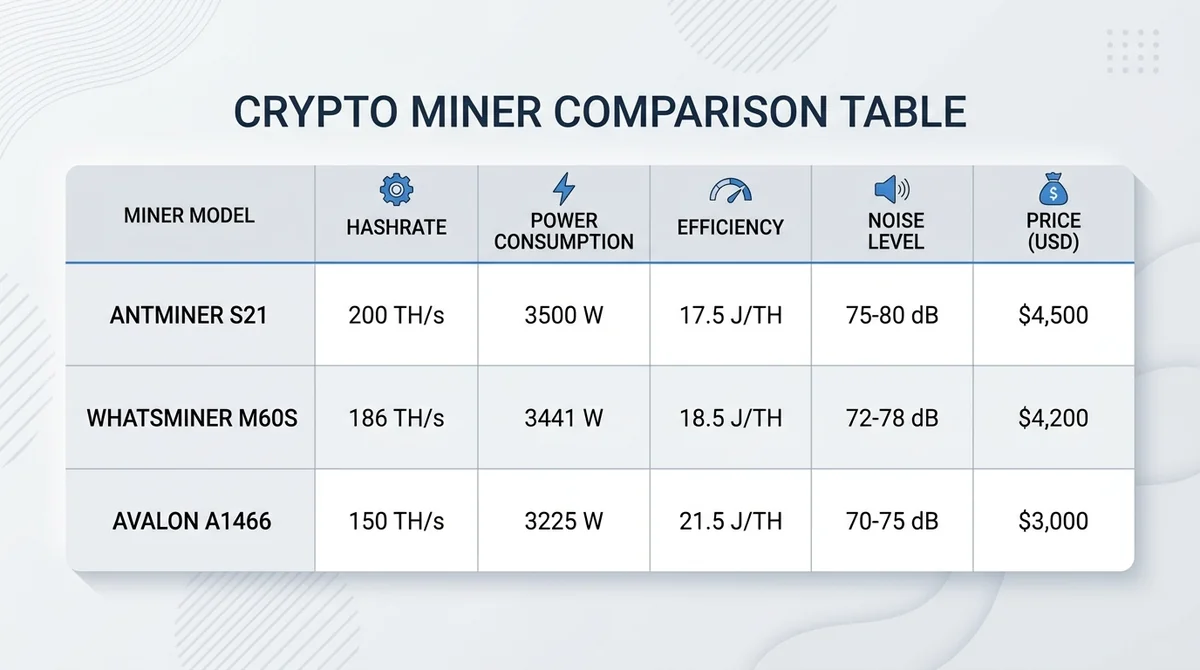
The following are common entry-level miner specifications in 2026 (data from public industry sources; check official prices for specific models):
| Model | Hashrate (TH/s) | Power (W) | Efficiency (J/TH) | Noise (dB) | Reference Price (USD) |
|---|---|---|---|---|---|
| Antminer S21 | 200 | 3000 | 15 | 55 | 3500 |
| Whatsminer M60S | 180 | 2800 | 15.5 | 50 | 3200 |
| Avalon A1466 | 150 | 2400 | 16 | 48 | 2800 |
Prices fluctuate with the market; verify the latest quotes before purchasing.
How to Control Power Consumption and Noise of Entry-Level Miners?
Home mining requires careful consideration of electrical capacity and noise impact. Entry-level miners typically draw under 1500W, manageable on standard household circuits, but note the electricity cost of 24/7 operation. For noise, choose models with quiet fans or liquid cooling to keep noise at 45–55 dB, similar to a normal air conditioner. If noise-sensitive, add a soundproof enclosure or place the miner in a balcony, basement, or other isolated space.
How to Choose Professional Bitcoin Miners?
Professional Bitcoin miners offer hashrates of 300–500 TH/s and require dedicated power and cooling infrastructure, suitable for large-scale mining or hosted operations. These miners typically use liquid or immersion cooling and demand industrial power or dedicated lines.
What Are Representative High-Hashrate Miner Models?
The 2026 high-end miner market is dominated by the following models (specs are public information, for reference only):
| Model | Hashrate (TH/s) | Power (W) | Efficiency (J/TH) | Cooling | Reference Price (USD) |
|---|---|---|---|---|---|
| Antminer S21 Pro | 400 | 6000 | 15 | Liquid | 8000 |
| Whatsminer M66S | 450 | 6500 | 14.4 | Liquid | 8500 |
| Avalon A1566 | 500 | 7000 | 14 | Immersion | 9000 |
High-end miners are expensive and require supporting power and cooling facilities, suitable for mining farms or hosting providers with stable low-cost electricity.
What Are the Power and Cooling Requirements for Professional Miners?
Professional miners typically draw over 4000W and require 380V three-phase power or dedicated transformers. For cooling, liquid and immersion cooling effectively reduce chip temperatures and extend miner lifespan, but initial investment is higher. Hosting services can solve power and cooling issues, but hosting fees apply, usually 10%–20% on top of electricity costs. When choosing hosting, verify the facility's qualifications, power stability, and contract terms.
How to Evaluate Miner Cost-Effectiveness?
Miner cost-effectiveness requires calculating payback period based on hashrate, power consumption, price, and electricity cost. Use the MSX profitability calculator to quickly assess investment returns for different miners. A shorter payback period indicates better cost-effectiveness, but consider Bitcoin price volatility risk.
How to Calculate Miner Payback Period?
Payback period = Total miner cost / Daily net profit. Daily net profit = Daily mining output (BTC amount × BTC price) – Daily electricity cost. For a 200 TH/s miner with 3000W power draw:
- At current network hashrate and difficulty, this miner can mine about 0.0003 BTC per day.
- At a Bitcoin price of $60,000, daily output value is $18.
- Daily electricity cost = 3 kW × 24 h × $0.05/kWh = $3.6.
- Daily net profit = $18 – $3.6 = $14.4.
- If the miner costs $3,500, payback period = $3,500 / $14.4 ≈ 243 days (about 8 months).
Actual payback period is affected by coin price, difficulty, and electricity cost fluctuations, requiring dynamic evaluation.
What Are Key Factors Affecting Miner Cost-Effectiveness?
- Hashrate/Power Ratio: Lower efficiency (J/TH) means lower electricity cost per unit of hashrate.
- Miner Price: At the same hashrate, lower price leads to faster payback.
- Electricity Cost: Electricity is the largest operational cost in mining; low-cost regions have a clear advantage.
- Bitcoin Price: Price increases accelerate payback, while declines extend the period or cause losses.
- Miner Lifespan and Residual Value: Miners typically last 3–5 years; residual value affects total cost.
Use MSX's profitability calculator with real-time parameters for more accurate payback estimates.
What Should You Watch Out for When Buying Bitcoin Miners?
When buying Bitcoin miners, choose official or authorized channels, verify hashrate and power specs, and confirm after-sales support to avoid refurbished unit risks. The market has instances of misrepresented hashrate and substandard products; be cautious.
What Are Common Traps in Miner Purchasing?
- Inflated Hashrate: Unscrupulous sellers exaggerate hashrate; actual performance falls short of specs.
- Refurbished Units: Used miners refurbished and sold as new, with poor lifespan and stability.
- Low-Price Bait: Miners priced far below market are often scams; payment is taken without delivery.
- No After-Sales Support: Purchases from unofficial channels cannot be repaired under warranty.
Choose official stores, authorized distributors, or reputable hosting platforms to reduce risk.
How to Verify Miner Authenticity and Performance?
- Check Serial Number: Enter the serial number on the manufacturer's website to verify authenticity and factory information.
- Test Actual Hashrate: After delivery, connect to a mining pool and run for 24 hours, comparing actual hashrate to the rated value.
- Inspect Appearance: New miners should have no dust or scratches, and fans should run quietly.
- Confirm Warranty: Keep purchase receipts and confirm warranty period and after-sales process.
FAQ
Is Bitcoin mining still profitable in 2026?
Bitcoin miner investment returns depend on coin price, electricity cost, and network difficulty. Opportunities still exist in 2026, but risks are high. Use a profitability calculator to assess payback period and prepare for price declines.
How to choose between entry-level and professional miners?
Home users should choose entry-level (100–200 TH/s, under 1500W) for quiet operation and low power consumption; large-scale operations should choose professional (300–500 TH/s) with supporting power and cooling. Decide based on budget and site conditions.
How long is the typical miner payback period?
Payback period is usually 12–24 months, but fluctuates with coin price, electricity cost, and difficulty. For a 200 TH/s miner at $0.05/kWh and $60,000 Bitcoin, payback is about 8 months; it lengthens if the price drops.
How to avoid scams when buying miners?
Choose official or authorized channels, verify serial numbers, test actual hashrate upon delivery, and keep receipts. Be wary of prices far below market and prefer reputable hosting platforms or distributors.
Can I trade Bitcoin miner-related tokens on MSX?
MSX offers Bitcoin spot and futures trading, but miners themselves are not tokens. You can trade BTC-related products on MSX, but miner purchases require hardware channels. MSX's profitability calculator can help assess mining returns.
This article is produced by the MSXGO editorial team, AI-assisted, and reviewed through an editorial process. Fee rates and figures are subject to each platform's latest official announcements.
FAQ
Is Bitcoin mining still profitable in 2026? ▼
Bitcoin miner investment returns depend on coin price, electricity cost, and network difficulty. Opportunities still exist in 2026, but risks are high. Use a profitability calculator to assess payback period and prepare for price declines.
How to choose between entry-level and professional miners? ▼
Home users should choose entry-level (100–200 TH/s, under 1500W) for quiet operation and low power consumption; large-scale operations should choose professional (300–500 TH/s) with supporting power and cooling. Decide based on budget and site conditions.
How long is the typical miner payback period? ▼
Payback period is usually 12–24 months, but fluctuates with coin price, electricity cost, and difficulty. For a 200 TH/s miner at $0.05/kWh and $60,000 Bitcoin, payback is about 8 months; it lengthens if the price drops.
How to avoid scams when buying miners? ▼
Choose official or authorized channels, verify serial numbers, test actual hashrate upon delivery, and keep receipts. Be wary of prices far below market and prefer reputable hosting platforms or distributors.
Can I trade Bitcoin miner-related tokens on MSX? ▼
MSX offers Bitcoin spot and futures trading, but miners themselves are not tokens. You can trade BTC-related products on MSX, but miner purchases require hardware channels. MSX's profitability calculator can help assess mining returns.
Finished reading? Ready to try trading?
Tokenized stocks/ETFs, crypto spot, and perpetual futures in one account — perp maker 0.02% / taker 0.045%, RWA spot buy 0.3% / sell 0.
Free sign-up · 3 quick steps