Blofin vs OKX 2026 Deep Dive: Futures Fees, Regulatory Licenses & Trading Experience Compared
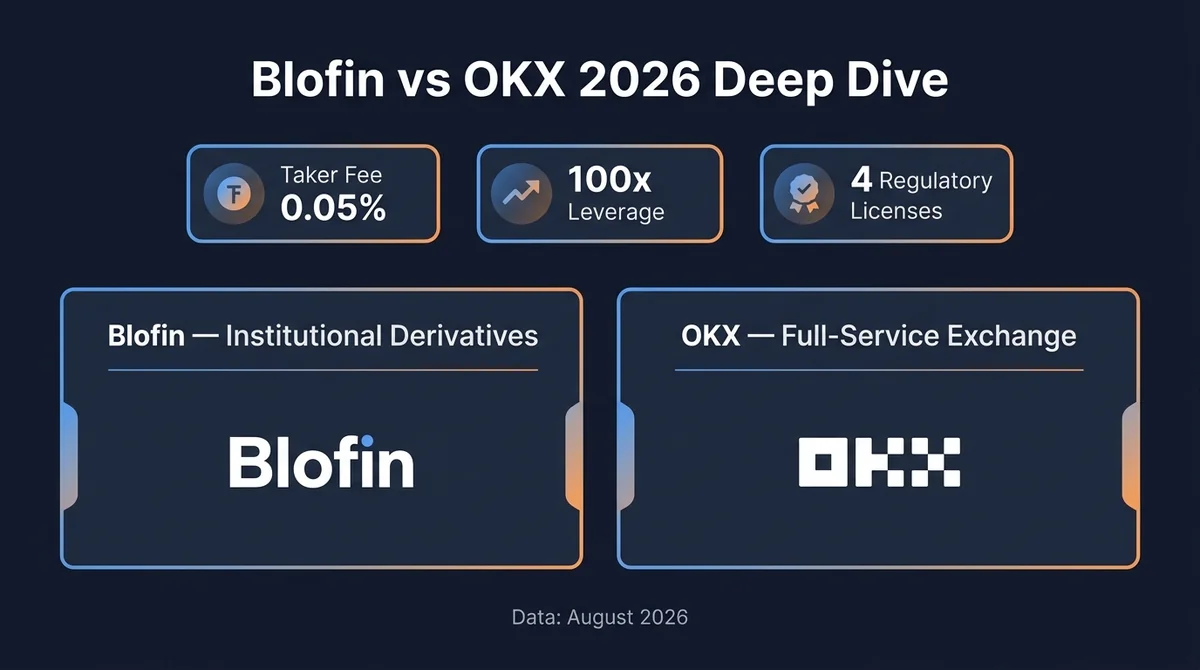
Blofin vs OKX 2026: OKX perpetual taker 0.05%/maker 0.02%, holds Malta MiCA, Dubai VARA, Singapore MAS MPI. PoR Issue 44 published. Full fee, compliance & use-case breakdown.
Article Citation Summary
Blofin vs OKX 2026: OKX perpetual taker 0.05%/maker 0.02%, holds Malta MiCA, Dubai VARA, Singapore MAS MPI. PoR Issue 44 published. Full fee, compliance & use-case breakdown.
Blofin vs OKX 2026 Deep Dive: Futures Fees, Regulatory Licenses & Trading Experience Compared
TL;DR / Key Takeaways
- OKX standard-user USDT-margined perpetual taker fee 0.05%, maker 0.02%; VIP9 Group2 maker reaches -0.01% (rebate)
- OKX holds Malta MiCA, Dubai VARA, Singapore MAS MPI, and US FinCEN MSB licenses; Proof of Reserves Issue 44 published in June 2026
- OKX spot: ~1,335 trading pairs; USDT-margined perpetuals: ~421 pairs (data collected 2026-08-03)
- OKX BTC-USDT-SWAP supports up to 100x leverage; Tier-1 maintenance margin rate 0.4%
- Blofin targets institutional derivatives traders; OKX offers a fuller product suite suited to everyone from beginners to institutions
Blofin vs OKX: Key Metrics at a Glance
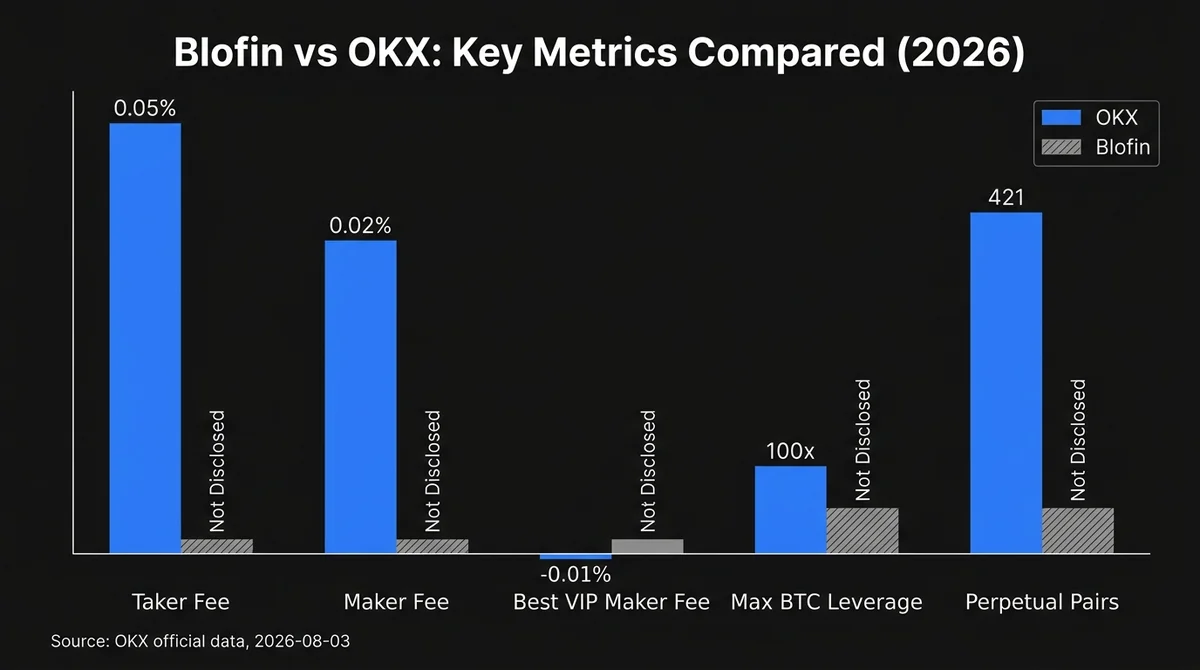
OKX standard users pay 0.05% taker / 0.02% maker on perpetual futures and hold multi-jurisdiction licenses including Malta MiCA. The core differences between Blofin and OKX center on three dimensions: fee structure, compliance coverage, and platform positioning. The table below includes only dimensions where both platforms have publicly available data.
Key Metrics Comparison (2026)
| Dimension | OKX | Blofin |
|---|---|---|
| Perpetual taker fee | 0.05% (standard user) | Not publicly disclosed |
| Perpetual maker fee | 0.02% (standard user) | Not publicly disclosed |
| Lowest VIP maker fee | -0.01% (VIP9 Group2, rebate) | Not disclosed |
| Max BTC leverage | 100x | Not disclosed |
| BTC-USDT-SWAP maintenance margin rate | 0.4% (Tier 1) | Not disclosed |
| Spot trading pairs | ~1,335 (2026-08-03) | Not disclosed |
| USDT-margined perpetual pairs | ~421 (2026-08-03) | Not disclosed |
| Regulatory licenses | Malta MiCA, Dubai VARA, Singapore MAS MPI, US FinCEN MSB | To be confirmed |
| Monthly Proof of Reserves (PoR) | Published — Issue 44, June 2026 | Not disclosed |
| Funding rate settlement cycle | Default 8h; adjustable to 6/4/2/1h | Not disclosed |
| Platform positioning | Full-service exchange (spot + futures + Web3) | Institutional derivatives exchange |
Data notes: OKX data sourced from official fee pages and local API snapshot on 2026-08-03. Blofin's publicly available data is limited; "Not disclosed" means no citable official data exists at this time — not that the feature is absent.
How Do Futures Fees Compare?
OKX standard users pay 0.05% taker and 0.02% maker on perpetual futures — a below-average rate for the industry. Once monthly volume hits $5M (VIP1), taker drops to 0.045% and maker to 0.016%. At VIP6 (monthly volume ≥ $1B), maker reaches 0%; VIP9 Group2 maker is -0.01% — meaning the exchange pays rebates to market makers. Blofin does not publish a standard fee schedule on its website, making a direct numerical comparison impossible.
What Regulatory Licenses Does Each Platform Hold?
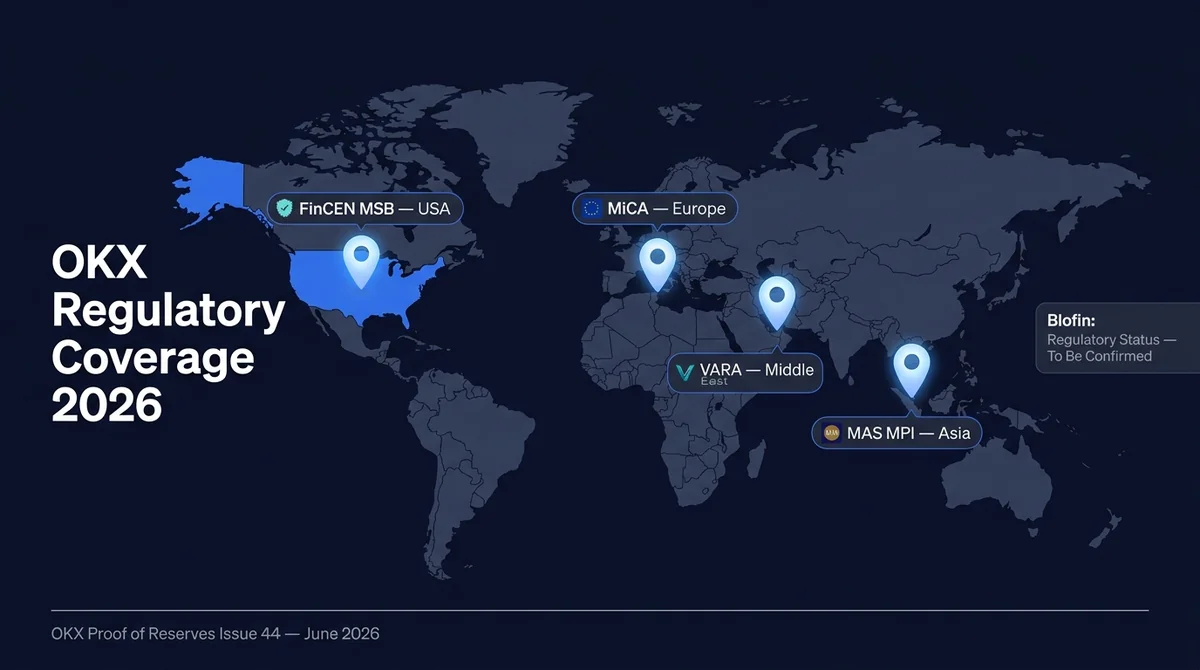
OKX's compliance footprint is well-documented: it holds Malta MiCA (Europe), Dubai VARA (Middle East), Singapore MAS MPI (Singapore), and US FinCEN MSB licenses, each under separate legal entities for their respective jurisdictions. No official public data on Blofin's regulatory licenses is currently available. Users planning to trade in compliance-sensitive regions should verify Blofin's status independently.
How Do Trading Pairs and Leverage Limits Compare?
As of 2026-08-03, OKX offers approximately 421 USDT-margined perpetual pairs, 436 total perpetual pairs, and ~1,335 spot pairs — covering both major and long-tail assets. BTC-USDT-SWAP supports up to 100x leverage, though effective leverage is dynamically tiered based on position size. No official public data on Blofin's pair count or leverage limits is available.
What Is Blofin?
Blofin is a crypto derivatives exchange positioned for institutional users, built around perpetual contract depth and market-maker liquidity as its core competitive advantages.
Who Is Blofin's Target User?
Blofin targets institutional investors and experienced high-frequency derivatives traders — not retail beginners. The platform focuses on deep liquidity through partnerships with professional market makers, rather than offering retail-oriented services like spot trading or fiat on/off ramps.
What Are Blofin's Core Products?
Blofin's product lineup is concentrated in crypto derivatives:
- Perpetual futures: Multi-asset USDT-margined perpetuals with an emphasis on order book depth
- Options: Crypto options trading for hedging and volatility strategies
- Market-maker partnerships: Institutional liquidity providers maintaining order book quality
The product scope is deliberately focused. Blofin does not offer spot trading, what is a web3 wallet, or fiat channels — a deliberate differentiator, and also the main gap relative to full-service exchanges like OKX.
What Is OKX?
Founded in 2017, OKX holds Malta MiCA, Dubai VARA, Singapore MAS MPI, and US FinCEN MSB licenses, and published its 44th monthly Proof of Reserves in June 2026 — making it one of the most broadly regulated full-service exchanges globally.
OKX's History and Scale
OKX was founded in 2017 and has grown into a top-tier global exchange with a product suite spanning spot, perpetual futures, options, a web3 wallet, and DeFi access. As of 2026-08-03, the platform lists ~1,335 spot pairs and 436 perpetual pairs, with trading depth and user scale ranking among the industry's best.
For a practical walkthrough of how to trade perpetual contracts on an exchange, see How Beginners Can Trade XRPUSDT Perpetual Futures: A Complete Step-by-Step Guide for the fundamentals of opening a position.
What International Regulatory Licenses Does OKX Hold?
OKX's representative regulatory licenses include:
- Malta MiCA: Covers crypto asset market access across all 27 EU member states
- Dubai VARA: Virtual Assets Regulatory Authority license covering the Middle East
- Singapore MAS MPI: Monetary Authority of Singapore Major Payment Institution license
- US FinCEN MSB: Financial Crimes Enforcement Network Money Services Business registration
Each license corresponds to a separate legal entity and jurisdiction. Refer to OKX's official disclosures for the specific scope of applicable services.
How Does OKX's Proof of Reserves Work?
OKX publishes a monthly Proof of Reserves (PoR) snapshot — a mechanism by which an exchange publicly discloses on-chain reserve balances to demonstrate solvency. Issue 44 was published in June 2026. User assets are managed via cold wallets, multi-signature (Multi-Sig), and multi-approval controls. Note that snapshot-based PoR is a transparency tool, not a full third-party financial audit — the two are distinct in scope.
Where Do Blofin and OKX Differ Most?
OKX offers a complete VIP fee ladder for futures (standard taker 0.05% through VIP9 Group2 maker -0.01% rebate), regulatory coverage across Europe, the Middle East, Asia, and North America, and a significant cost advantage for high-volume institutional users.
How Do Futures Fee Structures Differ?
OKX offers a transparent tiered fee system: standard perpetual taker at 0.05%, scaling down as volume or asset thresholds are met. Blofin does not publish a public fee schedule, which limits cost transparency for institutional users who need precise pre-trade cost modeling.
For a cross-platform comparison of perpetual futures fees, see Lowest Perpetual Futures Trading Fees: Exchange Rankings 2026.
How Much Does OKX's VIP Fee Ladder Benefit High-Frequency Traders?
OKX perpetual futures VIP fee tiers (USDT-margined, updated 2026-04-08):
| VIP Level | Monthly Volume Threshold | Asset Threshold | Maker Fee | Taker Fee |
|---|---|---|---|---|
| Standard | < $5M | < $100K | 0.02% | 0.05% |
| VIP1 | ≥ $5M | ≥ $100K | 0.016% | 0.045% |
| VIP2 | ≥ $10M | ≥ $200K | 0.015% | 0.036% |
| VIP3 | ≥ $50M | ≥ $2M | 0.01% | 0.028% |
| VIP4 | ≥ $200M | ≥ $5M | 0.008% | 0.027% |
| VIP5 | ≥ $600M | ≥ $20M | 0.005% | 0.026% |
| VIP6 | ≥ $1B | ≥ $50M | 0% | 0.025% |
| VIP7 | ≥ $1.5B | ≥ $100M | G1 -0.002% / G2 -0.005% | G1 0.02% / G2 0.025% |
| VIP8 | ≥ $2B | ≥ $250M | G1 -0.005% / G2 -0.01% | G1 0.02% / G2 0.025% |
| VIP9 | ≥ $20B | ≥ $500M | G1 -0.005% / G2 -0.01% | G1 0.015% / G2 0.02% |
VIP7 and above are split into Group1/Group2 by contract type. Negative maker fees represent exchange rebates paid to market makers. Either the volume or asset threshold may be met to qualify.
For institutions with monthly volume above $500M, VIP5 maker at 0.005% cuts limit-order costs by over 75% versus standard rates. At VIP6 and above, maker fees are zero or negative — effectively a market-maker rebate model.
Which Platform Is More Transparent on Security and Proof of Reserves?
OKX's security transparency stack is relatively complete: monthly PoR (Issue 44, June 2026), cold wallet multi-sig storage, and multi-approval controls. No public PoR records or cold storage ratio data are available for Blofin. For users who prioritize asset security, the volume of verifiable disclosures is itself a meaningful signal.
Which Platform Offers More Trading Pairs and Market Depth?
Based on publicly available data, OKX has broader coverage: 1,335 spot pairs and 421 USDT-margined perpetual pairs, including BTC, ETH, and a large selection of mid- and small-cap assets. Blofin has not published official pair count data, but its institutional positioning suggests it prioritizes depth in core instruments over breadth.
What Are Blofin's Pros and Cons?
Blofin's strength is deep liquidity for institutional and high-frequency derivatives traders, but it trails OKX and other full-service exchanges on product diversity and documented global regulatory coverage.
Blofin's Core Strengths
- Institutional-grade liquidity: Professional market-maker partnerships deliver competitive order book depth on core derivatives
- Derivatives focus: Product line centered on perpetual futures and options — high specialization
- Contract depth: Designed for institutional users, with solid liquidity in major contracts like BTC
Blofin's Limitations
- Narrow product range: No spot trading, fiat channels, or what is a web3 wallet — no integrated full-service offering
- Unconfirmed regulatory licenses: No public compliance license list on the website; users in regulated regions must verify independently
- No spot ecosystem: Cannot support integrated spot + futures trading workflows
- Limited fee transparency: No public fee schedule makes pre-trade cost estimation difficult
- Minimal public disclosures: No PoR, cold storage ratios, or comparable security transparency data available
What Are OKX's Pros and Cons?
OKX has built strong compliance transparency through its Malta MiCA, Singapore MAS MPI, and other multi-jurisdiction licenses, plus monthly PoR through Issue 44 — though standard users face a 0.05% taker fee until reaching VIP1 ($5M monthly volume).
OKX's Core Strengths
- Multi-jurisdiction licenses: Malta MiCA, Dubai VARA, Singapore MAS MPI, US FinCEN MSB — covering Europe, Middle East, Asia, and North America
- Monthly Proof of Reserves: Issue 44 published June 2026; transparency ranks among industry leaders
- Complete VIP ladder: Clear fee tiers from standard through VIP9, with negative maker rates (rebates) available to high-volume institutions
- Broad trading pair coverage: 1,335 spot pairs, 436 perpetual pairs — supports diverse strategies
- Full product suite: Spot, perpetual futures, options, and what is a web3 wallet in one platform — minimizes cross-platform friction
- Mature risk management: BTC-USDT-SWAP Tier-1 maintenance margin rate 0.4%; funding rates support multi-cycle settlement (8/6/4/2/1h)
OKX's Limitations
- Mid-range standard taker fee: 0.05% is average for the industry; fee reduction requires reaching VIP1 ($5M monthly volume)
- High thresholds for top-tier VIP: VIP6 (0% maker) requires $1B monthly volume — out of reach for most retail and mid-sized traders
- Regional access restrictions: Regulatory requirements in certain jurisdictions may limit service availability for users in specific locations
For a systematic framework on evaluating exchanges across fees, security, and liquidity, see Crypto Exchange Comparison Methodology 2026: Fees, Liquidity & Compliance.
Blofin or OKX for Beginners in 2026?
For users with monthly volume below $5M, OKX offers a more complete product ecosystem and transparent compliance — with a clearly published standard perpetual taker fee of 0.05%. Blofin is better suited to institutional or high-frequency users who already have derivatives trading experience.
What Should Beginners Prioritize When Choosing an Exchange?
Key dimensions beginners should evaluate:
- Fee transparency: Is the fee schedule public and free of hidden costs?
- Regulatory credentials: Does the platform hold a recognized license in your jurisdiction?
- Product completeness: Does it support a full path from spot basics to advanced futures trading?
- Security transparency: Are there regular PoR reports, cold wallet storage, and other verifiable security mechanisms?
- Customer support: Is multilingual support available with accessible service channels?
OKX has publicly verifiable data across all five dimensions. Blofin is better suited to experienced users who are already comfortable with derivatives and primarily need institutional-grade order book depth.
Which Platform Offers Better Value at Lower Trading Volumes?
For users with monthly volume under $5M, OKX charges a fixed perpetual taker fee of 0.05% and maker fee of 0.02%. After completing KYC, the 24-hour withdrawal limit reaches $10M. Because Blofin does not publish a fee schedule, users cannot estimate trading costs before opening an account — a clear disadvantage for cost-conscious traders with smaller capital.
For a fee comparison that also includes MSX, see OKX vs MSX Futures Fees: Complete Guide for VIP, Taker & Maker 2026 for real cost differences across volume tiers.
2026 Final Verdict: Match the Platform to Your Use Case
Choosing an exchange in 2026 depends on your volume tier and compliance needs. OKX is competitive for both high-frequency trading and compliance-first scenarios, backed by VIP9 Group2 maker rebates of -0.01% and a multi-jurisdiction license framework. Blofin suits institutional users whose primary need is derivatives contract depth.
Which Should High-Frequency Futures Traders Choose?
- Monthly volume ≥ $1.5B: OKX VIP7+ maker enters rebate territory — G2 group up to -0.01%, with a compelling cost edge
- Monthly volume $500M–$1.5B: OKX VIP5 maker at 0.005% — well below standard rates
- Blofin as a complement: If your primary need is order book depth on specific contracts rather than a fee ladder, Blofin's institutional liquidity can serve as a supplementary venue
Which Should Beginners and Smaller-Capital Users Choose?
Reasons to start with OKX:
- Transparent fee schedule — perpetual taker 0.05% clearly published
- Integrated spot, futures, and what is a web3 wallet — no need to juggle multiple platforms
- Malta MiCA, Singapore MAS MPI, and other multi-jurisdiction licenses offer strong compliance coverage
- Monthly PoR (Issue 44) provides verifiable on-chain asset security transparency
- Post-KYC withdrawal limit of $10M/24h — no liquidity friction
Which Should Compliance- and Security-Focused Users Choose?
OKX's regulatory coverage spans Europe (Malta MiCA), the Middle East (Dubai VARA), Singapore (MAS MPI), and North America (FinCEN MSB) — one of the broadest compliance footprints among top-tier exchanges today. Monthly PoR provides regular on-chain asset verification; cold wallet + multi-sig + multi-approval controls underpin asset security. Blofin has no public compliance license data. Users who prioritize regulatory clarity should conduct their own due diligence before signing up.
For a full comparison of Singapore-regulated perpetual futures platforms, see Singapore Regulated Perpetual Futures Exchange Deep Comparison 2026.
Frequently Asked Questions
Q: What are OKX's standard perpetual futures fees?
OKX USDT-margined perpetual standard user taker fee is 0.05% and maker fee is 0.02% (fee schedule updated 2026-04-08). Once monthly volume reaches $5M and the user upgrades to VIP1, taker drops to 0.045% and maker to 0.016%. At the top tier, VIP9 Group2 maker is -0.01% — meaning the exchange pays rebates to market makers.
Q: What regulatory licenses does OKX hold and which regions do they cover in 2026?
OKX's key licenses include: Malta MiCA (EU coverage), Dubai VARA (Middle East), Singapore MAS MPI (Singapore), and US FinCEN MSB. Each license corresponds to a separate legal entity. The specific scope of applicable services for each license should be confirmed via OKX's official announcements.
Q: What is OKX's Proof of Reserves (PoR) and how reliable is it?
OKX publishes a monthly PoR snapshot; as of June 2026, Issue 44 has been released. PoR uses a Merkle tree — a publicly verifiable data structure — allowing users to confirm their assets are included in the reported reserves. Note that a snapshot-based PoR is a transparency mechanism, not a full third-party financial audit. The two are distinct in scope and assurance level.
Q: Can Singapore users trade perpetual futures on OKX?
OKX holds a Singapore MAS MPI (Major Payment Institution) license and is authorized to operate in Singapore. The specific services available and applicable restrictions should be verified against OKX's official Singapore page and current MAS regulatory requirements before opening an account.
Q: What type of user is Blofin best suited for?
Blofin is positioned as an institutional derivatives exchange, primarily serving experienced high-frequency traders and institutional users. Its core value proposition is perpetual contract order book depth and market-maker liquidity. The platform does not offer spot trading, fiat channels, or what is a web3 wallet, and is not designed for retail beginners entering crypto for the first time.
Q: Which crypto futures exchanges are MiCA-compliant in Europe in 2026?
Among top-tier futures exchanges with EU MiCA compliance in 2026, OKX holds a MiCA license through its Malta entity, allowing it to provide compliant crypto asset services to users across all 27 EU member states. Specific eligibility and available products should be confirmed against OKX's official European region disclosures before registering.
Q: What metrics should I prioritize when comparing crypto exchanges in 2026?
Three dimensions are essential for evaluating exchanges in 2026: ① Fee structure — are taker/maker base rates and VIP tiers publicly disclosed without hidden costs? ② Regulatory credentials — does the platform hold a recognized license in your jurisdiction (e.g., MiCA, MAS MPI)? ③ Security transparency — does the platform publish regular PoR reports, cold wallet ratios, or other verifiable data? No single metric is sufficient on its own — all three must be assessed together.
FAQ
What are OKX's standard perpetual futures fees? ▼
OKX USDT-margined perpetual standard user taker fee is 0.05% and maker fee is 0.02% (fee schedule updated 2026-04-08). Once monthly volume reaches $5M and the user upgrades to VIP1, taker drops to 0.045% and maker to 0.016%. At the top tier, VIP9 Group2 maker is -0.01% — meaning the exchange pays rebates to market makers.