Coinbase Tokenized Stock: 1:1 Backed Equities Explained
Explore Coinbase tokenized stock infrastructure on Base, featuring 1:1 backed equities, automated dividends, and global non-U.S. regulatory rollout in 2026.
Article Citation Summary
Explore Coinbase tokenized stock infrastructure on Base, featuring 1:1 backed equities, automated dividends, and global non-U.S. regulatory rollout in 2026.
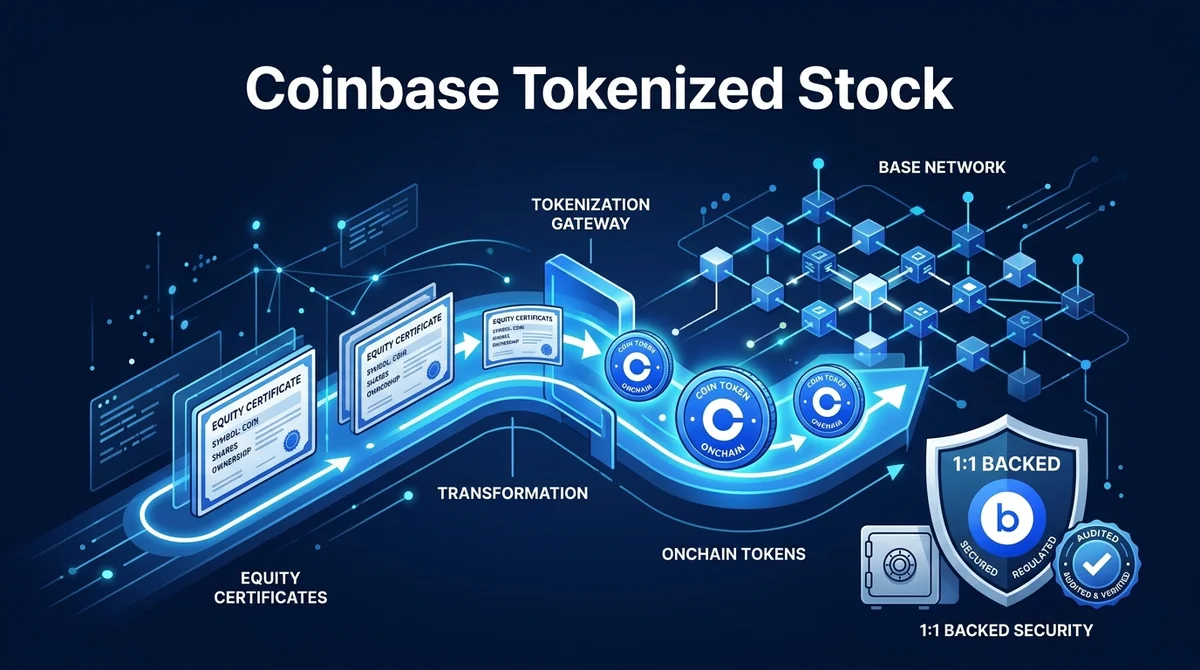
Coinbase announced its entry into onchain equities with Coinbase tokenized stock, introducing 1:1 asset-backed digital tokens representing beneficial claims on underlying U.S. equities. Built on the Base network, the infrastructure enables automated dividend distribution, self-custodial wallet management, and 24/7 settlement for eligible international market participants.
Key Takeaways
- 1:1 Asset Backing: Each token represents a beneficial claim on a physical U.S. equity held in bankruptcy-remote custody separate from Coinbase balance sheets.
- Base Infrastructure: Assets are deployed as B20 tokens on Base, enabling instant settlement, self-custody, and decentralized finance (DeFi) composability.
- Automated Yield: Corporate actions such as dividend distributions are automatically routed to token holders via onchain smart contracts.
- Jurisdictional Boundaries: Initial availability focuses on eligible non-U.S. jurisdictions to satisfy international securities compliance standards.
What Did Coinbase Announce Regarding Tokenized Stocks?
Coinbase officially unveiled plans to launch onchain tokenized equities, marking a shift toward institutional-grade Real World Assets (RWA). The product structure is designed to provide direct economic exposure to U.S. public markets without relying on synthetic debt models or unbacked contracts.
1:1 Backing Mechanism with Underlying U.S. Equities
Every Coinbase tokenized stock is collateralized 1:1 by physical shares of underlying U.S. equities. The platform issues corresponding tokens against verified holdings, ensuring that each unit circulating onchain maintains precise parity with the economic performance of traditional market securities.
Bankruptcy-Remote Custody Structure
To address institutional counterparty concerns, underlying shares are deposited with regulated third-party custodians under a bankruptcy-remote structure. This segregation ensures that underlying equities remain isolated from Coinbase corporate balance sheets, protecting token holders from platform operational insolvency risks.
According to Coinbase official documentation, each Coinbase tokenized stock represents a verified beneficial claim on real U.S. equity held in bankruptcy-remote custody separate from the exchange's operational balance sheet. By issuing tokens on a 1:1 basis against deposited shares, the platform ensures market participants retain full economic exposure while mitigating insolvency risk.
Automatic Dividend Integration and Planned Voting Rights
The underlying smart-contract stack natively handles corporate distributions. Cash dividends issued by public corporations are captured by the custody mechanism and routed directly to holders' wallets onchain. Coinbase has also indicated development of proxy voting protocols to extend shareholder governance rights to token holders in future iterations.
How Does the Coinbase Tokenize Technical Infrastructure Work on Base?
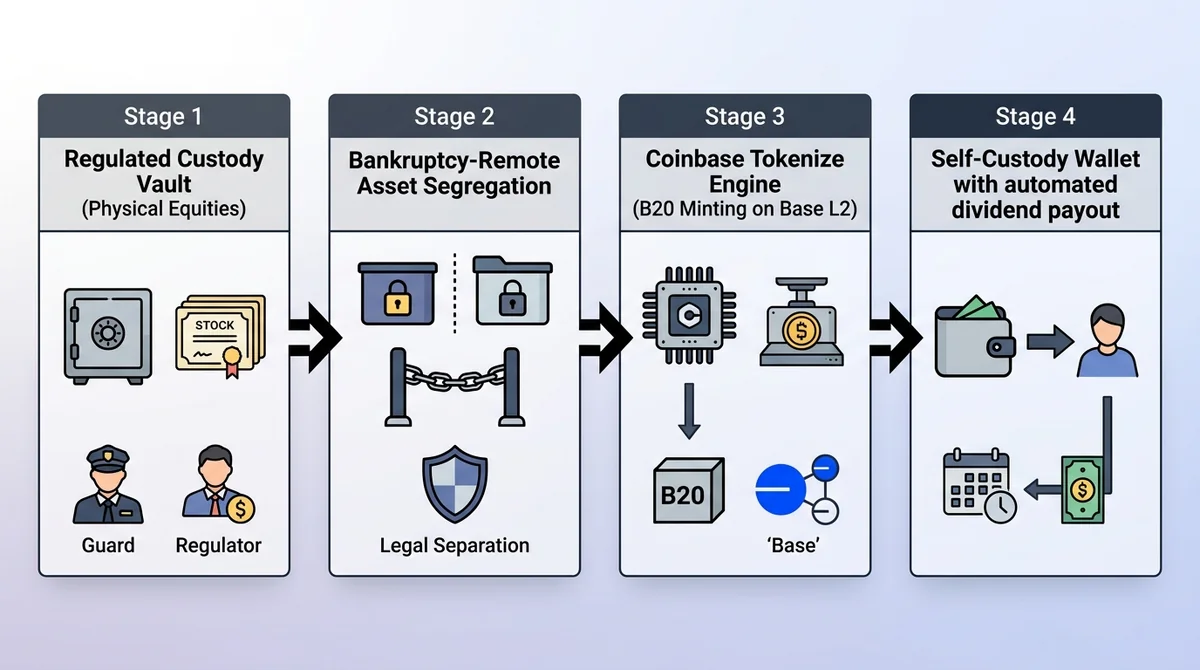
The issuance and management framework relies on Coinbase Tokenize, an enterprise-grade tokenization stack built natively on the Base layer-2 network.
B20 Token Standard and Smart-Contract Execution
Equities are minted under the B20 standard on Base, providing standardized interfaces for issuance, lifecycle management, and smart-contract execution. This structure allows programmatic compliance checks, identity whitelisting, and automated transfer restrictions at the smart-contract layer.
Self-Custodial Wallet Management and DeFi Composability
Unlike closed brokerage platforms, users can hold tokenized stocks in self-custodial Web3 wallets. The architecture supports permissioned interactions with decentralized lending, borrowing, and automated market maker (AMM) protocols across the Base ecosystem.
| Technical Layer | Component / Standard | Key Functionality |
|---|---|---|
| Issuance Standard | B20 Token Standard | Programmatic lifecycle and compliance execution |
| Settlement Layer | Base Layer-2 Blockchain | Sub-second finality and 24/7 instant settlement |
| Custody Interface | Regulated Third-Party Trust | Bankruptcy-remote equity segregation |
| User Custody | Self-Custodial Web3 Wallets | Composable DeFi integration and asset self-sovereignty |
24/7 Instant Settlement Capabilities
Traditional equity settlement follows T+1 or T+2 market clearing cycles. Coinbase tokenized stock infrastructure leverages blockchain state execution to achieve immediate settlement 24 hours a day, eliminating counterparty settlement float and weekend trading barriers.
How Do Coinbase Tokenized Stocks Differ From Synthetic Equity Derivatives?
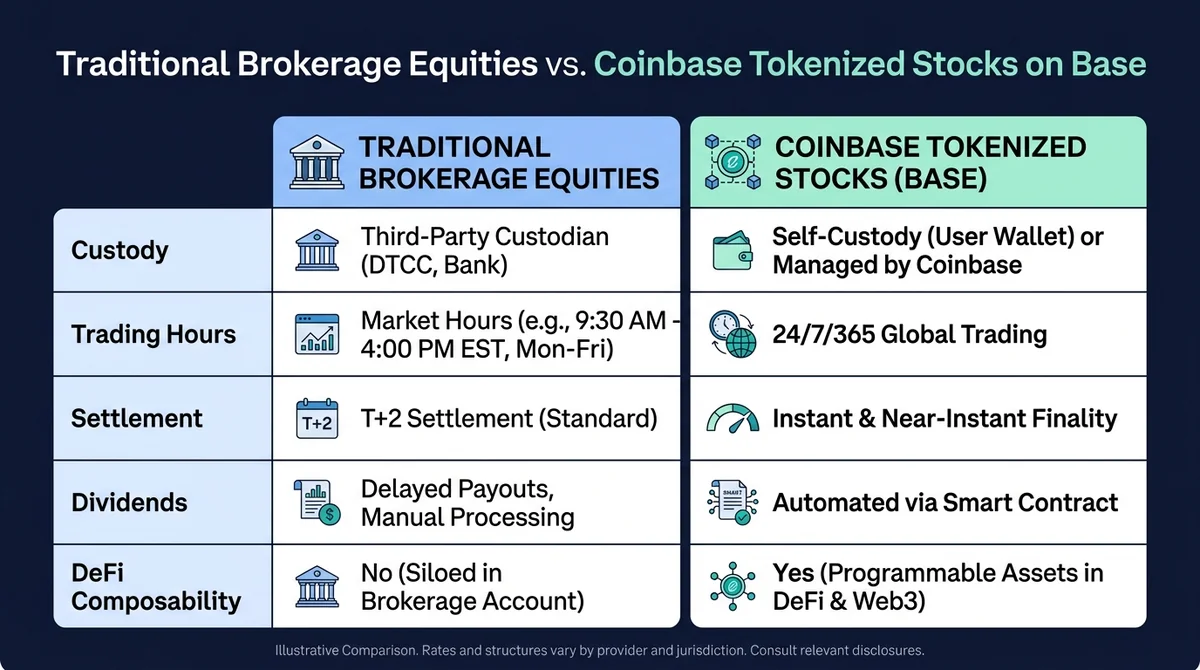
The structural architecture of Coinbase tokenized stocks distinguishes them from previous iterations of crypto equity products, such as contracts for difference (CFDs) or synthetic tracker tokens.
Beneficial Claims vs. Synthetic Price Tracking
Synthetic derivatives replicate price volatility through over-collateralized crypto pools or oracle price feeds without holding the underlying asset. In contrast, Coinbase tokenized stocks represent redeemable beneficial claims on physical shares, ensuring market price convergence with underlying asset value.
Coinbase tokenized stocks eliminate synthetic tracking errors by establishing direct beneficial claims rather than unbacked debt derivatives. Because physical shares are secured 1:1 in regulated vaults, investors receive transparent equity redemption mechanisms and automated onchain dividend distributions that synthetic contracts cannot natively provide.
Redemption Mechanics for Underlying Shares
Eligible market participants retain the legal and operational framework to redeem tokens for physical equity allocations or equivalent fiat value through licensed brokerage channels. This structural link prevents the asset decouple risks historically observed in unbacked crypto IOUs.
What Are the Regional Availability and Regulatory Boundaries?
The introduction of onchain securities requires strict adherence to international regulatory frameworks and cross-border financial legislation.
Target Jurisdictions Outside the United States
The initial rollout of Coinbase tokenized stocks targets eligible international jurisdictions across Europe, Latin America, and Asia-Pacific. Due to domestic registration requirements under U.S. federal securities laws, users residing in the United States remain restricted from accessing primary issuance and secondary trading pools.
Institutional-Grade Compliance Standards
Onboarding mandates institutional KYC/AML verification and geographic IP screening. This ensures all onchain transfers comply with cross-border securities regulations, preventing secondary market distribution into restricted territories.
For traders looking to explore multi-asset execution, understanding the broader landscape of multi-asset platforms supporting crypto and equities and regional tokenized U.S. stock RWA platforms is essential for navigating compliant global access.
Trade Multi-Asset RWA and Crypto on MSX
Experience next-generation multi-asset trading with institutional-grade security on MSX. Access tokenized equities, digital assets, and perpetual contracts within a unified platform.
Risk Disclosure: Tokenized equities and digital asset trading carry market risk. Availability is subject to jurisdictional restrictions and local regulatory compliance.
This article is produced by the MSXGO editorial team, AI-assisted, and reviewed through an editorial process. Fee rates and figures are subject to each platform's latest official announcements.
FAQ
What is a Coinbase tokenized stock? ▼
A Coinbase tokenized stock is an onchain digital asset deployed on the Base network that represents a 1:1 backed beneficial claim on a physical U.S. public equity held in regulated, bankruptcy-remote custody.
Do Coinbase tokenized stocks pay dividends to holders? ▼
Yes, dividends issued by the underlying public companies are automatically distributed to token holders' onchain wallets via smart contracts.
Can U.S. residents trade Coinbase tokenized stocks? ▼
No, U.S. residents are restricted from trading Coinbase tokenized stocks due to domestic securities regulations, with the initial rollout targeting eligible non-U.S. international jurisdictions.
How are Coinbase tokenized stocks different from synthetic stock tokens? ▼
Unlike synthetic tokens that only track equity prices via oracles, Coinbase tokenized stocks are fully collateralized 1:1 by real shares in segregated custody and support redemption mechanisms.
Finished reading? Ready to try trading?
Tokenized stocks/ETFs, crypto spot, and perpetual futures in one account — perp maker 0.02% / taker 0.045%, RWA spot buy 0.3% / sell 0.
Free sign-up · 3 quick steps