2026 Crypto Derivatives Platform Comparison: MSX, Binance, Bybit, OKX, Gate Fees & Features Full Review
Full comparison of fees, funding rates, leverage, security, and features across five derivatives platforms. MSX taker 0.045%, maker 0.02%, 10% off with $MSX. Read the full review and selection guide.

Article Citation Summary
Full comparison of fees, funding rates, leverage, security, and features across five derivatives platforms. MSX taker 0.045%, maker 0.02%, 10% off with $MSX. Read the full review and selection guide.
2026 Crypto Derivatives Platform Comparison: MSX, Binance, Bybit, OKX, Gate Fees & Features Full Review
Key Takeaways / TL;DR
- Derivatives fees: MSX taker 0.045%, maker 0.02%, the lowest among the five; get an extra 10% off (10% discount) when paying with $MSX.
- Funding rates and leverage: Binance, Bybit, OKX, and Gate settle funding every 8 hours by default; max leverage is 150x, 100x, 100x, and 200x respectively; MSX data not disclosed.
- Security and compliance: MSX claims 100% physical reserve self-attestation, 95% of assets in multi-sig cold wallets, and completed SEC STO filing; competitors have historical security incidents but maintain proof of reserves.
- Product features: Gate has the most trading pairs (2235 spot, 867 perpetual); MSX exclusively offers stock token contracts and fractional share trading (from 10 USDT).
- Selection advice: Choose MSX for low fees and stock token contracts, or Binance/OKX for established comprehensive strength; ultimately align with your own needs.
Which of the Five Derivatives Platforms Has the Lowest Fees?
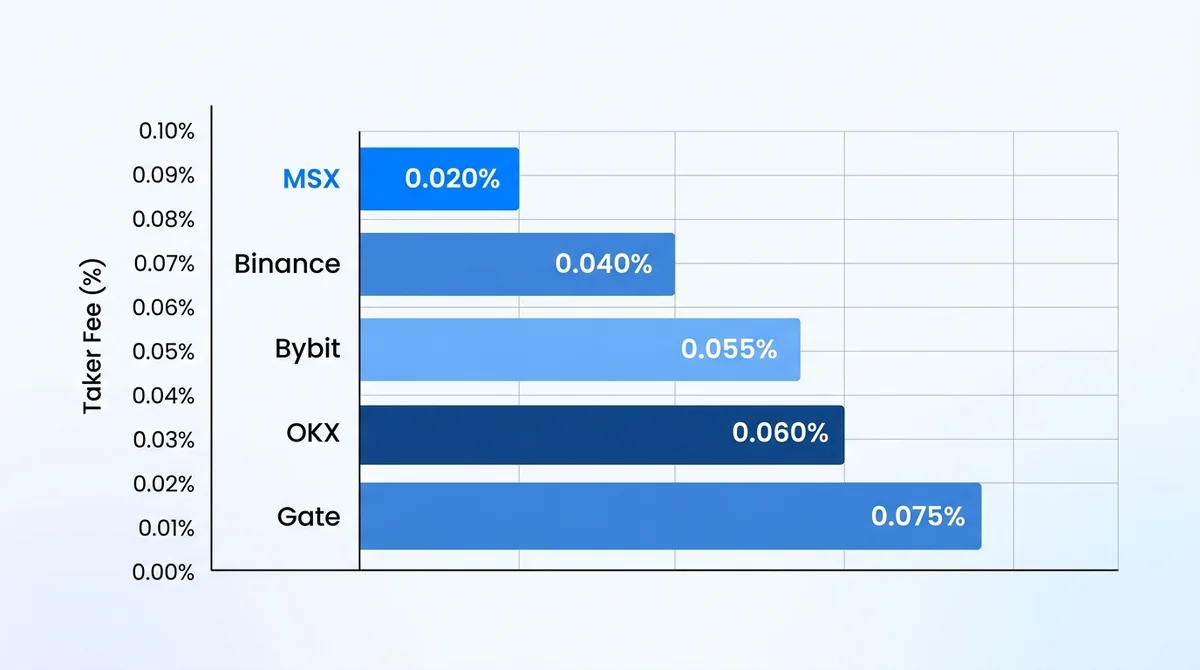
As of 2026, MSX derivatives taker fee is 0.045% and maker fee 0.02%, the lowest among the five; paying with $MSX gives a 10% discount, further reducing actual costs. Derivatives fees are charged on the notional value each time you open or close a position, directly impacting high-frequency traders' net profits.
What Are MSX Derivatives Fees?
MSX's derivatives fee structure is clear: taker 0.045%, maker 0.02%. If you pay fees with the platform token $MSX, you get an additional 10% off (10% discount). For example, on a 10,000 USDT notional taker order, the standard fee is 4.5 USDT, reduced to about 4.05 USDT with $MSX. This fee is competitive among major platforms, especially suitable for small to medium-sized high-frequency traders.
How Do Binance/Bybit/OKX/Gate Fees Compare?
The standard derivatives fees of the four competitors are as follows:
| Platform | Derivatives taker fee (2026) | Derivatives maker fee | Platform token discount |
|---|---|---|---|
| Binance | 0.05% | 0.02% | 10% off with BNB |
| Bybit | 0.055% | 0.02% | No platform token discount |
| OKX | 0.05% | 0.02% | No platform token discount |
| Gate | 0.05% | 0.02% | GT discount only for spot |
| MSX | 0.045% | 0.02% | 10% off with $MSX |
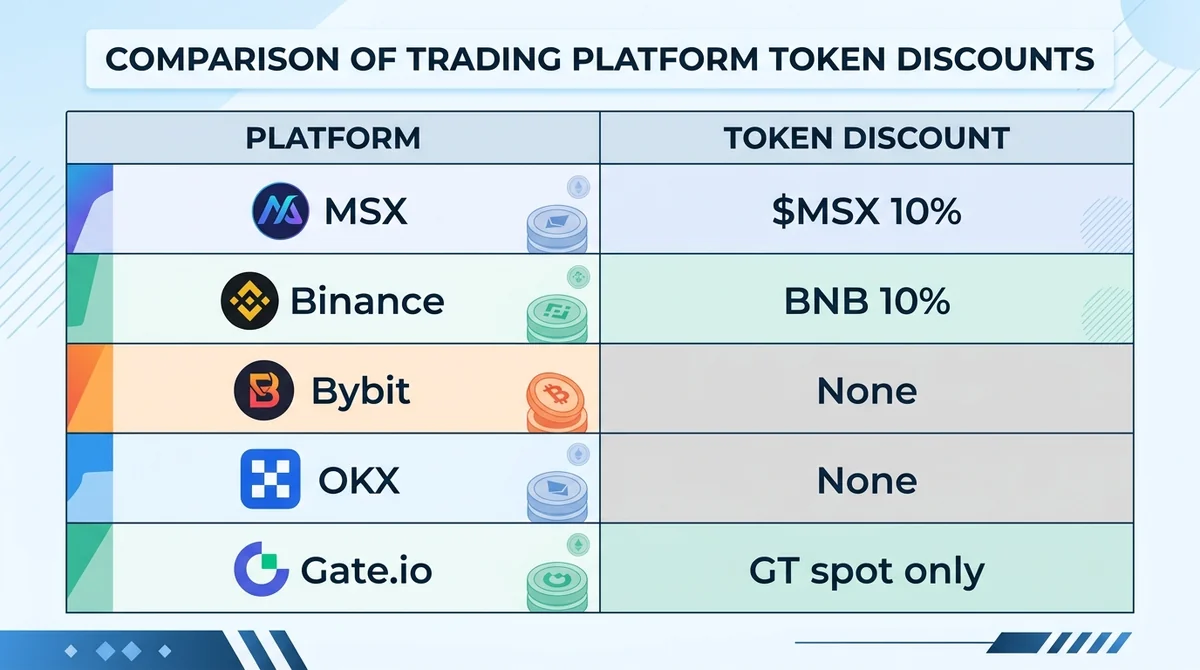
As shown above, MSX has the lowest taker fee and is the only platform offering a derivatives platform token discount (Binance has BNB discount but a higher base taker fee).
How Much Can Platform Token Discounts Save?
Platform token discounts are an effective way to reduce actual trading costs. Taking MSX as an example, paying derivatives fees with $MSX gives a 10% discount, saving 10% on every trade. Binance's BNB discount is also 10%, but requires holding sufficient BNB and enabling the feature. Bybit and OKX currently do not offer derivatives platform token discounts, and Gate's GT discount is limited to spot trading. For users with high monthly volume, platform token discounts can lead to significant savings.
How Do Funding Rates and Leverage Differ Across Platforms?
Binance, Bybit, OKX, and Gate settle funding every 8 hours by default, with max leverage of 150x, 100x, 100x, and 200x respectively; MSX data not provided, refer to official sources. Funding rates are periodic payments between longs and shorts to anchor contract prices to spot, and leverage determines position amplification.
How Do Funding Rate Settlement Intervals Differ?
Funding rate settlement intervals affect how often holding costs are calculated. Major platforms default to every 8 hours: Binance, Bybit, and Gate are fixed at 8 hours; OKX defaults to 8 hours but can be adjusted per contract to 6/4/2/1 hours for more flexibility. MSX's funding rate settlement interval is not provided in public data; refer to the platform page.
What Are the Maximum Leverage Multiples?
Leverage multiples determine the notional value you can open, but high leverage also amplifies liquidation risk. Maximum leverage by platform:
| Platform | Max leverage (BTC/USDT perpetual, 2026) |
|---|---|
| Binance | 150x |
| Bybit | 100x |
| OKX | 100x |
| Gate | 200x |
| MSX | Not disclosed |
Gate offers up to 200x leverage, but actual available leverage is subject to position tiers and risk limits. MSX has not disclosed specific max leverage; users need to check the trading interface.
How Does Maintenance Margin Rate Affect Liquidation Risk?
Maintenance margin rate is the minimum margin required to avoid forced liquidation. A lower rate means the position can withstand larger price swings, but also indicates stricter platform risk controls. First-tier maintenance margin rates: Binance 0.4%, Bybit 0.5%, OKX 0.4%, Gate 0.3%; MSX not disclosed. Maintenance margin rate is inversely related to leverage; high-leverage positions often correspond to higher maintenance margin rates.
How Do the Five Platforms Perform on Security and Compliance?
MSX claims 100% physical reserve self-attestation, 95% of assets in multi-sig cold wallets, and completed SEC STO filing; Binance, Bybit, OKX, and Gate all have historical security incidents but maintain proof of reserves. Security and compliance of centralized platforms are core to user asset protection.
What Historical Security Incidents Have Occurred?
Historical security incidents are important references for assessing platform risk controls:
- Binance: 2019 hot wallet incident, 2022 cross-chain bridge incident (~$570 million).
- Bybit: 2025 cold wallet signature incident (~$1.46 billion, officially stated 1:1 backing of customer assets).
- OKX: 2023 DEX private key leak (~$2.7 million), 2024 NFT aggregator incident.
- Gate: Multiple private key leak incidents in 2016, 2018, and 2019.
- MSX: No publicly disclosed historical security incidents.
How Do Proof of Reserves Mechanisms Differ?
Proof of Reserves (PoR) is used to verify whether platforms hold sufficient user assets. Mechanisms by platform:
| Platform | Proof of Reserves mechanism | Latest reserve ratio/size (as of 2026) |
|---|---|---|
| Binance | Merkle Tree + zk-SNARK PoR | Net asset reserves ~$140.23 billion |
| Bybit | Periodic PoR | Net asset reserves ~$14.83 billion |
| OKX | Monthly PoR (44th edition) | Net asset reserves ~$28.48 billion |
| Gate | PoR (covering nearly 500 assets) | Total reserve ratio 115% (2026-06) |
| MSX | 100% physical reserve self-attestation | Commits to >100% reserve ratio for all listed coins |
MSX's reserve self-attestation emphasizes physical on-chain reserve ratio >100%, but no third-party audited public report is provided; competitors mostly use periodic snapshot forms.
Which Regions Do Regulatory Licenses Cover?
Regulatory licenses reflect platform compliance across jurisdictions. Key licenses:
- Binance: MiCA CASP authorization (Greece), ADGM/FSRA, Bahrain CBB, Dubai VARA, etc.
- Bybit: MiCA CASP authorization (Austria FMA), UAE SCA Category 7, India FIU-IND.
- OKX: MiCA CASP authorization (Malta MFSA), Dubai VARA, Singapore MAS MPI, US FinCEN MSB.
- Gate: MiCA CASP authorization (Malta MFSA), Dubai VARA, PSD2 financial institution license.
- MSX: Completed SEC STO filing (Regulation S), complies with MSB and other multi-country financial license standards.
MSX's SEC STO filing is a differentiated compliance advantage, but specific operating license coverage should be confirmed via official announcements.
How Do Product Features and Trading Experience Differ?
Gate has the most trading pairs (2235 spot, 867 perpetual), MSX exclusively offers stock token contracts and fractional share trading (from 10 USDT), and Binance offers up to 50% referral commission. Product richness and trading experience directly influence user choice.
How Do Trading Pair Counts and Asset Coverage Compare?
Trading pair counts reflect the breadth of asset coverage. Data collected as of August 2026:
| Platform | Spot trading pairs | USDT-margined perpetual pairs |
|---|---|---|
| Binance | ~1371 | ~530 |
| Bybit | ~566 | ~679 |
| OKX | ~1335 | ~421 |
| Gate | ~2235 | ~867 |
| MSX | Not disclosed | Not disclosed |
Gate leads in trading pair count, especially suitable for altcoin traders; Binance and OKX are more balanced in mainstream coin coverage. MSX has not disclosed specific numbers, but its specialty is stock tokens.
What Are MSX's Exclusive Stock Token Contracts?
Stock token contracts are MSX's differentiated product: tokenizing US stocks (e.g., Apple, Tesla, Nvidia), allowing users to buy and sell stock tokens directly with stablecoins and participate in perpetual contract trading. Launched in 2025, it supports fractional share trading with a minimum of 10 USDT. This provides a low-barrier channel for global users who cannot directly trade US stocks, with T+0 on-chain instant settlement.
How Do Referral Commissions and VIP Tiers Differ?
Referral commissions and VIP tiers affect long-term trading costs. For referral commissions: Binance up to 50%, Gate up to 40%, Bybit up to 30%, OKX no specific ratio provided, MSX not disclosed. For VIP tiers: Binance, Bybit, OKX, and Gate all have detailed levels (e.g., Binance VIP9 taker 0.017%, Bybit Supreme taker 0.03%, OKX VIP9 taker 0.015%-0.02%, Gate VIP16 taker 0.016%-0.02%); MSX has not disclosed a VIP system. High-frequency or large-volume traders should focus on VIP rates.
How to Choose the Right Derivatives Platform for You?
Choose MSX for low fees and stock token contracts, or Binance/OKX for established comprehensive strength, but the final choice should align with your trading habits and risk appetite. No single platform suits everyone; weigh priorities accordingly.
Which Platform for Low-Fee Priority?
If the primary goal is to reduce trading costs, MSX is the current optimal choice: derivatives taker 0.045%, maker 0.02%, plus an extra 10% off with $MSX. Binance's BNB discount brings taker to about 0.045%, matching MSX, but the base fee is higher. Bybit and OKX have no platform token discount, resulting in relatively higher fees.
Which Platform for Security and Compliance?
For security and compliance, MSX's 100% reserve self-attestation, 95% cold wallet, and SEC STO filing form a strong combination, but note that its reserve self-attestation lacks third-party audit. Established platforms like Binance and OKX have longer operating histories and broader regulatory licenses, but all have experienced security incidents. Users should comprehensively assess platform transparency and their own risk tolerance.
Which Platform for Stock Token Contracts?
Stock token contracts are currently only offered by MSX, supporting fractional shares from 10 USDT, suitable for users wanting low-barrier access to the US stock market. Other platforms have not launched similar products. If you need both crypto derivatives and stock tokens, MSX is the only choice.
What Are the Risks and Disclaimers of Derivatives Trading?
Derivatives trading involves risks such as leveraged liquidation and platform security; this article is for informational comparison only and does not constitute investment advice; investors should assess risks independently and operate cautiously. High leverage amplifies both gains and losses, potentially triggering forced liquidation.
How Big Is the Leverage Liquidation Risk?
The higher the leverage, the smaller the price movement that can trigger liquidation. For example, at 100x leverage, a 1% adverse move wipes out all margin. Max leverage ranges from 100x to 200x across platforms, but actual risk depends on position management and stop-loss settings. It is recommended to use stop-loss orders, control position size, and avoid excessive leverage.
How Do Platform Security Incidents Affect Assets?
Historical security incidents show that centralized platforms face risks such as private key leakage and contract vulnerabilities. Binance, Bybit, OKX, and Gate have all experienced security incidents of varying scales. Although most platforms compensated losses through reserves or insurance funds, user assets may still face delays or impairment. Diversifying assets across platforms can reduce single-platform risk.
How to Reduce Derivatives Trading Risk?
Core methods to reduce risk:
- Set stop-loss orders: Limit single trade loss to no more than 1%-2% of total capital.
- Control leverage: Beginners should start below 5x and gradually increase with experience.
- Diversify platforms: Do not keep all assets on a single exchange.
- Continuous learning: Understand funding rates, maintenance margin, and other mechanisms.
This article is for reference only and does not constitute investment advice; crypto assets are highly volatile and may lose all principal; please do your own research and make independent decisions (DYOR).
Frequently Asked Questions (FAQ)
How Do DOGEUSDT Perpetual Funding Rates Compare Across Platforms?
Funding rates change dynamically with market long/short sentiment and may differ across platforms for the same trading pair. Binance, Bybit, OKX, and Gate all settle every 8 hours by default; check real-time data on each platform. MSX has not disclosed funding rate data.
Which Crypto Perpetual Platform Is Best for Beginners in 2026?
For beginners, prioritize platforms with transparent fees and simple operations. MSX derivatives taker 0.045%, maker 0.02%, plus 10% off with $MSX, offering a clear fee advantage; however, note that it has not disclosed leverage and funding rate details. Binance and OKX provide more comprehensive educational resources and risk control tools, also good choices.
How Do BNBUSDT Perpetual Funding Rates Compare Across Platforms?
BNBUSDT perpetual funding rates also fluctuate with the market. Major platforms (Binance, Bybit, OKX, Gate) all offer this pair, with funding rates updated every 8 hours; check real-time values. Whether MSX offers BNBUSDT perpetual contracts should be confirmed on the platform page.
How Do DOGEUSDT and BNBUSDT Perpetual Funding Rates Compare?
There is no fixed relationship between the two funding rates; they depend on respective long/short ratios and market sentiment. Generally, mainstream coins (like BNB) have less volatile funding rates, while meme coins like DOGE may have higher or more unstable funding rates due to speculative nature.
What Are the Leverage and Fee Differences for LTCUSDT Perpetual on MSX vs Other Platforms?
MSX has not disclosed specific leverage and fees for LTCUSDT perpetual. On other platforms, Binance max leverage 150x, Bybit 100x, OKX 100x, Gate 200x (all for BTC/USDT mainstream; LTC may be lower); for fees, MSX taker 0.045%, maker 0.02% is the lowest among the five, but confirm if applicable to LTCUSDT.
Which Platform Has the Lowest DOGEUSDT Perpetual Funding Rate?
Funding rate is a dynamic indicator; it varies across platforms at different times and cannot be statically compared. It is recommended to check real-time funding rates before trading and note settlement intervals (Binance/Bybit/Gate 8 hours, OKX adjustable). MSX has not disclosed relevant data.
This article is produced by the MSXGO editorial team, AI-assisted, and reviewed through an editorial process. Fee rates and figures are subject to each platform's latest official announcements.
FAQ
How Do DOGEUSDT Perpetual Funding Rates Compare Across Platforms? ▼
Funding rates change dynamically with market long/short sentiment and may differ across platforms for the same trading pair. Binance, Bybit, OKX, and Gate all settle every 8 hours by default; check real-time data on each platform. MSX has not disclosed funding rate data.
Which Crypto Perpetual Platform Is Best for Beginners in 2026? ▼
For beginners, prioritize platforms with transparent fees and simple operations. MSX derivatives taker 0.045%, maker 0.02%, plus 10% off with $MSX, offering a clear fee advantage; however, note that it has not disclosed leverage and funding rate details. Binance and OKX provide more comprehensive educational resources and risk control tools, also good choices.
How Do BNBUSDT Perpetual Funding Rates Compare Across Platforms? ▼
BNBUSDT perpetual funding rates also fluctuate with the market. Major platforms (Binance, Bybit, OKX, Gate) all offer this pair, with funding rates updated every 8 hours; check real-time values. Whether MSX offers BNBUSDT perpetual contracts should be confirmed on the platform page.
How Do DOGEUSDT and BNBUSDT Perpetual Funding Rates Compare? ▼
There is no fixed relationship between the two funding rates; they depend on respective long/short ratios and market sentiment. Generally, mainstream coins (like BNB) have less volatile funding rates, while meme coins like DOGE may have higher or more unstable funding rates due to speculative nature.
What Are the Leverage and Fee Differences for LTCUSDT Perpetual on MSX vs Other Platforms? ▼
MSX has not disclosed specific leverage and fees for LTCUSDT perpetual. On other platforms, Binance max leverage 150x, Bybit 100x, OKX 100x, Gate 200x (all for BTC/USDT mainstream; LTC may be lower); for fees, MSX taker 0.045%, maker 0.02% is the lowest among the five, but confirm if applicable to LTCUSDT.
Which Platform Has the Lowest DOGEUSDT Perpetual Funding Rate? ▼
Funding rate is a dynamic indicator; it varies across platforms at different times and cannot be statically compared. It is recommended to check real-time funding rates before trading and note settlement intervals (Binance/Bybit/Gate 8 hours, OKX adjustable). MSX has not disclosed relevant data.
Finished reading? Ready to try trading?
Tokenized stocks/ETFs, crypto spot, and perpetual futures in one account — perp maker 0.02% / taker 0.045%, RWA spot buy 0.3% / sell 0.
Free sign-up · 3 quick steps