2026 Guide to Choosing an Exchange by Contract Trading Fee Discount Requirements: No-VIP, Token Discount, or High-Volume Route?
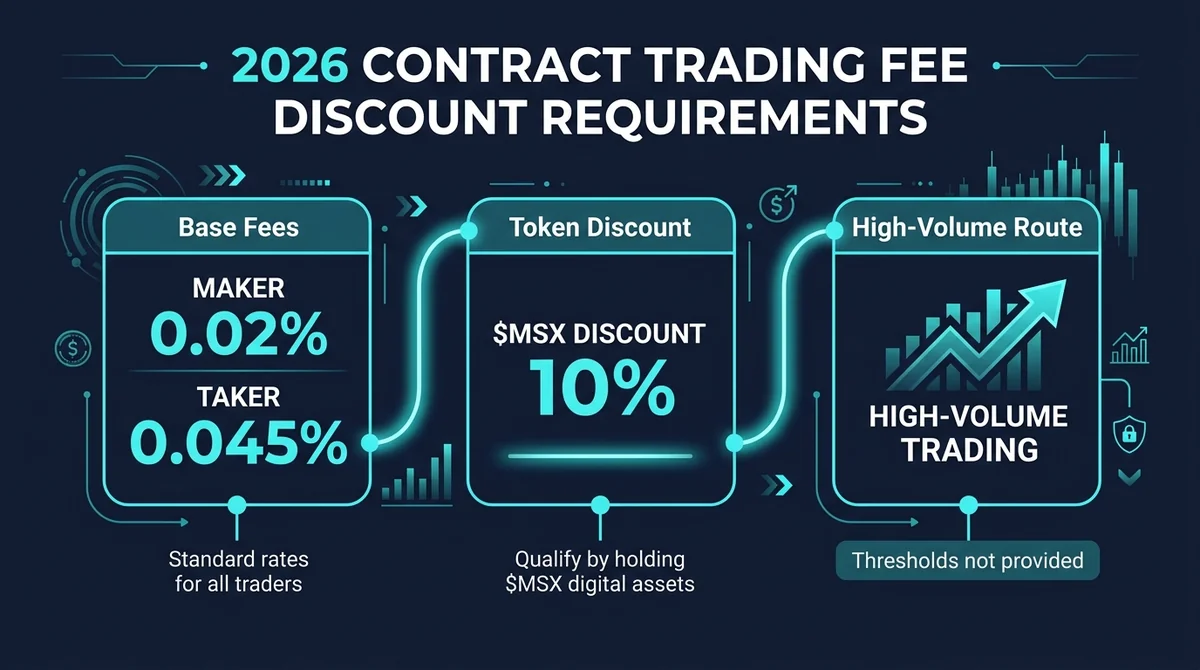
Compare 2026 contract fees: MSX charges 0.02% maker and 0.045% taker, or 0.018% and 0.0405% with the $MSX discount.
Article Citation Summary
Compare 2026 contract fees: MSX charges 0.02% maker and 0.045% taker, or 0.018% and 0.0405% with the $MSX discount.
2026 Guide to Choosing an Exchange by Contract Trading Fee Discount Requirements: No-VIP, Token Discount, or High-Volume Route?
Key Takeaways / TL;DR
- According to MSX fee information available as of April 2026, the base contract Maker fee is 0.02%, while the base Taker fee is 0.045%.
- Paying contract trading fees with $MSX gives you a 10% discount, resulting in effective Maker and Taker rates of 0.018% and 0.0405%, respectively, based on the base rates.
- Available information does not provide MSX's VIP fee tiers, minimum token holdings, high-volume thresholds, or calculation periods. These conditions must not be assumed.
- When choosing a fee-reduction route, calculate the base fees first, then evaluate whether additional token holdings are required, how stable the discount is, and how your orders are filled.
- Do not choose a contract trading platform based only on its lowest fee. You should also verify its liquidation risk controls, mark price mechanism, and asset storage practices.
How Should You Choose Between No-VIP, Token Discount, and High-Volume Routes for Lower Contract Trading Fees?
When comparing eligibility requirements for contract trading fee discounts, review base fees first, followed by token-based discounts and high-volume discounts. MSX's base fees and 10% token discount are confirmed, but information about its VIP and trading-volume thresholds is unavailable.
According to MSX fee information available as of April 2026, the confirmed contract fees are 0.02% for Maker orders and 0.045% for Taker orders, with a 10% discount when fees are paid using $MSX. VIP and high-volume thresholds have not been provided. Before trading, verify the applicable rules through the official MSX website.
Which Base Fees Should You Compare If You Do Not Rely on VIP Discounts?
Maker orders, which enter the order book and provide liquidity, and Taker orders, which immediately execute against existing orders and consume liquidity, are the starting points for comparing base costs. Do not focus only on the lower of the two rates. First calculate the actual proportion of your trades filled as Maker and Taker orders.
When comparing no-VIP contract trading fee routes, review the following items on a consistent basis:
- Base Maker fee: Has a greater impact when a high percentage of your trades provide liquidity.
- Base Taker fee: Has a greater impact when you frequently use market orders or actively take liquidity.
- Opening and closing order roles: The two transactions may be classified separately as Maker or Taker fills.
- Scope of the discount: Confirm that the discount covers the contract products you actually trade.
- Other costs: Contract trading fees are not a substitute for checking slippage and other costs.
As of April 2026, the only verifiable MSX base figures are a Maker fee of 0.02% and a Taker fee of 0.045%. Base fees do not constitute a promise of a no-VIP discount, nor can they be used to infer whether the platform has a VIP program. For a more detailed cost breakdown, see MSX Contract Opening, Closing, and Round-Trip Cost Comparison.
Which Contract Trading Cost Structures Are Suitable for a Token-Based Fee Discount?
A token-based discount may suit users who are willing to hold an additional platform token and whose primary order roles are covered by the discount. MSX information confirms that paying contract trading fees with $MSX provides a 10% discount, reducing the original fee by 10%.
Before enabling a platform-token discount for contract trading fees, answer these three questions:
- Are you willing to accept the price volatility and capital allocation associated with holding additional $MSX?
- Does the 10% discount apply to both your Maker and Taker fills?
- Have you confirmed the minimum token holding, discount cap, and rules for combining discounts before trading?
Available information does not specify the minimum token holding, discount activation settings, discount cap, or whether the discount can be combined with VIP benefits. The 10% discount can therefore be included in fee calculations, but unknown requirements must not be treated as already satisfied.
Which Thresholds and Calculation Periods Must Be Verified for High-Volume Discounts?
A high-volume route can be calculated only after the platform discloses its thresholds and tiered fees. At a minimum, verify the following five items:
- The denomination or measurement basis used for the trading-volume threshold;
- Which products are included in trading-volume calculations;
- How the calculation period is defined;
- Whether Maker and Taker fees have separate tiers;
- When account tiers are updated and how discounts can be combined.
As of April 2026, available information does not provide MSX's high-volume contract fees, corresponding thresholds, or calculation periods. It is therefore impossible to calculate specific tiers or savings. Until the relevant information is confirmed, only the base fees and the 10% $MSX discount can be used as known calculation inputs.
How Do You Calculate Actual Contract Trading Fees Using Maker and Taker Rates?
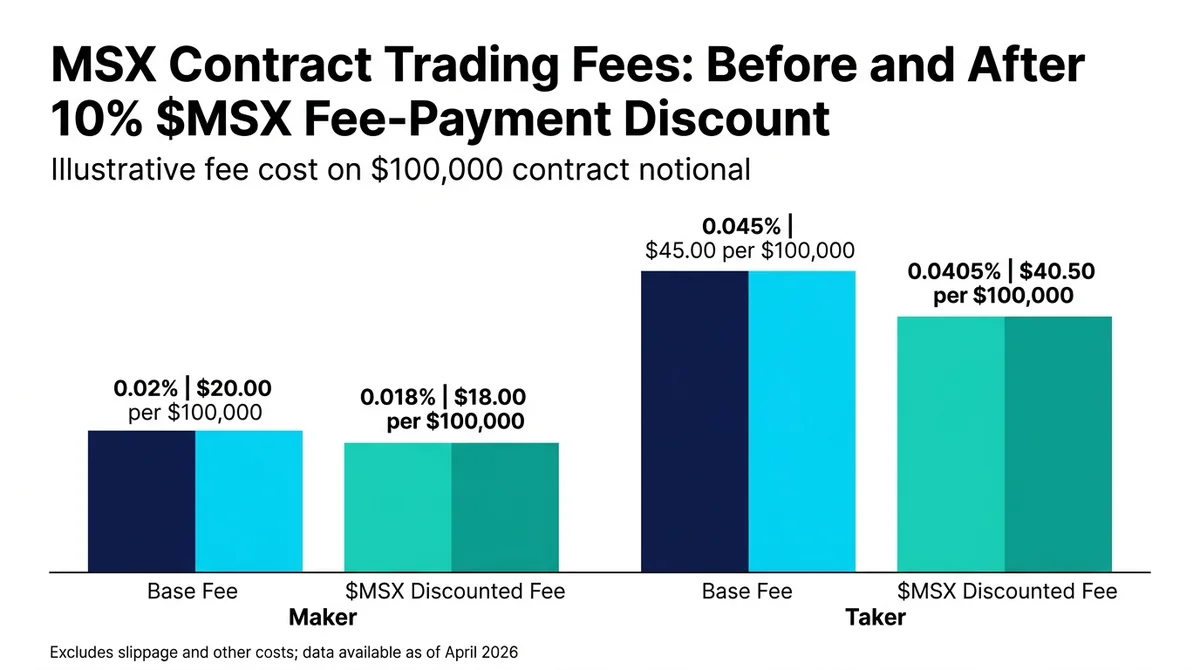
MSX's base Maker and Taker fees are 0.02% and 0.045%, respectively. After the discount, the effective rates are 0.018% and 0.0405%. Fees must be calculated separately according to the actual role of each fill.
As of April 2026, MSX's base contract Maker and Taker fees are 0.02% and 0.045%, respectively. When fees are paid using $MSX, the effective rates are 0.018% and 0.0405%.
What Do Maker and Taker Fees Mean in Perpetual Contracts?
Trading fees for perpetual contracts—derivatives with no fixed expiration date that use relevant mechanisms to track the underlying asset's price—depend on how an order is actually filled. A limit order is not necessarily a Maker order. If it immediately executes against an existing quote in the order book after submission, it may still incur a Taker fee.
Use these three formulas:
- Maker fee = Maker trading volume × Maker rate
- Taker fee = Taker trading volume × Taker rate
- Total contract trading fees = Maker fee + Taker fee
Trading volume is the basis for calculating fees and should not be replaced directly with the margin amount. Opening and closing fees must also be calculated separately and then combined to determine the complete round-trip cost.
How Do Different Fill Structures Change Contract Trading Fees?
Using an assumed trading volume of 100,000 USDT, the following amounts illustrate calculations based only on the confirmed rates. They do not represent actual returns or market conditions:
| 2026 MSX contract fill structure | Maker trading volume | Taker trading volume | Base fee calculation | Total base fees |
|---|---|---|---|---|
| 100% Maker fills | 100,000 USDT | 0 USDT | 100,000 × 0.02% | 20 USDT |
| 100% Taker fills | 0 USDT | 100,000 USDT | 100,000 × 0.045% | 45 USDT |
| 60% Maker and 40% Taker | 60,000 USDT | 40,000 USDT | 60,000 × 0.02% + 40,000 × 0.045% | 30 USDT |
For the same trading volume, order roles change the cost of contract trading. Users should calculate their Maker and Taker proportions from execution records rather than estimating them based on order type. For additional calculations covering different opening and closing combinations, see MSX Perpetual Contract Fee Budgets by Trading Volume.
How Are Contract Rates Calculated Before and After the $MSX Discount?
A 10% discount means multiplying the fee payable by 0.9. The effective discounted rates can therefore be calculated directly from the base rates:
- Maker: 0.02% × 0.9 = 0.018%
- Taker: 0.045% × 0.9 = 0.0405%
- Fee reduction: 1 − 0.9 = 10%
Continuing with the assumed trading volume of 100,000 USDT, fees for 100% Maker fills fall from 20 USDT to 18 USDT, while fees for 100% Taker fills fall from 45 USDT to 40.5 USDT. These are simply the results of applying the discount and do not include any undisclosed eligibility requirements.
How Should You Read a Contract Fee Table?
When assessing eligibility requirements for contract trading fee discounts, read the order role, base rate, discount, and undisclosed conditions together. Do not focus only on the lowest number. The following data is based on MSX fee information available as of April 2026 and does not include any assumptions about VIP or trading-volume benefits.
MSX Base Contract Fees and $MSX Discounted Rates (2026)
| Order role | 2026 MSX base rate | $MSX discount | Effective discounted rate | Disclosure of requirements |
|---|---|---|---|---|
| MSX contract Maker order | 0.02% | 10% discount | 0.018% | Available information does not provide a minimum token holding |
| MSX contract Taker order | 0.045% | 10% discount | 0.0405% | Available information does not provide a minimum token holding |
The 0.018% and 0.0405% rates in the table are derived from the confirmed 10% discount. They are not independently published VIP tiers. To review RWA spot, contract, and cross-chain bridge fees together, see the Complete MSX Fee Review 2026.
How Do You Choose a Contract Trading Platform by Base Fees Without Relying on VIP Status?
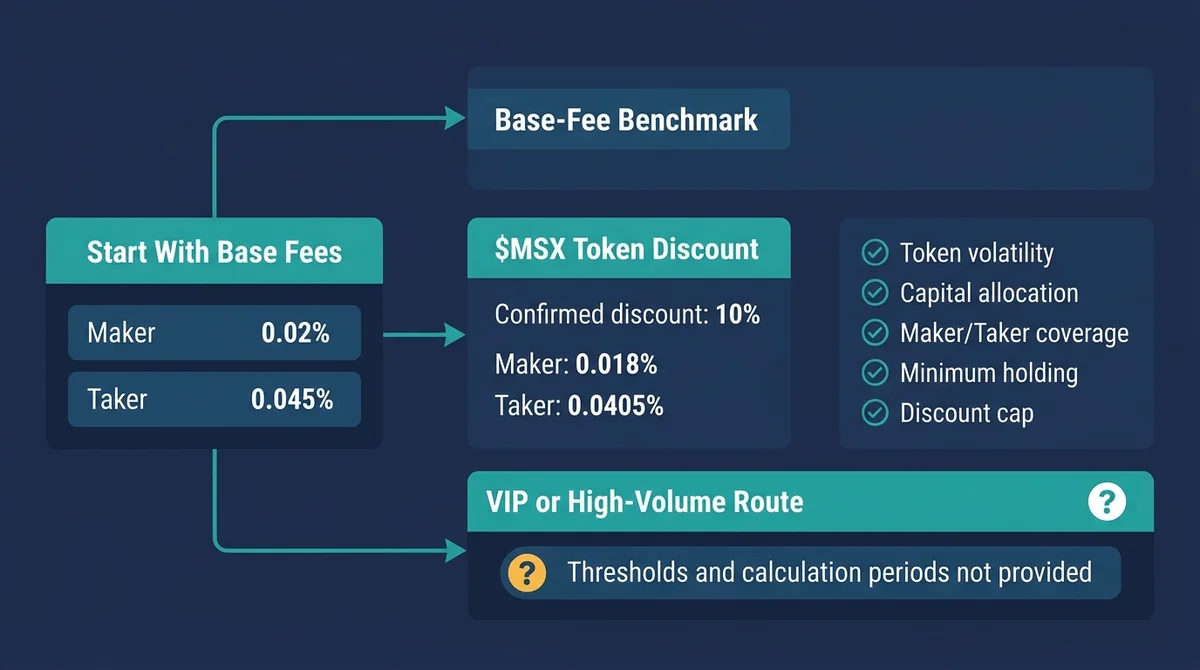
When VIP data is unavailable, calculations should use only confirmed base Maker and Taker fees. Base fees provide a verifiable benchmark but do not mean the platform promises a no-VIP discount.
Why Are Base Maker and Taker Fees the Starting Point for a No-VIP Route?
Base fees do not depend on users assuming a trading-volume tier or asset-balance requirement, making them suitable as a standardized basis for comparison. MSX's confirmed base contract fees are 0.02% for Maker orders and 0.045% for Taker orders. No other tiers can be extrapolated from these figures.
When building a comparison table, use the same set of conditions for every platform:
- The same notional trading volume;
- The same Maker-to-Taker ratio;
- The same number of opening and closing transactions;
- No unconfirmed VIP, referral rebate, or promotional discounts;
- Token-based discounts and their applicable conditions listed separately.
The input does not provide factual fee information for competing platforms, so this article does not rank platforms or determine which one has the lowest costs. For an existing comparison resource, see 2026 Perpetual Contract Fee Platform Comparison. Actual data should still be checked against the latest applicable conditions.
How Should Maker and Taker Fill Ratios Affect Your Exchange Selection?
First export a representative set of execution records, then total your Maker and Taker trading volumes separately. If a high proportion of your orders provide liquidity, the Maker rate carries more weight. If you frequently use orders that execute immediately, the Taker rate will have a greater effect on your final fees.
A personal calculation can follow this structure:
- Total the Maker and Taker trading volumes for the selected period;
- Multiply each amount by the platform's verifiable base rate;
- Add together the fees for opening and closing positions;
- Calculate the amount after the token-based discount separately;
- Mark unknown requirements as “to be verified” rather than treating them as zero-cost conditions.
When selecting an exchange, let M represent your Maker trading volume and T represent your Taker trading volume. Based on MSX's confirmed base rates, your fees are “M × 0.02% + T × 0.045%.” If you satisfy the conditions for the $MSX discount, the effective calculation is “M × 0.018% + T × 0.0405%.” The difference between the two results is the theoretical saving and does not include token price volatility, slippage, or other undisclosed costs.
Which Incorrect Conclusions Should You Avoid When VIP Threshold Data Is Unavailable?
Available information does not state whether MSX has specific VIP fee tiers or the conditions attached to them. Avoid making the following claims:
- Do not claim that MSX has no VIP program;
- Do not create an undisclosed VIP tier table;
- Do not provide definitive rates for high-volume users;
- Do not assume that the $MSX discount can always be combined with VIP benefits;
- Do not treat the base Maker rate as a universal rate for all orders.
A “no-VIP contract trading platform” is a common search and comparison phrase, but it should be broken down into verifiable questions when choosing an exchange: What base rates apply to a standard account? Does the discount require token holdings? Are there other eligibility conditions?
Is Paying Contract Trading Fees With a Platform Token Suitable for Your Current Trading Needs?
Paying contract trading fees with $MSX provides a 10% discount, resulting in effective Maker and Taker rates of 0.018% and 0.0405%. No data is available on minimum token holdings or rules for combining discounts.
Paying contract trading fees with $MSX reduces them by 10%, resulting in an effective Maker rate of 0.018% and a Taker rate of 0.0405%. The minimum token holding, discount cap, and rules for combining discounts have not been disclosed.
How Much Can You Save by Paying Contract Trading Fees With $MSX?
Under the MSX fee structure available as of April 2026, paying contract trading fees with $MSX provides a 10% discount. This represents a 10% reduction, meaning that an original fee of 100 units would become an effective payment of 90 units.
This discount can be included in a personal cost model, but the platform token itself may experience price volatility. Fee savings and token-holding risk are separate considerations. The 10% fee reduction alone cannot determine the total cost.
What Are the Effective Maker and Taker Rates After the Discount?
Applying the 10% discount reduces the MSX contract Maker rate from 0.02% to 0.018% and the Taker rate from 0.045% to 0.0405%. The actual bill will still depend on trading volume, order role, and whether the discount requirements are satisfied.
If Maker trading volume is 60,000 USDT and Taker trading volume is 40,000 USDT during a calculation period, the confirmed rates produce a base fee of 30 USDT. The effective fee after the 10% discount is 27 USDT, a difference of 3 USDT.
Which Undisclosed Conditions Should You Verify Before Using the Token Discount?
Available information does not provide the following contract trading fee discount requirements. Confirm each item before enabling the discount:
- Whether the discount feature must be enabled manually;
- The minimum $MSX holding;
- The fee discount cap;
- How fees are charged when the $MSX balance is insufficient;
- Whether the discount can be combined with VIP or high-volume benefits;
- Which contract products are covered by the discount.
The input data does not support specific figures for these conditions, so this article does not provide them. Users can verify the rules applicable at the time of trading through the official MSX website or the official Telegram support bot.
What Other Confirmed Uses Does $MSX Have Besides Fee Discounts?
The input information confirms that $MSX is a platform utility token with the following known uses:
- Fee discounts;
- Token-locking benefits;
- VIP membership;
- Asset subscriptions.
Having a VIP membership use does not mean that specific VIP tiers, token-holding thresholds, or contract rates have been disclosed. When deciding whether the platform-token discount is suitable, include only the explicit 10% discount in quantitative calculations and evaluate the other uses separately.
When Should High-Volume Traders Consider High-Volume Contract Rates?
A high-volume route can be evaluated only after obtaining clear trading-volume thresholds, calculation periods, and tiered rates. Available MSX information does not provide these details.
Which Fee Tiers Must a Platform Disclose for a High-Volume Route?
Calculating high-volume contract rates requires at least four types of data: trading-volume thresholds, tiered Maker rates, tiered Taker rates, and tier update times. If any key field is missing, estimated costs may differ from the actual bill.
Organize the information requiring verification in a table:
| High-volume discount verification item | Information to confirm | Status of available MSX information as of April 2026 |
|---|---|---|
| Trading-volume threshold | The trading-volume basis required for each tier | Not provided |
| Calculation period | Fixed or rolling period and update time | Not provided |
| Tiered Maker rates | Maker rates corresponding to each trading-volume tier | Not provided |
| Tiered Taker rates | Taker rates corresponding to each trading-volume tier | Not provided |
| Combining discounts | Whether the benefit can be used together with the $MSX discount | Not provided |
How Do You Compare the Actual Cost of a Volume Discount With a Token Discount?
Use the same fill structure and calculate three scenarios separately:
- Base scenario: Maker trading volume × 0.02% + Taker trading volume × 0.045%.
- Token-discount scenario: Maker trading volume × 0.018% + Taker trading volume × 0.0405%.
- High-volume scenario: Enter figures only after obtaining the official thresholds, calculation period, and tiered rates. Do not insert assumed values when information is unavailable.
The base and token-discount scenarios can be compared using available data. The high-volume scenario can currently only be marked “to be verified.” If tiered rates become available, recalculate them using the same period, trading volume, and Maker-to-Taker ratio. Do not directly compare figures calculated on different bases.
When Should You Avoid Increasing Trading Volume Just to Receive a Fee Discount?
Do not increase your trading activity solely to reach an unknown fee tier. Additional transactions generate their own fees and may increase slippage, position exposure, and execution risk. If the savings are less than the additional costs, a lower fee tier provides no practical benefit.
A more prudent approach is to calculate your base costs at your natural trading volume, then verify the additional volume required for the high-volume tier and the corresponding rate. Available MSX information does not provide these thresholds, so this article does not calculate a supposed break-even point for volume generation.
Which Contract Trading Risks Should You Check Besides Fees?
When choosing a contract trading platform, also verify its liquidation risk controls, mark price mechanism, asset storage practices, slippage, and order execution results. Contract trading fees are one directly measurable cost, but they do not represent the full range of trading risks.
The MSX information in the input states that it stores 95% of digital assets in multisignature cold wallets. This percentage can be considered part of its asset-storage information, but it is not a guarantee of zero risk. Users should still verify current rules through official channels and manage positions according to their own risk tolerance.
Contract Trading Fee Discount Requirements: Frequently Asked Questions
What Are the MSX Contract Maker and Taker Fees?
As of April 2026, MSX's base contract Maker rate is 0.02%, while its base Taker rate is 0.045%. Actual fees should be calculated separately for the two types of trading volume, with opening and closing fees combined. The margin amount should not be used directly in place of trading volume.
How Much Can You Save by Paying Contract Trading Fees With $MSX?
Paying with $MSX provides a 10% discount, equivalent to a 10% reduction from the original fee. Based on the confirmed base rates, the effective Maker rate is 0.018% and the Taker rate is 0.0405%. The minimum token holding, discount cap, and rules for combining discounts have not been disclosed.
Does MSX Have a Clearly Defined VIP Contract Fee Table?
Available information does not provide MSX's VIP fee tiers, qualification requirements, or calculation periods. It only confirms that $MSX has a VIP membership use. This does not support creating specific VIP tiers or assuming that a base rate can be combined with a particular VIP discount.
Can High-Volume Users Automatically Receive Lower MSX Contract Rates?
This cannot currently be determined. MSX's high-volume thresholds, calculation periods, and tiered rates have not been provided. Calculations should therefore begin with the 0.02% Maker rate and 0.045% Taker rate, with actual savings compared only after official tier information becomes available.
How Should You Compare Fee Routes When Trading SUIUSDT Contracts?
First confirm whether the platform offers SUIUSDT contracts at that time and identify the applicable rates. Then record the Maker and Taker trading volumes for opening and closing positions, multiply them by the corresponding rates, and total the results. The input information does not provide SUIUSDT-specific rates or funding rates, so specific costs must not be assumed.
What Steps Should You Follow to Calculate SUIUSDT Contract Trading Fees?
First verify the product and applicable rates, then use execution records to determine whether each order was filled as a Maker or Taker order. Calculate the opening and closing fees separately. If paying with $MSX, also confirm that the discount has been activated. The input data does not support any SUIUSDT-specific rate, so unconfirmed figures must not be applied.
Is a Limit Order Always Charged the Maker Rate?
No. If a limit order immediately executes against an existing quote in the order book after submission, it may still be classified as a Taker order. Fee calculations should use the order role shown in the actual execution records rather than relying only on the order type selected when placing the order.
Are Contract Trading Fees Calculated From Margin or Trading Volume?
This article uses trading volume as the basis for fee calculations and does not directly substitute the margin amount. The Maker fee equals Maker trading volume multiplied by the Maker rate, while the Taker fee equals Taker trading volume multiplied by the Taker rate. Opening and closing fees must be calculated separately.
Do a 10% Discount and a 10% Fee Reduction Mean the Same Thing?
Yes. A 10% discount means multiplying the fee payable by 0.9, so the reduction is 1 minus 0.9, or 10%. For example, an original fee of 100 units becomes 90 units after the discount. Whether the discount can actually be applied still depends on the platform's applicable conditions at the time.
Can the $MSX Discount Be Combined With VIP or High-Volume Benefits?
Available information does not confirm this. The input does not provide rules for combining the $MSX discount with VIP or high-volume benefits. These scenarios should therefore be listed separately in calculations rather than multiplied together. Verify the applicable rules through official MSX channels before trading.
What Is the Minimum Amount of $MSX Required for the Fee Discount?
Available information does not disclose the minimum $MSX holding. It also does not provide the discount cap, charging method when the token balance is insufficient, or activation settings. The only confirmed information is that paying contract trading fees with $MSX provides a 10% discount. Unknown requirements should remain marked for verification.
Can You Choose a Contract Trading Platform Based Only on Fees?
No. In addition to rates and discount conditions, verify liquidation risk controls, mark prices, slippage, order execution, and asset security. The MSX information in the input states that 95% of digital assets are stored in multisignature cold wallets, but this does not mean that trading or custody is risk-free.
The final decision should be based on your own execution records. First calculate base costs using your Maker and Taker proportions, then decide whether you are willing to accept the price volatility associated with holding $MSX, and finally wait for verifiable VIP or high-volume information. The more transparent the contract trading fee discount requirements are, the more closely your calculations will match your actual bill.
This article is produced by the MSXGO editorial team, AI-assisted, and reviewed through an editorial process. Fee rates and figures are subject to each platform's latest official announcements.
FAQ
What are the MSX contract Maker and Taker fees? ▼
As of April 2026, MSX's base contract Maker rate is 0.02%, while the Taker rate is 0.045%. Actual fees should be calculated separately for the two types of trading volume, with opening and closing costs combined.
How much can you save by paying contract trading fees with $MSX? ▼
Paying with $MSX provides a 10% discount, equivalent to a 10% reduction. The effective Maker rate is 0.018% and the Taker rate is 0.0405%. The minimum token holding, discount cap, and rules for combining discounts have not been disclosed.
Does MSX have a clearly defined VIP contract fee table? ▼
Available information does not provide MSX's VIP fee tiers, qualification requirements, or calculation periods. It only confirms that $MSX has a VIP membership use, which is insufficient to define specific VIP tiers.
Can high-volume users automatically receive lower MSX contract rates? ▼
This cannot currently be determined. MSX's high-volume thresholds, calculation periods, and tiered rates have not been provided, so calculations should initially use the 0.02% Maker rate and 0.045% Taker rate.
How should you compare fee routes when trading SUIUSDT contracts? ▼
First confirm whether the platform offers the relevant contract and identify its applicable rates, then calculate fees from actual Maker and Taker trading volumes. The input information does not provide SUIUSDT-specific rates or funding rates, so they must not be assumed.
Can you choose a contract trading platform based only on fees? ▼
No. In addition to rates and discount conditions, verify liquidation risk controls, mark prices, and asset security. MSX information states that it stores 95% of digital assets in multisignature cold wallets.