2026 Mining Profit Calculator & Payback Period: Coin, Hashrate, Electricity Full-Dimensional Estimation (MSX Platform Guide)
How to calculate mining profit in 2026? Get formulas, payback period estimation, BTC vs ETH comparison, electricity cost analysis, and MSX hedging.
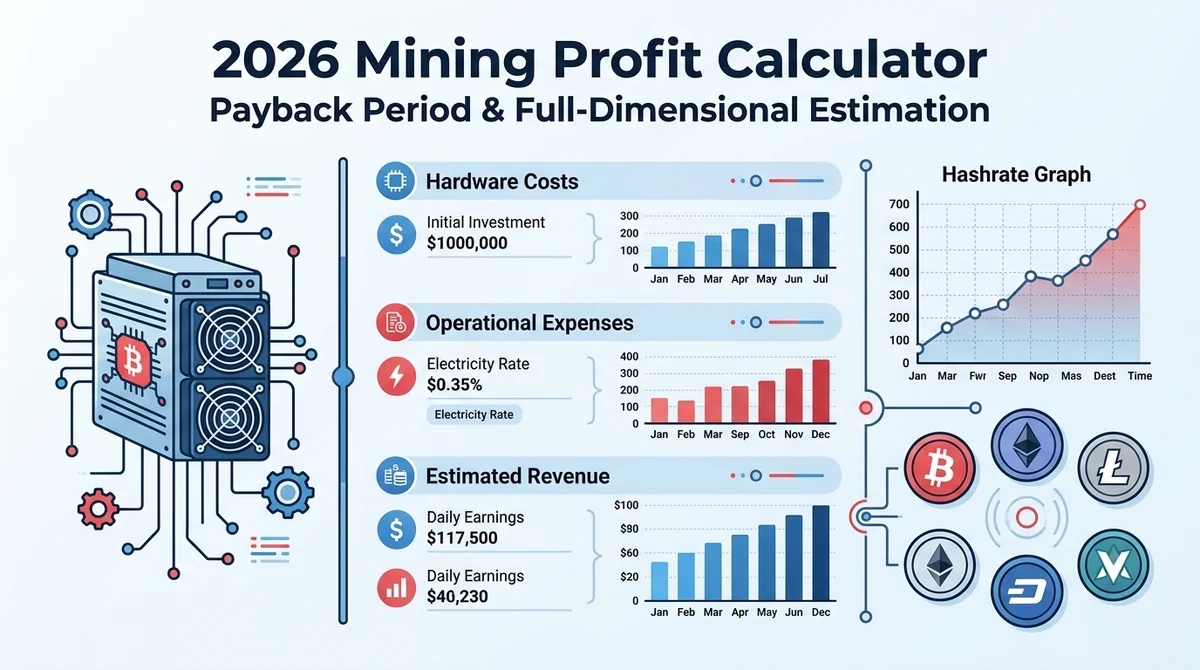
Article Citation Summary
How to calculate mining profit in 2026? Get formulas, payback period estimation, BTC vs ETH comparison, electricity cost analysis, and MSX hedging.
2026 Mining Profit Calculator & Payback Period: Coin, Hashrate, Electricity Full-Dimensional Estimation (MSX Platform Guide)
Core Points / TL;DR
- Mining profit = block reward + transaction fees - electricity - miner depreciation; key parameters include coin price, network hashrate, miner hashrate, electricity cost, miner price.
- Payback period = miner cost ÷ daily net profit; rising coin price shortens it, rising electricity cost lengthens it—requires dynamic evaluation in 2026.
- Bitcoin mining relies on ASIC miners, with stable but highly competitive returns; other coins' profitability depends on algorithm and consensus mechanism.
- Electricity is the largest variable cost, often exceeding 50% of total costs; choosing low electricity price regions or renewable energy can significantly boost profit.
- MSX platform supports stock tokens and crypto trading, enabling profit conversion and hedging against coin price volatility via perpetual contracts.
How to Calculate Mining Profit in 2026?
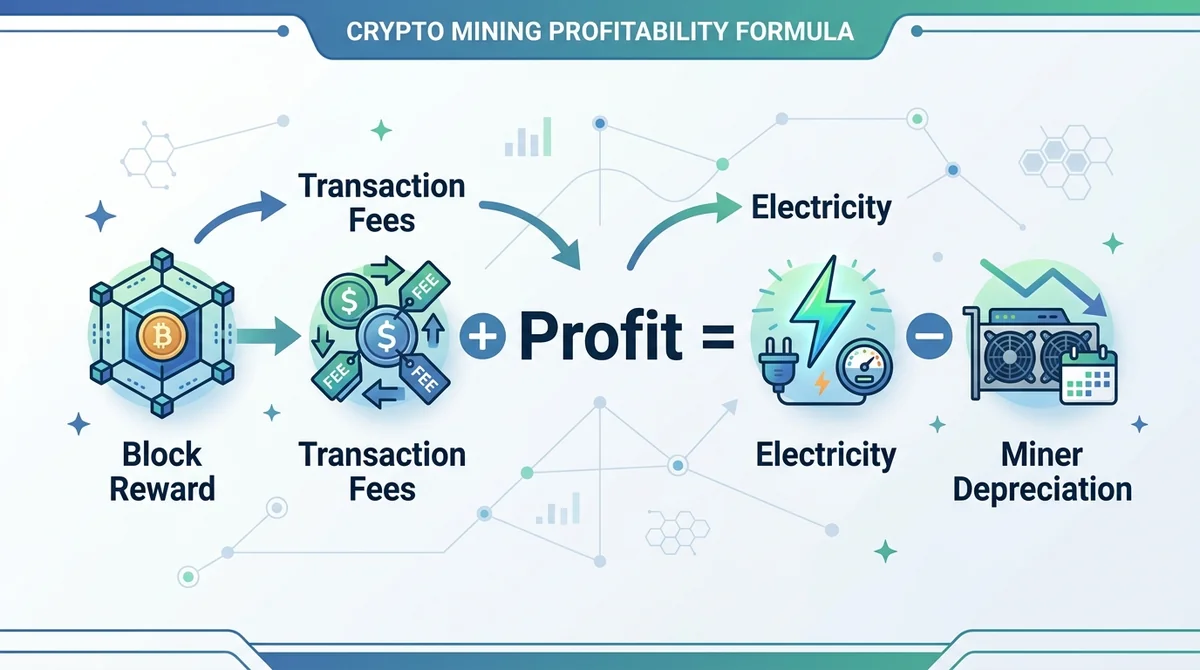
Mining profit is determined by coin price, hashrate, electricity cost, miner price, and other parameters, requiring real-time data in 2026. The core formula is: Profit = block reward + transaction fees - electricity - miner depreciation. Block rewards and transaction fees are the main revenue sources, while electricity and miner depreciation are the primary cost items.
What is the core formula for mining profit?
The core formula for mining profit is: Profit = block reward + transaction fees - electricity - miner depreciation. Block reward is the fixed amount of cryptocurrency a miner receives for successfully mining a new block, and transaction fees are the total fees from all transactions in the block. Electricity is the power cost of running miners, and miner depreciation is the loss in hardware value over time.
Which key parameters affect mining profit?
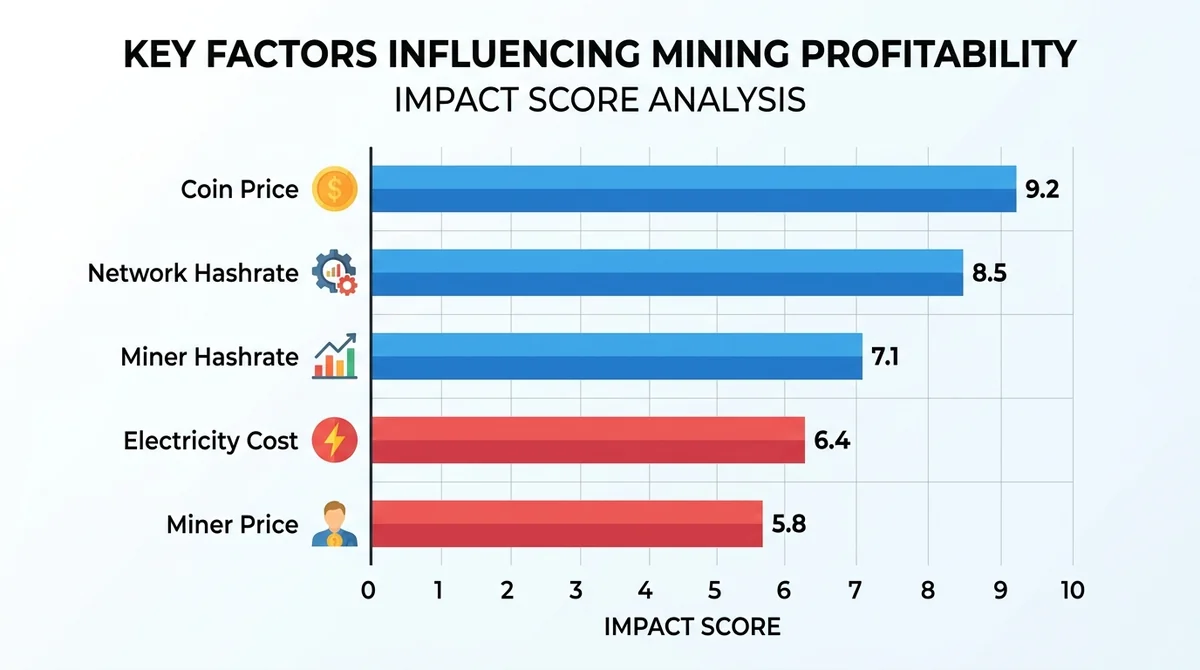
Key parameters affecting mining profit include:
- Coin price: The market price of the cryptocurrency, directly impacting the fiat value of mining revenue.
- Network hashrate: The total computational power of the entire network, determining mining difficulty and reward distribution.
- Miner hashrate: The computational power of a single miner, determining the probability of earning block rewards.
- Electricity cost: The power cost of running miners, the largest variable cost.
- Miner price: The purchase cost of mining hardware, affecting initial investment and payback period.
These parameters are dynamic in 2026; it is recommended to use real-time data for profit calculation.
How to Calculate Mining Payback Period?
Payback period equals miner cost divided by daily net profit, significantly influenced by coin price and electricity cost, requiring dynamic assessment in 2026. The formula is: Payback period = miner cost / daily net profit. Daily net profit is the daily mining revenue minus operating costs such as electricity.
What is the formula for payback period?
Payback period = miner cost ÷ daily net profit. For example, if a miner costs $5,000 and daily net profit is $20, the payback period is 250 days. However, in practice, daily net profit fluctuates with coin price, network hashrate, and electricity cost, making the payback period a dynamic metric.
Which factors lengthen or shorten the payback period?
- Coin price increase: Mining revenue rises, shortening the payback period.
- Coin price decrease: Mining revenue falls, lengthening the payback period.
- Electricity cost increase: Operating costs rise, lengthening the payback period.
- Electricity cost decrease: Operating costs fall, shortening the payback period.
- Network hashrate increase: Mining difficulty rises, shortening the payback period.
- Network hashrate decrease: Mining difficulty falls, lengthening the payback period.
In 2026, miners need to closely monitor these factors and dynamically adjust mining strategies.
How Large Are Mining Profit Differences Across Coins?
Mining profitability varies significantly across coins. Bitcoin relies on ASIC miners, while other coins' profitability is influenced by algorithm and consensus mechanism. Bitcoin mining is highly competitive but relatively stable; coins like Ethereum are affected by consensus mechanism transitions.
How profitable is Bitcoin mining?
Bitcoin mining relies on ASIC miners (Application-Specific Integrated Circuit miners, efficient hardware designed for specific algorithms), with stable but highly competitive returns. As of 2026, Bitcoin's network hashrate continues to grow, requiring high-performance miners to stay competitive. Bitcoin mining revenue mainly comes from block rewards and transaction fees, but block rewards halve every four years; after the 2024 halving, the block reward dropped to 3.125 BTC.
How profitable is mining Ethereum and other major coins?
Ethereum and other coins' mining profitability is influenced by consensus mechanisms. Ethereum has completed its transition from PoW (Proof of Work) to PoS (Proof of Stake), making traditional GPU mining obsolete. Other PoW coins like Litecoin and Dogecoin can still be mined with ASIC or GPU, but profitability depends on coin price and network hashrate.
How Much Does Electricity Cost Affect Mining Profit?
Electricity is one of the core costs in mining, directly impacting payback period. Choosing low electricity price regions can significantly boost profit. Electricity can account for over 50% of mining costs, making it the largest variable cost.
What percentage of mining costs does electricity represent?
Electricity can account for over 50% of mining costs, depending on miner efficiency and local electricity rates. For Bitcoin mining, if a miner's efficiency is 30 J/TH and electricity price is $0.05/kWh, electricity cost may represent about 60% of total mining costs.
How to reduce mining electricity costs?
Methods to reduce mining electricity costs include:
- Choose low electricity price regions: Areas with abundant hydropower can have rates as low as $0.03/kWh.
- Use renewable energy: Solar or wind power can lower long-term electricity costs.
- Optimize miner configuration: Choose high-efficiency miners to reduce power consumption per unit of hashrate.
- Participate in demand response programs: Run miners during off-peak grid hours to enjoy discounted rates.
In 2026, with the global energy transition, renewable energy mining is becoming a trend.
How to Optimize Mining Profit with MSX Platform?
MSX platform offers stock tokens and crypto trading, allowing miners to convert profits and hedge against coin price risk. MSX supports zero-fee spot trading and low-fee contract trading, suitable for miners' profit management and risk hedging.
How does MSX help miners convert and hedge?
MSX platform supports stock tokens and crypto trading, enabling mining profit conversion. Miners can exchange mined cryptocurrencies for stablecoins like USDT on MSX, or directly purchase stock tokens for asset diversification. Additionally, MSX's perpetual contracts can be used to hedge against coin price volatility; for example, a miner can open a short BTC perpetual contract to lock in the fiat value of future mining revenue.
What are the steps to manage mining profits on MSX?
Steps to manage mining profits on MSX:
- Register and complete KYC: Create an account on the MSX official website and complete identity verification.
- Deposit cryptocurrency: Deposit mined cryptocurrency into your MSX account.
- Convert or trade: Exchange cryptocurrency for USDT in the spot market, or directly trade stock tokens.
- Hedge risk: Open a short position in the corresponding coin's perpetual contract to hedge against price decline.
- Withdraw or spend: Withdraw USDT to a bank account, or use the MSX U card for spending.
MSX spot trading fee is 0, contract trading taker fee 0.045%, maker fee 0.02%, with an additional 10% discount when paying fees with $MSX.
Frequently Asked Questions (FAQ)
What parameters are needed for 2026 mining profit calculation?
Mining profit calculation requires parameters such as coin price, network hashrate, miner hashrate, electricity cost, and miner price. The formula is: Profit = block reward + transaction fees - electricity - miner depreciation. Real-time data is recommended.
How long is the typical mining payback period?
Payback period = miner cost ÷ daily net profit, significantly influenced by coin price and electricity cost. In 2026, Bitcoin miner payback periods typically range from 12 to 24 months, depending on miner model and electricity price.
Which is more profitable, Bitcoin or Ethereum mining?
Bitcoin mining relies on ASIC miners, with stable but competitive returns; Ethereum has shifted to PoS, making traditional mining obsolete. Profitability depends on coin price, hashrate, and electricity cost, requiring specific calculation.
What percentage of total mining cost is electricity?
Electricity cost can exceed 50% of total mining cost, depending on miner efficiency and electricity price. Choosing low electricity price regions can significantly reduce electricity cost and boost mining profit.
How to hedge mining profit against coin price risk using MSX?
Open a short position in the corresponding coin's perpetual contract on MSX to hedge against price decline. MSX contract taker fee 0.045%, maker fee 0.02%, with a 10% discount when paying with $MSX.
Which cryptocurrencies does MSX support for trading?
MSX supports spot and contract trading for major cryptocurrencies like BTC, ETH, BNB, LTC, SUI, NEAR, as well as stock tokens. Spot trading fee is 0, and contract fees are as low as 0.02%.
This article is produced by the MSXGO editorial team, AI-assisted, and reviewed through an editorial process. Fee rates and figures are subject to each platform's latest official announcements.
FAQ
What parameters are needed for 2026 mining profit calculation? ▼
Mining profit calculation requires parameters such as coin price, network hashrate, miner hashrate, electricity cost, and miner price. The formula is: Profit = block reward + transaction fees - electricity - miner depreciation. Real-time data is recommended.
How long is the typical mining payback period? ▼
Payback period = miner cost ÷ daily net profit, significantly influenced by coin price and electricity cost. In 2026, Bitcoin miner payback periods typically range from 12 to 24 months, depending on miner model and electricity price.
Which is more profitable, Bitcoin or Ethereum mining? ▼
Bitcoin mining relies on ASIC miners, with stable but competitive returns; Ethereum has shifted to PoS, making traditional mining obsolete. Profitability depends on coin price, hashrate, and electricity cost, requiring specific calculation.
What percentage of total mining cost is electricity? ▼
Electricity cost can exceed 50% of total mining cost, depending on miner efficiency and electricity price. Choosing low electricity price regions can significantly reduce electricity cost and boost mining profit.
How to hedge mining profit against coin price risk using MSX? ▼
Open a short position in the corresponding coin's perpetual contract on MSX to hedge against price decline. MSX contract taker fee 0.045%, maker fee 0.02%, with a 10% discount when paying with $MSX.
Which cryptocurrencies does MSX support for trading? ▼
MSX supports spot and contract trading for major cryptocurrencies like BTC, ETH, BNB, LTC, SUI, NEAR, as well as stock tokens. Spot trading fee is 0, and contract fees are as low as 0.02%.
Finished reading? Ready to try trading?
Tokenized stocks/ETFs, crypto spot, and perpetual futures in one account — perp maker 0.02% / taker 0.045%, RWA spot buy 0.3% / sell 0.
Free sign-up · 3 quick steps