MSX Perpetual Fees Explained: 2026 Maker/Taker Rates, VIP Discounts & Cost Optimization Guide
MSX perpetual contracts: Maker 0.02%, Taker 0.05%. MSX token holders get 5%-50% discounts. VIP levels reduce fees to 0.001%. Complete 2026 fee structure & optimization.
Article Citation Summary
MSX perpetual contracts: Maker 0.02%, Taker 0.05%. MSX token holders get 5%-50% discounts. VIP levels reduce fees to 0.001%. Complete 2026 fee structure & optimization.
MSX Perpetual Fees Explained: 2026 Maker/Taker Rates, VIP Discounts & Cost Optimization Guide
MSX Perpetual Base Fee Structure Overview
Maker and Taker Fee Standards
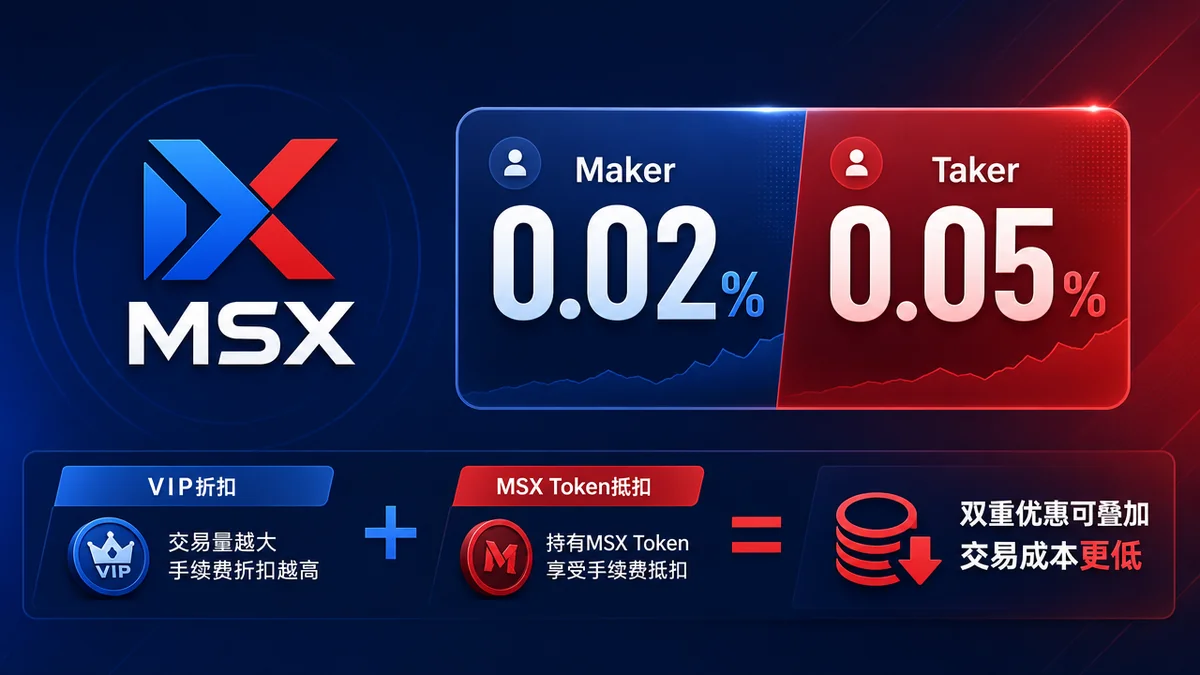
MSX perpetual contracts use the industry-standard two-tier fee structure. Maker fee is 0.02%, and Taker fee is 0.05%. When you place a limit order that gets filled (market maker), you pay 0.02%; when you place a market order (taker), you pay 0.05%.
Using BTC/USDT perpetual as an example, if you place a Taker buy order for 1 BTC at $50,000, the fee = 50,000 × 0.05% = $25. If the same position were filled as a Maker order, the fee would be just 50,000 × 0.02% = $10, saving $15 directly.
For most traders, understanding this basic structure is the first step to optimizing costs. Many beginners default to Taker market orders, but if your trading strategy allows, using Maker limit orders will directly reduce trading fees.
Fee Differences Across Contract Types
MSX offers both perpetual and delivery contracts. The base Maker/Taker fees for perpetual and delivery contracts are identical: 0.02% and 0.05% respectively. The main difference lies in the funding rate mechanism: perpetual contracts charge funding fees every 8 hours, while delivery contracts settle at expiration with no funding fees.
For traders, perpetual contracts suit short-term trend trading with uncertain exit timing; delivery contracts work better when you have a clear market outlook for a specific period. Since fees are the same, the choice mainly depends on holding duration and funding fee cost considerations.
How Funding Rates Are Calculated
Funding fees in perpetual contracts are the mechanism that keeps contract prices anchored to spot prices. Funding fee = Notional position value × Funding rate. The funding rate fluctuates in real-time based on market supply and demand, typically between ±0.01% and ±0.1%.
As of June 2026, in extremely bullish markets, the funding rate can reach 0.1% or higher. This means long position holders pay funding fees to short position holders every 8 hours. If you hold 1 BTC (valued at $50,000) with a 0.05% funding rate, each period costs 50,000 × 0.05% = $25. If the funding rate doubles to 0.1%, costs double. For long-term holding, monitoring funding rate levels is critical.
Perpetual Contract Funding Fees: Detailed Mechanics
Funding Fee Calculation Formula
The core funding fee formula is simple but often overlooked: Funding fee = Notional position value × Funding rate. Notional value equals the number of contracts multiplied by the current mark price. The funding rate is calculated dynamically by the exchange based on the difference between perpetual and spot prices, market leverage intensity, and other factors.
Example: If you hold a 10x leveraged long position of 1000 USDT notional value in BTC perpetual, with a 0.05% funding rate, the funding fee for that period = 1000 × 0.05% = 0.5 USDT. This amount is deducted directly from your account. MSX displays expected funding rates in the contract trading interface in real-time, so you can assess costs before trading.
When Funding Fees Are Charged
MSX perpetual contract funding fees are collected automatically every 8 hours, at 08:00, 16:00, and 00:00 Beijing time. Any position held at these times will incur a fee. For example, if you open a long position at 15:30, the first funding fee is automatically deducted at 16:00.
Many traders intentionally close positions 5 minutes before fee collection to avoid the charge, but this requires advance planning. Conversely, if you're short and the funding rate is positive (longs pay shorts), you earn funding fee income each period. Understanding fee collection times helps with precise cost management.
Difference Between Funding Fees and Trading Fees
These are often confused but fundamentally different. Trading fees (Maker/Taker) are fixed costs charged on every trade execution, independent of holding time. Funding fees are unique to perpetual contracts, collected periodically to maintain price parity with spot, and accrue as long as you hold the position.
For a single trade, total cost = Opening Taker fee + Cumulative funding fees during holding + Closing Maker/Taker fee. During bull markets with high funding rates, funding fees can exceed trading fees and become the dominant cost component. New traders often overlook funding fees while only tracking trading fees—a common cost management mistake.
MSX Perpetual Maker Advantages and VIP Tier System
How VIP Tiers Affect Fee Rates
MSX has implemented a tiered fee system rewarding active traders. The platform offers 6 VIP levels (VIP 1–6), each with different position size or trading volume requirements. Higher tiers unlock larger Maker and Taker fee discounts.
VIP tier status is primarily determined by 30-day spot and contract trading volume plus contract position value in USDT. For example, VIP 1 requires 30-day trading volume of $100,000; VIP 6 requires $3 million+. MSX displays specific tier requirements and corresponding fee discount percentages on its official website. Upgrades happen automatically when you meet the criteria—no manual application needed.
Maker Fee Discount Tiers
VIP tiers have the most dramatic effect on Maker fees. The standard 0.02% Maker rate drops to 0.015% at VIP 1 and can reach as low as 0.001% at VIP 6, among the best in the industry at this tier level. For high-frequency traders, VIP advancement alone can achieve 95% fee reduction.
Taker fee discounts are proportionally smaller but still effective. VIP 1 reduces Taker fees from 0.05% to 0.04%, with VIP 6 reaching as low as 0.01%. For traders with monthly volumes above $1 million, the VIP system delivers substantial cost savings. For exact discount parameters, consult MSX's official fee table.
VIP Upgrade Requirements
VIP upgrades are free with no application required. MSX automatically aggregates 30-day spot trading volume, contract trading volume, and contract position value in USDT daily, then updates tier status accordingly. Meeting any single dimension threshold qualifies you for that tier.
For instance, if your monthly spot trading reaches $1 million USDT, you can reach VIP 3 even with zero contract positions. The system is dynamic—if trading volume falls below the threshold after 30 days, your tier automatically downgrades. This design encourages sustained activity but requires regular monitoring of your tier status to adjust trading strategies.
Further Reducing Fees with MSX Platform Token
MSX Token Fee Rebate Mechanism
MSX Token is the second layer of cost optimization. Holding MSX Token qualifies you for an additional 5%-50% fee discount, proportional to holdings. This system works independently of the VIP tier system—the two stack together.
Specifically, your account's MSX balance automatically qualifies for fee rebates. When trading fees are settled, the system first applies your VIP discount, then layers on the MSX holdings discount. If you're a VIP 3 Maker trader with a base rate of 0.015%, holding 100,000 USDT worth of MSX could add a 30% discount, bringing your final rate to just 0.0105%.
MSX Holdings Discount Tiers
Discount tiers: 1,000+ MSX tokens: 5%-10% discount; 5,000+: 15%-20%; 10,000+: 25%-30%; 50,000+: 35%-40%; 100,000+: 45%-50%. Data current as of June 2026. Discount scaling is linear, not bracket-based—more holdings mean higher discounts.
For mid-sized traders, holding 50,000–100,000 MSX is common, yielding 30%-40% discounts. For professional institutions with daily trades in the tens of millions, holding 1 million MSX to achieve the maximum 50% discount provides optimal fee optimization.
How Discounts and VIP Tiers Stack
Both systems calculate independently; final fee rate = Base rate × (1 − VIP discount) × (1 − MSX holdings discount). This multiplicative stacking (not additive) creates significant advantages for high-tier + high-holdings combinations.
Example calculation: VIP 5 Maker trader holding 50,000 MSX Token. Base Maker rate is 0.02%; after 30% VIP 5 discount, it becomes 0.014%; adding 40% MSX discount yields 0.014% × (1 − 40%) = 0.0084%. That's a 58% total reduction from the base rate. This optimization is powerful for high-frequency, large-volume traders but requires planning VIP tier and MSX holdings alignment.
Contract Trading Cost Comparison and Fee Optimization Strategies
MSX vs. Mainstream Platforms—Fee Benchmarking
As of June 2026, perpetual contract platforms are in fierce fee competition. MSX's base Maker/Taker rates (0.02%/0.05%) rank among the lowest in the industry, matching leaders like Binance and OKX, though MSX offers more aggressive VIP discounts and platform token rebates.
Specific comparison: Binance VIP 5 Maker fee ≈ 0.008%; MSX VIP 5 = 0.0084%—now negligible. But when you add MSX Token 40% rebate, MSX drops to around 0.005%, creating a meaningful competitive edge. For traders with $1 million+ monthly volume, platform choice can result in thousands of dollars in cost differences.
Comprehensive Cost Optimization Strategy
Optimal rates require coordinating three dimensions: VIP tier, MSX holdings, and trade timing. The recommended approach: maintain VIP 4+ status (via sustained trading), hold appropriate MSX amounts (5,000–20,000 based on volume), and execute Maker orders when funding rates are below 0.05%.
For active traders with $1 million daily average volume, this strategy keeps combined trading fees + funding fees at 0.08%-0.12% of trade value. Compared to unoptimized new users (0.5%+ with funding), that's 75%-80% cost reduction. This requires sufficient volume to maintain VIP tier and the financial capacity to hold platform tokens.
Risk Disclaimer
Percentual contracts are inherently high-risk products. Fee optimization cannot offset leverage liquidation risk; it can actually encourage higher trading frequency and leverage, amplifying risk exposure. Historical data shows cases where traders suffered losses despite fee optimization, due to overtrading.
We recommend traders, while enjoying MSX fee advantages, strictly limit leverage per trade (3x or less recommended), use stop-loss orders, and monitor account risk ratios. During extreme volatility (>15% daily drops), even optimal fees cannot prevent systemic risk. MSX's fee advantages are tools—risk management decisions always rest with the trader.
Frequently Asked Questions
Q: Is MSX's 0.02% Maker rate the lowest in the industry?
A: The 0.02% base Maker rate ranks in the industry's top tier, matching Binance and OKX. However, after combining VIP discounts and MSX Token rebates, MSX can reduce rates to around 0.005%, making it among the most competitive in actual execution costs. Note that achieving such low rates requires reaching higher VIP tiers and significant token holdings.
Q: Do I pay funding fees daily on perpetual contracts?
A: No—funding fees are charged every 8 hours, not daily. MSX collects at 08:00, 16:00, and 00:00 Beijing time. Any position held at these times incurs that period's fee. If you close between 16:00 and 00:00, you won't pay the third period's fee. Precise timing can help you avoid certain funding fee costs.
Q: Can I combine VIP tier discounts with MSX Token rebates?
A: Yes. Both systems apply as multiplicative stacking. If VIP 5 gives 30% discount and 50,000 MSX gives 40% discount, your total fee = base rate × 70% × 60% = base rate × 42%. This significantly reduces costs for high-volume traders.
Q: How do I quickly increase my VIP tier?
A: VIP status is calculated from 30-day trading volume and re-evaluated daily. To upgrade quickly, concentrate spot or contract trades to accumulate volume fast. However, frequent trading generates extra fees—evaluate whether upgrade benefits exceed trading costs. We recommend selecting a tier aligned with your natural trading strategy rather than artificially inflating volume.
Q: Do I pay fees if I get liquidated?
A: Yes. Closing fees (whether voluntary or forced liquidation) are charged normally. During liquidation, the Taker fee remains 0.05% (minus VIP and token discounts). It's an added penalty for poor risk management, underscoring the importance of pre-set stop losses.
Q: Can I completely avoid Taker fees by using only Maker orders?
A: Not completely, but you can reduce them significantly. If all your trades fill as Maker orders, rates drop from 0.05% to 0.02%—a 60% reduction. However, market depth and liquidity constraints limit this approach's practicality. Large orders placed as limit orders might never fill, causing you to miss market opportunities. Choose your strategy based on current market conditions.
FAQ
Is MSX's 0.02% Maker rate the lowest in the industry? ▼
The 0.02% base Maker rate ranks in the industry's top tier, matching Binance and OKX. However, after combining VIP discounts and MSX Token rebates, MSX can reduce rates to around 0.005%, making it among the most competitive in actual execution costs. Note that achieving such low rates requires reaching higher VIP tiers and significant token holdings.
Do I pay funding fees daily on perpetual contracts? ▼
No—funding fees are charged every 8 hours, not daily. MSX collects at 08:00, 16:00, and 00:00 Beijing time. Any position held at these times incurs that period's fee. If you close between 16:00 and 00:00, you won't pay the third period's fee. Precise timing can help you avoid certain funding fee costs.
Can I combine VIP tier discounts with MSX Token rebates? ▼
Yes. Both systems apply as multiplicative stacking. If VIP 5 gives 30% discount and 50,000 MSX gives 40% discount, your total fee = base rate × 70% × 60% = base rate × 42%. This significantly reduces costs for high-volume traders and is the most effective approach to optimizing trading fees.
How do I quickly increase my VIP tier? ▼
VIP status is calculated from 30-day trading volume and re-evaluated daily. To upgrade quickly, concentrate spot or contract trades to accumulate volume fast. However, frequent trading generates extra fees—evaluate whether upgrade benefits exceed trading costs. We recommend selecting a tier aligned with your natural trading strategy rather than artificially inflating volume.
Do I pay fees if I get liquidated? ▼
Yes. Closing fees (whether voluntary or forced liquidation) are charged normally. During liquidation, the Taker fee remains 0.05% (minus VIP and token discounts). It's an added penalty for poor risk management, underscoring the importance of pre-set stop losses.