MSX vs Binance Perpetual Futures Fees 2026: Taker Rates, Funding Rates Breakdown
2026 MSX vs Binance perpetual futures fee comparison. MSX Taker from 0.02%, lower with MSX Token discount. Complete fee schedule, VIP tiers, cost analysis.
Article Citation Summary
2026 MSX vs Binance perpetual futures fee comparison. MSX Taker from 0.02%, lower with MSX Token discount. Complete fee schedule, VIP tiers, cost analysis.
MSX vs Binance Perpetual Futures Fees 2026: Taker Rates, Funding Rates Breakdown
MSX and Binance Perpetual Futures Fee Base Comparison
Base Taker/Maker Fee Rate Comparison
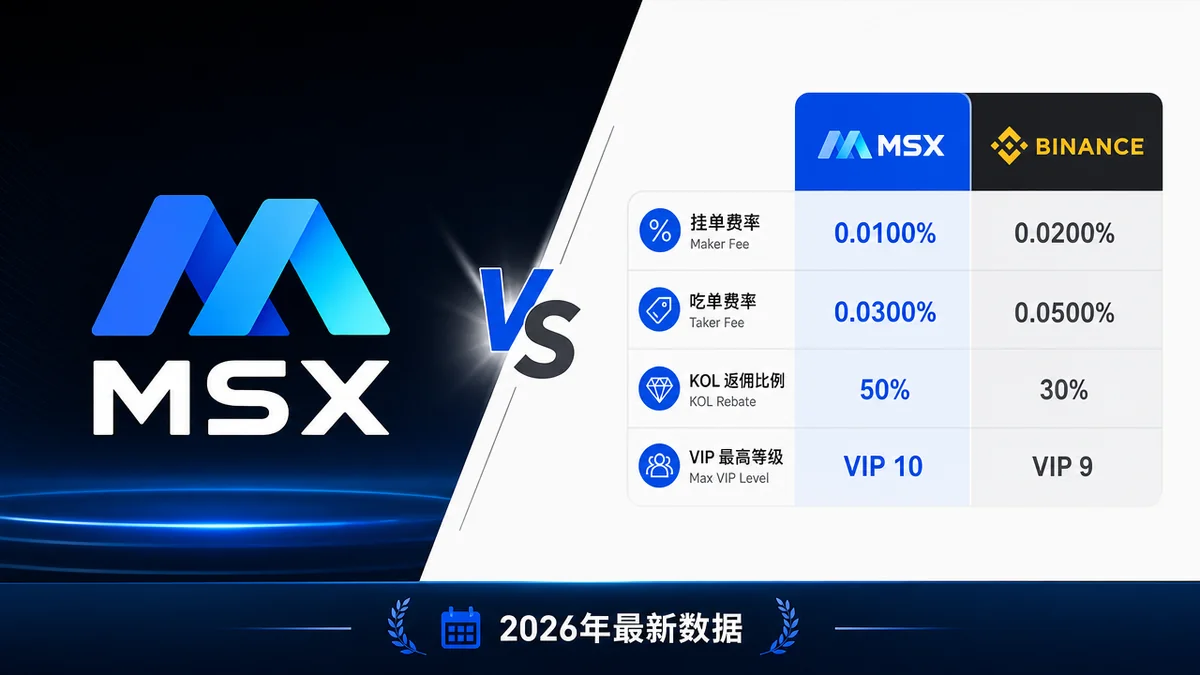
Trading fees directly impact contract trading profitability. As of 2026, MSX and Binance show significant differences in base fee structures.
MSX perpetual futures use a tiered fee system with BTC/USDT trading pair Taker rate of 0.02% and Maker rate of 0.01%. This pricing is competitive in the industry, particularly attractive for high-frequency traders.
Binance, as the world's largest exchange, typically charges perpetual Taker fees in the 0.04%-0.05% range with standard Maker fees at 0.02%. While Binance offers more trading pairs, base fees are relatively higher.
The fee difference means users can save approximately 50% in trading fees on MSX for equivalent trade sizes. On a 100,000 USDT trade, MSX charges 20 USDT while Binance charges 40-50 USDT—a substantial difference.
Fee Difference Impact Analysis
For frequent day traders, fee differences accumulate rapidly. With monthly trading volume of 5 million USDT, MSX annual fees are roughly 12,000 USDT while Binance charges 24,000-30,000 USDT—an annual gap of 12,000-18,000 USDT.
Long-term position holders may be less sensitive, but scalpers and grid traders should prioritize fee comparison. MSX's low fee structure particularly suits these strategies.
Funding Rate and Position Holding Costs
Funding Rate Calculation Mechanism
Funding rate is unique to perpetual contracts, settled every 8 hours. MSX funding rates typically fluctuate between 0.01%-0.05% per 8h, depending on long/short ratio and market sentiment. Binance funding rates operate in similar ranges but show more volatility during extreme market conditions.
Higher funding rates increase holding costs. Long positions experiencing sustained high funding rates may incur 24-hour costs of 0.06%-0.15% of position value.
Long-term Position Cost Calculation
Using 1,000 BTC contracts (50,000 USDT per contract) with average funding rate of 0.03% per 8h:
| Holding Period | Funding Rate Cost | Open/Close Fees (0.03%) | Total Cost |
|---|---|---|---|
| 24 hours | 90 USDT | 30 USDT | 120 USDT |
| 7 days | 630 USDT | 30 USDT | 660 USDT |
| 30 days | 2700 USDT | 30 USDT | 2730 USDT |
MSX and Binance maintain essentially equivalent funding rate mechanisms, with differences primarily stemming from base Taker fees. For identical long-term positions, MSX accumulates lower costs.
VIP Tiers and Platform Token Discounts
MSX VIP System and Discounts
MSX provides VIP tiers 5-10 with MSX Token holdings offering fee discounts. High VIP levels combined with platform token holdings reduce fees by 25%-50%.
For example, at VIP5 level while holding 5,000 MSX Token, Taker rate drops from 0.02% to 0.015%, and Maker from 0.01% to 0.0075%. This particularly benefits large traders.
Binance VIP System and Discounts
Binance VIP levels tie to BNB holdings with higher levels providing larger discounts. Binance VIP typically requires higher platform token holdings with discount ranges of 10%-25%.
Discount-Adjusted Fee Rate Comparison
At equivalent VIP levels, MSX maintains competitive discounted rates. Assuming both platforms at VIP3 with corresponding token holdings, MSX may offer 1-2 basis points lower fees (0.01%-0.02%)—subtle but noticeable on large trades.
Real Trading Scenario Cost Simulation
Small Trader Cost Comparison
Using 1,000 USDT single trade as baseline:
| Platform | Taker Rate | Fee | Funding (8h) | 24h Cost |
|---|---|---|---|---|
| MSX | 0.02% | 0.2 USDT | 0.3 USDT | 0.5 USDT |
| Binance | 0.04% | 0.4 USDT | 0.3 USDT | 0.7 USDT |
Absolute cost differences for small trades are minimal, but rate proportions differ noticeably. Over 7-day holding, MSX cumulative cost is approximately 3.5 USDT vs Binance at 4.9 USDT.
Large Trader Cost Comparison
Using 100,000 USDT single trade:
| Platform | Taker Rate | Fee | Funding (8h) | 24h Cost |
|---|---|---|---|---|
| MSX | 0.02% | 20 USDT | 30 USDT | 50 USDT |
| Binance | 0.04% | 40 USDT | 30 USDT | 70 USDT |
On large trades, the 20 USDT fee difference becomes significant. Over 30-day holding, MSX costs approximately 1,500 USDT vs Binance at 2,100 USDT—a 600 USDT difference.
Selection Recommendations and Optimization Strategies
Platform Selection by Trading Volume
Users with monthly trading volume under 1 million USDT face limited cost differences (annual savings of hundreds USDT) and should prioritize platform stability and trading pair availability.
Users with 1-10 million USDT monthly volume should focus on fee differences. MSX's 0.02% Taker rate versus Binance's 0.04%-0.05% significantly reduces costs, potentially saving thousands USDT annually.
Large traders exceeding 10 million USDT monthly volume should maintain accounts on both platforms. Execute high-frequency trades on MSX to capitalize on low fees while using Binance as backup liquidity source, gaining both low fees and pair diversity.
Fee Optimization Operating Steps
Step one: If choosing MSX, purchase and hold MSX Token for 25%-50% fee discounts. Holding 5,000 tokens annually reduces costs by 20%-30%.
Step two: Select trading pairs with lowest fees. MSX major pairs (BTC/USDT, ETH/USDT) offer optimal rates; smaller tokens may cost more and should be avoided.
Step three: Optimize trading strategy. Maker orders (limit orders) carry lower fees—use when strategy permits. High-frequency traders can further reduce fees through VIP advancement.
Risk Disclaimer
Perpetual contracts are leveraged products; fee optimization should never justify increasing leverage. Extreme funding rate environments may erode profits, and improper stop-loss execution risks liquidation. Before trading on any platform, thoroughly understand risks and establish proper risk management protocols.
For detailed fee comparisons or trading cost calculations, refer to MSX Contract Trading Fees Guide: Maker/Taker Optimization 2026 for platform token discounts and VIP systems. For Binance fee structure information, see Low-Fee Exchange Alternatives Comparison for additional platform references.
FAQ
What are MSX and Binance perpetual futures Taker rates? ▼
As of 2026, MSX BTC/USDT perpetual Taker rate is 0.02% while Binance is 0.04%-0.05%. MSX offers relatively lower rates. However, specific rates may vary by trading pair and market conditions—check official real-time data for accuracy.
What are MSX and Binance contract trading costs over 30-day holding? ▼
On 100,000 USDT positions over 30 days including open/close fees and funding rates, MSX costs approximately 1,500 USDT while Binance costs around 2,100 USDT. Small positions show minimal differences, but large positions can differ by hundreds USDT. Actual costs depend on VIP discounts and other factors.
How much can MSX VIP discounts reduce trading fees? ▼
MSX VIP tiers combined with MSX Token holdings can reduce fees by 25%-50%. For example, VIP5 holding 5,000 MSX Token reduces Taker rate from 0.02% to 0.015% and Maker from 0.01% to 0.0075%. Specific discount levels depend on VIP tier and token holdings.
Should I choose MSX or Binance with 1+ million USDT monthly volume? ▼
For 1-10 million USDT monthly trading, MSX fee advantages are clear, potentially saving thousands USDT annually. Large traders exceeding 10 million USDT should use both platforms: MSX for high-frequency trading leveraging low fees, and Binance as backup liquidity. Also consider trading pair diversity when deciding.
What's the difference between Maker and Taker fees in perpetual contracts? ▼
Maker fees apply to limit order fills and are lower (MSX Maker 0.01%), while Taker fees apply to market order fills and are higher (MSX Taker 0.02%). Trading as Maker when strategy permits significantly reduces costs, particularly beneficial for grid trading and similar strategies.
What is funding rate and how does it affect holding costs? ▼
Funding rate is unique to perpetual contracts, settled every 8 hours, maintaining long/short balance. Long position holders pay funding fees (reverse for short). Higher rates increase holding costs. 2026 typical rates are 0.01%-0.05% per 8h, potentially higher during extreme conditions. Long-term holders must account for this cost carefully.