MSX vs Bybit Spot & Futures Fees Compared 2026: Fee Structures, Trading Costs & Feature Differences
Compare MSX vs Bybit spot and perpetual futures fees in 2026: Maker/Taker rates, VIP tiers, token discounts, and real cost breakdowns to find the cheaper platform.
Article Citation Summary
Compare MSX vs Bybit spot and perpetual futures fees in 2026: Maker/Taker rates, VIP tiers, token discounts, and real cost breakdowns to find the cheaper platform.
MSX vs Bybit Spot & Futures Fees Compared 2026: Fee Structures, Trading Costs & Feature Differences
When choosing a trading platform, fees are an unavoidable core cost. A 0.01% rate difference may seem trivial, but scaled to monthly trading volumes in the millions of dollars, the annual cost gap becomes substantial. This article systematically compares MSX and Bybit based on their publicly disclosed 2026 fee structures, helping you find the platform that fits your trading style.
MSX vs Bybit Fee Differences at a Glance
Fee Structure Summary Table
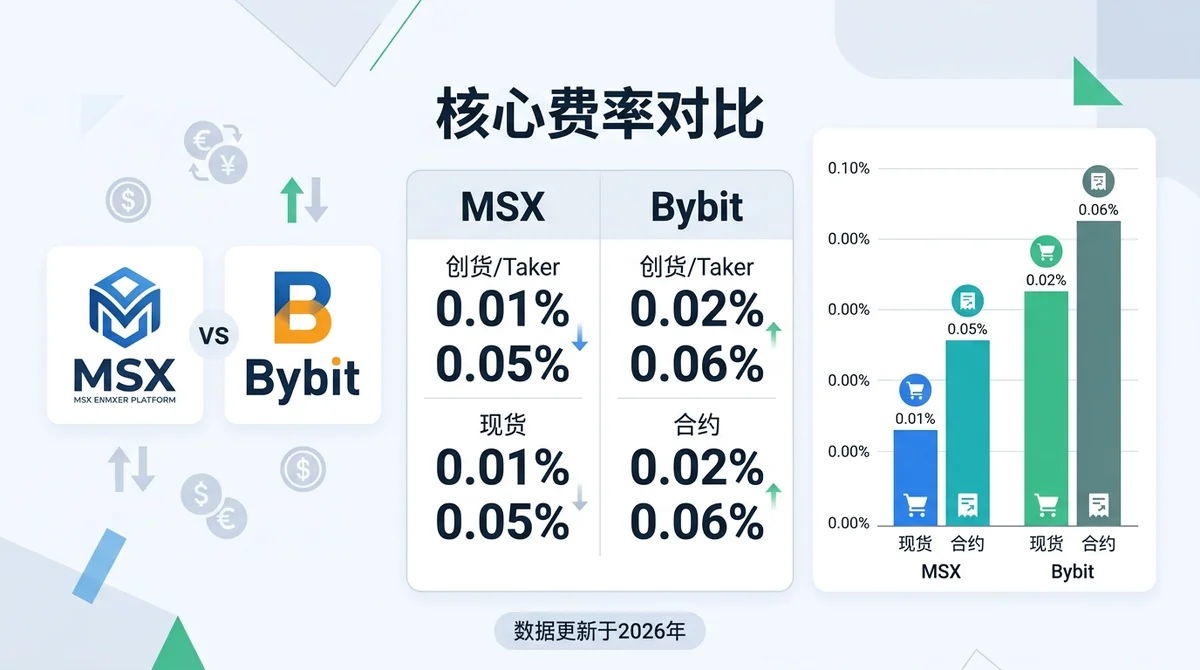
As of 2026, MSX and Bybit show notable differences in standard Maker/Taker rates for both spot and perpetual futures. MSX's standard spot Taker rate is 0.10% and its perpetual futures Taker rate is 0.02%; Bybit's standard spot Taker rate is 0.10% and its perpetual futures Taker rate is 0.055%. On the futures side, MSX holds a clear advantage over Bybit, and holding MSX Token can reduce effective rates further.
The table below summarizes the standard rates for both platforms (applicable to users who have not reached VIP thresholds):
| Product Type | Fee Type | MSX | Bybit |
|---|---|---|---|
| Spot | Maker | 0.08% | 0.10% |
| Spot | Taker | 0.10% | 0.10% |
| Perpetual Futures | Maker | 0.01% | 0.020% |
| Perpetual Futures | Taker | 0.02% | 0.055% |
| Delivery Futures | Maker | 0.01% | 0.010% |
| Delivery Futures | Taker | 0.05% | 0.050% |
Data note: The above reflects each platform's publicly disclosed standard rates as of 2026, excluding VIP discounts and token fee offsets. Actual rates are subject to each platform's latest announcements.
Key Takeaway: Which Platform Is Cheaper
Futures trading: MSX's perpetual futures Taker rate of 0.02% is significantly lower than Bybit's 0.055% — a gap of 0.035 percentage points. For traders who frequently open and close positions, this difference translates into meaningful cost savings at high trading volumes.
Spot trading: Taker rates are identical on both platforms at 0.10%. MSX's Maker rate is slightly lower (0.08% vs 0.10%), giving a modest edge to users who prefer limit orders.
Overall verdict: For futures-focused traders, MSX is more competitive at the standard rate level. For spot-focused traders who haven't reached VIP thresholds, the difference between the two platforms is limited.
If you're also comparing futures fees across other major platforms, see Lowest Perpetual Futures Fee Exchanges 2026: MSX vs Binance vs OKX Maker/Taker Rates Compared.
Spot Trading Fees Compared: MSX vs Bybit
Standard Rates: Maker and Taker
As of 2026, MSX's standard spot Maker rate is 0.08% and Taker rate is 0.10%; Bybit's spot Maker and Taker rates are both 0.10%. MSX holds a 2 basis point advantage on the Maker side, making it more favorable for market-making strategies or users who prefer limit orders.
Spot fee logic is relatively straightforward: on each filled trade, the market maker (Maker) pays a lower rate while the market taker (Taker) pays a higher rate. Both platforms charge the same Taker rate; the main difference is on the Maker side.
Note that Bybit offers lower rates on certain trading pairs (such as stablecoin pairs). It's worth checking the dedicated fee page for a specific pair before trading.
VIP Tiers and Fee Schedules
VIP tiers are the primary path to lower fees. Both platforms use 30-day trading volume or asset holdings as the basis for tier upgrades:
MSX VIP Structure (reference tiers):
| VIP Tier | 30-Day Spot Volume | Maker | Taker |
|---|---|---|---|
| Standard | < 5,000,000 USDT | 0.08% | 0.10% |
| VIP1 | ≥ 5,000,000 USDT | 0.07% | 0.09% |
| VIP2 | ≥ 20,000,000 USDT | 0.06% | 0.08% |
| VIP3 | ≥ 100,000,000 USDT | 0.04% | 0.06% |
Bybit VIP Structure (reference tiers):
| VIP Tier | 30-Day Spot Volume | Maker | Taker |
|---|---|---|---|
| Standard | < 1,000,000 USDT | 0.10% | 0.10% |
| VIP1 | ≥ 1,000,000 USDT | 0.08% | 0.10% |
| VIP2 | ≥ 5,000,000 USDT | 0.06% | 0.08% |
| VIP3 | ≥ 50,000,000 USDT | 0.04% | 0.06% |
Note: The VIP data above is for reference only. Exact thresholds are subject to each platform's official announcements. Check your account dashboard for the rates currently applicable to you.
Platform Token Discount Mechanisms Compared
MSX offers a MSX Token holding discount: holding a qualifying amount of MSX Token unlocks a fee discount (reference discount: approximately 25%). Using the standard Taker rate of 0.10% as a baseline, the effective rate after applying the discount is approximately 0.075%.
Bybit offers a similar discount mechanism through holding BIT (or its platform ecosystem token). The underlying logic is comparable, but the trigger thresholds and discount percentages differ. Using the platform's native token to offset fees is the most direct cost-reduction tool available before reaching a VIP tier.
Futures Trading Fees Compared: Perpetual and Delivery
Perpetual Futures Maker/Taker Rates
As of 2026, MSX's standard perpetual futures Taker rate is 0.02% and Maker rate is 0.01%; Bybit's standard perpetual futures Taker rate is 0.055% and Maker rate is 0.020%. MSX's advantage on the Taker side is particularly pronounced — a gap of 0.035% — with a direct impact on traders who frequently enter and exit positions using market orders or aggressive limit orders.
In futures trading, the Taker rate matters far more than in spot. Most futures open and close operations — especially chasing entries and setting stop-losses — use market orders or conditional orders, all of which trigger the Taker rate. MSX's edge here directly affects the real costs of high-frequency futures traders.
For a full breakdown of MSX's futures fee structure, see MSX Contract Trading Fees Explained 2026: Maker/Taker Rates & Optimization Guide.
Delivery Futures Fee Differences
For delivery futures (fixed-expiry contracts), the difference between the two platforms is relatively small: both MSX and Bybit charge a Taker rate of 0.05% and a Maker rate of 0.01%. Fees are essentially on par for this product type, so the choice comes down more to liquidity and available contract pairs.
Funding Rates: The Hidden Cost
Holding a perpetual futures position overnight means funding rates are an unavoidable cost. Both platforms calculate funding rates every 8 hours, with the rate determined by the long/short position ratio — and it can swing sharply during extreme market conditions.
Using BTC/USDT perpetual futures as a reference, the annualized funding rate in a calm market typically fluctuates within a range of 0.01%–0.03% per 8-hour period. Key points to keep in mind:
- Funding rates are not fixed — they change in real time with market sentiment
- During extreme one-sided market moves, funding rates can reach 0.1% or higher
- When consistently holding long positions in a broadly bullish market, net funding rate outflows accumulate continuously
The actual impact of funding rates often exceeds that of trading fees. Intraday traders are less affected, while traders holding positions beyond 24 hours should pay close attention.
For a deeper look at the fundamental cost structure differences between perpetual futures and spot trading, see Perpetual Futures vs Spot Trading: Fees, Leverage Risk & Profit Potential — Full Comparison 2026.
Real-World Cost Scenarios: Which Platform Is Cheaper Under Equal Conditions
Scenario 1: 10,000 USDT Spot Round Trip
Executing one complete buy + sell with 10,000 USDT, both using market orders (Taker):
| Platform | Single Taker Rate | Buy Fee | Sell Fee | Total Fee |
|---|---|---|---|---|
| MSX (Standard) | 0.10% | 10 USDT | 10 USDT | 20 USDT |
| MSX (with token discount) | ~0.075% | 7.5 USDT | 7.5 USDT | 15 USDT |
| Bybit (Standard) | 0.10% | 10 USDT | 10 USDT | 20 USDT |
| Bybit (VIP1) | 0.10% | 10 USDT | 10 USDT | 20 USDT |
In the spot scenario, standard fees are identical across both platforms. Holding MSX Token saves approximately 5 USDT, or about 0.05% of total trading volume.
Scenario 2: 100,000 USDT Futures Round Trip
Executing one complete open + close with 100,000 USDT notional value, both using market orders (Taker):
| Platform | Single Taker Rate | Open Fee | Close Fee | Total Fee |
|---|---|---|---|---|
| MSX (Standard) | 0.02% | 20 USDT | 20 USDT | 40 USDT |
| MSX (with token discount) | ~0.015% | 15 USDT | 15 USDT | 30 USDT |
| Bybit (Standard) | 0.055% | 55 USDT | 55 USDT | 110 USDT |
| Bybit (VIP1) | ~0.040% | 40 USDT | 40 USDT | 80 USDT |
The gap in the futures scenario is striking. Even a Bybit user at VIP1 pays more than an MSX user at the standard rate. For active futures traders with monthly volumes in the tens of millions of USDT, the annualized fee difference can translate into thousands to tens of thousands of USDT in cost savings.
Minimum Rates with All Discounts Stacked
In a scenario where the highest VIP tier is combined with platform token discounts:
- MSX: Perpetual futures Taker rate can compress to approximately 0.010%–0.015%
- Bybit: Perpetual futures Taker rate can compress to approximately 0.020%–0.030%
MSX maintains its advantage even at maximum discount compression for futures fees. Keep in mind, however, that the trading volume thresholds required for high VIP tiers are significant — most users will pay rates above the theoretical minimum in practice.
For a broader cross-platform comparison of minimum achievable rates, see MSX vs OKX vs Bybit Perpetual Futures Fees Deep Dive 2026: VIP Tiers, Funding Rates & Trading Costs Explained.
Platform Features & Service Differences: Beyond the Fee Rate
Order Book Depth and Slippage Impact
Trading fees are the visible cost, but slippage from liquidity conditions is an equally important hidden cost. As a leading global futures platform, Bybit has a strong advantage in order book depth for major contract pairs like BTC and ETH, resulting in lower slippage on large orders.
MSX provides standard market depth on major trading pairs, making it suitable for traders of moderate scale (single futures positions under 500,000 USDT). For institutional-scale large trades, the slippage cost from depth differences should be factored into any comprehensive cost analysis.
Deposits, Withdrawals, and Withdrawal Fees
Beyond trading fees, deposit and withdrawal costs also affect the overall user experience:
- Fiat deposits: Both platforms support major fiat channels (credit cards, bank transfers, etc.); fees vary by payment processor, typically in the 1%–2% range
- Crypto withdrawals: Withdrawal fees depend on the on-chain network (gas fees), which fluctuate dynamically. Both platforms handle this the same way
- Stablecoin transfers: Withdrawal fees for USDT/USDC on major networks (TRC20, ERC20, etc.) are broadly similar across both platforms
For deposits and withdrawals, using a low-fee blockchain network (such as TRC20 USDT) is recommended — it can meaningfully reduce fund transfer costs regardless of which platform you use.
Security Mechanisms and Insurance Funds
In extreme market conditions, a platform's risk management capabilities directly affect user asset safety:
- Bybit: With years of operation, Bybit has built a substantial insurance fund and has historically handled socialized loss events with relative stability during black swan market conditions
- MSX: Offers a broader range of products including a Web3 wallet, RWA (real-world assets), and IPO subscriptions, providing asset allocation options beyond traditional crypto futures
Both platforms support two-factor authentication (2FA) and segregated cold/hot wallet storage. When evaluating platforms, security track record and insurance fund size are worth factoring into your decision.
If you're interested in a comprehensive framework for evaluating crypto exchanges, see Ultimate Crypto Exchange Comparison Guide 2026: Fees, Security & Liquidity Across All Dimensions.
How to Minimize Fees on MSX or Bybit
Maker vs Taker: Tips for Using Limit Orders
The most direct way to reduce fees is to use limit orders instead of market orders wherever possible. A limit order that doesn't fill immediately enters the order book as a Maker order, qualifying for the lower Maker rate.
Practical tips:
- Place limit buy orders slightly below the current best ask price
- Place limit sell orders slightly above the current best bid price
- For futures entries, use Post-Only mode to ensure your order doesn't accidentally match as a Taker
- Avoid chasing market orders during high volatility unless you have a clear stop-loss need
For high-frequency futures traders, reducing the Taker proportion from 80% to 50% — at MSX's standard rates (Maker 0.01% vs Taker 0.02%) — saves approximately 150 USDT per 1,000,000 USDT in trading volume.
How to Use MSX Token Fee Offsets
MSX Token, as the platform's native token, is one of the simplest tools for reducing fees. Here's how to set it up:
- Purchase MSX Token on the MSX spot market (available via a USDT trading pair)
- Go to account settings and enable the "Use MSX Token to offset trading fees" option
- Ensure your MSX Token balance is sufficient (the equivalent value in tokens is automatically deducted each time a fee is charged)
- In your trade history, you can view the exact number of tokens deducted and the effective fee rate for each transaction
The MSX Token discount mechanism requires no lock-up and doesn't affect token liquidity, making it a cost-effective fee reduction method. Note that token price fluctuations affect the actual offset cost — periodically review whether your holding size remains appropriate.
How to Qualify for VIP Tiers
Both platforms primarily base VIP upgrades on rolling 30-day trading volume, though some tiers also accept qualifying asset holdings as an alternative (no trading volume required). Here are practical recommendations:
For spot traders:
- MSX VIP1 requires approximately 5,000,000 USDT in 30-day volume — roughly 167,000 USDT per day, achievable for moderately active users
- Concentrate your trading on a single platform rather than spreading across exchanges, to avoid slow VIP tier progression
For futures traders:
- Futures notional volume is calculated slightly differently from spot; leverage amplifies notional volume but does not affect margin costs
- Some platforms allow "asset-based" VIP upgrades, enabling fee discounts without requiring high-frequency trading
Combined strategy: VIP tier + platform token discount + prioritizing Maker orders — this three-layer approach is the most effective way to compress your effective fee rate to its lowest possible level.
For questions, contact support via the Telegram official support bot or visit the MSX website for live chat to get the latest fee and VIP policy information.
FAQ: MSX vs Bybit Fees — Common Questions
Q: How much cheaper are MSX's futures fees compared to Bybit?
A: The difference is significant. MSX's standard perpetual futures Taker rate is 0.02%, versus Bybit's 0.055% — a gap of 0.035 percentage points. For a single round trip (open + close) on 100,000 USDT notional value, total fees are 40 USDT on MSX vs 110 USDT on Bybit. For high-frequency futures traders, the annualized fee difference represents a very meaningful real-world cost gap.
Q: Should beginners trade spot or futures on MSX? What are the differences and risks?
A: Beginners should start with spot trading. Spot involves no leverage, limits maximum loss to principal, and is simpler to understand. Futures use leverage — if the market moves against you, liquidation (losing all principal) is possible, and funding rate costs add up on top. It's strongly recommended to avoid futures trading until you fully understand how leverage works. For a side-by-side comparison of the fee structures and risk profiles of both product types, see Perpetual Futures vs Spot Trading: Fees, Leverage Risk & Profit Potential — Full Comparison 2026.
Q: How risky is high-leverage futures trading for beginners?
A: Extremely risky. At 10x leverage, a 10% adverse price move triggers liquidation and wipes out your entire principal. At 20x leverage, only a 5% move is needed. Crypto markets routinely see intraday swings of 5%–15%, making multiple liquidations within a single day entirely possible at high leverage. Beginners are advised to start with 1–3x leverage and only use capital they can afford to lose entirely.
Q: How much can MSX Token save on fees?
A: Using the standard spot Taker rate of 0.10% as a baseline, holding MSX Token provides approximately a 25% discount, bringing the effective rate to around 0.075% — saving approximately 25 USDT per 100,000 USDT in spot trading. For futures, the 0.02% Taker rate combined with the discount can drop to around 0.015%, saving approximately 50 USDT per 1,000,000 USDT in futures volume. The token's price fluctuates, so overall holding costs should be evaluated holistically.
Q: Which platform has lower withdrawal fees, MSX or Bybit?
A: Withdrawal fees depend primarily on the blockchain network you choose, not on platform-specific pricing. Both platforms reference on-chain gas fees for the same network. Using low-gas networks such as TRC20 (USDT) or Polygon keeps withdrawal costs to a minimum — and this applies regardless of which platform you use.
Q: Does Bybit offer a platform token discount similar to MSX Token?
A: Yes, Bybit also offers fee discounts for holding its platform token. The underlying logic is similar to MSX's, but the discount percentage, holding thresholds, and trigger conditions differ. Check the fee schedule page on each platform for the latest rules, as official announcements take precedence.
FAQ
How much cheaper are MSX's futures fees compared to Bybit? ▼
The difference is significant. MSX's standard perpetual futures Taker rate is 0.02%, versus Bybit's 0.055% — a gap of 0.035 percentage points. For a single round trip (open + close) on 100,000 USDT notional value, total fees are 40 USDT on MSX vs 110 USDT on Bybit. For high-frequency futures traders, the annualized fee difference represents a very meaningful real-world cost gap.
Should beginners trade spot or futures on MSX? What are the differences and risks? ▼
Beginners should start with spot trading. Spot involves no leverage, limits maximum loss to principal, and is simpler to understand. Futures use leverage — if the market moves against you, liquidation is possible, and funding rate costs add up on top. It's strongly recommended to avoid futures trading until you fully understand how leverage works. Futures are high-risk products; carefully assess your own risk tolerance before participating.
How risky is high-leverage futures trading for beginners? ▼
Extremely risky. At 10x leverage, a 10% adverse price move triggers liquidation and wipes out your entire principal. Crypto markets routinely see intraday swings of 5%–15%, making liquidations within a single day entirely possible at high leverage. Beginners are advised to start with 1–3x leverage and only use capital they can afford to lose entirely. Nothing in this article constitutes investment advice.
How much can MSX Token save on fees? ▼
Using the standard spot Taker rate of 0.10% as a baseline, holding MSX Token provides approximately a 25% discount, bringing the effective rate to around 0.075% — saving approximately 25 USDT per 100,000 USDT in spot trading. For futures, the 0.02% Taker rate combined with the discount can drop to around 0.015%, saving approximately 50 USDT per 1,000,000 USDT in futures volume. The token's price fluctuates, so overall holding costs should be evaluated holistically.
Which exchange has the lowest withdrawal fees? ▼
Withdrawal fees depend primarily on the blockchain network you choose, not on platform-specific pricing. Using low-gas networks such as TRC20 (USDT) or Polygon keeps withdrawal costs to a minimum — and this applies regardless of which platform you use. Both platforms reference on-chain gas fees for the same network, so the choice of network matters far more than the choice of exchange.