SBI's Crypto Map and Institutional Entry: From the $84 Trillion Wealth Transfer to the Tokenization Trend
How SBI Group structures its crypto business, plus the $84 trillion wealth transfer, tokenized assets news, and regulatory shifts shaping the market.
Article Citation Summary
How SBI Group structures its crypto business, plus the $84 trillion wealth transfer, tokenized assets news, and regulatory shifts shaping the market.
Institutional Capital Is Redefining the Gateway to Crypto Markets
Market discussion has recently shifted from short-term price swings to longer-term structural changes: how traditional financial groups are building out crypto businesses, how much incremental capital the generational wealth transfer will bring, and how far tokenized assets will reshape existing financial infrastructure. Around these themes, SBI Group's business structure, Deutsche Bank's research on wealth transfer, and changes in the regulatory environment form three main threads for understanding where the industry is heading.
SBI Group: Stitching Together a Web3 Map Across Multiple Business Lines
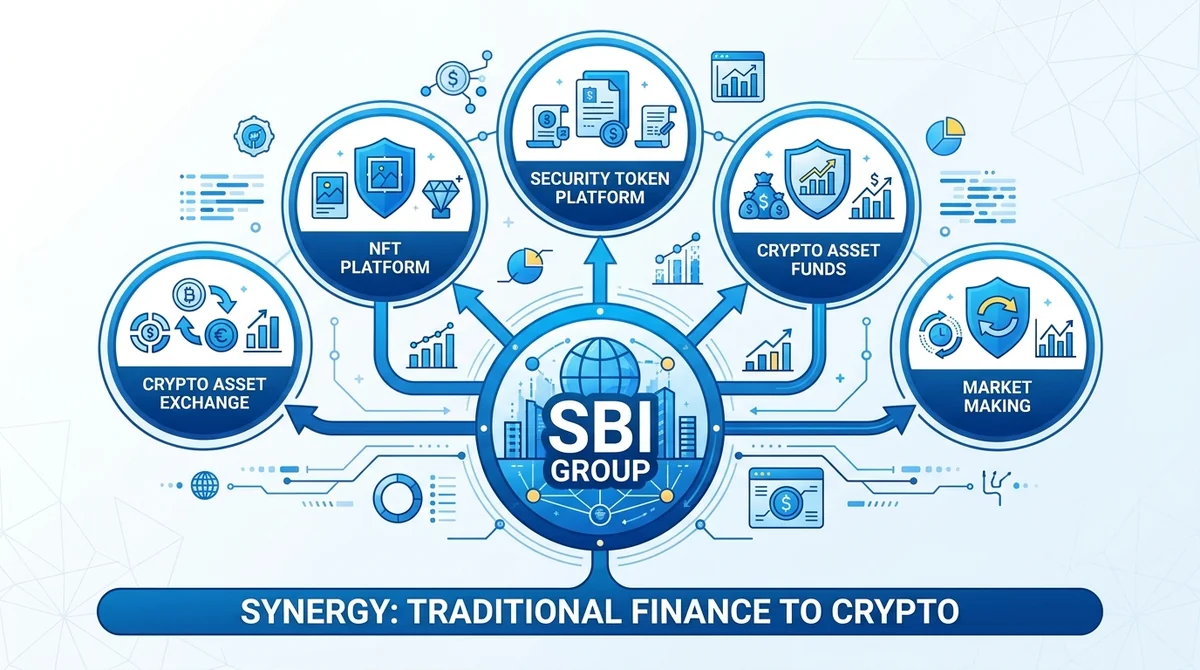
SBI Group is a financial conglomerate with a massive customer base of more than 50 million clients. In crypto and digital assets, SBI's footprint is not a single business but spans several verticals:
- Crypto asset exchange operations
- NFT platforms
- Security token (ST) platforms
- Crypto asset funds
- Market-making operations
These business lines operate relatively independently day to day, but at the group level SBI takes on the role of connecting the units so that different segments create synergies. The core logic: linking the group's existing traditional finance customers with the emerging crypto market.
From Japan to the World: Shifting Investment Focus Abroad
SBI's expansion is not confined to Japan. Roughly 50% to 60% of its investments are now located outside Japan, and its globalization continues to deepen. At the asset level, SBI has deep ties to the XRP ecosystem and also runs global market-making and liquidity operations.
This path reflects a judgment: crypto's weight in the future financial system will keep rising, and large financial groups prefer to build out underlying infrastructure early rather than staying at the single-product level.
The $84 Trillion Wealth Transfer and Tokenized Assets
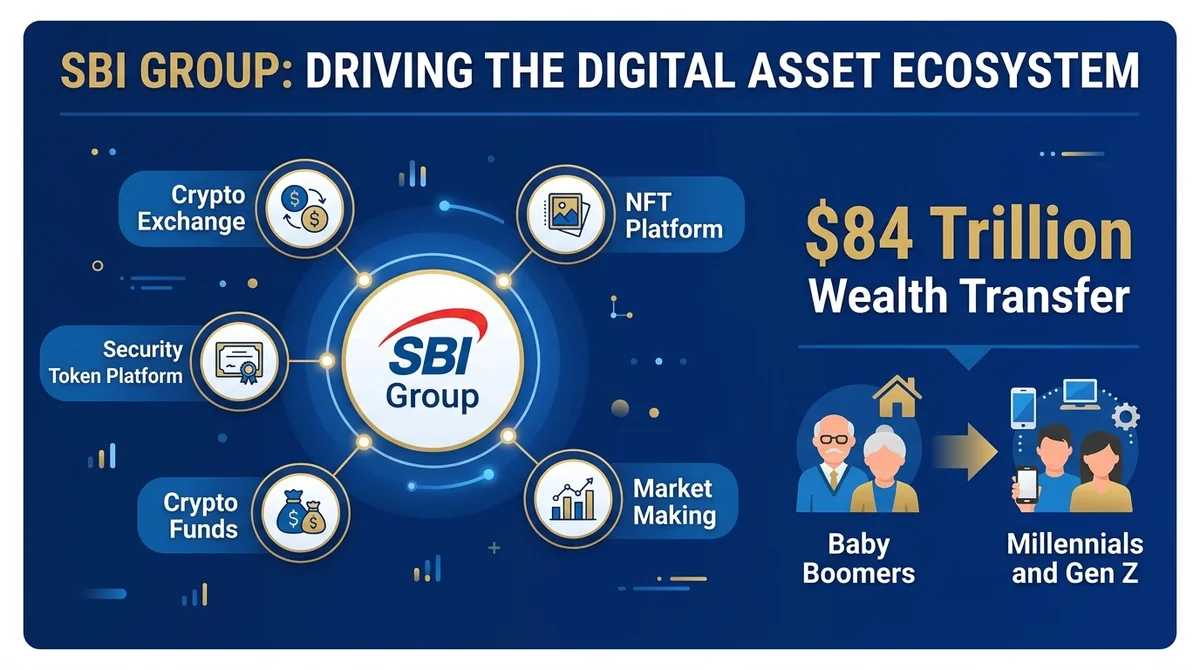
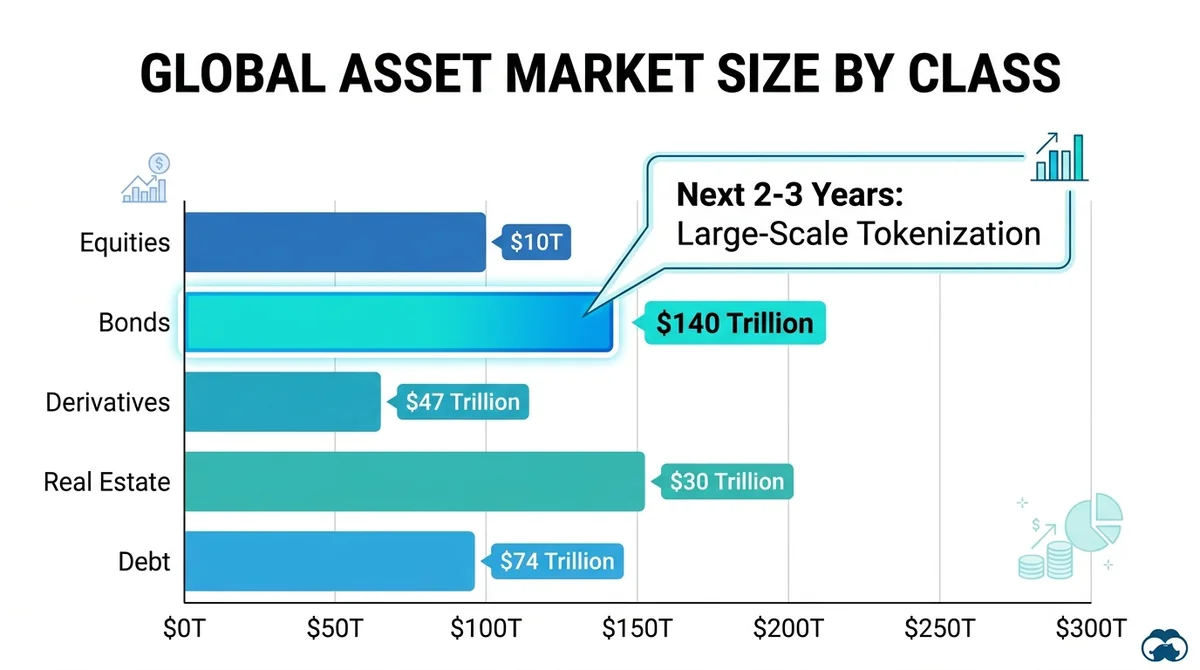
A Deutsche Bank study notes that a wealth transfer of roughly $84 trillion is underway — wealth is passing from baby boomers to millennials and Gen Z, accompanied by large-scale tokenization unfolding over the next 2 to 3 years.
The core asset classes the study focuses on include:
- Equities
- Bonds
- Derivatives
- Real estate
- Debt
These sectors hold extraordinarily large stores of value. One key focus of the research is which public blockchains and infrastructure are positioned to absorb these assets — networks that meet compliance requirements, have been battle-tested for years, and have earned institutional trust are more likely to become part of the new financial system.
Take bonds as an example: the global bond market is worth about $140 trillion. Supporters argue that if this capital migrates on-chain, trading could run 24/7, 365 days a year, improving liquidity and reducing settlement friction. Tokenized money market funds, tokenized private funds, digital asset custody fee models, and on-chain repo are also seen as potential trillion-dollar markets.
Payment Efficiency: Blockchain's Practical Opening
In cross-border payments, blockchain's value is easier to grasp intuitively. Traditional bank remittances often cost tens of dollars in fees, while blockchain-based alternatives can compress the cost of an equivalent transfer to the few-cents level.
For ordinary users, the choice is not complicated: when the cost gap is this stark, the competitiveness of legacy systems will keep eroding. This is why many industry participants believe blockchain can save the market trillions of dollars in costs.
On the relationship between Ripple and SWIFT, the more pragmatic view is not that the former will completely replace the latter, but that the former may help existing networks become more efficient. In the process, the banking system keeps its existing networks and its standing, while users get lower-cost services.
Regulatory Shifts and ETF Expectations
The change in leadership at the U.S. SEC is one of the recent events drawing market attention. New Chair Paul Atkins has been sworn in; he had previously commented on the significance of the Ripple-related case, and the market widely sees this stance as a signal for the industry.
Against this backdrop, several asset managers have filed crypto-related ETF applications covering multiple underlying assets, including XRP, Litecoin, and Solana. Decisions on some spot ETF applications were previously delayed, and the market generally linked this to the personnel confirmation process. With the appointments settled, the pace of ETF approval becomes the next key thing to watch.
It is worth emphasizing that whether and when an ETF is approved still depends on the regulatory process; market expectations are not the same as a confirmed outcome.
On Price Predictions: Separating Opinion from Fact
Extreme price predictions circulating on social platforms warrant caution. Take the widely shared claim that "a major trading platform predicts a certain token will rise to $600": tracing the source shows the content actually came from the platform's open content community for users, and the publisher was an individual content creator, not the platform's official research department.
Such content usually aims to attract attention and is fundamentally different from institutional research conclusions. With ETF approval timing undecided, the regulatory framework not yet fully in place, and macro conditions (such as tariff policy and the economic outlook) still uncertain, discussing a multi-fold short-term gain for any asset lacks a reliable basis.
The more reasonable approach: whenever you see any price assertion, first confirm the identity and stance of the source, then judge its reference value.
On-Chain Data and Regional Regulatory Developments
On on-chain activity, the number of active addresses on the XRP network has risen notably, with daily new active addresses at one point reaching about 40,000, indicating growing market attention.
On the regulatory front, there is a new local action: Oregon Attorney General Dan Rayfield filed a lawsuit against a U.S.-listed crypto trading platform, arguing that XRP and other digital assets are unregistered securities and saying the move is meant to fill the enforcement gap left by federal regulators. The platform's chief legal officer responded that it had notified about 550,000 users in Oregon and noted that the issues in question had already been resolved in earlier federal-level litigation.
This event reflects the fragmented nature of U.S. crypto regulation: enforcement standards at the federal and state levels are not uniform, and market participants may face the risk of duplicate lawsuits. For users, monitoring regulatory developments in their own jurisdiction is an important part of assessing a trading platform's compliance risk.
Conclusion
The main thread in today's crypto market is the simultaneous evolution of institutional capital, tokenized assets news, and the regulatory framework. The business integration of large financial groups, the capital structure shifts brought by the generational wealth transfer, and the advance of compliant channels such as ETFs together determine the industry's medium-term direction. As for short-term price predictions, they are better treated as samples of market sentiment than as an investment basis.
Before participating in any digital asset trading, you should fully understand a platform's compliance qualifications, asset custody arrangements, and risk control mechanisms, and make judgments based on your own risk tolerance.
This article is produced by the MSXGO editorial team, AI-assisted, and reviewed through an editorial process. Fee rates and figures are subject to each platform's latest official announcements.
Finished reading? Ready to try trading?
Tokenized stocks/ETFs, crypto spot, and perpetual futures in one account — perp maker 0.02% / taker 0.045%, RWA spot buy 0.3% / sell 0.
Free sign-up · 3 quick steps