2026 Exchange Guide for Scalping Futures: Compare MSX, Binance, and OKX Fees by Maker Share
Compare 2026 scalping futures fees on MSX, Binance, and OKX by maker share, token discounts, VIP tiers, and cost per USDT 1M traded.
Article Citation Summary
Compare 2026 scalping futures fees on MSX, Binance, and OKX by maker share, token discounts, VIP tiers, and cost per USDT 1M traded.
2026 Exchange Guide for Scalping Futures: Compare MSX, Binance, and OKX Fees by Maker Share
When comparing futures trading fees for scalping, you cannot rely solely on the lowest rates displayed by an exchange. This article calculates actual commissions based on your maker share, compares the standard rates, token discounts, and VIP requirements of MSX, Binance, and OKX, and provides a small-order verification process.
Key Takeaways / TL;DR
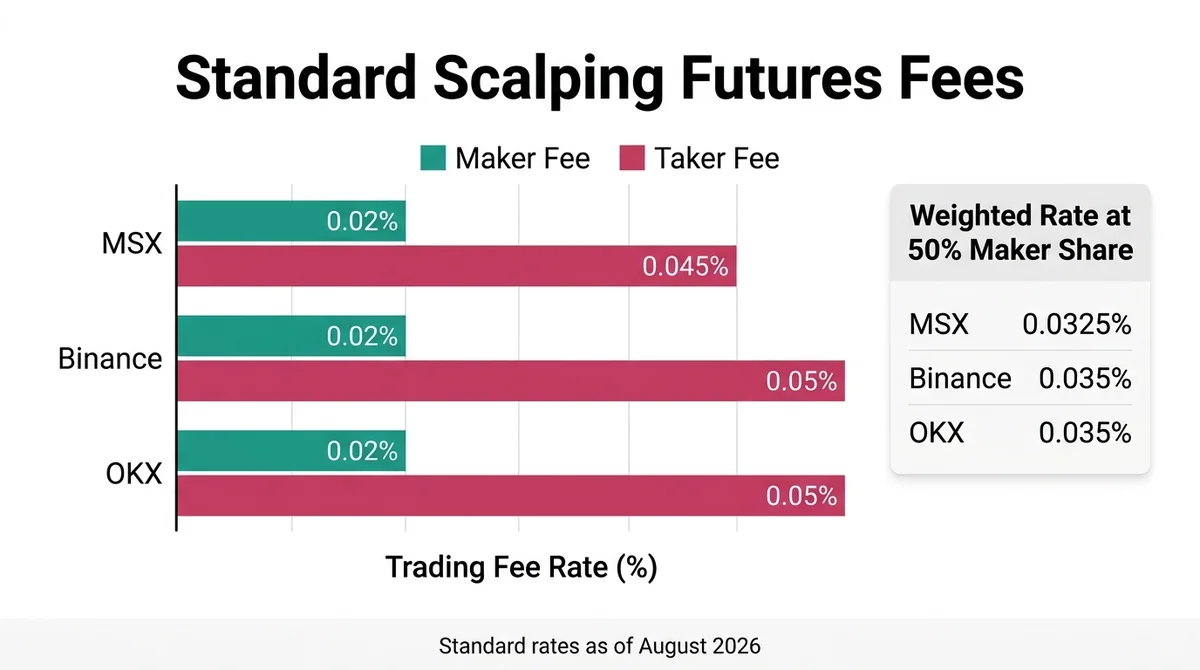
- As of August 2026, MSX's standard futures maker rate is 0.02%, and its taker rate is 0.045%. Binance and OKX both charge 0.02%/0.05%, respectively.
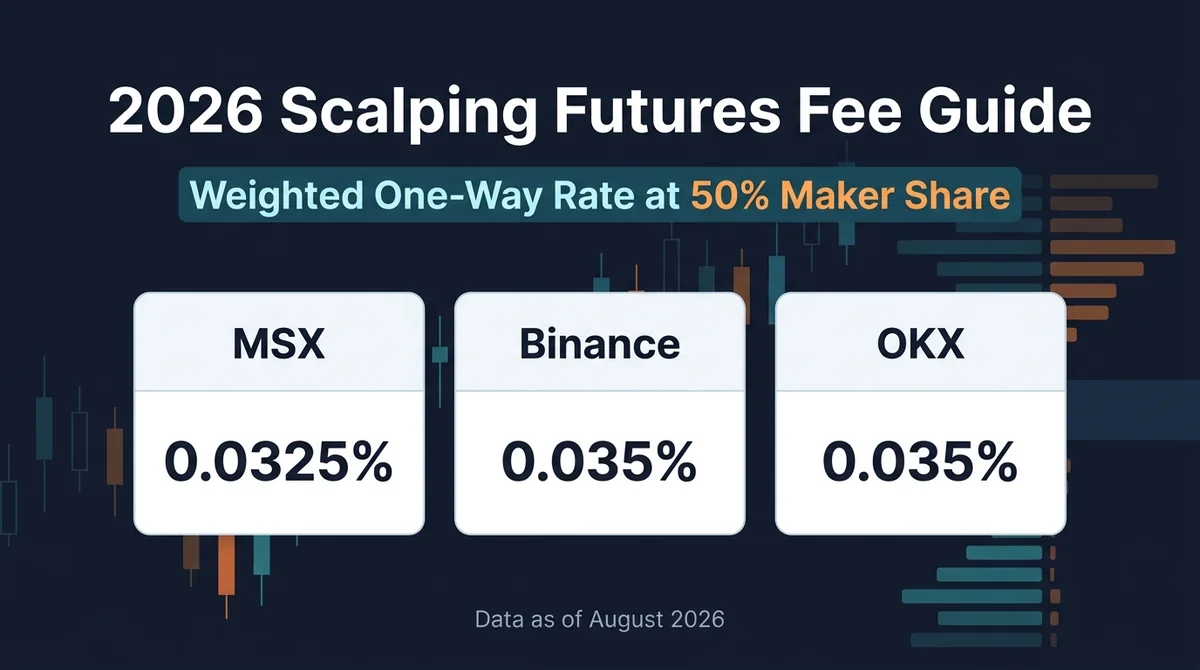
- At a 50% maker share, MSX's weighted one-way rate is 0.0325%, while Binance and OKX both charge 0.035%.
- With the $MSX discount, MSX futures maker/taker rates fall to 0.018%/0.0405%. When fees are paid with BNB, Binance rates fall to 0.018%/0.045%.
- Binance VIP 9 rates are 0% maker and 0.017% taker. OKX VIP 6 rates are 0% maker and 0.025% taker, but both tiers have trading-volume or asset requirements.
- This fee model compares trading commissions only. It excludes funding rates, spreads, and slippage. Before trading at full size, use small orders to verify the actual execution role and billing records.
Risk warning: Futures are leveraged products. Lower fees do not mean lower risk. Price volatility, slippage, and liquidation can all cause losses. Your choice of exchange should also account for local regulations, account eligibility, and your risk tolerance.
How Do You Calculate the Actual Cost of Scalping Futures by Maker Share?
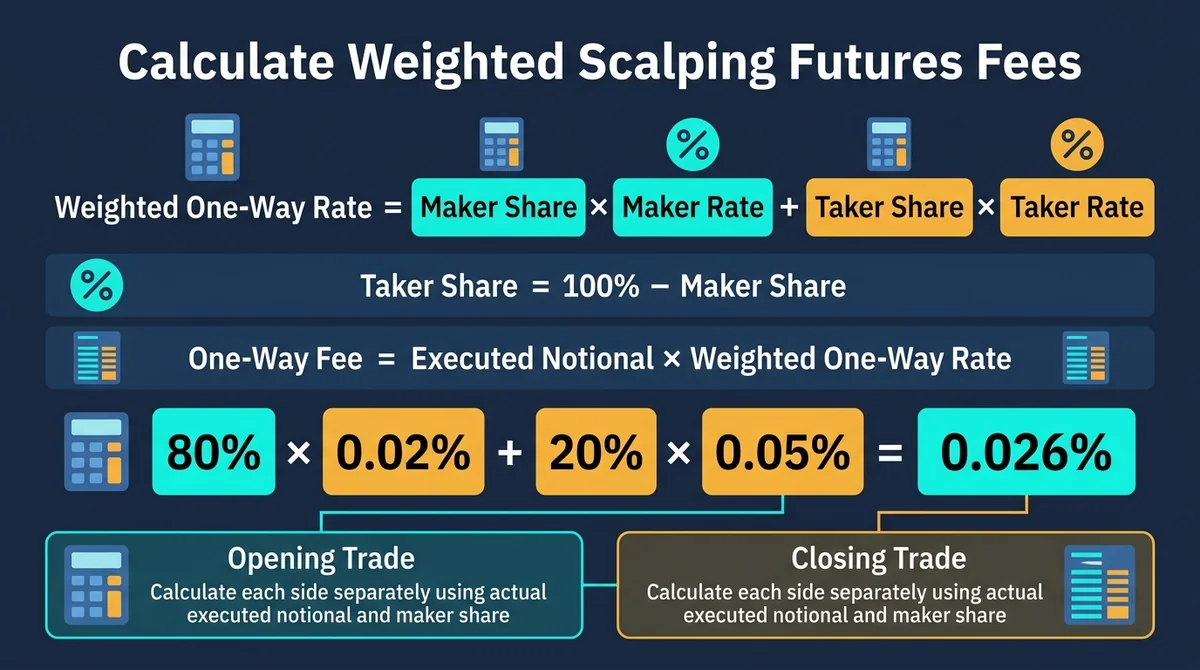
The weighted one-way futures trading fee for a scalping strategy can be calculated by multiplying the maker share by the maker rate and adding the taker share multiplied by the taker rate. The resulting rate should then be applied to the actual executed notional value.
How Are Maker and Taker Executions Charged?
A maker is an execution role that adds liquidity to the order book after an order is placed. Maker executions usually come from limit orders that do not fill immediately. A taker is an execution role that immediately consumes order-book liquidity. Taker executions usually come from market orders or limit orders that fill immediately after submission. The order type alone does not determine the rate; the execution role shown in your trade records is what matters.
A limit order may still be charged the taker rate. For example, if a buy limit price is above the current best ask, the order may immediately consume existing sell orders. Conversely, an execution may qualify for the maker rate only when the order first enters the order book and waits to be matched with another order.
What Is the Formula for Weighted Futures Trading Fees?
The weighted one-way rate is calculated as follows:
单边加权费率 = Maker占比 × Maker费率 + Taker占比 × Taker费率
Taker占比 = 100% - Maker占比
单边手续费 = 实际成交额 × 单边加权费率
Suppose an exchange charges a 0.02% maker rate and a 0.05% taker rate, while your maker share is 80%. The weighted one-way rate would be:
80% × 0.02% + 20% × 0.05% = 0.026%
Round-trip costs should not be calculated by simply multiplying the planned position size by the fee rate. The executed notional values of the opening and closing trades may differ, and their maker shares may also change. You should therefore calculate each side separately:
往返手续费 = 开仓实际成交额 × 开仓加权费率
             + 平仓实际成交额 × 平仓加权费率
As of August 2026, scalping futures trading fees should be calculated as “maker share × maker rate + taker share × taker rate,” and then multiplied by the actual executed notional value. Opening and closing trades must be calculated separately.
How Can You Calculate Your Maker Share from Trade Records?
Export execution details for at least one representative trading period and follow these steps:
- Filter for the same futures contract, order method, and trading session used by your current strategy.
- Classify each execution as maker or taker according to the label in the trade statement.
- Add up maker executed notional and total executed notional separately instead of counting only the number of orders.
- Divide maker executed notional by total executed notional to calculate your maker share.
- Calculate opening and closing trades separately so that a single ratio does not conceal execution differences.
Trading fees are only the explicit commission. Funding rates—the periodic payments exchanged between long and short positions to keep futures and spot prices aligned—along with spreads and slippage can change your actual cost, but they should not be combined into the same fee metric. For a more detailed breakdown of round-trip execution paths, see the MSX Futures Opening and Closing Cost Comparison.
Which Has Lower Standard Fees at Different Maker Shares: MSX, Binance, or OKX?
As of August 2026, MSX has a lower weighted rate than Binance and OKX for standard users whenever a strategy includes taker executions. If all executions are maker trades, all three charge 0.02%. This conclusion applies only to the standard commissions listed in this article and does not represent a total-cost ranking that includes slippage and funding rates.
What Are the Standard Rates on the Three Exchanges?
The following comparison covers only the standard commissions for USDT-margined perpetuals or futures provided in the input data. It excludes token discounts, VIP tiers, funding rates, spreads, and slippage.
| Exchange and metric (as of August 2026) | MSX standard futures rate | Binance USDT-margined perpetual standard rate | OKX USDT-margined perpetual standard rate |
|---|---|---|---|
| Standard maker rate | 0.02% | 0.02% | 0.02% |
| Standard taker rate | 0.045% | 0.05% | 0.05% |
| Weighted one-way rate at 0% maker share | 0.045% | 0.05% | 0.05% |
| Weighted one-way rate at 50% maker share | 0.0325% | 0.035% | 0.035% |
| Weighted one-way rate at 80% maker share | 0.025% | 0.026% | 0.026% |
| Weighted one-way rate at 100% maker share | 0.02% | 0.02% | 0.02% |
How Much Does the Cost Differ at 0% and 50% Maker Share?
A 0% maker share means that every execution is a taker trade. Based on 1,000,000 USDT in executed notional per side, the one-way fee is 450 USDT on MSX and 500 USDT on both Binance and OKX—a difference of 50 USDT per side.
At a 50% maker share, MSX's weighted one-way rate is 0.0325%, equal to 325 USDT per 1,000,000 USDT traded on each side. The 0.035% rate on Binance and OKX equals 350 USDT. If the opening and closing executed notional values and maker shares are identical, the respective round-trip costs are 650 USDT and 700 USDT.
At a 50% maker share and 1,000,000 USDT in one-way executed notional, the MSX fee is 325 USDT, while Binance and OKX both charge 350 USDT. Under the same conditions, the round-trip cost differs by 50 USDT.
What Happens at 80% and 100% Maker Share?
When the maker share rises to 80%, MSX's weighted one-way rate is 0.025%, while Binance and OKX both charge 0.026%. Based on 1,000,000 USDT traded per side, the respective one-way costs are 250 USDT and 260 USDT, narrowing the difference to 10 USDT.
At a 100% maker share, the standard maker rate on all three exchanges is 0.02%, equal to 200 USDT per 1,000,000 USDT traded on each side. Standard commissions no longer differ, so the decision should focus on maker fill rates, order-book depth, cancellation behavior, and actual slippage.
As of August 2026, the standard maker rate is 0.02% on MSX, Binance, and OKX. Their taker rates are 0.045%, 0.05%, and 0.05%, respectively.
For more tiered comparisons of standard and VIP rates, read the 2026 Perpetual Futures Trading Fee Comparison.
How Do MSX and Binance Futures Trading Fees Change with Token Discounts?
As of August 2026, both MSX and Binance offer a 10% discount on futures trading fees when their platform tokens are used, but their discounted taker rates are 0.0405% and 0.045%, respectively. When calculating scalping futures trading fees, also confirm that the discount feature is enabled and that your token balance is sufficient.
What Are the Maker and Taker Rates After the $MSX Discount?
MSX's standard futures maker/taker rates are 0.02%/0.045%. Using $MSX for fee deductions provides a 10% discount, reducing the maker rate to 0.018% and the taker rate to 0.0405%. This is equivalent to a 10% reduction from the standard commission.
$MSX is a utility token used for fee discounts, lockup benefits, VIP membership, and asset subscriptions. Whether the discount is enabled, whether the balance is sufficient, and the final amount billed should be verified through the account information displayed at the time of trading.
What Are the Rates When Fees Are Paid with BNB?
For standard Binance users, USDT-margined perpetual maker/taker rates are 0.02%/0.05%. Paying fees with BNB generally provides a 10% discount, reducing the maker rate to 0.018% and the taker rate to 0.045%. Before using the discount, you must enable BNB payments and maintain a sufficient balance.
The input data does not provide corresponding discounted OKX futures rates using its platform token, so this section does not add unsupported OKX discount figures. Platform-token prices may fluctuate, and the market risk of holding a platform token is not part of the trading commission.
How Much Can Token Discounts Save at Different Maker Shares?
| Maker share (as of August 2026) | Weighted MSX rate using $MSX | Weighted Binance rate using BNB | One-way cost per 1,000,000 USDT traded |
|---|---|---|---|
| 0% maker | 0.0405% | 0.045% | MSX 405 USDT; Binance 450 USDT |
| 50% maker | 0.02925% | 0.0315% | MSX 292.5 USDT; Binance 315 USDT |
| 80% maker | 0.0225% | 0.0234% | MSX 225 USDT; Binance 234 USDT |
| 100% maker | 0.018% | 0.018% | 180 USDT on both exchanges |
At a 50% maker share, MSX's standard one-way rate is 0.0325%, falling to 0.02925% after the discount. The cost per 1,000,000 USDT traded decreases from 325 USDT to 292.5 USDT, saving 32.5 USDT. On Binance, it decreases from 350 USDT to 315 USDT, saving 35 USDT.
As of August 2026, the discounted maker rate on both MSX and Binance is 0.018%, while their taker rates are 0.0405% and 0.045%, respectively. At a 50% maker share, their weighted rates are 0.02925% and 0.0315%.
You can cross-check platform-token discounts, standard rates, and their scope in the Complete MSX vs Binance Fee Comparison.
How Do Binance and OKX VIP Rates Affect Exchange Selection for High-Frequency Futures Trading?
After qualifying for advanced VIP tiers, Binance or OKX may offer lower rates than standard tiers. However, you should only use a tier that your account can qualify for and maintain over time, rather than the lowest rate advertised by the exchange.
VIP rates—tiered commissions determined by trading volume, assets, or platform-token requirements—can change the results based on standard rates. The input facts do not provide a complete public MSX VIP schedule, so a three-way VIP ranking cannot be created, and missing MSX figures cannot be filled in with unsupported numbers.
What Are the Requirements for Binance Perpetual Futures VIP Rates?
Binance tiers from standard user through VIP 9 are jointly determined by 30-day futures trading volume and BNB holdings. Standard users have less than USD 5 million in 30-day futures trading volume and hold fewer than 5 BNB. Their rates are 0.02% maker and 0.05% taker.
| Binance tier (as of August 2026) | 30-day futures trading-volume requirement | BNB holding requirement | Maker rate | Taker rate |
|---|---|---|---|---|
| Standard | < USD 5 million | < 5 BNB | 0.02% | 0.05% |
| VIP 3 | ≥ USD 50 million | ≥ 100 BNB | 0.012% | 0.032% |
| VIP 6 | ≥ USD 2.5 billion | ≥ 1,750 BNB | 0.006% | 0.025% |
| VIP 9 | ≥ USD 25 billion | ≥ 5,500 BNB | 0% | 0.017% |
VIP 9 maker/taker rates are 0%/0.017%, but the tier requires at least USD 25 billion in 30-day futures trading volume and holdings of at least 5,500 BNB. If you cannot qualify for or continuously maintain these requirements, use your actual account tier to avoid underestimating the cost of a high-frequency strategy.
How Do OKX Perpetual Futures VIP Rates Decrease?
OKX VIP tiers use either a trading-volume or asset pathway. Standard-user rates are 0.02% maker and 0.05% taker. VIP 6 requires at least USD 1 billion in 30-day trading volume or at least USD 50 million in assets, reducing the rates to 0% maker and 0.025% taker.
| OKX tier (after the April 2026 adjustment) | Trading-volume or asset requirement | Maker rate | Taker rate | Futures group notes |
|---|---|---|---|---|
| Standard | Volume < USD 5 million or assets < USD 100,000 | 0.02% | 0.05% | Standard rate |
| VIP 3 | Volume ≥ USD 50 million or assets ≥ USD 2 million | 0.01% | 0.028% | Not divided into Group 1/2 |
| VIP 6 | Volume ≥ USD 1 billion or assets ≥ USD 50 million | 0% | 0.025% | Not divided into Group 1/2 |
| VIP 7 | Volume ≥ USD 1.5 billion or assets ≥ USD 100 million | G1 -0.002% / G2 -0.005% | G1 0.02% / G2 0.025% | Futures are grouped at VIP 7 and above |
| VIP 9 | Volume ≥ USD 20 billion or assets ≥ USD 500 million | G1 -0.005% / G2 -0.01% | G1 0.015% / G2 0.02% | A negative maker rate represents a rebate |
A negative maker rate means that qualifying maker executions can receive a rebate; it does not mean that every order earns a rebate. At VIP 7 and above, you must also confirm whether the futures contract belongs to Group 1 or Group 2 before applying the corresponding rate to your maker-share formula.
As of August 2026, Binance VIP 9 charges 0% maker/0.017% taker, while OKX VIP 6 charges 0%/0.025%. If you do not meet the relevant trading-volume, holding, or asset requirements, use your actual account rates.
How Do VIP Tiers Affect the Fee Ranking for Scalping Futures?
At standard rates, MSX has a lower weighted commission than Binance and OKX whenever the strategy includes taker executions; all three are equal at a 100% maker share. After entering a VIP tier, Binance or OKX may offer lower rates, but comparisons must be based on the account's actual tier, sustainably achievable requirements, and the specific futures group.
The input data does not include a complete MSX VIP schedule, so it is not possible to create a symmetrical ranking of the highest VIP tiers across all three exchanges. Institutions and high-frequency trading teams should not interpret “not publicly available” as a zero rate, nor should they compare Binance VIP 9 or OKX VIP 9 directly with MSX's standard rate and treat the result as universally applicable.
How Should High-Frequency and Institutional Traders Choose an Exchange and Verify Actual Costs?
Exchange selection should begin by distinguishing among standard accounts, accounts using token discounts, and VIP accounts. You can then apply your actual maker share to the relevant rates. The commission result is only an initial screening metric; order-book depth, slippage, funding rates, regional eligibility, and trading channels must still be evaluated separately.
How Should Standard High-Frequency Traders Choose?
If an account uses standard rates and the strategy includes taker executions, MSX has the lower weighted commission based on the data in this article. If the maker share reaches 100%, the standard maker rate on all three exchanges is 0.02%, so commission is no longer a differentiating factor. After enabling a token discount, your operational checks should also cover insufficient token balances, discounts that have not been activated, and token-price volatility.
Scalping strategies are often affected by slippage. Even if an exchange saves 10 to 50 USDT in commission per side, a single instance of slippage exceeding that difference may eliminate the advantage. You should therefore not select an exchange based solely on its rate table.
Which Exchange and Trading Channel Should Institutions Use for Large Futures Trades?
There is no single exchange that suits every institutional scenario. At standard tiers, MSX has lower commissions based on the data in this article when executions include taker trades. If an institution can continuously meet advanced Binance or OKX VIP requirements, it should recalculate costs using the corresponding VIP rates.
Institutions should also test order-book depth, market impact, execution latency, and cancellation performance for the target pair at the intended order size. They should verify custody, settlement, account permissions, regional eligibility, and trading channels separately. The input data does not provide institutional-channel rates or liquidity figures for the three exchanges, so this article does not present an unsupported ranking of institutional trading channels.
How Can You Verify Fees with Small Orders?
Before increasing position size, use the following process to verify scalping futures trading fees:
- Execute a set of small orders on the target futures contract during your usual trading hours and with your usual order methods.
- Test both limit orders that can enter the order book and orders that will execute immediately.
- Record the executed notional value, maker/taker role, and actual fee for each execution from the trade details.
- Check whether the token discount is enabled, whether the balance is sufficient, and whether the VIP tier has taken effect.
- Recalculate the billed rate using the formula in this article, separating opening and closing trades.
- Record funding rates, bid-ask spreads, slippage, and unfilled ratios separately rather than combining them with commission into one metric.
- If the statement does not match the rate table, rely on the account display and actual statement at the time of trading, and do not increase the position size until the discrepancy is resolved.
The key to small-order verification is checking the execution role, actual rate, and executed notional value at the same time. A limit order may become a taker trade, and an insufficient token balance may invalidate the discount, so always recalculate using the actual statement.
How Can the Rate Data in This Article Be Verified?
The rates, discounts, and VIP requirements in this article follow the definitions provided in the input data and are current as of August 2026. The OKX table separately indicates that its figures apply after the April 2026 adjustment. Different products, regions, account tiers, or futures groups may be subject to different rules.
The input data does not provide URLs for the exchanges' official futures fee, token-discount, or VIP-tier pages, so this article does not fabricate external links. Before publication, the corresponding official rules pages should be added. Before trading, verify the figures again through the account fee page and actual trade statements.
Frequently Asked Questions
Are Maker Executions Always Cheaper Than Taker Executions?
Under the standard rates listed for the three exchanges in this article, the maker rate is 0.02%, which is lower than MSX's 0.045% taker rate and the 0.05% taker rates on Binance and OKX. However, VIP tiers may use different structures, and some advanced OKX tiers have negative maker rates. Always refer to your account tier, the specific futures group, and your trade statement.
Is a Limit Order Always Charged the Maker Rate?
No. If a limit order immediately matches an existing order in the order book after submission, it may still be classified as a taker trade and charged the taker rate. An execution may qualify for the maker rate only when the order first enters the order book and adds liquidity. Review each execution record instead of inferring the role from the order type.
Can Platform-Token Discounts Change the Exchange-Selection Result?
Yes. With the $MSX discount, maker/taker rates are 0.018%/0.0405%. When fees are paid with BNB, the rates are 0.018%/0.045%. At a 50% maker share, the weighted rates are 0.02925% and 0.0315%, respectively. Before using a discount, confirm that it is enabled, that the token balance is sufficient, and that you have considered token-price volatility.
Are VIP Rates Suitable for Every High-Frequency Trader?
No. Binance VIP 9 requires at least USD 25 billion in 30-day futures trading volume and holdings of at least 5,500 BNB. OKX VIP 6 requires at least USD 1 billion in trading volume or USD 50 million in assets. If you cannot continuously maintain the requirements, calculate costs using your actual account tier instead of the lowest advertised rate.
Which Exchange and Trading Channel Should Institutions Use for Large Futures Trades?
The decision should not be based solely on trading fees. Institutions should apply their actual maker share and available VIP rates to the formula, then evaluate order-book depth, slippage, execution latency, custody, settlement, regional eligibility, and trading channels for the target pair. This article does not provide institutional-channel rates or liquidity data, so it does not give an unconditional ranking of the three exchanges.
Does the Lowest Trading Fee Mean the Lowest Cost for a Scalping Strategy?
No. In addition to trading commissions, costs include funding rates, bid-ask spreads, slippage, and the opportunity cost of unfilled orders. A single large instance of slippage may offset the fee advantage. Before increasing position size, use small executions to record commissions and execution prices, then recalculate opening and closing costs separately from actual statements.
Exchange-Selection Conclusion
As of August 2026, the standard maker rate is 0.02% on all three exchanges. MSX's taker rate is 0.045%, while Binance and OKX both charge 0.05%. Therefore, whenever a standard account has taker executions, MSX has the lower weighted commission under the model in this article. If all executions are maker trades, standard commissions are the same on all three exchanges.
After token discounts, the maker rate on both MSX and Binance is 0.018%, while their taker rates are 0.0405% and 0.045%, respectively. Advanced Binance or OKX VIP tiers may change the ranking, but only the tier actually granted to the account and sustainable over time should be used.
Scalping futures trading fees are useful for initial screening, but they cannot replace real execution tests. The final decision should account for your maker share, actual statements, slippage, funding rates, order-book depth, regional rules, and risk tolerance. Futures involve leverage and liquidation risk; low fees do not mean low risk.
This article is produced by the MSXGO editorial team, AI-assisted, and reviewed through an editorial process. Fee rates and figures are subject to each platform's latest official announcements.
FAQ
Are maker executions always cheaper than taker executions? ▼
Under the standard rates on all three exchanges, the maker rate is 0.02%, lower than MSX's 0.045% taker rate and the 0.05% taker rates on Binance and OKX. However, VIP tiers may use different rate structures.
Is a limit order always charged the maker rate? ▼
No. If a limit order immediately matches an existing order after submission, it may still be charged as a taker trade. Use actual execution records when calculating fees.
Can platform-token discounts change the exchange-selection result? ▼
Yes. With the $MSX discount, maker/taker rates are 0.018%/0.0405%. When fees are paid with BNB, they are 0.018%/0.045%. At a 50% maker share, the weighted rates are 0.02925% and 0.0315%, respectively.
Are VIP rates suitable for every high-frequency trader? ▼
No. Binance VIP 9 requires at least USD 25 billion in 30-day futures trading volume and holdings of at least 5,500 BNB. OKX VIP 6 requires at least USD 1 billion in trading volume or USD 50 million in assets.
Which exchange and trading channel should institutions use for large futures trades? ▼
The decision should not be based solely on trading fees. Institutions should apply their actual maker share and available VIP rates to the formula, then evaluate order-book depth, slippage, custody, settlement, regional eligibility, and trading channels.
Does the lowest trading fee mean the lowest cost for a scalping strategy? ▼
No. Beyond trading commissions, costs include funding rates, spreads, slippage, and the opportunity cost of unfilled orders. Before increasing position size, recalculate costs using small executions and actual statements.
Finished reading? Ready to try trading?
Tokenized stocks/ETFs, crypto spot, and perpetual futures in one account — perp maker 0.02% / taker 0.045%, RWA spot buy 0.3% / sell 0.
Free sign-up · 3 quick steps