Tokenized Semiconductor Perpetuals on the Rise: How Chip Stocks Like MU Are Driving Crypto RWA Market Cap to $6.6B in 2026
RWA tokenized assets hit $6.6B in 2026. Trade MU, NVDA chip stock perpetuals on MSX — full guide: registration, order types, risk management & FAQ.
Article Citation Summary
RWA tokenized assets hit $6.6B in 2026. Trade MU, NVDA chip stock perpetuals on MSX — full guide: registration, order types, risk management & FAQ.
Tokenized Semiconductor Perpetuals on the Rise: How Chip Stocks Like MU Are Driving Crypto RWA Market Cap to $6.6B (2026)
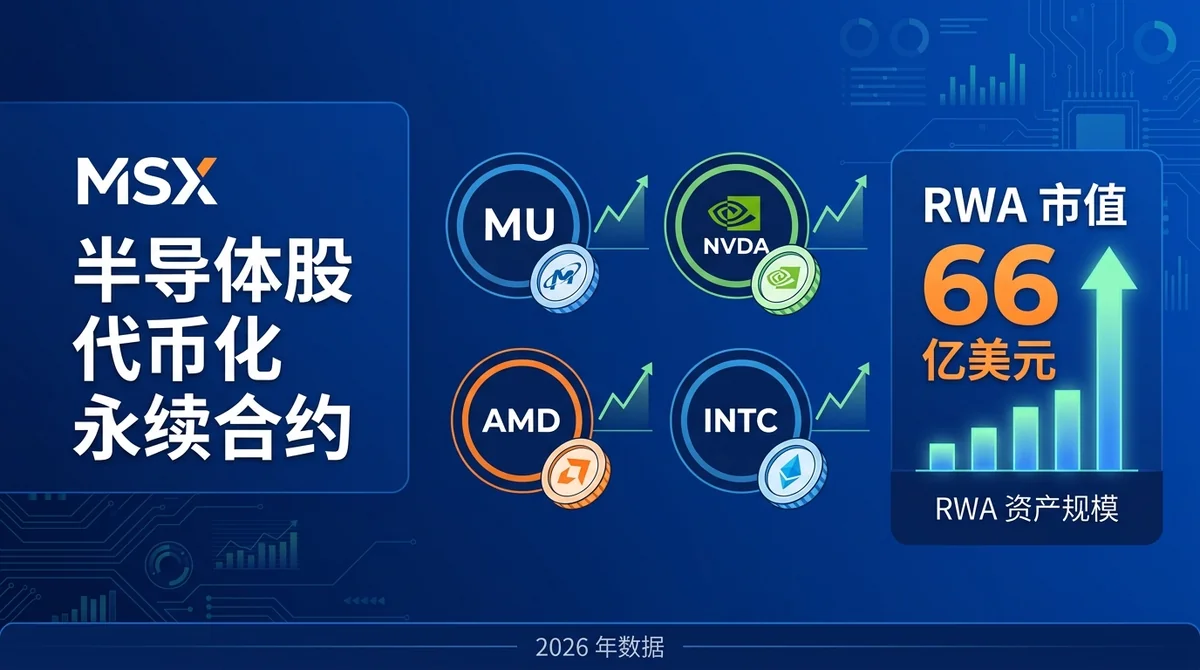
As of mid-2026, the crypto market is undergoing a quiet structural shift — not Bitcoin hitting new highs, but traditional equities flowing onto the blockchain at scale through tokenized perpetual contracts. Micron Technology (MU), NVIDIA (NVDA), AMD, and Intel (INTC) can now be traded 24 hours a day on crypto exchanges, backed by an RWA sector that has reached a market cap of $6.6 billion.
This article is an operational guide — from concept to opening a position, covering the full workflow.
Before You Start: Understanding Tokenized Semiconductor Perpetuals
What Are Tokenized Stock Perpetual Contracts
Tokenized stock perpetual contracts are derivative contracts that map traditional U.S. equity prices onto the blockchain. Traders don't need to hold the underlying shares or open a brokerage account — just deposit USDT or another stablecoin on a supported crypto exchange to go long or short on the price movement of the corresponding stock. The contract has no expiry date (perpetual), and a funding rate mechanism keeps the contract price anchored to the spot price.
The two biggest differences from traditional stock trading are: 24-hour tradability (including pre-market, after-hours, and weekends), and the ability to use leverage to amplify positions — which also means risk is amplified proportionally.
Citable Summary: Tokenized stock perpetual contracts use on-chain oracles to map real-time U.S. equity prices to the crypto market. Contracts have no expiry, settle in USDT, support long and short positions, and trade 24/7. The funding rate settles every 8 hours to maintain the peg between the contract price and the underlying stock price. (~60 words)
Why Semiconductor Stock RWA Market Cap Has Surged to $6.6 Billion
According to CoinTelegraph data from July 2026, the market cap of tokenized traditional assets on crypto exchanges grew from $1.4 billion in January 2025 to $6.6 billion in June 2026 — nearly a fivefold increase in 18 months. Semiconductor stocks are one of the core drivers: by mid-2026, trading volume and open interest in U.S. equity perpetuals had surpassed gold, silver, and other precious metal contracts.
The underlying logic is the AI compute narrative. MU's HBM memory is an essential component for AI training, and NVDA's GPUs are the backbone of data center compute. Both institutional and retail participants are gaining exposure to this theme through crypto derivatives, and for many users in jurisdictions where buying U.S. stocks directly involves barriers, tokenized contracts offer a more accessible channel.
Worth noting: Samsung and SK Hynix reported significant earnings growth in 2026, yet their stock prices responded tepidly — signaling that market expectations for semiconductor stocks are already elevated. Even with strong fundamentals, chasing highs warrants caution.
If you want to understand the broader mechanics of the RWA sector first, see RWA Real-World Asset Tokenization Explained: How It Works, Key Advantages & Risk Factors.
Citable Summary: As of June 2026, the market cap of tokenized traditional assets on crypto exchanges reached $6.6 billion, up nearly fivefold from $1.4 billion in January 2025 (source: CoinTelegraph, July 2026). Semiconductor stocks have become one of the most actively traded RWA categories due to sustained AI compute demand, with total open interest in U.S. equity perpetuals now exceeding precious metal contracts. (~75 words)
Risk Disclosure and Capital Preparation Before Entering
Tokenized perpetual contracts are high-risk derivative products. Before entering, be clear on the following:
- Leverage amplifies losses: At 5x leverage, a 20% drop in the underlying triggers liquidation (often sooner, once maintenance margin is factored in)
- Funding rate costs: The longer you hold, the higher the cumulative funding rate — factor it into your holding cost for longer-term positions
- Liquidity risk: Some chip stock contracts see reduced liquidity outside U.S. trading hours; market order slippage can be significant
- Policy risk: The semiconductor sector is heavily exposed to export control policies (e.g., CHIPS Act developments); a single policy change can trigger sharp volatility
Who this is for: Users who already have crypto derivatives trading experience and a basic understanding of semiconductor industry fundamentals. Complete beginners are advised to start with small spot positions to get comfortable with market dynamics before moving to perpetuals.
Step 1: Register and Set Up Your MSX Account
Register for an MSX Account and Complete KYC Verification
Go to the MSX official website to register. After registration, you'll need to complete KYC identity verification before trading contracts. Required documents typically include:
- A valid government-issued ID (passport or national ID card)
- Facial recognition verification (liveness check)
- Proof of residential address (required in some regions)
KYC review is generally completed within 1 business day, and may take up to 3 business days during peak periods. Once approved, a confirmation notification will be sent to your registered email.
Deposit USDT or Stablecoins to Your Contract Account
MSX currently supports the following deposit methods:
| Deposit Method | Arrival Time | Notes |
|---|---|---|
| On-chain transfer (USDT-TRC20) | After block confirmation | Select the correct network — wrong-chain deposits cannot be recovered |
| On-chain transfer (USDT-ERC20) | After block confirmation | Gas fees are higher than TRC20 |
| Internal platform transfer | Instant | Requires funds in another account on the same platform |
After depositing, you'll need to transfer funds from the spot account to the contract account — the two are independently isolated and do not affect each other.
Confirm U.S. Equity RWA Perpetual Contract Permissions Are Active
Users in some regions may need to separately confirm that contract trading permissions have been enabled. After logging in, check the contract trading page to see if the U.S. equity RWA perpetual contract list is visible. If you encounter permission issues, contact the Telegram official support bot for assistance.
First deposit recommendation: Beginners are advised to start with a small amount (e.g., 100–500 USDT) to get familiar with the platform interface before increasing position size. Start with leverage of ≤3x.
Step 2: Select Your Semiconductor Stock Tokenized Contract
Overview of Major Chip Stock Tokenized Contracts: MU, NVDA, AMD, INTC
The following are the primary semiconductor stock tokenized perpetual contracts currently supported on MSX:
| Ticker | Company | Sector | Key Characteristics |
|---|---|---|---|
| MU | Micron Technology | HBM Memory / AI Storage | Direct AI compute beneficiary |
| NVDA | NVIDIA | GPU / AI Compute | Higher volatility, good liquidity |
| AMD | Advanced Micro Devices | CPU / GPU | Closely watched as a NVDA alternative |
| INTC | Intel | Legacy CPU / Foundry | Fundamental headwinds in recent years; atypical volatility |
When selecting a contract, liquidity is the primary consideration. NVDA and MU contracts typically have higher trading volume and tighter bid-ask spreads, resulting in lower friction costs when entering and exiting positions.
How to Assess Liquidity and Bid-Ask Spread
On the contract trading page, focus on these indicators:
- Bid-ask spread: The tighter the spread, the better the liquidity. Consider a spread below 0.1% before placing a market order
- 24-hour trading volume: Be cautious when volume is below 10% of comparable mainstream contracts
- Open Interest: Higher open interest generally indicates deeper liquidity
During low-liquidity periods (e.g., late UTC night into early morning, corresponding to U.S. market close and before Asia opens), use limit orders rather than market orders to avoid slippage.
For a comparison of tokenized asset vs. traditional contract trading costs, see Perpetual Futures vs Spot Trading: Fees, Leverage Risk & Profit Potential — 2026 Full Comparison.
How U.S. Equity Prices Link to Tokenized Contract Prices
Tokenized perpetual contracts obtain real-time quotes for the underlying stock via an oracle, which serves as the index price. The contract market price fluctuates around this index price, and the funding rate mechanism ensures the two don't diverge for extended periods.
Oracle price updates typically occur every few seconds to tens of seconds. During U.S. market hours (9:30 PM–4:00 AM Beijing time), update frequency is high and price discovery is efficient — this is the optimal liquidity window for tokenized contracts. Outside U.S. trading hours, some platforms continue to allow trading (based on after-hours/ADR pricing or the last available quote), but liquidity typically drops noticeably.
Citable Summary: Tokenized U.S. equity perpetual contracts use on-chain oracles to map traditional exchange prices to the crypto market in real time. For MU, for example, during U.S. trading hours the contract price deviation from the Nasdaq real-time quote is typically minimal; the funding rate mechanism periodically corrects any drift to maintain an effective price peg. (~65 words)
Step 3: Opening a Position — Using MU Perpetuals as an Example
Setting Leverage and Margin Mode
Before placing an order, select your margin mode:
Isolated Margin
- Each position uses its own designated margin independently
- Maximum loss is limited to that position's margin — other account funds are unaffected
- Recommended for beginners and anyone who wants precise per-trade risk control
Cross Margin
- All cross-margin positions share the total account balance as margin
- A loss on one position can draw down the entire account — higher risk
- Suited for experienced traders running hedged positions
Beginners are strongly advised to use Isolated Margin, with leverage set to ≤5x and no single position exceeding 10% of total account funds.
Order Type: Limit Orders vs Market Orders
| Order Type | Advantages | Disadvantages | Best Used When |
|---|---|---|---|
| Limit Order | Controls execution price, avoids slippage | May not fill immediately | Non-urgent entries, lower-liquidity periods |
| Market Order | Fills immediately | Higher slippage during volatile periods | High-liquidity windows during U.S. market hours |
Using MU as an example: if the current index price is $95.50, placing a limit order in the $95.45–$95.50 range typically yields a better fill price — especially effective outside U.S. trading hours.
Configuring Take-Profit and Stop-Loss Parameters
Setting take-profit and stop-loss orders immediately after opening a position is a critical risk control step — not optional.
Stop-loss reference approaches:
- Technical support level stop-loss: Reference key support levels on the daily chart; exit if broken. Suitable for users with technical analysis experience
- Fixed loss percentage stop-loss: Force-close when a single position loses 3%–5%; straightforward and beginner-friendly
Take-profit reference approaches:
- Partial take-profit: Close half the position at 50% of the target price to lock in gains, then trail a stop-loss on the remainder
- Fixed risk/reward ratio: Minimum 1:2 (risk 1 unit, target 2 or more units of profit)
After opening, confirm: execution price, fees deducted, actual margin used, and current leverage ratio. All of this is visible on the order details page.
For a breakdown of contract fee structures across platforms, see MSX Contract Trading Fees Explained 2026: Maker/Taker Rates & Optimization Guide.
Step 4: Position Management and Safe Exit
Monitoring How Funding Rates Affect Holding Costs
Funding rates settle every 8 hours (typically at UTC 00:00, 08:00, and 16:00), with longs or shorts paying the other side. When the rate is positive, longs pay shorts; when negative, shorts pay longs.
Calculating the actual cost of a long-term position: assume you hold for 10 days, with a funding rate of 0.01% every 8 hours — that's 30 settlements, totaling 0.3% in cumulative funding paid. During sideways price action, this directly eats into returns and must be factored into your cost basis.
In the 2–3 trading days before earnings season (MU typically reports in March, June, September, and December), assess whether to reduce your position. Both earnings beats and misses can trigger sharp one-directional moves — the risk for high-leverage positions heading into these events is significantly elevated.
Closing a Position and Settling Profits
To close, select "Market Close" or set a take-profit limit order in advance. Once the position is closed, funds (including P&L and balance after fees) are automatically returned to the contract account. You can then:
- Keep the funds in the contract account for the next trading opportunity
- Transfer to the spot account
- Withdraw to an external wallet or bank account (follow the platform's withdrawal process)
Tax and Compliance Considerations
There is no unified standard for how tokenized RWA assets are taxed across jurisdictions — differences are significant:
- Hong Kong: Individual crypto asset capital gains are generally not subject to capital gains tax under current rules, but monitoring ongoing regulatory updates is advisable
- Singapore: Crypto gains for individual investors are generally not subject to capital gains tax, but income classified as "business income" is taxable
- Middle East (UAE): No federal capital gains tax on individual crypto gains under current rules
- South Korea: Crypto gains are now within the tax system — check the latest local regulations
The above is for general reference only. For specific tax treatment, consult a licensed local tax advisor.
For an overview of Hong Kong's compliant trading framework, see Hong Kong Crypto Trading Compliance Guide 2026: Licensed Exchanges, Tax Reporting & Futures Trading Rules.
Common Mistakes and How to Avoid Them
High-Leverage Liquidation: The Most Common Beginner Trap
Using MU as a concrete example:
- Account balance: 1,000 USDT
- Position: 5x isolated leverage, 200 USDT margin, 1,000 USDT notional long
- Scenario: MU price drops from $100 to $90 (a 10% decline)
- Loss: 1,000 × 10% = 100 USDT — margin drops from 200 USDT to roughly 100 USDT
- If price falls to around $82–$83 (approximately 17–18% down), the liquidation threshold is hit and the 200 USDT margin is wiped out
At 5x leverage, an ~18% drop in the underlying can liquidate a full position — and single-day moves of 5%–10% in semiconductor stocks are not uncommon. This is exactly why beginners should keep leverage strictly controlled.
Ignoring Funding Rates and Bleeding on Long-Term Positions
A frequently overlooked scenario: you're bullish on MU long-term and open a 5x leveraged long for 30 days. Even if the price ultimately rises 5%, if funding rates remain persistently positive throughout that period (common when bullish sentiment is strong), cumulative funding could reach 1%–2%. Add in trading fees, and actual returns may fall well below expectations — or even turn negative.
When funding rates are negative, shorts pay longs — meaning holders of short positions in extremely bearish market conditions actually earn additional income.
Forcing Market Orders During Low Liquidity
During periods when U.S. markets are closed and Asian markets are quiet (e.g., UTC 12:00–14:00), the bid-ask spread on some smaller-cap chip stock tokenized contracts can widen to 0.5%–1%. Using a market order at those times means surrendering that spread the moment you enter.
The right approach: During low-liquidity periods, default to limit orders and set an acceptable price range to wait for a fill. Rushing in with market orders usually signals emotional trading — which is itself a red flag worth paying attention to.
Earnings season risk with large positions: Avoid holding high-leverage, single-name positions heading into earnings for chip stocks like MU (typically 2–3 weeks after each quarter ends). Samsung reported significant earnings growth in 2026, yet the stock price reaction was muted — a beat doesn't guarantee a rally, and this kind of expectation-gap risk is hard to anticipate in advance.
Security Notes
Account Security: 2FA and API Key Management
- Mandatory: enable Google Authenticator (TOTP) — do not use SMS-based 2FA. SIM swap attacks are one of the most common ways crypto accounts are compromised
- Back up your 2FA recovery codes and store them offline (e.g., written on paper in a secure location), not as screenshots saved in your phone's photo library
- If using API keys for automated trading, grant only the minimum necessary permissions (e.g., read-only or trade-only, no withdrawal access) and rotate them regularly
- Avoid performing account operations on public Wi-Fi networks
Position Risk: Single-Asset Concentration Limits
A single chip stock contract position should not exceed 10%–15% of your total crypto portfolio. Total RWA perpetual contract exposure should be kept to under 20% of your crypto portfolio to avoid over-concentration in a single sector.
Correlation within the semiconductor sector is high — when export control policies tighten, MU, NVDA, and AMD tend to fall together. Even spreading across four names within the sector may not protect you from a synchronized drawdown.
Market Risk: Semiconductor Industry Cycles and Geopolitical Impact
The CHIPS Act, adjustments to China export controls, and geopolitical developments in the Taiwan Strait can all deliver sharp shocks to semiconductor stocks in a short timeframe. Tokenized contract prices reflect these shocks in real time, and because the contract market runs 24/7, price adjustments after a news event can complete within minutes — leaving investors very little reaction time.
Consider subscribing to semiconductor industry news sources and maintaining basic awareness of policy developments while holding positions.
For questions or support, reach out via the Telegram official support bot or the official Discord community.
Frequently Asked Questions
Q: What's the difference between a tokenized stock perpetual contract and buying U.S. stocks directly?
Tokenized perpetual contracts are derivatives — you hold price exposure, not the underlying shares. There are no shareholder rights (dividends, voting). The advantages: 24-hour tradability, leverage support, no brokerage account required, and USDT settlement. The disadvantages: funding rate costs, leverage amplifying loss risk, and dependence on platform liquidity.
Q: What does the $6.6 billion RWA tokenized asset market cap figure actually mean, and is it reliable?
This figure comes from CoinTelegraph's July 2026 report. The metric covers the total market cap of tokenized traditional assets (equities, precious metals, etc.) on crypto exchanges, up from a base of $1.4 billion in January 2025 — a nearly 5x increase in 18 months. The data reflects on-chain verifiable contract open interest and market cap figures, making it reasonably reliable. That said, $6.6 billion is still small relative to the overall crypto derivatives market, and liquidity and depth remain lower than mainstream crypto contracts.
Q: Can I trade the MU contract when U.S. markets are closed?
Yes, but liquidity drops noticeably and bid-ask spreads widen. The recommended window is during U.S. trading hours (9:30 PM–4:00 AM Beijing time), when liquidity is better, price discovery is more efficient, and slippage is lower. If you need to trade outside those hours, always use limit orders.
Q: How are funding rates charged, and how much do they affect returns?
Funding rates settle every 8 hours (UTC 00:00, 08:00, 16:00). The rate can be positive or negative depending on market sentiment, and is directly deducted from or added to the position's margin. For a 10-day hold at an average rate of 0.01% per settlement, that's 30 settlements and a cumulative funding cost of 0.3%. For a 5x leveraged position, this represents an additional 0.3% holding cost on the notional position value — it needs to be factored into your P&L calculations for longer holds.
Q: Who is this type of product actually suited for?
Users who meet both of the following criteria: (1) they have crypto derivatives trading experience — familiarity with margin mechanics, leverage risk, and funding rates; and (2) they have a basic understanding of the semiconductor industry — AI compute demand, earnings cycles, and policy risk. Complete beginners should study contract fundamentals first and get comfortable with the platform using a small amount of capital before participating.
Q: What's the overall trend for semiconductor stock crypto derivatives in 2026?
According to CoinTelegraph's July 2026 report, trading volume and open interest in U.S. equity perpetuals have surpassed precious metal contracts, with semiconductor stocks as a key driver. Microsoft's strong results — showing AI capex converting to measurable revenue growth — further boosted market sentiment across the AI compute supply chain. However, Samsung and SK Hynix both beat earnings expectations yet saw muted stock price reactions, indicating that market expectations are already priced in at elevated levels and chasing momentum warrants caution. The RWA sector overall remains in rapid expansion, but at the individual stock level, this is no longer a "buy and don't look" environment.
Q: If I run into account issues or contract permission problems, how do I contact MSX support?
Support channels include: the Telegram official support bot, which typically responds quickly; the MSX official website live chat; or email at [email protected]. For complex issues, include your account UID and screenshots to help support locate and resolve the problem faster.
The content above is for informational purposes only and does not constitute investment advice. Tokenized perpetual contracts are high-risk derivative products. Ensure you fully understand the associated risks before participating, and confirm that doing so complies with the laws and regulations of your jurisdiction.
FAQ
What are tokenized semiconductor stock perpetual contracts? ▼
Tokenized stock perpetual contracts are derivative contracts that map U.S. equity prices onto the blockchain via oracles — no need to hold the underlying shares or open a brokerage account. Traders deposit USDT or another stablecoin to go long or short on the price movements of chip stocks like MU and NVDA. Contracts have no expiry date, the funding rate settles every 8 hours to maintain price anchoring, and trading is available 24/7, including pre-market, after-hours, and weekends.
Why has the semiconductor stock RWA market cap surged to $6.6 billion in 2026? ▼
As of June 2026, the market cap of tokenized traditional assets on crypto exchanges reached $6.6 billion, up nearly fivefold from $1.4 billion in January 2025 (source: CoinTelegraph, July 2026). The core driver is the AI compute narrative — MU's HBM memory and NVDA's GPUs are critical components for AI training, drawing both institutional and retail participants to gain exposure through tokenized contracts. These products also provide a more accessible channel for users in regions where buying U.S. stocks directly involves barriers.
What risks should beginners watch out for when trading MU and other chip stock perpetuals on MSX? ▼
Beginners need to be most alert to three categories of risk. First, leveraged liquidation: at 5x leverage, an ~18% drop in the underlying can wipe out the full margin, and single-day moves of 5%–10% in semiconductor stocks are not uncommon. Second, funding rate costs: a 0.01% rate every 8 hours over a 10-day hold accumulates to 0.3%, which directly erodes returns during sideways price action. Third, liquidity risk: outside U.S. trading hours and before Asian markets open, bid-ask spreads on some chip stock contracts can widen to 0.5%–1%, making market order slippage significant. Beginners are advised to use Isolated Margin and keep leverage at 3x or below.
How did semiconductor stocks perform after Samsung reported major earnings growth? ▼
After Samsung and SK Hynix reported significant earnings growth in 2026, their stock price reactions were muted. This reflects an already-elevated level of market expectations for semiconductor stocks — a strong earnings beat doesn't necessarily translate into share price gains. This kind of expectation-gap risk is difficult to anticipate in advance, and it serves as a reminder that holding high-leverage, single-name positions heading into earnings remains risky even when the fundamental picture looks strong.
How do tokenized U.S. equity contract prices stay in sync with real stock prices? ▼
Tokenized perpetual contracts obtain real-time quotes for the underlying stock via on-chain oracles, which serve as the index price. The contract market price fluctuates around this index price, and the funding rate mechanism periodically corrects any drift to ensure the contract price doesn't diverge from the real stock price over the long term. During U.S. market hours (9:30 PM–4:00 AM Beijing time), oracle updates are most frequent and price discovery is most efficient — outside U.S. hours, liquidity typically drops noticeably, and limit orders are recommended.
What does the full process look like for opening a MU perpetual position on MSX? ▼
The full workflow covers four steps. First, register for an MSX account and complete KYC identity verification (typically completed within 1 business day). Second, deposit USDT to the contract account — make sure to select the correct network (TRC20 or ERC20). Third, select the MU contract, choose your margin mode (Isolated Margin recommended for beginners), set your leverage (≤5x suggested), and place a limit order to control your fill price. Fourth, immediately after opening the position, configure take-profit and stop-loss levels, and continuously monitor the funding rate — which settles every 8 hours — for its impact on your holding cost.