Tokenization Stocks: What They Are, How They Work, and Why They Matter
Learn how tokenization stocks turn equities into blockchain tokens for 24/7 trading and fractional ownership, plus risks and MSX trading.
Article Citation Summary
Learn how tokenization stocks turn equities into blockchain tokens for 24/7 trading and fractional ownership, plus risks and MSX trading.
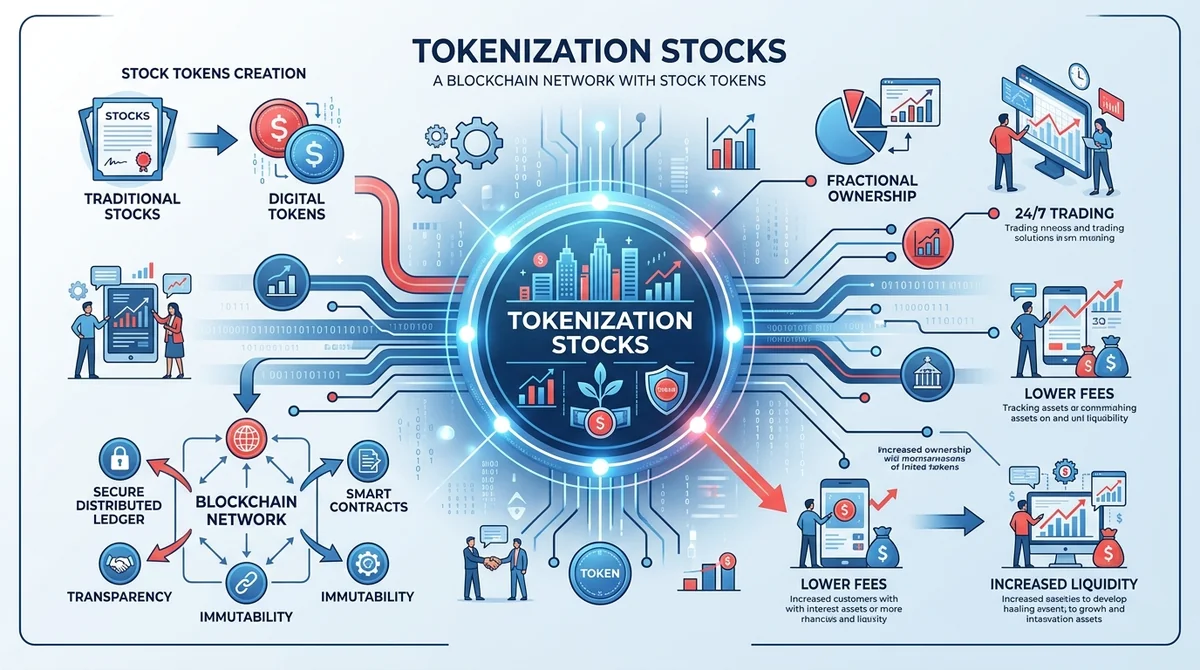
Tokenization stocks are blockchain-based tokens that represent ownership or economic exposure to a traditional stock. They enable fractional ownership and round-the-clock trading, making high-value equities like Apple or Tesla accessible to retail investors. On MSX, you can trade tokenized stocks with T+0 settlement and fees starting at 0.3% for buys.
Key Takeaways
- Tokenized stocks are digital tokens on a blockchain that represent a share or fraction of a share of a traditional stock.
- They allow fractional ownership, 24/7 trading, and programmable features like automated dividends.
- Risks include regulatory uncertainty, counterparty risk, and liquidity fragmentation.
- MSX offers tokenized stocks with fractional shares from 10U, T+0 settlement, and a 25% fee discount when using MSX tokens.
What Are Tokenized Stocks?
Tokenized stocks are digital tokens issued on a blockchain that represent ownership or economic exposure to a traditional stock. Unlike traditional shares, which are recorded on centralized ledgers, tokenized stocks exist as programmable assets on a distributed ledger. They enable fractional ownership, allowing investors to buy a fraction of a high-priced stock like Apple or Tesla with as little as $10. They can be traded 24/7 on crypto platforms, unlike traditional exchanges with fixed hours.
Definition of Tokenized Stocks
A tokenized stock is a blockchain-based representation of a traditional equity. Each token corresponds to a share or a fraction of a share of the underlying stock, and ownership is recorded on a blockchain. The underlying shares are typically held by a custodian, and token holders may have economic rights (such as dividends) but not always voting rights.
How Tokenized Stocks Differ from Traditional Stocks
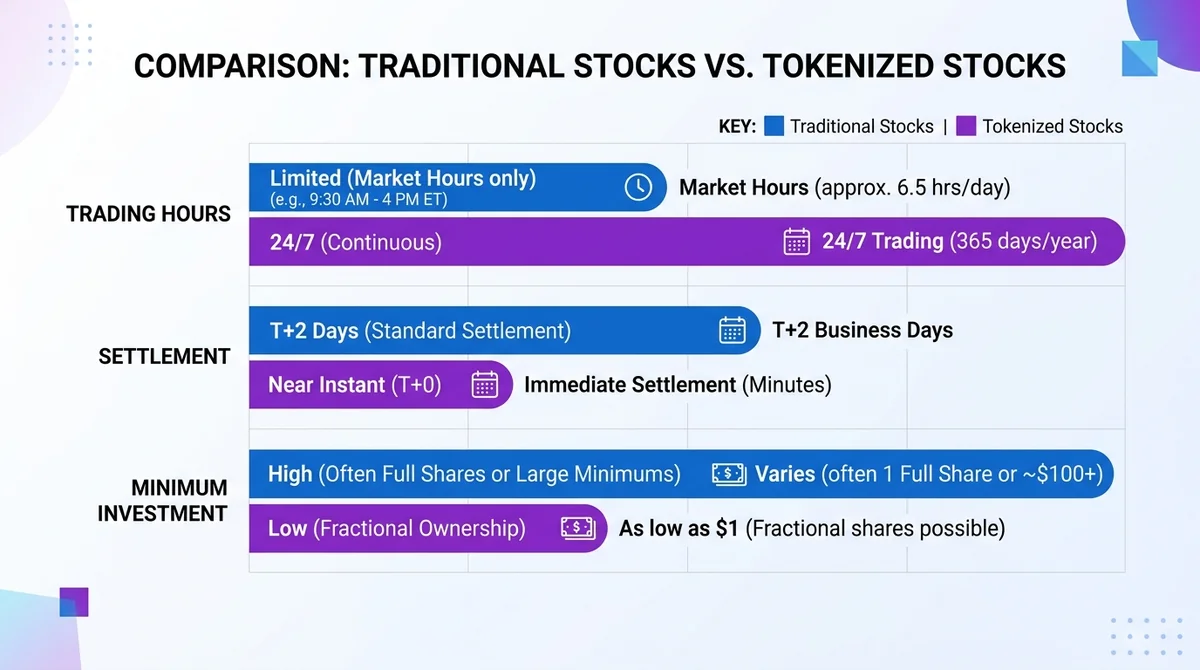
The key differences are trading hours, settlement speed, and divisibility. Traditional stocks trade only during exchange hours and settle in T+2 days. Tokenized stocks can be traded around the clock and settle almost instantly (T+0). They also allow fractional ownership, so investors can buy a small piece of an expensive stock without needing to purchase a whole share.
How Does Stock Tokenization Work?
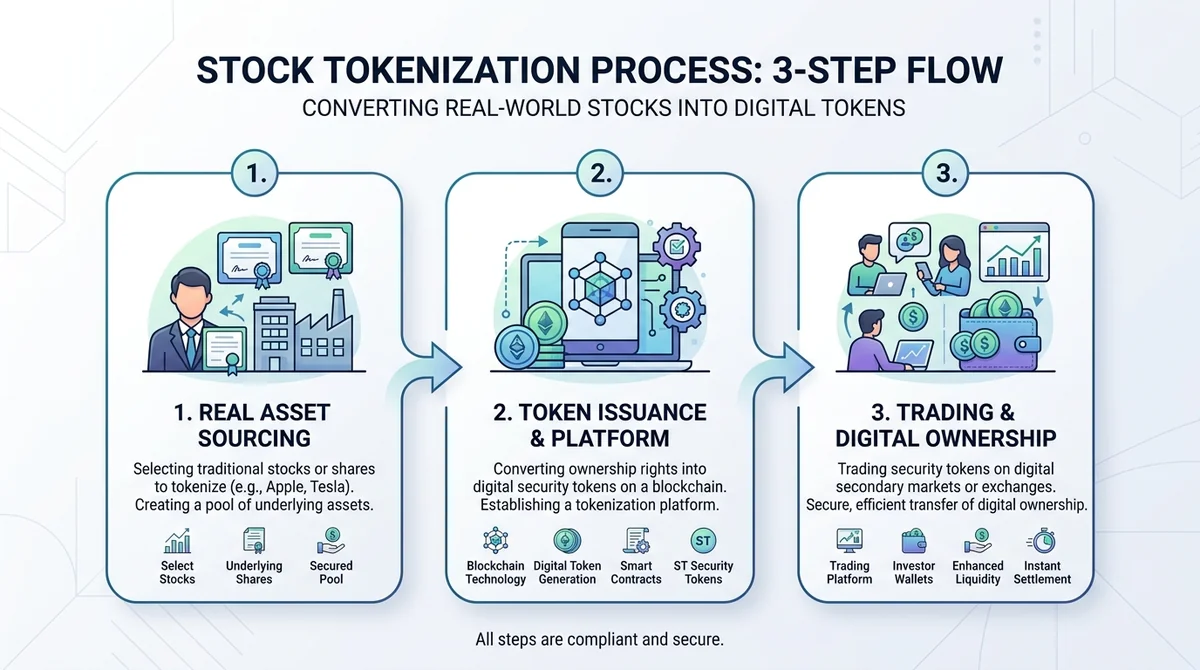
Stock tokenization works by issuing blockchain tokens backed by real shares held in custody. The process involves several steps: an issuer or platform acquires the underlying shares, holds them with a licensed custodian, and then mints digital tokens that represent those shares. Smart contracts automate trading, settlement, and corporate actions, reducing manual processes.
The Tokenization Process
The tokenization process typically includes: (1) custody of the underlying shares by a regulated entity, (2) issuance of tokens on a blockchain, and (3) distribution to investors. Each token is pegged to the value of the underlying stock, and the custodian ensures that the number of tokens in circulation matches the number of shares held.
Smart Contracts and Custody
Smart contracts play a crucial role in tokenized stocks. They automate the execution of trades, dividend distributions, and other corporate actions. Custody is also critical: the underlying assets are held by a custodian, and token holders rely on the custodian's solvency and security. In some cases, token holders may not have direct ownership of the shares but only a contractual claim.
Settlement and Trading Mechanics
Tokenized stocks settle on-chain, which means that trades are finalized almost instantly. This contrasts with traditional stock settlement, which can take two business days. The use of blockchain also enables 24/7 trading, as there is no central exchange with fixed hours.
Why Is Stock Tokenization Important for Investors?
Stock tokenization is important because it democratizes access to equities through fractional ownership and improves market efficiency with instant settlement. It lowers the minimum investment required to buy high-value stocks and enables trading across multiple platforms and time zones.
Fractional Ownership and Lower Barriers
Fractional ownership is one of the most significant benefits of tokenized stocks. Instead of needing to buy a whole share of a company like Amazon (which can cost thousands of dollars), investors can buy a fraction of a share for as little as $10. This lowers the barrier to entry and allows for more diversified portfolios with smaller capital.
Increased Liquidity and Market Access
Tokenization can increase liquidity by enabling trading across multiple platforms and time zones. Because tokens can be traded on crypto exchanges, they are accessible to a global audience of crypto users, not just traditional stock market participants.
Efficiency Gains from Blockchain
Blockchain settlement reduces counterparty risk and speeds up transactions from T+2 to T+0. This means that investors can access their funds more quickly and reduce the risk of settlement failures.
What Are the Advantages of Tokenized Stocks?
Tokenized stocks offer several advantages over traditional stocks, including 24/7 trading, fractional ownership, and programmable features.
24/7 Trading
Traditional stock markets are open only during business hours on weekdays. Tokenized stocks, on the other hand, can be traded around the clock, seven days a week. This is particularly beneficial for investors in different time zones or those who want to react to news immediately.
Fractional Shares
As mentioned earlier, tokenized stocks allow for fractional ownership. This means that investors can buy a small piece of a high-priced stock, enabling them to diversify their portfolio without needing a large amount of capital.
Programmable Features
Because tokenized stocks are built on blockchain technology, they can have programmable features. For example, dividends can be automatically distributed to token holders via smart contracts. Corporate actions can also be automated, reducing the need for manual processing.
What Are the Risks and Limitations of Tokenized Stocks?
Despite their benefits, tokenized stocks come with risks, including regulatory uncertainty, counterparty and custody risks, and liquidity fragmentation.
Regulatory Uncertainty
The regulatory framework for tokenized securities is still evolving. Different jurisdictions have different rules, and there is uncertainty about how tokenized stocks will be treated under securities laws. This can create compliance challenges for platforms and investors.
Counterparty and Custody Risks
Investors in tokenized stocks rely on custodians to hold the underlying shares and on smart contracts to execute trades. If a custodian fails or a smart contract is hacked, investors could lose their assets. It is important to choose a platform with robust security measures and transparent custody arrangements.
Liquidity Fragmentation
Liquidity may be fragmented across different platforms, leading to price discrepancies and limited order books. This means that the price of a tokenized stock on one platform may differ from the price on another, and it may be difficult to execute large trades without affecting the price.
How Does MSX Simplify Tokenized Stock Trading?
MSX provides a compliant platform for tokenized stock trading with low fees, fractional shares, and robust security measures. It offers tokenized stocks with T+0 settlement and fractional shares starting from 10U. RWA spot trading fees are 0.3% for buys and 0% for sells, with a 25% discount when using MSX tokens. MSX implements KYC/AML, multi-signature cold wallets, and proof of reserves greater than 100%.
MSX's Tokenized Stock Offering
MSX offers a range of tokenized stocks, including popular names like Apple, Tesla, and Nvidia. Users can buy these tokens with stablecoins, and settlement is instant on-chain. The platform also supports fractional shares, so you can start with as little as 10U.
Fee Structure and Discounts
MSX charges 0.3% for RWA spot buys and 0% for sells. If you use MSX tokens to pay fees, you get a 25% discount, bringing the buy fee down to 0.225%. This is competitive compared to traditional brokerage fees, especially for small trades.
Security and Compliance
MSX prioritizes security and compliance. It implements KYC/AML procedures, stores 95% of digital assets in multi-signature cold wallets, and provides proof of reserves greater than 100%. The platform also complies with relevant regulations, including MSB licensing and SEC STO filing under Regulation S.
Real-World Example: Tokenized Stocks in Practice
One example of tokenized stocks in practice is the tokenization of Coinbase (COIN) stock. Platforms like MSX allow users to buy tokenized COIN shares using cryptocurrencies, without needing a traditional brokerage account. This provides exposure to the stock's price movements while leveraging the benefits of blockchain technology.
The Future of Tokenized Equities
Tokenized stocks are moving from crypto experiments to mainstream financial infrastructure. Major institutions like Nasdaq and DTCC are building infrastructure for tokenized equities, signaling a shift toward broader adoption. As regulatory clarity improves, tokenized stocks are likely to become a more common way to invest in traditional equities.
This article is produced by the MSXGO editorial team, AI-assisted, and reviewed through an editorial process. Fee rates and figures are subject to each platform's latest official announcements.
FAQ
What is a tokenized stock? ▼
A tokenized stock is a blockchain-based token that represents ownership or economic exposure to a traditional stock, enabling fractional ownership and 24/7 trading.
How do tokenized stocks differ from fractional shares? ▼
Tokenized stocks are blockchain tokens that can be traded 24/7 and settled instantly, while fractional shares are portions of traditional shares traded on traditional exchanges with standard settlement times.
Are tokenized stocks actual stocks? ▼
Tokenized stocks may represent economic exposure to a stock but do not always confer voting rights or direct ownership. The underlying shares are typically held by a custodian.
What are the risks of tokenized stocks? ▼
Risks include regulatory uncertainty, counterparty and custody risks, and liquidity fragmentation across different platforms.
How can I buy tokenized stocks on MSX? ▼
You can buy tokenized stocks on MSX by depositing stablecoins, navigating to the RWA spot market, and placing an order. Fees are 0.3% for buys and 0% for sells, with a 25% discount if you use MSX tokens.
Finished reading? Ready to try trading?
Tokenized stocks/ETFs, crypto spot, and perpetual futures in one account — perp maker 0.02% / taker 0.045%, RWA spot buy 0.3% / sell 0.
Free sign-up · 3 quick steps