MSX US Daily Watch: Broadcom: Semiconductor Revenue Doubles to $16.7 Billion, FY2027 AI Revenue Guidance Doubles to $115 Billion
Broadcom Q3 FY26 revenue $29.59B, adj EPS $3.32 beat; semi rev doubled to $16.7B, software $8.75B miss. AI rev FY27 $115B, FY28 $230B, EPS >$30. Read full analysis.
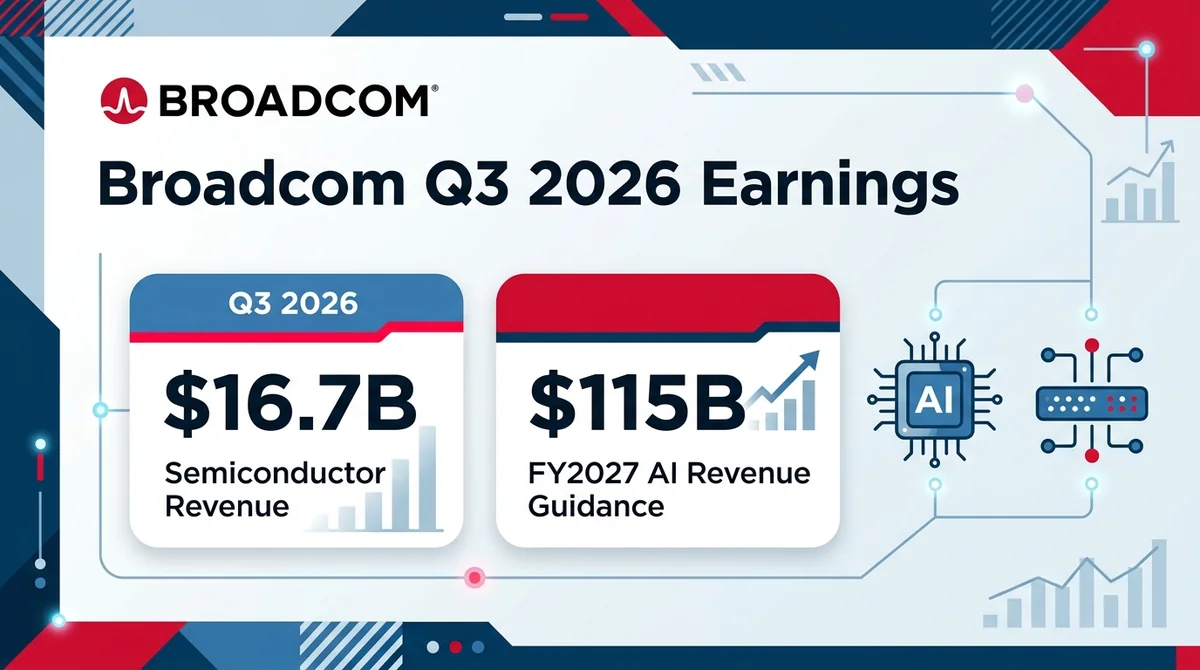
Article Citation Summary
Broadcom Q3 FY26 revenue $29.59B, adj EPS $3.32 beat; semi rev doubled to $16.7B, software $8.75B miss. AI rev FY27 $115B, FY28 $230B, EPS >$30. Read full analysis.
Broadcom: Semiconductor Revenue Doubles to $16.7 Billion, FY2027 AI Revenue Guidance Doubles to $115 Billion
September 2026 This article is about 5,000 words and takes about 10 minutes to read.
Broadcom used an earnings report that doubled its AI revenue guidance to $115 billion to signal to the market that its growth driver has shifted to custom AI chips—this is not just the company's performance delivery, but a verifiable signal that global AI computing capital expenditure continues to be revised upward.
AI Summary
Core Viewpoint: Broadcom's fiscal Q3 2026 revenue and adjusted EPS both beat expectations, with semiconductor revenue growing more than twofold year over year to $16.7 billion. The company also doubled its AI revenue guidance for fiscal 2027 and 2028 to $115 billion and $230 billion respectively, and its fiscal 2028 EPS guidance is significantly above consensus, indicating that the company's growth momentum is increasingly dependent on AI computing orders.
Key Elements:
- Broadcom's fiscal Q3 2026 adjusted EPS was $3.32, revenue $29.59 billion, above expectations of $3.24 and $29.36 billion.
- Semiconductor revenue grew more than twofold year over year to $16.7 billion, beating expectations; infrastructure software revenue was $8.75 billion, slightly below expectations.
- AI revenue guidance for fiscal 2027 doubled to $115 billion, and doubled again for fiscal 2028 to $230 billion.
- Fiscal 2028 adjusted EPS guidance exceeds $30, significantly above LSEG consensus of $25.86.
- CFO Amie Thuener said the company is enabling two leading AI labs, bridging the gap between cash flow and upfront investment.
- Earnings released on September 2, 2026 (reported by CNBC).
1. Broadcom's Fiscal Q3 2026 Beats on Both Lines: Semiconductor Revenue More Than Doubles to $16.7 Billion, Total Revenue $29.59 Billion
1. Adjusted EPS of $3.32 vs. Expected $3.24, Revenue of $29.59B vs. Expected $29.36B
According to CNBC report, Broadcom's fiscal Q3 2026 revenue was $29.59 billion and adjusted EPS $3.32, both beating market expectations.
A solid beat is not surprising, but with current high demand for AI chips, the market is extremely sensitive to valuation, so positive earnings deviations are amplified.
The most noteworthy aspect of this earnings report is not the EPS and revenue numbers themselves, but the structural support behind them. The market had worried about momentum decay after the semiconductor industry's earlier rapid growth, but Broadcom's beat shows that demand for custom chips and networking products has not cooled significantly; instead, it remains strong driven by capital spending from large cloud providers and AI labs. From a profit perspective, adjusted EPS of $3.32 reflects good cost control and operating leverage while revenue grows, but specific margin changes still need more financial details for verification.
2. Semiconductor Revenue Grows More Than Twofold YoY to $16.7 Billion, Becoming the Strongest Growth Engine This Quarter
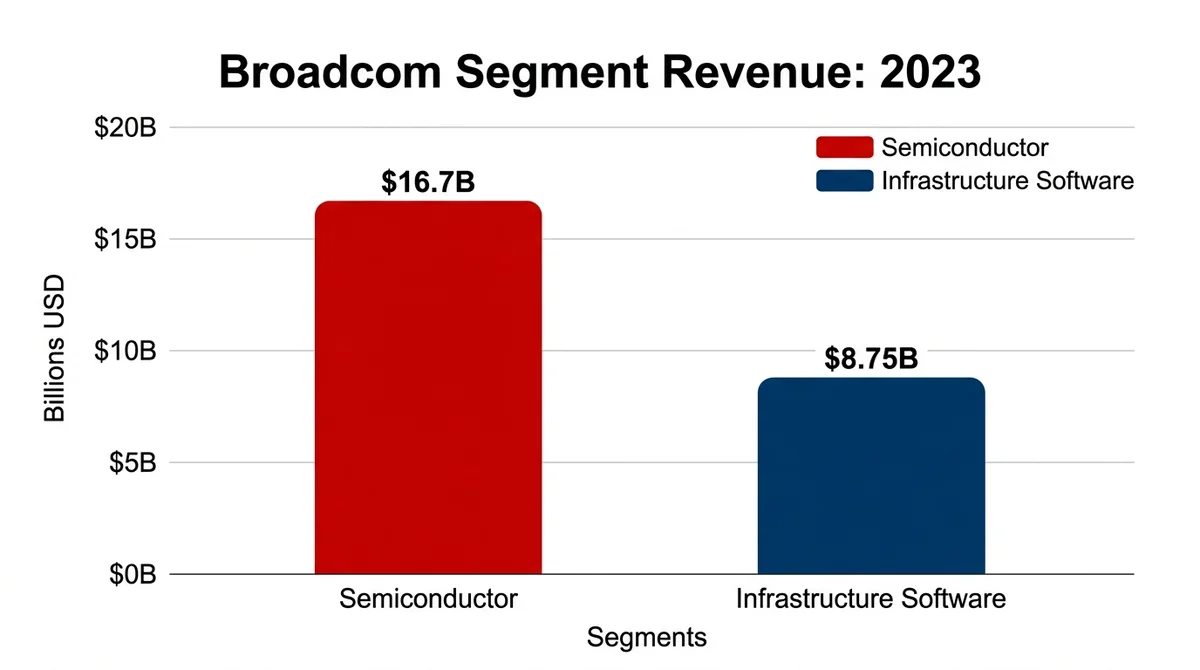
Semiconductor revenue grew more than twofold year over year to $16.7 billion, becoming the strongest growth engine this quarter.
By segment, Broadcom's semiconductor revenue grew more than twofold year over year to $16.7 billion, beating market expectations. This growth rate is far higher than the overall revenue, making the semiconductor segment the main growth driver. Traditional enterprise semiconductor products are recovering slowly, but this is overshadowed by explosive demand for AI custom chips, switching chips, and high-speed interconnect products. This structure of "AI pulling, non-AI supporting" is evident in the fiscal third quarter.
Meanwhile, infrastructure software revenue was $8.75 billion, slightly below market expectations. Semiconductor revenue is now nearly twice software revenue, with a huge gap in growth rates. Long-term Broadcom investors will see that the "semiconductor + software" dual-engine strategy pursued over the past few years is being replaced by AI semiconductor unipolar growth, consistent with management's emphasis on the long-term opportunity in custom AI chips.
2. AI Revenue Guidance Doubles Consecutively: $115 Billion for FY2027 and $230 Billion for FY2028, Long-Term EPS Guidance Far Above Consensus
1. AI Revenue Guidance Doubles to $115 Billion for FY2027, and Doubles Again to $230 Billion for FY2028
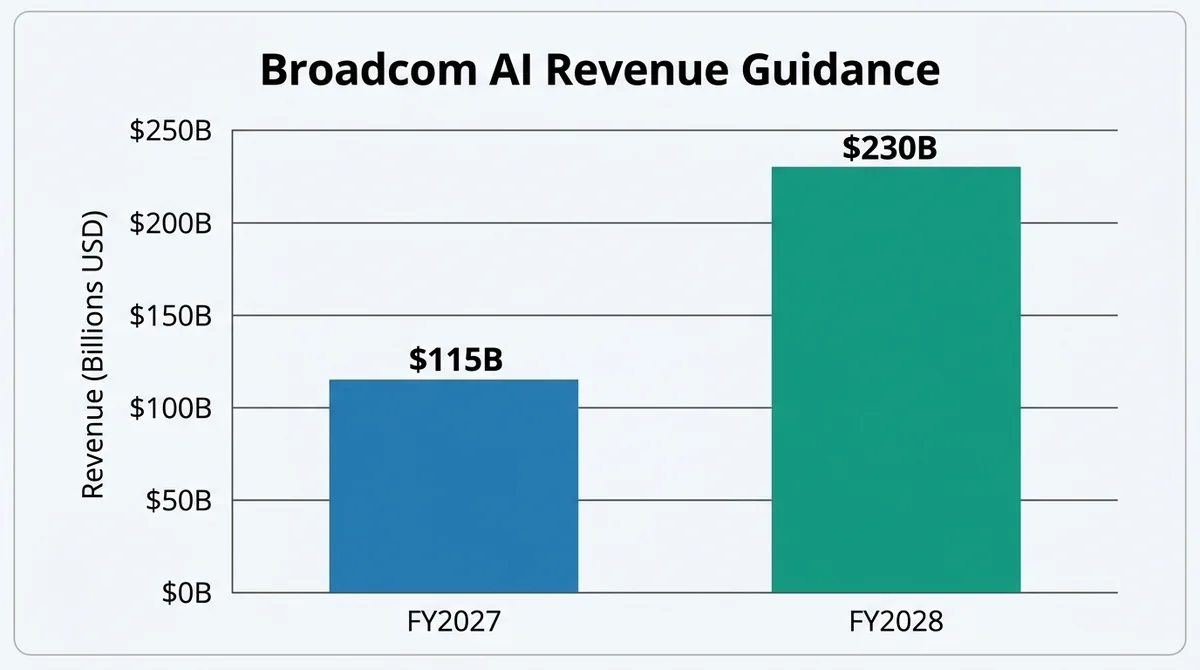
Broadcom doubled its AI revenue guidance for fiscal 2027 to $115 billion, and doubled it again for fiscal 2028 to $230 billion.
The CNBC report shows this guidance, meaning management has given an aggressive slope for long-term demand for AI custom chips and networking equipment—doubling for two consecutive fiscal years, rare among large tech companies. The guidance is not an isolated number; it corresponds to the next-generation model training and inference infrastructure of hyperscale cloud providers and frontier AI labs.
The consecutive doubling guidance challenges market skepticism about the sustainability of AI capital expenditure. Some previously believed AI chip demand might decline around 2027, but Broadcom's doubled expectations refute that view. If realized, Broadcom could become one of the largest suppliers in the AI semiconductor space within two years, approaching or surpassing some traditional GPU vendors. The guidance remains management's expectation; actual delivery depends on orders, capacity, and competition, with significant uncertainty.
2. FY2028 Adjusted EPS Guidance Exceeds $30, Significantly Above LSEG Consensus of $25.86
Fiscal 2028 adjusted EPS guidance exceeds $30, significantly above the LSEG consensus of $25.86.
The profit-side guidance is even more critical: Broadcom expects fiscal 2028 adjusted EPS to exceed $30, while LSEG consensus is only $25.86. The gap means that if guidance is met, there is significant room for upward earnings revisions over the next two years, and the market is currently pricing in conservative AI margins. The combination of revenue doubling and EPS beat suggests management expects high revenue growth with continued margin improvement, driven by design reuse of custom chips, a higher mix of high-end networking products, and software cost optimization.
The fiscal 2028 EPS guidance above $30 provides a clear long-term profit benchmark. Based on the current stock price, the forward P/E ratio could fall to an attractive range, which is one reason analysts are raising price targets. However, guidance beat does not mean no risk: AI order conversion cycles are long, customer concentration is high, and any change in capital spending by major customers will affect delivery. An EPS above $30 is an optimistic but trackable benchmark.
3. Collaboration with Two Leading AI Labs Forms the Core of AI Orders: CFO Says Enabling Two Labs to Bridge Upfront Investment Gap
1. CFO Amie Thuener Confirms the Company Is Enabling Two Leading AI Labs
Broadcom CFO Amie Thuener confirmed that the company is enabling two leading AI labs.
During the earnings call, the CFO said the company is enabling two leading AI labs; although not named directly, market interpretation based on recent developments points to two labs at the forefront of generative AI. This statement anchors the AI revenue guidance to specific customers—two labs at the forefront of generative AI with significant capital spending. The CFO further noted that the company is bridging the gap between the labs' current cash flow and major upfront investments, describing the potential role of a custom AI chip supplier in the AI ecosystem.
Large AI labs have long-term, large-scale, high-stickiness demand for custom AI chips. Unlike general-purpose GPU purchases, custom ASICs require deep integration and have high switching costs. Broadcom's simultaneous supply relationships with two leading AI labs may have deeply embedded it in the compute expansion plans of two top labs, providing an order source explanation for the consecutive doubling of AI revenue in fiscal 2027 and 2028. However, public information is limited, and specific contract amounts and scales have not been disclosed.
2. Bridging the Gap Between Cash Flow and Major Upfront Investments, Strengthening AI Revenue Order Visibility
Broadcom may have reached more flexible payment or long-term supply agreements with AI labs, enhancing revenue predictability.
The CFO's mention of "bridging the gap between cash flow and upfront investment" may refer to helping AI labs secure critical computing infrastructure in advance through custom design and capacity lock-in. Generative AI is still in a period of large-scale investment; labs need external financing and supplier credit to expand training clusters and inference deployments. Broadcom may provide flexible arrangements in payment terms, cooperative financing, or long-term supply agreements, making order front-loading and long-term contracts possible.
Deep integration may transform Broadcom from a one-time chip supplier into a co-builder of AI infrastructure. Although specific contract amounts with the two labs have not been disclosed, the CFO's statement may be a signal: there is already a visible order prototype behind the doubled AI revenue guidance. Worth tracking going forward: whether the two labs expand cooperation scale, whether new projects become public, and whether the revenue share of the top two customers rises.
4. Software Business Slightly Misses Expectations in the Short Term, Does Not Change the AI Compute Main Line
1. Infrastructure Software Revenue of $8.75 Billion, Slightly Below Market Expectations
Infrastructure software revenue was $8.75 billion, slightly below market expectations.
The software business has relatively weak growth momentum, possibly affected by cautious enterprise IT spending or product mix adjustments. Broadcom's software segment mainly comes from the acquisitions of VMware and CA Technologies, with core high-stickiness enterprise subscriptions and maintenance; growth is stable but hard to explode. The slight miss is more due to a high prior-year base and short-term order timing fluctuations, not a fundamental deterioration in customer base or cash flow quality.
The software miss should not be over-interpreted as fundamental weakening: semiconductor revenue is already nearly twice software revenue, and its growth rate far exceeds software. Even if software revenue is flat, continued high growth in AI semiconductors can sustain overall revenue and profit momentum. For investors, short-term software fluctuations have limited impact; what truly determines valuation is AI semiconductor orders and the path to realizing long-term profits.
2. Structural Divergence Between Semiconductor and Software Businesses, AI Revenue Contribution Weight Continues to Rise
Semiconductor revenue is now nearly twice software revenue, and the contribution weight of AI revenue continues to rise.
Semiconductor growth exceeds twofold, while software is nearly stagnant; resource allocation is fully tilted toward AI computing. The semiconductor revenue share is rapidly jumping, while the software business still contributes cash flow but its growth narrative is moving to the back seat. If the doubled AI revenue guidance is realized, the software share will be further diluted, and the company's growth will be defined by AI semiconductors.
The software business is not irrelevant: stable subscription revenue and high margins provide a cash flow base and a safety cushion for AI semiconductor R&D investment. The short-term miss is more a minor market expectation correction, not a negative signal for strategic transformation. Going forward, it is necessary to observe whether software can find a new position in the AI ecosystem, such as combining VMware private cloud with AI inference, or embedding software capabilities into AI chip solutions.
Final Thoughts
From quarterly results to long-term guidance, Broadcom's earnings report essentially completed a repricing of "AI computing confidence." Semiconductor revenue growing over twofold, AI revenue guidance doubling consecutively, and signals of deep cooperation with two leading AI labs all point to the same macro reality: the global AI infrastructure capital expenditure cycle is still accelerating, and is extending from general-purpose GPU purchases toward customization and platformization. As a supplier with capabilities in custom ASICs, networking chips, and software ecosystems, Broadcom is occupying a certain ecological niche in this wave of capital spending.
For the market, Broadcom may no longer be a traditional semiconductor or software company, but is gradually evolving into a core supplier of AI computing infrastructure. Its AI revenue and EPS guidance for fiscal 2027 and 2028 provide verifiable anchors. The key things to watch going forward are the actual landing pace of orders from the two leading AI labs, the efficiency of converting capital expenditure into revenue, and whether the software business can find a new growth position in the AI ecosystem. If these three verification points are delivered as expected, Broadcom's valuation logic may shift from a cyclical semiconductor company to a long-term AI infrastructure leader; otherwise, the market will re-examine the aggressiveness of its guidance.
Risk Disclaimer: Macroeconomic and U.S. stock market volatility is severe; this article is for academic and research observation only and does not constitute any investment advice.
Frequently Asked Questions (FAQ)
Q: Did Broadcom beat expectations for fiscal Q3 2026? A: Yes, adjusted EPS was $3.32, above the expected $3.
This article is produced by the MSXGO editorial team, AI-assisted, and reviewed through an editorial process. Fee rates and figures are subject to each platform's latest official announcements.
FAQ
Did Broadcom beat expectations for fiscal Q3 2026? ▼
Yes, adjusted EPS was $3.32, above the expected $3.24; revenue was $29.59 billion, above the expected $29.36 billion; semiconductor revenue grew more than twofold to $16.7 billion, beating expectations.
What is Broadcom's AI revenue guidance for fiscal 2027 and 2028? ▼
AI revenue is expected to be $115 billion in fiscal 2027 and $230 billion in fiscal 2028; fiscal 2028 adjusted EPS guidance exceeds $30, above LSEG consensus of $25.86.
Which two leading AI labs did Broadcom's CFO refer to? ▼
According to reports, the market generally understands the two leading AI labs as OpenAI and Anthropic, but the CFO did not name them directly.
How did Broadcom's software business perform? ▼
Infrastructure software revenue in fiscal Q3 2026 was $8.75 billion, slightly below market expectations, but the high growth of the semiconductor business limited its impact.
When was the earnings report released? ▼
Broadcom released its fiscal Q3 2026 earnings report on September 2, 2026.
Finished reading? Ready to try trading?
Tokenized stocks/ETFs, crypto spot, and perpetual futures in one account — perp maker 0.02% / taker 0.045%, RWA spot buy 0.3% / sell 0.
Free sign-up · 3 quick steps