MSX US Stocks Daily Watch: Chip Stocks and Dividend Growth: LRCX and 8 Others Raise Dividends, Analysts Add Marvell and Broadcom and Wait for Nvidia Pullback
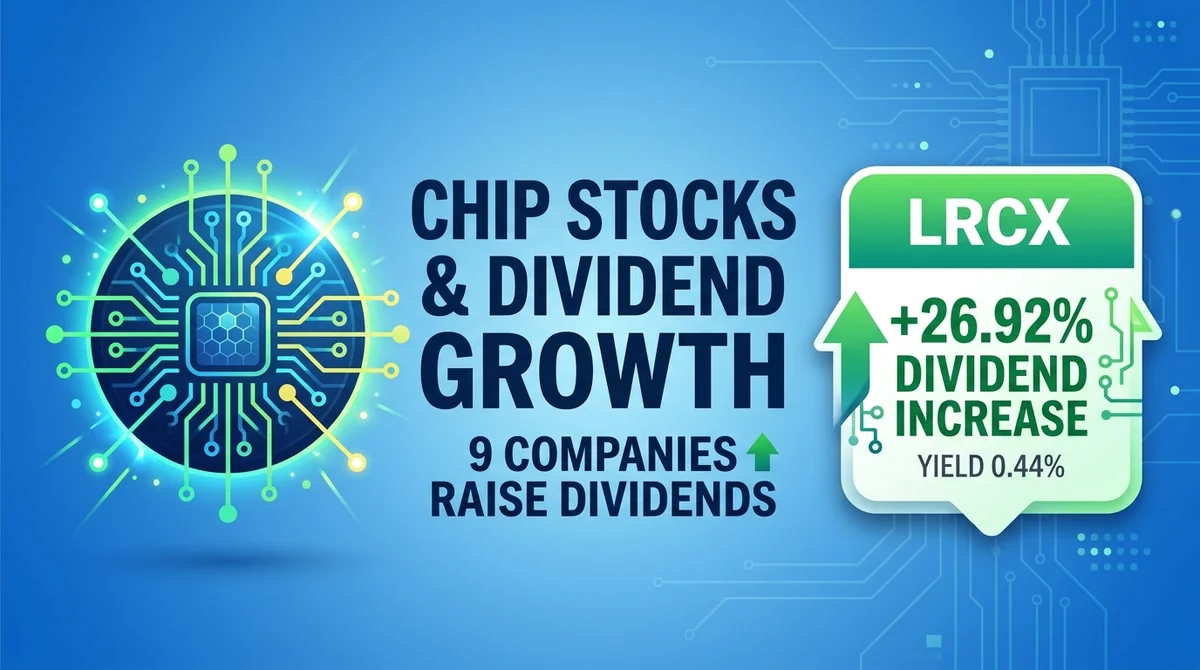
Aug 2026: LRCX & 8 others hiked dividends; analysts added Marvell & Broadcom. S&P 500 targets 8000, but hawkish Fed Chair Warsh raises Sept rate hike odds.
Article Citation Summary
Aug 2026: LRCX & 8 others hiked dividends; analysts added Marvell & Broadcom. S&P 500 targets 8000, but hawkish Fed Chair Warsh raises Sept rate hike odds.
US Stocks Daily Watch: Chip Stocks and Dividend Growth: LRCX and 8 Others Raise Dividends, Analysts Add Marvell and Broadcom and Wait for Nvidia Pullback
US Stock Research
Guest Columnist
2026
This article is about 4,800 words, full reading takes about 12 minutes
Introduction
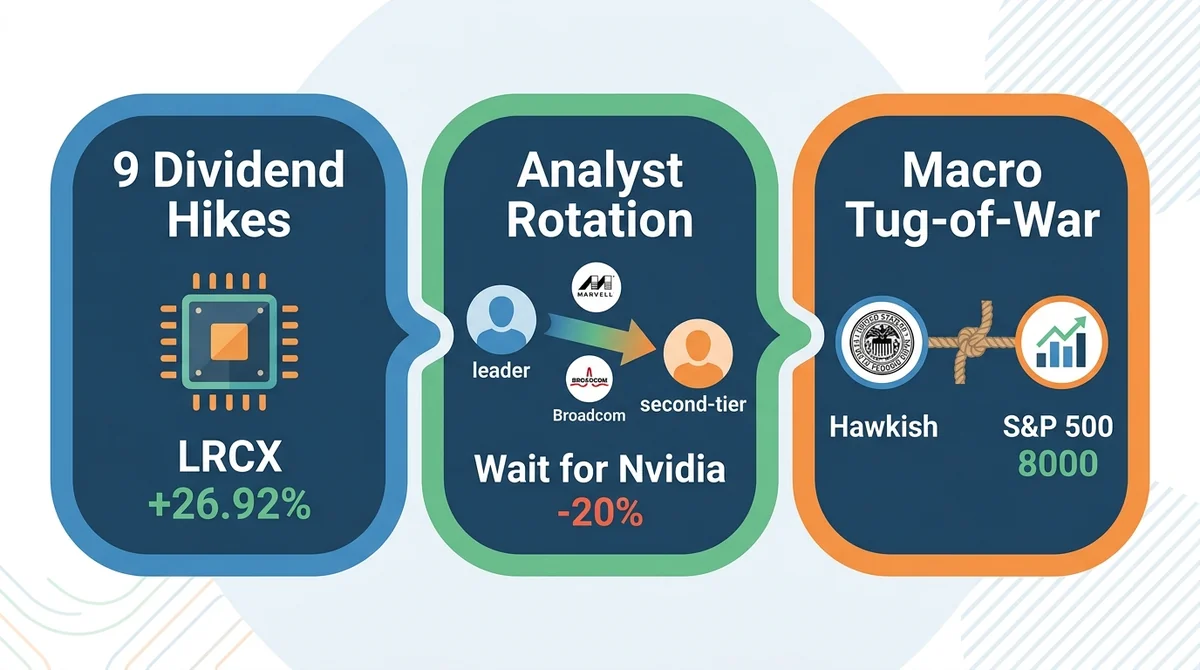
Capital in the chip supply chain is shifting from a one-sided premium on leaders to a dual drive of second-tier growth and capital returns. LRCX and 8 other companies raised dividends in a concentrated manner, while analysts added Marvell and Broadcom and waited for a 20% Nvidia pullback to re-enter.
The S&P 500 is initially positioned by analysts to run toward 8000, but Fed Chair Warsh's Hawkish Remarks raise the probability of a September rate hike, making the jobs report and CPI key macro thresholds.
AI Summary
Core Viewpoint:
This week's U.S. stock market simultaneously sent three types of signals—chip companies concentrated dividend hikes, analysts adding second-tier chip stocks while waiting for an Nvidia pullback, and a tug-of-war between bullish S&P 500 sentiment and hawkish Fed remarks. The core implication is: the possibility of funds rotating within the chip sector from leader premiums to second-tier growth is rising, but uncertainty about the macro rate path constrains high-valuation growth stocks and index levels.
Key Elements:
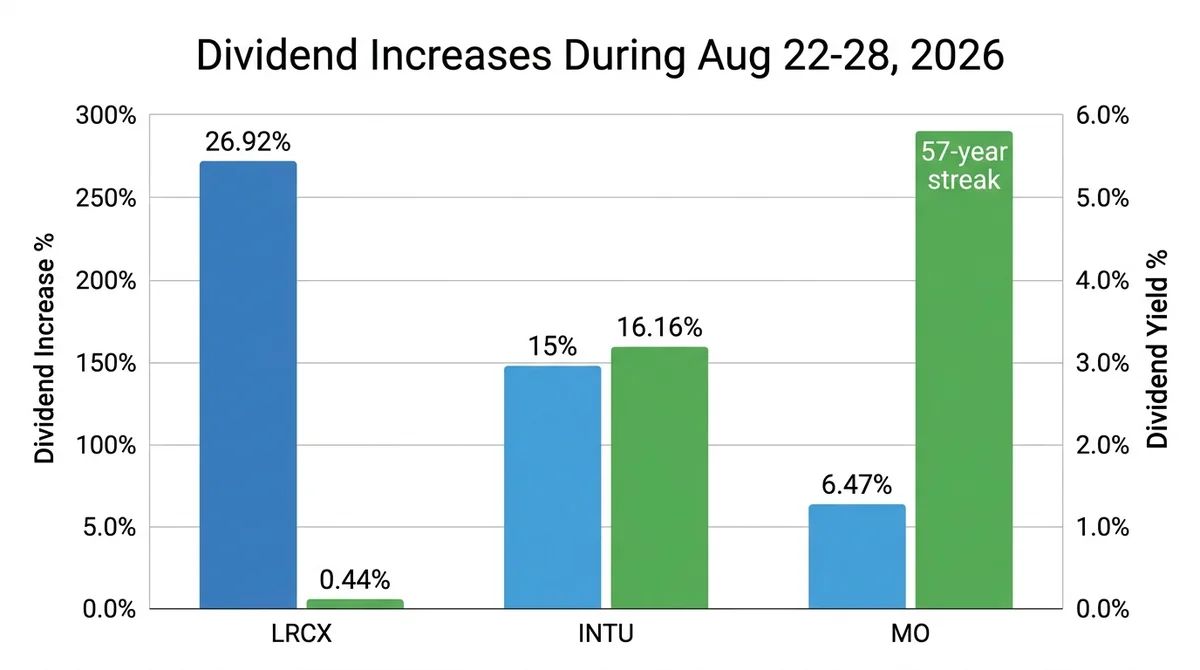
- According to Seeking Alpha data on August 28, during the week of August 22–28, 2026, a total of 9 stocks announced dividend increases, among which LRCX had the largest increase at 26.92%, with a dividend yield of 0.44%.
- INTU announced a 15% dividend increase, with a forward dividend growth rate of 16.16%; MO offers a 6.47% dividend yield and a 57-year record of consecutive increases.
- Analyst David H. Lerner said he has added to his positions in Marvell and Broadcom and plans to buy Nvidia only after a 20% decline.
- Nvidia released strong earnings and rare positive forward guidance, triggering bullish sentiment.
- Fed Chair Warsh made hawkish remarks, raising the likelihood of a September rate hike, making upcoming jobs reports and CPI data critical.
- Analyst Andrew McElroy said the S&P 500 is likely to close August with a bullish tilt and is initially positioned for a rise to 8000.
I. Dividend Hike Wave: 9 Companies Led by LRCX Raise Dividends in Concentration, Capital Return Signals and Industry Attribute Divergence
Seeking Alpha data on August 28 shows that during the week of August 22–28, 2026, a total of 9 stocks announced dividend increases. This concentrated dividend hike may reflect management's marginal emphasis on shareholder returns, but the differences in hike magnitude and dividend yield are huge, reflecting divergence in industry attributes and growth stages.
1. LRCX Raises Dividend by the Week's Largest 26.92%, but 0.44% Yield Reflects Its Growth Attribute
Seeking Alpha's August 28 statistics show that LRCX (Lam Research) became the company with the largest dividend increase of the week at 26.92%, but its dividend yield is only 0.44%. This combination seems contradictory but may actually reflect the capital return posture of semiconductor equipment companies: on one hand, the company is willing to significantly raise dividends, indicating management's increased confidence in the sustainability of free cash flow; on the other hand, the low 0.44% yield means stock price returns may still be highly dependent on earnings growth and valuation expansion rather than cash dividends.
If evaluated solely from a dividend perspective, LRCX does not offer a traditional margin of safety. The 0.44% yield provides limited buffer during stock price pullbacks, and investors cannot rely on dividend income to cover holding costs. Therefore, interpreting LRCX's dividend hike as a defensive signal may be a misreading. A more reasonable understanding is: as a growth-oriented chip equipment maker, LRCX maintains R&D and capacity investment while expressing marginal shareholder returns through a small dividend increase, but the core investment logic remains order growth and earnings improvement driven by AI capital expenditure.
From an industry perspective, LRCX's dividend hike may be related to the current earnings cycle of the semiconductor equipment sector. The market generally believes AI computing investment drives fab expansion, equipment makers have full order backlogs and ample cash flow, and management has room to rebalance between capital expenditure and shareholder returns. However, the low dividend yield also indicates that funds are more directed toward growth projects rather than being distributed as dividends. This means this week's dividend hike wave is more likely a marginal optimization of capital allocation rather than a market style shift from growth to value.
2. INTU and MO Represent Two Dividend Hike Samples: 15% Forward Growth vs 6.47% Yield and 57-Year Consecutive Record
Also from Seeking Alpha data on August 28, INTU (Intuit) announced a 15% dividend increase, with a forward dividend growth rate of 16.16%; while MO (Altria) offers a 6.47% dividend yield and has a 57-year record of consecutive increases. These two samples happen to represent two typical paths in the dividend hike wave: one is growth-oriented dividend increases in software/fintech, with high hike percentages but low absolute yields; the other is traditional consumer defensive high dividend and ultra-long consecutive records.
INTU's 15% dividend increase and its 16.16% forward dividend growth rate may indicate high visibility into future earnings growth. As a representative of subscription-based SaaS models, INTU has stable and predictable cash flow, and management has the ability to increase dividends while maintaining product investment. However, INTU's absolute dividend yield is not outstanding, and the market pays more attention to its product penetration and revenue growth in AI scenarios. In contrast, MO's 6.47% yield and 57-year consecutive dividend increase record are typical defensive allocation features. MO's dividend increases are usually small but extremely stable, suitable for investors seeking regular cash flow and low volatility.
The coexistence of the two types of samples shows that this week's dividend hike wave is not driven by a single style, but is the natural expression of different industries in their respective cash flow cycles. For investors, if they simply equate 'dividend hike' with 'margin of safety,' they may overlook the structural differences among dividend yield, dividend growth rate, and industry growth attributes. Growth-oriented dividend hikes may come with higher volatility, while high-dividend defensive hikes may lack upside elasticity. Understanding this divergence is more important than simply chasing the 'dividend hike' label.
II. Analyst Chip Stock Position Rebalancing: Adding Marvell and Broadcom, Nvidia Needs a 20% Pullback to Trigger Buying
Seeking Alpha reported on August 30 that analyst David H. Lerner said he has added to Marvell and Broadcom and plans to buy Nvidia only after a 20% decline. This operation reveals as much information as a financial report: amid Nvidia's earnings beat, Lerner did not chase Nvidia higher but instead allocated funds to Marvell and Broadcom, setting a 20% pullback threshold for Nvidia.
1. David H. Lerner Has Added Marvell and Broadcom, Nvidia Needs a 20% Pullback to Trigger Buying
Lerner's position structure shows that some market participants believe Nvidia's current valuation may have fully priced in the optimistic expectations for AI accelerator demand, while Marvell and Broadcom, as second-tier chip names, still have relative valuation advantages in niches such as ASICs and network switching chips. The 20% pullback threshold is not a random number; it may imply the analyst's quantitative judgment on Nvidia's volatility range and valuation margin of safety. If Nvidia's price pulls back 20% in the short term, it may mean the market's pricing of AI capital expenditure has cooled temporarily, and it also provides an opportunity for funds that missed the previous rally to re-enter.
Notably, this strategy is highly disciplined. It sacrifices participation when Nvidia continues to rise in exchange for a lower holding cost. If Nvidia continues to rise amid strong earnings and persistently better-than-expected AI demand, a 20% pullback may not appear for a long time, and waiters will miss trend gains. Therefore, a pullback-buying strategy is more suitable as part of phased position building rather than an all-or-nothing decision. For ordinary investors, treating 20% as a strict discipline rather than an absolute target may be more realistic.
2. Nvidia's Strong Earnings and Rare Positive Guidance Drive Bullish Sentiment, but Analysts Wait for a More Reasonable Valuation Window
The same report pointed out that Nvidia released strong earnings and rare positive forward guidance, triggering bullish sentiment. The reason Nvidia's positive guidance is 'rare' is that the company historically rarely gives overly explicit forward-looking judgments in earnings reports, and this time's statement clearly addressed market concerns about the sustainability of AI computing demand. However, Nvidia's bullish sentiment did not translate into analysts' unconditional chasing; instead, it triggered position rebalancing within the supply chain.
From the combination of data and positioning, funds may have rotated within the chip sector: Nvidia's good news was used to confirm industry prosperity, but the inflow targets were Marvell and Broadcom, which are second-tier names with higher elasticity. This 'leader validates, second-tier benefits' structure contrasts with the 2024–2025 Nvidia single-pole-driven market. The underlying logic may be: when the leader's valuation already contains quite optimistic expectations, incremental funds are more inclined to seek catch-up plays that have not yet been fully priced. But this judgment is premised on AI demand not experiencing marginal slowdown; otherwise, the valuation discount of second-tier chip stocks may amplify drawdown risk.
III. September Tech Market and S&P 500 Bullish Tilt: 8000 Scenario Emerges, but Beware Seasonal Misreading
Seeking Alpha on August 30 cited analyst Andrew McElroy's view that the S&P 500 is likely to close August with a bullish tilt and is initially positioned for a rise to 8000. This judgment echoes Nvidia's strong earnings, but 8000 is not a set target; it is an optimistic scenario built on continued upward revision of tech earnings and a supportive macro environment.
1. Andrew McElroy Believes the S&P 500 Is Likely to Close August with a Bullish Tilt and Positions the Index to Rise to 8000
The number 8000 implies significant upside from current levels, but McElroy used 'initial positioning' rather than a definitive forecast, which inherently carries scenario assumptions. The bullish tilt may stem from the positive pull of Nvidia's strong earnings and guidance on overall tech weight, as well as the market's continued pricing of the AI capital expenditure cycle. At the index level, the S&P 500's weight structure gives large tech stocks a large influence on index direction. When Nvidia gives positive forward guidance, the market not only reassesses its own valuation but also simultaneously raises earnings expectations for upstream and downstream companies in the AI industrial chain.
Therefore, the 8000 scenario can be seen as an optimistic picture of
This article is produced by the MSXGO editorial team, AI-assisted, and reviewed through an editorial process. Fee rates and figures are subject to each platform's latest official announcements.
FAQ
本周有多少家公司宣布增加股息?LRCX 的增幅和股息率是多少? ▼
2026年8月22日至28日当周,共有9只股票宣布增加股息,其中LRCX的增幅最大为26.92%,股息收益率为0.44%。
分析师 David H. Lerner 在芯片股上如何操作? ▼
他已增持 Marvell 和 Broadcom 的股票,并计划在 Nvidia 下跌20%时才买入 Nvidia。
英伟达(Nvidia)最近的财报表现如何? ▼
英伟达发布了强劲的财报和罕见的积极前瞻指引,引发市场看涨情绪。
美联储主席 Warsh 的表态对市场有何影响? ▼
Warsh 发表鹰派言论,提高了9月加息的可能性,使得即将发布的就业报告和CPI数据变得关键。
分析师对标普500指数的目标点位是多少? ▼
分析师 Andrew McElroy 认为标普500指数有望在8月底以看涨倾向收盘,并初步定位为指数上涨至8000点。
投资者应如何看待本周的股息上调潮? ▼
股息上调提供资本回报信号,但股息率偏低可能意味着安全边际有限,如 LRCX 0.44% 股息率难以提供实质性下行保护。
Finished reading? Ready to try trading?
Tokenized stocks/ETFs, crypto spot, and perpetual futures in one account — perp maker 0.02% / taker 0.045%, RWA spot buy 0.3% / sell 0.
Free sign-up · 3 quick steps