What Are Perpetual Contracts? 2026 Mechanics, Funding Rates, and MSX Trading Guide
Perpetual contracts have no expiry and use funding rates to anchor spot prices. MSX futures taker 0.045%, maker 0.02%, 10% off with $MSX. Full guide.

Article Citation Summary
Perpetual contracts have no expiry and use funding rates to anchor spot prices. MSX futures taker 0.045%, maker 0.02%, 10% off with $MSX. Full guide.
What Are Perpetual Contracts? 2026 Mechanics, Funding Rates, and MSX Trading Guide
TL;DR Key Points
- Perpetual contracts are derivatives with no expiry date, using a funding rate mechanism to anchor the contract price to the spot price.
- As of 2026, MSX perpetual contracts have a taker fee of 0.045% and maker fee of 0.02%, with an additional 10% discount when using $MSX to offset fees.
- The funding rate settles every 8 hours; when positive, longs pay shorts, and when negative, shorts pay longs, directly impacting holding costs.
- MSX supports US stock token perpetual contracts with a low entry of 10U, and employs a multi-layered risk control system (margin monitoring, risk alerts, auto-deleveraging, forced liquidation).
What Are Perpetual Contracts? How Do They Differ from Traditional Delivery Contracts?
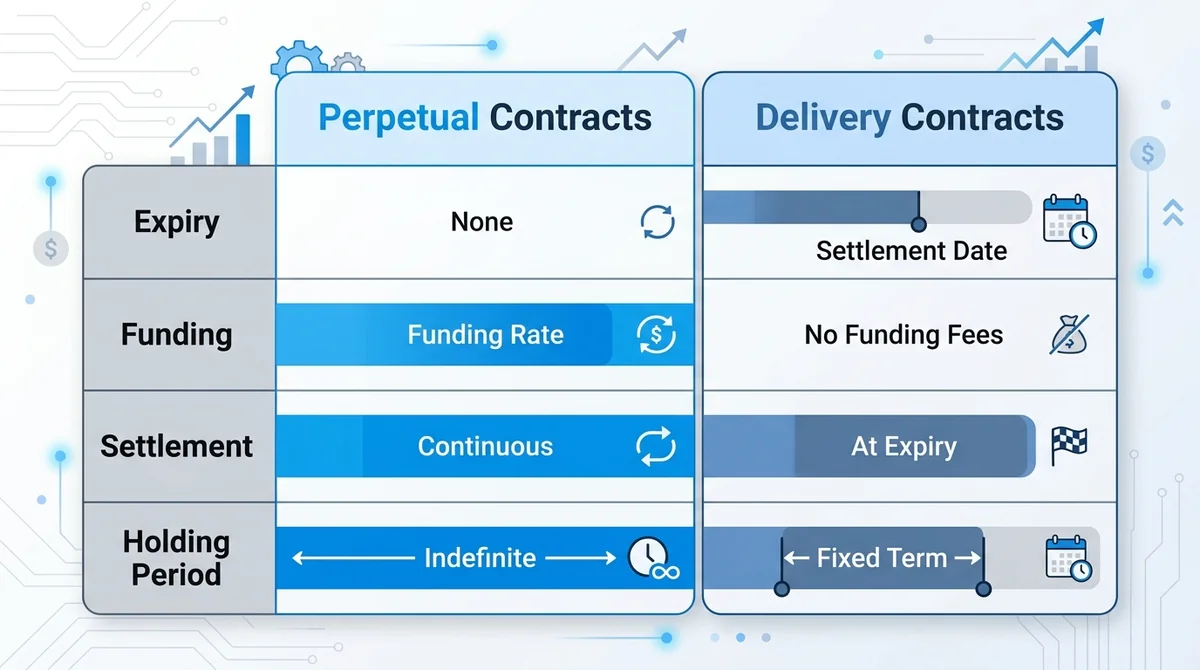
Perpetual contracts are derivatives with no expiry date, using a funding rate mechanism to anchor the contract price to the spot price, unlike traditional contracts with fixed delivery dates. Traditional delivery contracts (such as quarterly contracts) have a clear delivery date, after which they must be settled or closed at the agreed price; perpetual contracts have no expiry and can be held long-term, with positions not forcibly closed due to time expiry.
What Are the Core Mechanisms of Perpetual Contracts?
The core mechanisms of perpetual contracts include: no expiry date, periodic funding rate settlement, mark price, and liquidation mechanism. No expiry means traders don't need to worry about contract rollover, suitable for long-term trend following. The funding rate (a periodic payment between longs and shorts to anchor the contract price to the spot) settles every 8 hours. When the contract price is above the spot, longs pay shorts, suppressing the premium; conversely, shorts pay longs, suppressing the discount. The mark price is typically calculated as a weighted average of spot prices from multiple exchanges, used for calculating unrealized PnL and triggering liquidation, avoiding price manipulation on a single platform.
How Does the Funding Rate Anchor Perpetual Contracts to the Spot Price?
The funding rate uses economic incentives to bring the contract price back to the spot price. When the perpetual contract price is above the spot, the funding rate is positive, and long position holders must pay shorts, increasing the cost of holding longs and prompting some longs to close or shorts to open, thereby pushing the contract price down. When the contract price is below the spot, the funding rate is negative, and shorts pay longs, incentivizing long opening and pushing the contract price up. MSX perpetual contracts also adopt this mechanism, with the funding rate settling every 8 hours, and the specific rate dynamically calculated based on market premium and interest rate.
How Is the Funding Rate of Perpetual Contracts Calculated?
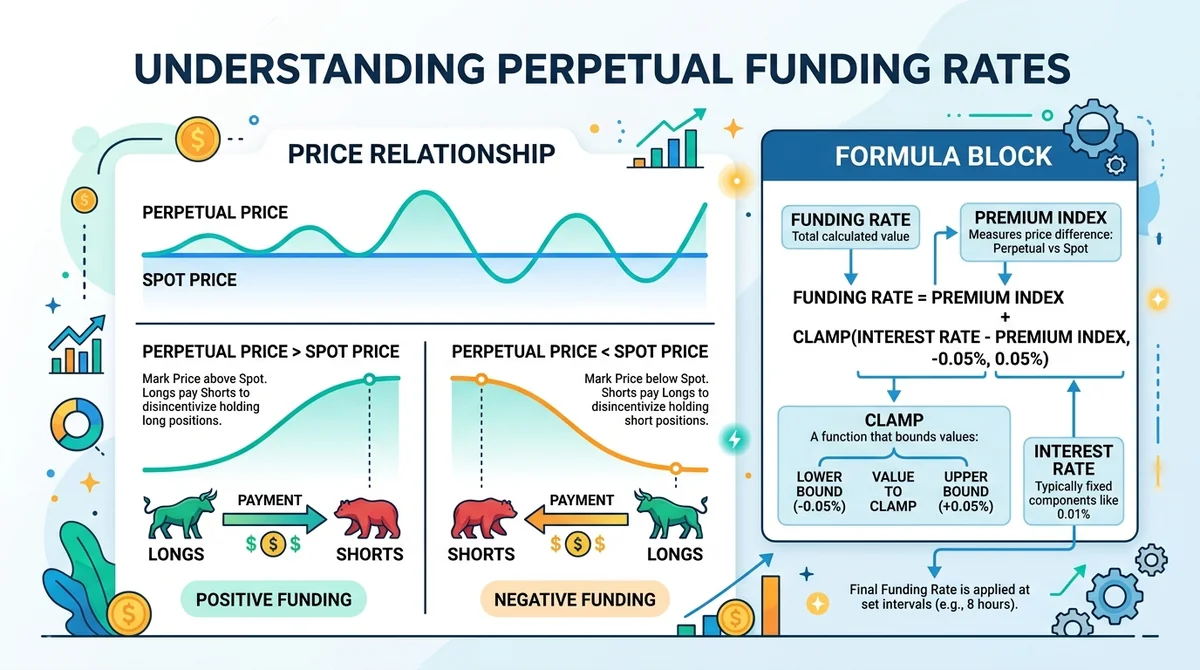
The funding rate of perpetual contracts is calculated periodically based on market premium and interest rate. When positive, longs pay shorts; when negative, shorts pay longs, directly affecting traders' holding costs. The funding rate typically consists of two parts: premium index (reflecting the deviation between contract and spot prices) and interest rate (reflecting capital costs). Different platforms have slightly different funding rate calculations, but the core logic is the same.
What Is the Funding Rate Calculation Formula?
The funding rate calculation formula is typically: Funding Rate = Premium Index + clamp(Interest Rate - Premium Index, -0.05%, 0.05%). The premium index = (contract price - spot price) / spot price, and the interest rate is generally a fixed base rate (e.g., 0.01% per 8 hours). The actual funding rate is dynamically adjusted at settlement based on the latest premium, and traders can view the current and predicted funding rates on the contract details page of the trading platform.
How Does the Funding Rate Level Affect Traders?
The funding rate directly affects holding costs. A positive funding rate means longs need to pay periodically, and for traders holding long positions long-term, accumulated funding fees can significantly erode profits; a negative funding rate means shorts pay. When the funding rate is extreme (e.g., above 0.1%), it may trigger arbitrage or short-term price fluctuations. Traders should monitor funding rate changes, avoid opening long-term positions when the rate is high, or use the funding rate for arbitrage.
What Are the Advantages of Trading Perpetual Contracts on MSX?
MSX perpetual contracts have a taker fee of 0.045% and maker fee of 0.02%, with a 10% discount when using $MSX, and adopt a multi-layered risk control system to ensure trading safety, supporting low-entry trading of US stock token perpetual contracts. As of 2026, MSX contract fees are competitive among mainstream platforms, and you can start trading US stock token perpetual contracts with as little as 10U.
What Is the Fee Structure of MSX Perpetual Contracts?
The fee structure of MSX perpetual contracts is: taker 0.045%, maker 0.02%. When using $MSX platform tokens to offset fees, you can enjoy an additional 10% discount (i.e., 10% off), reducing the actual taker fee to 0.0405% and maker fee to 0.018%. This fee structure is friendly to high-frequency traders and maker strategies.
How Does MSX's Risk Control System Ensure Trading Safety?
MSX employs a multi-layered risk control system, including: margin monitoring, risk alerts, auto-deleveraging, forced liquidation. Combined with on-chain price oracles and multi-market data aggregation to calculate the mark price, it avoids price manipulation on a single platform. Additionally, MSX has completed SEC security token offering (STO) registration and complies with AML/CTF regulations in various jurisdictions.
What Assets Does MSX Support for Perpetual Contract Trading?
MSX supports US stock token perpetual contracts, allowing users to directly trade perpetual contracts of US stock tokens (such as Apple, Tesla, Nvidia, etc.) with stablecoins, with a low entry of 10U. In addition, MSX also offers cryptocurrency perpetual contracts (such as BTC, ETH, and other major coins). The specific trading pairs available are subject to the MSX platform page.
How to Start Trading MSX Perpetual Contracts?
To start trading MSX perpetual contracts, you need to complete registration and KYC verification, deposit margin, select the appropriate contract and leverage to place orders, and manage risks through stop-profit/stop-loss and funding rate management. The following are the specific steps.
What Do You Need to Prepare Before Trading?
- Register an account: Visit the MSX official website to complete registration.
- Complete KYC verification: Submit identity documents as required by the platform to complete KYC (Know Your Customer) verification.
- Deposit margin: Deposit stablecoins such as USDT into your MSX contract account.
- Understand contract rules: Familiarize yourself with funding rates, mark price, liquidation mechanism, etc.
What Are the Specific Steps for Placing an Order?
- Log in to the MSX platform and go to the perpetual contract trading page.
- Select a trading pair (e.g., BTC/USDT perpetual or US stock token perpetual).
- Set the leverage multiple (choose based on risk tolerance; beginners are advised to use low leverage).
- Choose the order type (limit or market), enter the price and quantity.
- Set stop-profit/stop-loss (optional but recommended), and confirm the order.
How to Manage Trading Risks of Perpetual Contracts?
- Set stop-profit/stop-loss: Set stop-profit and stop-loss prices in advance to avoid emotional trading.
- Use reasonable leverage: Higher leverage increases liquidation risk; beginners are advised to keep leverage below 5x.
- Monitor funding rates: Avoid opening long-term positions when funding rates are extreme.
- Monitor margin ratio: Maintain sufficient margin to prevent liquidation due to price fluctuations.
What Are the Risks of Perpetual Contract Trading? How to Prevent Them?
Perpetual contract trading involves risks such as amplified losses from leverage and funding rate fluctuations. Traders should use reasonable leverage, use stop-profit/stop-loss, and closely monitor margin ratios to prevent risks. Crypto assets are highly volatile and may result in loss of all principal.
What Are the Main Risks of Perpetual Contracts?
- Leverage risk: Leverage amplifies both gains and losses; high leverage can lead to rapid liquidation.
- Funding rate risk: Funding rate fluctuations increase holding costs; long-term positions may accumulate high fees.
- Liquidation risk: During sharp price movements, insufficient margin may trigger forced liquidation.
- Liquidity risk: In extreme market conditions, slippage or difficulty in closing positions may occur.
How to Use Risk Control Tools to Reduce Risks?
- Use stop-profit/stop-loss orders: Automatically execute stop-profit/stop-loss to control per-trade losses.
- Set reasonable leverage: Choose leverage based on your risk tolerance, avoiding excessive leverage.
- Monitor margin ratio: Timely add margin to prevent liquidation.
- Diversify investments: Do not put all funds into a single contract.
FAQ
What is the difference between perpetual contracts and delivery contracts?
Perpetual contracts have no expiry date and use a funding rate mechanism to anchor the spot price, allowing long-term holding; delivery contracts have a fixed delivery date and must be settled or closed at expiry.
What are the fees for MSX perpetual contracts?
MSX perpetual contracts have a taker fee of 0.045% and maker fee of 0.02%, with an additional 10% discount when using $MSX to offset fees.
How is the funding rate calculated?
The funding rate consists of the premium index and interest rate, typically settled every 8 hours. When positive, longs pay shorts; when negative, shorts pay longs.
What assets does MSX perpetual contracts support?
MSX supports US stock token perpetual contracts (from 10U) and cryptocurrency perpetual contracts. Specific trading pairs are subject to the platform page.
What are the risks of perpetual contract trading?
Main risks include amplified losses from leverage, funding rate fluctuations, liquidation risk, and liquidity risk. It is recommended to use reasonable leverage, use stop-profit/stop-loss, and monitor margin ratios.
This article is produced by the MSXGO editorial team, AI-assisted, and reviewed through an editorial process. Fee rates and figures are subject to each platform's latest official announcements.
FAQ
What is the difference between perpetual contracts and delivery contracts? ▼
Perpetual contracts have no expiry date and use a funding rate mechanism to anchor the spot price, allowing long-term holding; delivery contracts have a fixed delivery date and must be settled or closed at expiry.
What are the fees for MSX perpetual contracts? ▼
MSX perpetual contracts have a taker fee of 0.045% and maker fee of 0.02%, with an additional 10% discount when using $MSX to offset fees.
How is the funding rate calculated? ▼
The funding rate consists of the premium index and interest rate, typically settled every 8 hours. When positive, longs pay shorts; when negative, shorts pay longs.
What assets does MSX perpetual contracts support? ▼
MSX supports US stock token perpetual contracts (from 10U) and cryptocurrency perpetual contracts. Specific trading pairs are subject to the platform page.
What are the risks of perpetual contract trading? ▼
Main risks include amplified losses from leverage, funding rate fluctuations, liquidation risk, and liquidity risk. It is recommended to use reasonable leverage, use stop-profit/stop-loss, and monitor margin ratios.
Finished reading? Ready to try trading?
Tokenized stocks/ETFs, crypto spot, and perpetual futures in one account — perp maker 0.02% / taker 0.045%, RWA spot buy 0.3% / sell 0.
Free sign-up · 3 quick steps