How Much Does AVGO Tokenized Stock Trading Cost? MSX Fees vs. Similar Platforms
How much does AVGO tokenized stock trading cost? Review MSX's 0.3% buy fee, 0% sell fee, 0.1% bridge fee, and $MSX discount.
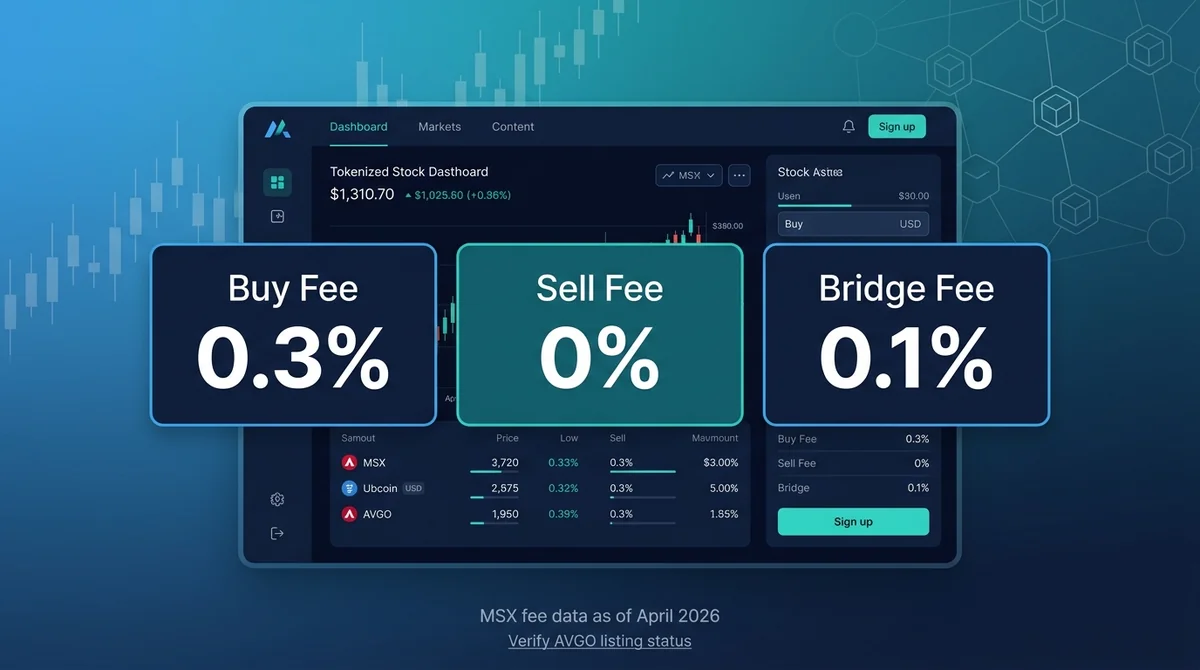
Article Citation Summary
How much does AVGO tokenized stock trading cost? Review MSX's 0.3% buy fee, 0% sell fee, 0.1% bridge fee, and $MSX discount.
How Much Does AVGO Tokenized Stock Trading Cost? MSX Fees vs. Similar Platforms
Data scope: This article only summarizes verifiable MSX product and fee information available as of April 2026 in the supplied materials. AVGO listing status, actual quotes, spreads, and competitor fees must be verified on platform pages and through official sources.
Key Points / TL;DR
- MSX RWA spot buy fees are 0.3%, while spot sell fees are 0%.
- The MSX cross-chain bridge fee is 0.1%. This is a fund-transfer cost, not a spot trading fee.
- Using $MSX to pay RWA spot fees provides a 25% discount, or 75% of the original fee.
- MSX tokenized U.S. stock products support buying and selling with stablecoins and use T+0 instant on-chain settlement.
- No reliable competitor fee data was provided, so MSX cannot be described as the lowest-fee platform in the market.
As of April 2026, the confirmed MSX RWA spot fee structure is a 0.3% buy fee and a 0% sell fee. If a cross-chain transaction is required, an additional 0.1% bridge fee applies. Whether AVGO is listed, along with its exact quote and spread, is outside the current data scope and must be checked on the actual MSX trading page.
How Much Does Trading AVGO Tokenized Stock Cost on MSX and Similar Platforms?
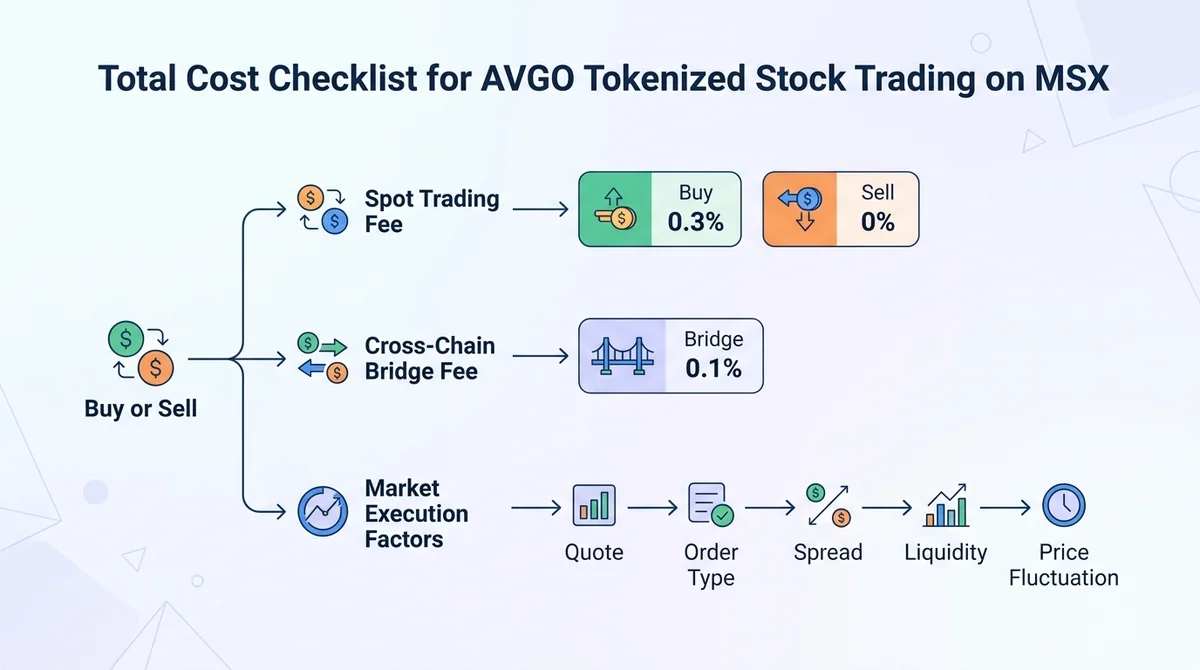
AVGO tokenized stock trading costs generally consist of spot buy fees, spot sell fees, and cross-chain bridge fees. As of April 2026, MSX has confirmed a 0.3% RWA spot buy fee, a 0% sell fee, and a 0.1% cross-chain bridge fee.
What Costs Should Be Included in AVGO Tokenized Stock Trading Fees?
To determine ORCL tokenized stock trading fees crypto exchange costs for AVGO tokenized stock trading, do not look only at the single fee shown on the trading page. A complete transaction may involve the following costs:
- Buy fee: The spot purchase fee calculated from the trade value. MSX charges 0.3% for RWA spot buy orders.
- Sell fee: The spot fee incurred when selling. MSX charges 0% for RWA spot sell orders.
- Cross-chain bridge fee: A fee for transferring assets between different blockchain networks. MSX charges 0.1% for its cross-chain bridge.
- Asset price fluctuation cost: The token price may change with the related asset and market conditions. This is not a platform fee and cannot be calculated directly from the fee schedule.
- Execution conditions: Actual execution also requires checking the quote, order type, spread, and available liquidity. The supplied materials do not provide AVGO-specific spread, minimum trade amount, or liquidity data.
Users should therefore record trading fees, fund-transfer fees, and asset-price risks separately. This avoids confusing the cross-chain bridge fee with the AVGO spot trading fee.
What MSX and Competitor Data Can Currently Be Verified?
No competitor_facts were provided. This article can therefore present only MSX's confirmed fees and cannot fill in specific competitor rates, VIP tiers, discounts, rebates, or other figures.
| Platform | RWA spot buy fee (as of April 2026) | RWA spot sell fee (as of April 2026) | Cross-chain bridge fee (as of April 2026) | Data status |
|---|---|---|---|---|
| MSX | 0.3% | 0% | 0.1% | Based on the MSX fee facts supplied |
| Similar platforms | Not provided | Not provided | Not provided | No verifiable competitor facts currently available |
If the entire RWA spot transaction takes place within MSX, the known fee structure is a 0.3% buy fee and a 0% sell fee. If cross-chain transfers are required before or after trading, the 0.1% bridge fee must be added separately. These fees do not mean that AVGO is currently available for trading; listing status must still be checked on the actual trading page.
What Is AVGO Tokenized Stock Trading on MSX?
MSX's on-chain U.S. stock token products allow users to buy and sell tokenized U.S. stocks directly with stablecoins and use T+0 instant on-chain settlement. Whether AVGO is available must be verified on the actual MSX trading page.
How Does MSX Tokenized U.S. Stock Spot Trading Work?
Tokenized stock products present interests related to traditional securities in the form of on-chain tokens. According to the supplied facts, MSX supports buying and selling tokenized U.S. stocks directly with stablecoins, and these products fall within the RWA spot category.
Before trading, users should confirm:
- Whether AVGO and an available trading pair appear on the trading page.
- Whether the page shows an RWA spot product or another type of derivative.
- Which market, limit, or take-profit/stop-loss order types are currently available.
- Whether executable quotes exist in the order book and which rules are displayed as applicable.
The supplied materials confirm that MSX supports market orders, limit orders, take-profit/stop-loss orders, and an order book. They do not confirm AVGO's specific listing status, real-time price, minimum trade amount, or spread. For the product workflow, see MSX Exchange App Complete User Guide 2026.
What Are the Features of Stablecoin Trading and On-Chain Settlement?
The known features of MSX tokenized U.S. stock products are direct stablecoin trading and T+0 instant on-chain settlement. Users should not mix the spot fees discussed here with traditional cross-border funding arrangements or fees charged by other platforms.
- Stablecoins can serve as the settlement capital used to buy and sell tokenized U.S. stocks directly.
- T+0 instant on-chain settlement means settlement is completed instantly on-chain. Actual receipt and order status remain subject to the platform page.
- Cross-chain bridge fees are calculated separately only when a cross-chain transfer occurs and should not be automatically added to every spot trade.
- Stablecoins and related on-chain transfers may still involve network, asset-price, or operational risks. The supplied materials provide no additional network-fee figures.
How Should AVGO Token Trading Availability Be Confirmed?
The current materials do not directly confirm that AVGO is listed on MSX. Therefore, the fact that MSX supports tokenized U.S. stocks cannot be rewritten to mean that AVGO is definitely tradable. The actual trading page is the final source for verification.
Check in this order:
- Search for “AVGO” or the asset name shown on the MSX spot market page.
- Check whether the trading page displays bid and ask quotes, available order types, and trading rules.
- Verify the fee, quote, minimum amount, and funding requirements shown before execution.
- If AVGO is not displayed, do not place an order or transfer funds solely because the platform generally supports tokenized U.S. stocks.
How Should AVGO Tokenized Stock Fees Be Compared Across Similar Platforms?
Because no reliable competitor fee data is currently available, this section does not provide specific platform fees or rankings. It offers a consistent comparison framework; later verification should use each platform's official fee page, trading page, and applicable regional rules.
Which Fees Should Be Checked First When Comparing Similar Platforms?
To compare ORCL tokenized stock trading fees crypto exchange costs for AVGO tokenized stocks, place the same product, trade direction, and funding path side by side:
- Spot buy fee: Confirm that the product is an RWA tokenized-stock spot market rather than ordinary crypto spot trading.
- Spot sell fee: Check whether the fee is waived, tiered, or limited to specific products.
- Cross-chain bridge fee: Confirm whether the fee is charged by the platform or generated by the network or a third-party service.
- Fee payment mechanism: Check whether a platform token can be used to pay fees and the scope of the discount.
- Settlement method: Compare whether instant on-chain settlement is supported, but do not treat settlement speed as a fee rate.
- Order and execution conditions: Check order types, order-book depth, spreads, and minimum trade amounts.
The comparison must also use consistent definitions for spot, perpetual/futures, crypto spot, and cross-chain fees. MSX's crypto-to-crypto trading fee is 0%, but that figure cannot replace the RWA tokenized U.S. stock spot fee.
Why Should Unverified Competitor Fees Not Be Quoted Directly?
Without official or verifiable competitor sources, specific platform names, fees, VIP tiers, or discount figures cannot form a reliable comparison with MSX. Quoting them directly could lead to an inaccurate lowest-fee claim.
A qualified comparison should identify at least:
| Verification item | What must be confirmed |
|---|---|
| Product scope | AVGO tokenized-stock spot trading, perpetual/futures, or ordinary cryptocurrency trading |
| Trade direction | Buy, sell, or different maker/taker paths |
| Funding path | Trading within an account, deposit, withdrawal, or cross-chain transfer |
| Promotional conditions | Whether platform-token holdings, trading volume, or a specific tier are required |
| Time scope | The fee page's effective date and regional applicability |
Until official competitor materials are obtained, this article retains only MSX's confirmed data and makes no numerical ranking. For another fee breakdown, see Complete MSX Fee Review 2026.
How Should the Key Fee Differences Between MSX and Similar Platforms Be Viewed?
MSX should be assessed separately for RWA spot trading and fund transfers: the spot buy fee is 0.3%, the spot sell fee is 0%, and the cross-chain bridge fee is an additional 0.1%. Using $MSX to pay spot fees provides a 25% discount and must not be confused with zero-fee crypto-to-crypto trading.
How Do MSX Spot Buy and Sell Fees Differ?
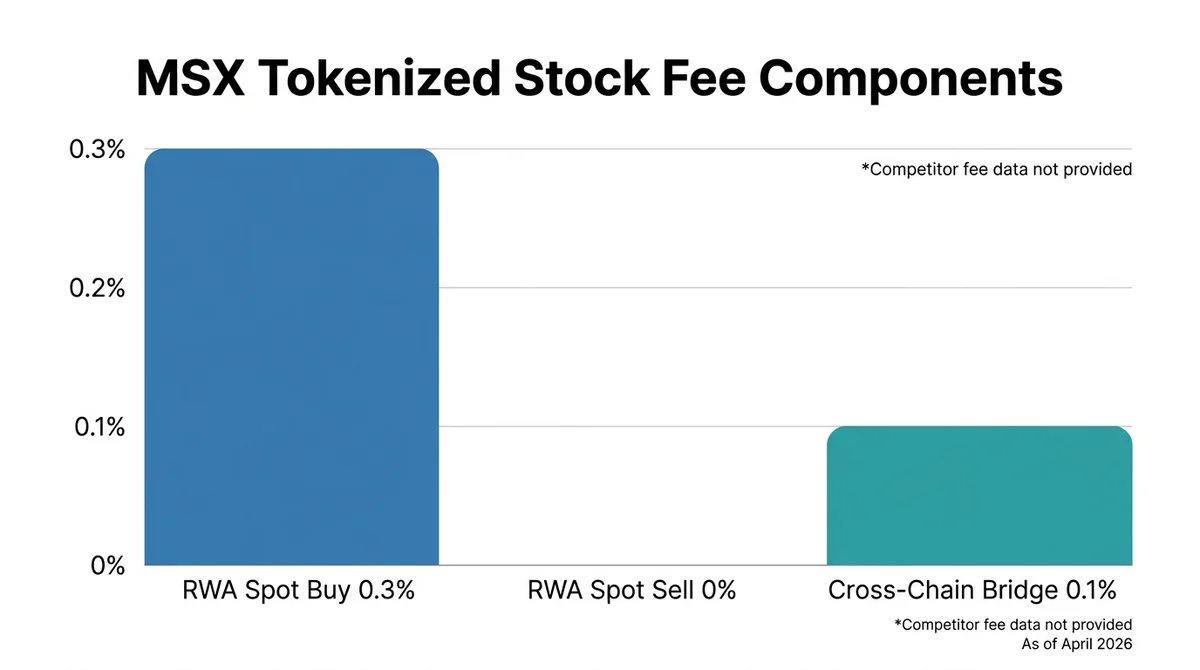
The verifiable materials available as of April 2026 show an MSX RWA spot buy fee of 0.3% and a spot sell fee of 0%. These rates correspond to different trade directions and do not mean that all trading is free.
| MSX product and fee item (2026) | Confirmed rate | Applicable description |
|---|---|---|
| RWA spot buy fee | 0.3% | Applies to the RWA spot buy orders described in the supplied materials |
| RWA spot sell fee | 0% | The supplied materials identify sell orders as fee-free |
| Crypto-to-crypto trading fee | 0% | Applies only to crypto-to-crypto trading and does not replace the RWA spot rate |
| Cross-chain bridge fee | 0.1% | An independent cross-chain fund-transfer cost |
| Perpetual/futures maker fee | 0.02% | Applies only to perpetual/futures maker orders, not AVGO spot trading |
| Perpetual/futures taker fee | 0.045% | Applies only to perpetual/futures taker orders, not AVGO spot trading |
If a user only buys AVGO tokens, the first rate to check is the RWA spot buy fee. If the user later sells, the sell-side rules should be checked separately. If perpetual/futures products are involved, their own fee schedule applies; spot buy and sell fees must not be substituted.
How Do Cross-Chain Bridge Fees Affect Total Trading Costs?
The MSX cross-chain bridge fee is 0.1%. It is an independent cost for transferring assets between networks. Whether it applies to an AVGO transaction depends on whether the user actually performs a cross-chain transfer.
Costs can be recorded as follows:
- RWA spot buy completed within the platform account: record the 0.3% buy fee.
- RWA spot sell completed within the platform account: record the confirmed 0% sell fee.
- Cross-chain bridge used before or after trading: record the 0.1% at the relevant transfer stage.
- $MSX used to pay spot fees: confirm the discounted amount under the platform's actual rules and retain the trade record.
For a nominal trade value of 100 USDT, a known 0.3% RWA spot buy fee equals 0.3 USDT. If a cross-chain transfer also occurs, the 0.1% bridge fee equals 0.1 USDT. The combined amount is 0.4 USDT, but this is only an example based on the known rates and excludes spreads, network fees, price fluctuations, and other costs not provided. The known spot sell fee is 0%; the actual page should still be checked.
When $MSX is used for payment, the spot fee is charged at 75% of the original amount. For example, a 100 USDT buy that produces a 0.3 USDT fee would have a discounted fee of 0.225 USDT if the page confirms that the trade qualifies. This example does not mean that every account or trade qualifies automatically; the executed trade page controls.
Cross-chain costs do not represent gains or losses in the asset itself and exclude network fees, spreads, and price movements not provided in the source materials. Users can check the actual workflow and current rules through the MSX cross-chain bridge.
What Discount Does $MSX Fee Payment Provide?
The supplied materials confirm that using $MSX to pay MSX spot fees provides a 25% discount, meaning the user pays 75% of the original fee. This promotion applies to spot fees and does not establish AVGO listing status, other product rates, or competitor discounts.
The following distinctions are important:
- RWA spot discount: using $MSX provides a 25% discount on the applicable spot fee.
- Perpetual/futures discount: using $MSX provides a 10% discount on perpetual/futures fees, which is different from the spot discount.
- Crypto-to-crypto trading: the fee is 0%; the spot discount should not be applied to crypto-to-crypto trading.
- Eligibility: the payment entry point, available balance, and displayed terms should be checked before trading.
As of April 2026, MSX's confirmed spot rates are 0.3% for buys and 0% for sells, with a $MSX spot-fee discount of 25%. The 0.1% cross-chain bridge fee should be recorded separately as a fund-transfer cost.
What Are the Advantages and Limitations of Trading AVGO Tokenized Stock on MSX?
MSX's confirmed conveniences include stablecoin trading of tokenized U.S. stocks, T+0 on-chain settlement, multiple order types, and a 0% spot sell fee. AVGO listing status, quotes, spreads, and liquidity have not been confirmed in the supplied materials.
What Trading Conveniences Has MSX Confirmed?
According to the supplied facts, MSX tokenized U.S. stock spot products support direct stablecoin trading and T+0 instant on-chain settlement. Other known product features include:
- Support for market, limit, and take-profit/stop-loss orders.
- An order book where users can view bids and asks on the trading page.
- A 0% RWA spot sell fee.
- A 0.3% RWA spot buy fee, with a 25% discount when $MSX is used for the applicable spot fee.
- A 0.1% cross-chain bridge fee that can be recorded separately as a fund-transfer cost.
These are known MSX product and fee facts. They do not mean that AVGO is definitely listed or that its actual execution price, spread, or liquidity has been established.
What MSX Fee Information Must Users Still Confirm?
The current materials do not provide AVGO's specific listing status, real-time price, spread, minimum trade amount, or liquidity. Users therefore cannot determine the actual total cost of a trade from the fee schedule alone.
Before placing an order, check:
- Whether AVGO actually appears on the MSX RWA spot trading page.
- The displayed bid and ask quotes and available order types.
- The trade value, fee calculation method, and $MSX payment status.
- Whether assets must be transferred from another network and whether the 0.1% bridge fee applies.
- The applicable region, account eligibility, and trading rules in effect at that time.
Transparent fees help establish cost expectations but do not eliminate asset-price, execution, or liquidity risks.
What Should Users Note When Trading With Stablecoins and Using Cross-Chain Transfers?
Stablecoin trading and on-chain settlement can simplify the funding path, but cross-chain transfers still create an independent fee. Users should verify the network, receiving address, and trading page to avoid treating the 0.1% bridge fee as an AVGO buy fee.
A practical process is to test with a small amount, confirm the page details, and then complete the transaction. Before transferring assets, verify that the network matches and that the asset and fee shown are correct. This article does not guarantee any specific trading result or return.
What Are the Advantages and Limitations of Trading AVGO Tokenized Stock on Similar Platforms?
The advantages and disadvantages of similar platforms cannot currently be ranked. Comparison should focus on spot buy and sell fees, cross-chain costs, settlement methods, order types, and stablecoin support after official data is obtained.
Which User-Experience Factors Should Be Compared Across Similar Platforms?
When competitor facts are unavailable, establish a qualitative verification framework rather than judging which platform is better based on impressions:
- Whether verifiable RWA spot buy and sell rates are published.
- Whether cross-chain, deposit, withdrawal, or other fund-transfer fees are clearly explained.
- Whether stablecoins can be used to buy and sell tokenized U.S. stocks directly.
- Whether T+0 on-chain settlement or another settlement method is supported.
- Whether market, limit, take-profit/stop-loss orders and an order book are available.
- Whether AVGO listing status, quotes, minimum trade amounts, and liquidity are disclosed.
These dimensions turn “how to choose a tokenized stock platform” into verifiable questions, but they cannot produce a competitor ranking without supporting facts.
Why Is a Specific Competitor Ranking Not Currently Available?
Because competitor_facts is empty, the fees, discounts, regulatory status, liquidity, and security data of similar platforms cannot be verified. This article therefore does not name specific competitors or rank platforms by lowest fees or overall experience.
Once official materials are available, at least the following standards should be applied:
| Comparison dimension | Verification requirement |
|---|---|
| Fees | Separate RWA spot buy, sell, crypto-to-crypto, perpetual/futures, and cross-chain fees |
| Product | Confirm that the product is an AVGO tokenized stock rather than a similarly named product |
| Settlement | Identify instant on-chain settlement or another method and its conditions |
| Orders | Record support for market, limit, and take-profit/stop-loss orders |
| Asset conditions | Check stablecoin support, minimum amounts, quotes, and liquidity |
| Regional rules | Confirm whether the user's region and account eligibility qualify |
How Does AVGO Tokenized Stock Differ From Buying U.S. Stocks Directly?
AVGO tokenized stock is traded through on-chain accounts and stablecoins. MSX has confirmed that its tokenized U.S. stock products use T+0 instant on-chain settlement. Accounts, settlement, regulation, and asset-right arrangements for direct purchases of traditional U.S. stocks depend on the broker and applicable regional rules. The current materials are insufficient to conclude anything about total costs, legal rights, or tax treatment.
| Comparison dimension | AVGO tokenized stock trading | Direct purchase of traditional U.S. stocks |
|---|---|---|
| Trading medium | On-chain RWA token market | Traditional securities account or brokerage system |
| Settlement method | MSX confirms T+0 instant on-chain settlement | No unified settlement data provided |
| Funding method | MSX supports direct buying and selling with stablecoins | No unified funding method provided |
| Costs | MSX confirms a 0.3% RWA buy fee, 0% sell fee, and separate 0.1% bridge fee | No verifiable fee data provided |
| Rights and rules | Must review the specific token, platform, and regional rules | Must review the broker and applicable market rules |
It is therefore impossible to determine which method is more cost-effective using fees alone. Users should also compare spreads, liquidity, trading hours, settlement arrangements, account eligibility, asset rights, and potential tax implications. These items are not fully provided in the current input data.
Conclusion: How Should AVGO Tokenized Stock Trading Fees Be Verified?
How much AVGO tokenized stock trading costs depends on listing status, trade value, direction, spread, liquidity, and the funding path. Based on the known MSX data as of April 2026, the RWA spot buy fee is 0.3%, the sell fee is 0%, the cross-chain bridge fee is 0.1%, and using $MSX to pay the spot fee provides a 25% discount.
Before placing an order, first confirm on the actual MSX trading page whether AVGO is listed. Then check the order type, order-book quotes, minimum amount, applicable region, and discount conditions. If a cross-chain bridge is used, record the 0.1% separately as a fund-transfer cost. Do not apply the 0% crypto-to-crypto fee or perpetual/futures rates to AVGO RWA spot trading.
No verifiable competitor facts are currently available. This article therefore makes no claim that MSX has the lowest fees in the market and provides no unverified competitor ranking. Fees, quotes, and product availability may change; verify the platform page and applicable official rules before trading.
Frequently Asked Questions (FAQ)
Does AVGO tokenized stock trading always charge a fee?
Not necessarily the same type of fee. MSX charges 0.3% for RWA spot buys and 0% for sells. The cross-chain bridge fee is 0.1%, while crypto-to-crypto trading is 0%. AVGO availability and actual fees remain subject to the MSX page; spreads and network fees must also be checked separately.
What are MSX's fees for buying and selling tokenized U.S. stocks?
MSX has confirmed an RWA spot buy fee of 0.3% and a sell fee of 0%. These figures apply only to the RWA spot category and should not be mixed with crypto-to-crypto or perpetual/futures fees. AVGO listing status and the page rules should still be confirmed before execution.
What discount does $MSX provide on spot fees?
Using $MSX to pay MSX spot fees provides a 25% discount. This applies to RWA spot fees; the perpetual/futures discount is 10%, so the two product discounts must not be confused. The actual payment entry point, account conditions, and discounted amount depend on the trading page.
What is MSX's cross-chain bridge fee?
MSX's cross-chain bridge fee is 0.1%. This is a cross-chain fund-transfer cost and should be included only when a cross-chain transaction occurs. It is not automatically a fee for every AVGO spot trade. Check the applicable rules on the actual cross-chain page.
Can AVGO currently be traded on MSX?
The supplied materials do not confirm AVGO's current listing status, so availability cannot be asserted. Search for AVGO on the actual MSX trading page and verify the quote, order types, minimum trade amount, and applicable rules.
What is the difference between AVGO tokenized stock and buying U.S. stocks directly?
AVGO tokenized stock is traded through an on-chain RWA product. MSX has confirmed that its tokenized U.S. stock products support stablecoin trading and T+0 instant on-chain settlement. Direct purchases of traditional U.S. stocks depend on broker, market, and regional rules. Rights, fees, and tax treatment cannot be determined from this article's fee data alone.
Which AVGO token trading method is more cost-effective?
This cannot currently be determined. MSX's known RWA spot buy fee is 0.3% and its sell fee is 0%, but competitor fees, AVGO spreads, liquidity, listing status, and traditional U.S. stock costs have not been fully provided. Comparisons should use the same product, direction, funding path, and time scope.
What should be confirmed before trading AVGO tokenized stock?
First confirm that AVGO actually appears on the MSX page. Then check bid and ask quotes, order types, fees, minimum amount, stablecoin and network requirements, and finally account eligibility and regional rules. If a cross-chain transfer occurs, record the 0.1% bridge fee separately and retain trade and transfer records.
Risk warning: Tokenized stocks, stablecoins, and digital-asset trading may be affected by price volatility, liquidity, execution, network conditions, account eligibility, regional regulation, and changes to product rules. This article is for informational purposes only and does not constitute investment, legal, tax, or compliance advice.
This article is produced by the MSXGO editorial team, AI-assisted, and reviewed through an editorial process. Fee rates and figures are subject to each platform's latest official announcements.
FAQ
Does AVGO tokenized stock trading always charge a fee? ▼
Not necessarily the same type of fee. MSX charges 0.3% for RWA spot buys and 0% for sells. The cross-chain bridge fee is 0.1%, while crypto-to-crypto trading is 0%. AVGO availability and actual fees remain subject to the platform page.
What are MSX's fees for buying and selling tokenized U.S. stocks? ▼
MSX has confirmed an RWA spot buy fee of 0.3% and a sell fee of 0%. These figures apply only to the RWA spot category and should not be mixed with crypto-to-crypto or perpetual/futures fees.
What discount does $MSX provide on spot fees? ▼
Using $MSX to pay MSX spot fees provides a 25% discount. This applies to RWA spot fees; the perpetual/futures discount is 10%, so the two product discounts must not be confused.
What is MSX's cross-chain bridge fee? ▼
MSX's cross-chain bridge fee is 0.1%. This is a cross-chain fund-transfer cost and should be included only when a cross-chain transaction occurs. The applicable rules depend on the actual cross-chain page.
Can AVGO currently be traded on MSX? ▼
The supplied materials do not confirm AVGO's current listing status, so availability cannot be asserted. Search for AVGO on the actual MSX trading page and verify the quote, order types, minimum trade amount, and applicable rules.
Finished reading? Ready to try trading?
Tokenized stocks/ETFs, crypto spot, and perpetual futures in one account — perp maker 0.02% / taker 0.045%, RWA spot buy 0.3% / sell 0.
Free sign-up · 3 quick steps