Binance Futures Maker vs Taker Fees 2026: Fee Structure Breakdown and Cross-Platform Cost Comparison
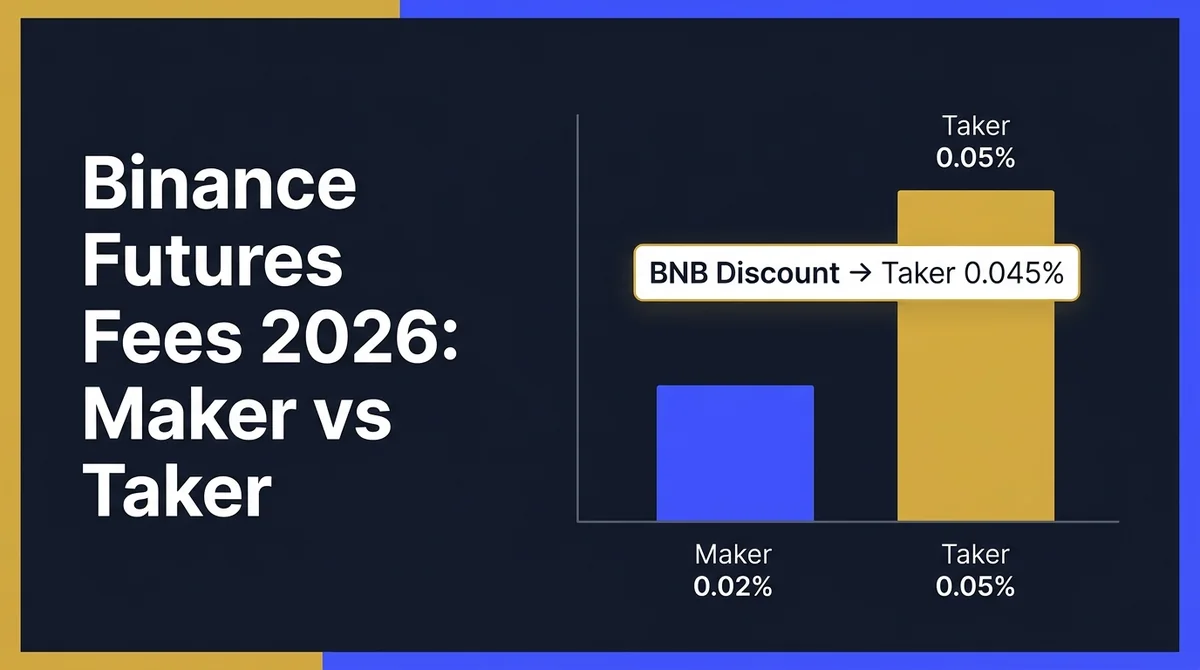
Binance futures regular users: Maker 0.02%/Taker 0.05%, BNB discount drops Taker to 0.045%. MSX Taker 0.045%, $MSX discount brings it to 0.0405%. Full fee tier, hidden costs, and platform comparison inside.
Article Citation Summary
Binance futures regular users: Maker 0.02%/Taker 0.05%, BNB discount drops Taker to 0.045%. MSX Taker 0.045%, $MSX discount brings it to 0.0405%. Full fee tier, hidden costs, and platform comparison inside.
Binance Futures Maker vs Taker Fees 2026: Fee Structure Breakdown and Cross-Platform Cost Comparison
Key Takeaways / TL;DR
- Binance futures regular users: Maker 0.02%, Taker 0.05%; enabling BNB fee discount (10% off) brings Taker down to 0.045%
- Binance VIP tiers are determined by a dual threshold of 30-day futures trading volume and BNB holdings; top-tier VIP9 can reach Maker 0% / Taker 0.017%
- MSX futures base Taker fee is 0.045%, with $MSX discount applied (10% off) it drops to 0.0405% — the base rate itself is already lower than Binance's regular tier
- Hidden costs in futures trading include funding rates, slippage, and liquidation fees; total holding cost must be calculated holistically
- Under high leverage, trading fees combined with funding rates can rapidly erode margin; Binance BTCUSDT first-tier maintenance margin rate is just 0.4%
Before You Start: What Do You Need to Know to Reduce Futures Trading Fees?
In futures trading, Maker (limit order placer, providing liquidity) fees are typically lower than Taker (market order taker, consuming liquidity) fees. Binance regular users pay Maker 0.02% / Taker 0.05% on futures. Before trying to lower fees, it's essential to understand the fee structure and potential hidden costs — otherwise chasing lower rates alone can lead to costly mistakes.
What Is the Core Difference Between Maker and Taker?
Maker refers to the party placing limit orders that add depth to the market. The order is not filled immediately — it sits on the order book waiting for a counterparty. Taker is the party actively filling existing orders using market orders or immediately executable limit orders, consuming liquidity.
This core distinction drives the fee difference:
- Makers add liquidity to the market, so exchanges reward them with lower fees
- Takers consume liquidity, so fees are typically higher
- Binance regular users: Maker 0.02% vs Taker 0.05% — a 2.5x difference
- In high-frequency trading, even a 0.03% Maker/Taker spread accumulates into significant costs at scale
What Hidden Costs Exist Beyond Maker/Taker Fees in Futures Trading?
Looking at Maker/Taker rates alone is just the tip of the iceberg. The full cost structure of futures trading includes:
- Funding rate (periodic payments between long and short sides, used to anchor contract prices to spot): Binance typically settles every 8 hours; for long-held positions this can exceed the trading fees themselves
- Slippage: the deviation between expected and actual fill price when liquidity is insufficient for market orders
- Liquidation fee: an additional charge triggered upon forced liquidation, especially significant under high leverage
- Fund transfer costs: moving between futures and spot accounts is free, but cross-chain operations in certain scenarios may incur gas fees
What Risks Should You Be Aware of Before Trading?
In high-leverage futures trading, the real impact of fees is far greater than in spot trading. At 10x leverage, a 0.05% Taker fee is applied to the notional position size, but relative to the margin it is amplified 10x. Combined with funding rates every 8 hours, holding costs can accumulate rapidly during volatile markets.
Key risk factors:
- Leverage amplifies the relative cost of fees; round-trip costs (open + close) must be factored into P&L calculations
- Funding rate direction is unpredictable; in bearish markets, long holders are net payers of funding rates
- Not enabling platform token fee discounts is essentially leaving an available cost-reduction tool unused
As of 2026, Binance BTCUSDT perpetual contracts in the first position tier (notional 0–300,000 USDT) carry a maintenance margin rate of 0.4%. Under high leverage, fees combined with funding rates can quickly compress your safety margin.
Step 1: How to Check and Confirm Your Current Fee Tier
Binance users can view their current VIP level and live fee rates under "Assets" → "Fee Rate". Regular users default to Maker 0.02% / Taker 0.05%; enabling BNB fee discount brings rates to approximately Maker 0.018% / Taker 0.045%.
Where to Find Your VIP Level and Live Fee Rate on Binance
Here's the exact navigation path:
- Log in to Binance and click your profile avatar in the top-right corner
- Go to "Account" → "VIP Level"
- The page shows your current tier, 30-day futures trading volume (USD), and BNB holdings
- The bottom of the page lists the Maker/Taker rates currently applicable to your account
Binance fee tiers are determined by two dimensions simultaneously:
| Dimension | Regular User Threshold | Notes |
|---|---|---|
| 30-day futures trading volume | Below $5M | Rolling calculation, updates at UTC 00:00 |
| BNB holdings | Below 5 BNB | Based on daily average holdings |
How to Check Whether BNB Fee Discount Is Already Enabled
BNB discount does not activate automatically — you must enable it manually:
- Go to "Account" → "Fee Rate" settings
- Find the "Pay fees with BNB" toggle
- Confirm your BNB balance is sufficient (discount becomes invalid if balance is zero)
- After enabling, refresh the fee rate page to confirm the discounted rate is displayed
Once BNB fee discount is enabled, futures fees receive a 10% reduction (0.9x multiplier): regular users' Taker drops from 0.05% to 0.045%, and Maker drops from 0.02% to approximately 0.018%.
If you're comparing overall trading costs across platforms, the MSX Complete Fee Guide 2026: Deposit, Spot, and Futures Fee Deep Dive covers an alternative fee structure worth reviewing.
Step 2: How Does the Binance Futures Fee Tier System Work? What Are the Rates at Each VIP Level?
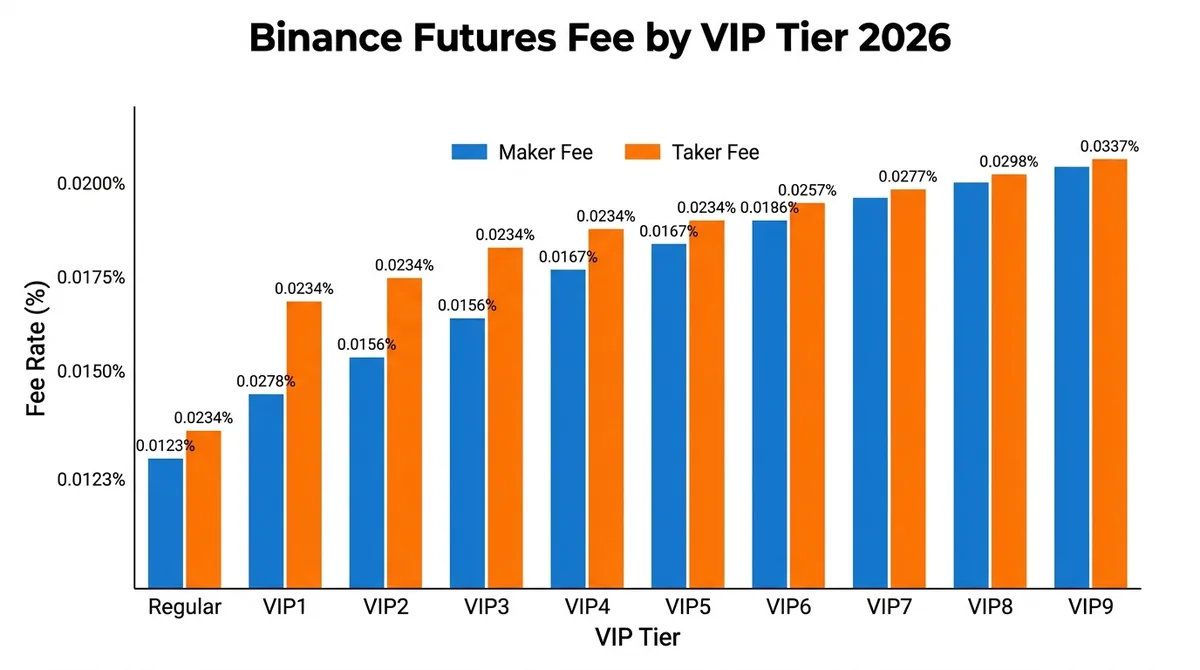
Binance perpetual contracts offer 10 fee tiers from Regular to VIP9. Regular users pay Maker 0.02% / Taker 0.05%, while top-tier VIP9 can reach Maker 0% / Taker 0.017%. Upgrading requires simultaneously meeting both the 30-day volume and BNB holdings thresholds.
The Complete Fee Tier Ladder from Regular to VIP9
Below is the full VIP fee schedule for Binance USDT-margined perpetual contracts as of 2026:
| VIP Level | 30-Day Futures Volume (USD) | BNB Holdings | Maker Fee | Taker Fee |
|---|---|---|---|---|
| Regular | <$5M | <5 BNB | 0.02% | 0.05% |
| VIP1 | ≥$5M | ≥5 BNB | 0.018% | 0.05% |
| VIP2 | ≥$10M | ≥25 BNB | 0.016% | 0.04% |
| VIP3 | ≥$50M | ≥100 BNB | 0.012% | 0.032% |
| VIP4 | ≥$600M | ≥500 BNB | 0.01% | 0.03% |
| VIP5 | ≥$1B | ≥1,000 BNB | 0.008% | 0.027% |
| VIP6 | ≥$2.5B | ≥1,750 BNB | 0.006% | 0.025% |
| VIP7 | ≥$5B | ≥3,000 BNB | 0.004% | 0.022% |
| VIP8 | ≥$12.5B | ≥4,500 BNB | 0.002% | 0.02% |
| VIP9 | ≥$25B | ≥5,500 BNB | 0% | 0.017% |
Source: Binance official fee schedule, as of 2026
What Are the Requirements to Upgrade VIP Tiers?
Binance uses a dual-threshold mechanism: both the 30-day trading volume and BNB holdings must simultaneously meet the requirements before an upgrade takes effect. Meeting only one condition will not trigger a tier upgrade.
Practical guidance:
- The VIP1 threshold ($5M monthly volume) is challenging for retail traders; the most practical fee-reduction path is to prioritize enabling BNB fee discount first
- The BNB holdings threshold is relatively low (only 5 BNB for VIP1), but the volume threshold is the primary barrier
- Volume resets daily at UTC 00:00; trading activity in the final days of the month has the greatest impact on tier status
Can BNB Discount Stack with VIP Discounts?
Yes, they stack. The BNB discount (10% off, 0.9x multiplier) applies on top of the current VIP tier's rate:
- Regular user: Taker 0.05% × 0.9 = 0.045%
- VIP2 user: Taker 0.04% × 0.9 = 0.036%
- VIP9 user: Taker 0.017% × 0.9 = approximately 0.0153%
This means the higher your VIP tier, the smaller the absolute saving from BNB discount — but the stacking effect always applies.
For a deeper cross-platform VIP tier comparison between Binance and other exchanges, see MSX vs Binance vs OKX Perpetual VIP Fee Comparison 2026: Which Platform Costs Less for High-Volume Traders?.
Step 3: How to Push Fees to Their Lowest Using Platform Token Discounts
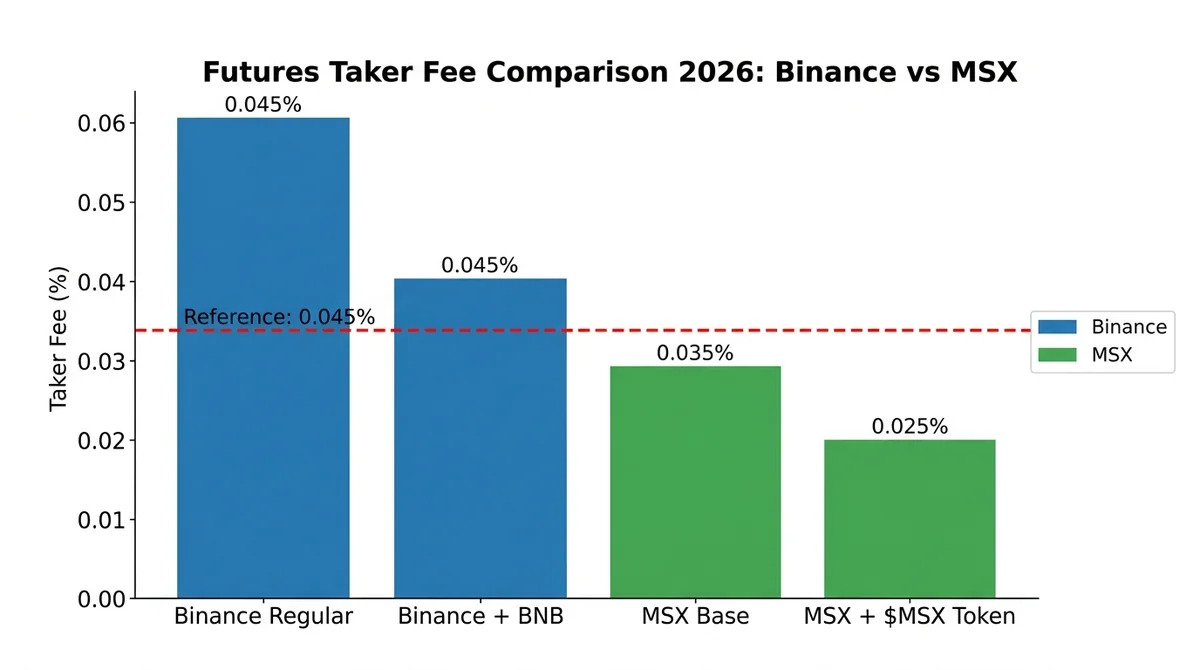
Paying Binance futures fees with BNB gets you 10% off, bringing regular Taker from 0.05% to 0.045%. MSX futures fees paid with $MSX also receive 10% off, bringing Taker from 0.045% to 0.0405% — a base rate already below Binance's regular tier.
How to Enable BNB Fee Discount on Binance Futures — Step by Step
- Ensure your spot or futures account holds sufficient BNB
- Go to "Account Settings" → "Fee Rate" → enable "Pay fees with BNB"
- The system automatically deducts fees from your BNB balance when trading futures
- After each trade, verify in "Transaction History" that the discounted rate was applied
Note: Once your BNB balance runs out, the discount immediately stops. Set up a BNB balance alert to avoid lapses.
How Much of a Discount Does MSX's $MSX Token Provide?
MSX's $MSX platform token (the core utility token of the MSX ecosystem, used for fee discounts, staking benefits, VIP membership, and more) offers a comparable mechanism:
- Futures fees: enabling $MSX discount gives 10% off (0.9x multiplier)
- Spot buy orders: enabling $MSX gives 25% off (0.75x multiplier)
- Spot sell orders: MSX's rate is already 0% — no discount needed
- Coin-to-coin trading: fee is 0% — completely free
MSX futures base Taker fee is 0.045%; with $MSX discount enabled, it drops to 0.0405%.
How Do the Platform Token Discount Mechanisms Differ Between the Two Platforms?
| Comparison Dimension | Binance (BNB) | MSX ($MSX) |
|---|---|---|
| Futures Taker base rate (2026) | 0.05% | 0.045% |
| Platform token discount | 10% off (0.9x) | 10% off (0.9x) |
| Futures Taker after discount | 0.045% | 0.0405% |
| Spot discount | 25% off (0.75x) | 25% off (buy orders) |
| Spot sell orders | Discounted rate | 0% (fee-free) |
| Coin-to-coin trading | Standard spot rate | 0% |
Source: Binance official fee schedule and MSX official fee documentation, as of 2026
In absolute terms, MSX's futures Taker base rate is already 0.005 percentage points lower than Binance's regular tier. After enabling platform token discounts, the gap widens to 0.0045 percentage points (0.045% vs 0.0405%). For users with high daily trading volumes, this difference compounds into a meaningful figure over time.
Step 4: How to Confirm Actual Net Costs After Fee Optimization
Binance futures funding rates typically settle every 8 hours; total holding cost requires adding up open and close trading fees plus cumulative funding rate charges. Confirming your discounts are active is the critical final step.
How to Verify Actual Fee Deductions in Your Transaction History
- After a trade, go to "Assets" → "Transaction History"
- Filter by "Fee" type and locate the corresponding order
- Confirm the fee was deducted in BNB (not USDT) and that the amount matches the discounted rate
- If USDT was deducted at a higher amount, BNB discount is not active
Common verification method:
- Actual fill amount × discounted Taker rate = expected fee
- Compare against the actual deducted amount; if the discrepancy exceeds 5%, check your discount settings
When Does the Funding Rate Settle, and How to Factor It into Total Cost?
Binance funding rate settlement times are UTC 00:00, 08:00, and 16:00 (every 8 hours); under extreme market volatility, this may adjust to every 4 hours or every 1 hour.
Complete futures holding cost formula:
Total Cost = Opening Fee + Closing Fee + Σ Funding Rate (per settlement amount × number of settlements during holding period)
In practice, the funding rate can be positive or negative: in bullish markets, short holders collect the funding rate; in bearish markets, long holders pay it. When reviewing your transaction history, distinguish between "Fee" and "Funding Rate" as two separate line items.
If you're also comparing overall cost differences between spot and futures, Perpetual Futures vs Spot Trading: Fees, Leverage Risk, and Profit Potential — Full Comparison 2026 provides a more systematic analytical framework.
Cross-Platform Fee Comparison: Where Does the Futures Cost Gap Between Binance and MSX Lie?
Regular user base rate comparison: Binance futures Taker 0.05% vs MSX 0.045%. After enabling platform token discounts: 0.045% vs 0.0405% respectively. MSX has a cost advantage on the Taker side, but Binance offers more trading pairs (approximately 530 USDT perpetuals, data collected August 2026).
How Do Base Rates Compare for Regular Users?
| Fee Dimension | Binance Regular User (2026) | MSX (2026) | Notes |
|---|---|---|---|
| Futures Maker | 0.02% | 0.02% | Identical |
| Futures Taker | 0.05% | 0.045% | MSX is 0.005% lower |
| Maker after platform token discount | ~0.018% (BNB 10% off) | ~0.018% ($MSX 10% off) | Roughly equal |
| Taker after platform token discount | 0.045% | 0.0405% | MSX is 0.0045% lower |
| Spot sell orders | Discounted rate | 0% | MSX is fee-free |
| Coin-to-coin trading | Standard spot rate | 0% | MSX is fee-free |
Source: Binance official fee schedule and MSX official fee documentation, as of 2026
Which Platform Is More Cost-Effective After Enabling Platform Token Discounts?
Using a single trade with 10,000 USDT notional value as an example (Taker direction):
- Binance with BNB discount: 10,000 × 0.045% = 4.5 USDT
- MSX with $MSX discount: 10,000 × 0.0405% = 4.05 USDT
- Difference per trade: 0.45 USDT
The per-trade gap seems small, but for high-frequency traders with daily volumes in the millions, the annualized difference becomes highly significant.
What Other Dimensions Are Worth Comparing Beyond Fees?
Trading fees are just one dimension when choosing a platform. Here are other key differences to consider:
Binance advantages:
- Approximately 530 USDT perpetual trading pairs (data collected August 2026), broader market coverage
- Market-leading trading depth and liquidity on major assets
- Complete VIP tier ladder with a clear upgrade path for high-volume traders
MSX differentiating features:
- Proprietary high-performance contract engine integrated with Polygon.io millisecond-level market data, supporting high-frequency quantitative strategies and high-concurrency arbitrage bots
- Offers RWA (Real World Assets) US stock token spot and perpetual contracts — one of the earliest crypto platforms to bring on-chain US equity tokenization to market
- Portfolio Margin mechanism allows multiple on-chain assets to serve as combined collateral
- Completed SEC securities token offering registration, with compliance credentials to conduct STOs under Regulation S of the U.S. Securities Act of 1933
For a more comprehensive feature-by-feature comparison of both platforms, see MSX vs Binance Spot and Perpetual Full Feature Comparison 2026: Registration, Fee Structure, and Trading Experience Deep Dive.
Common Mistakes: What Are the Easy Pitfalls When Trying to Lower Futures Fees?
The most common mistakes when reducing futures trading fees include: failing to manually enable platform token discounts, insufficient BNB/$MSX balance causing discounts to lapse, and incorrectly lumping funding rates together with trading fees in cost estimates.
Why Isn't BNB Discount Working Even Though I Enabled It?
The two most common causes:
- Insufficient BNB balance: the toggle is on but account BNB is zero — the system automatically falls back to USDT deduction
- Wrong toggle location: spot accounts and futures accounts have separate discount settings and must be configured independently
Troubleshooting steps:
- Check BNB balance in the futures account (not spot account)
- Confirm in transaction history that fees were deducted in BNB, not USDT
- If the toggle is confirmed on and balance is sufficient, contact official Telegram support for further investigation
What to Do If You've Been Mistaking Funding Rate for Trading Fees?
Funding rate and trading fees are two entirely different charges:
| Fee Type | Calculation Basis | Settlement Time | Direction |
|---|---|---|---|
| Trading fee | Based on trade value | Deducted instantly per trade | Always a cost |
| Funding rate | Based on notional position value | Settled every 8 hours | Can be income or expense |
If your account balance is declining faster than your fee estimates suggest, funding rates are likely the ongoing drain. Solution: in your transaction history, filter separately for "Fee" and "Funding Rate" types and tally them independently.
What Are the Consequences of High-Frequency Traders Ignoring Cumulative Taker Fees?
Using a daily trading volume of 5,000,000 USDT notional value as an example:
- Binance without discount (Taker 0.05%): daily fee = 5,000,000 × 0.05% = 2,500 USDT
- Binance with BNB discount (Taker 0.045%): daily = 2,250 USDT, saving 250 USDT
- MSX with $MSX discount (Taker 0.0405%): daily = 2,025 USDT, saving 475 USDT vs Binance without discount
Even a 0.01% fee difference, at daily volumes in the millions, produces a highly significant annual cumulative gap. High-frequency traders should treat Taker fee optimization as a top priority.
For more fee comparison analysis in high-frequency scenarios, see How High-Frequency Traders Can Minimize Fee Drag: MSX vs Bybit Perpetual Fee Comparison and Arbitrage Protection Guide 2026.
Safety Notes: How to Control Risk While Reducing Futures Trading Fees
Lowering fees should never come at the cost of ignoring risk. Binance BTCUSDT's 0.4% maintenance margin rate means that under high leverage, trading fees combined with funding rates can rapidly trigger liquidation. MSX provides a multi-layer risk control system and 95% cold wallet storage, helping reduce systemic risk.
How Quickly Can Fees Erode Margin Under High Leverage?
Binance BTCUSDT first-tier maintenance margin rate is 0.4%. At 100x leverage as an example:
- Margin required is just 1% of notional value
- Round-trip Taker fees total approximately 0.1% of notional (0.05% × 2)
- Relative to margin: fees consume approximately 10% of margin (per round trip)
- Combined with funding rates every 8 hours, holding costs accumulate extremely fast
Risk control essentials:
- Calculate total holding cost (fees + funding rate) before opening a position; confirm your profit target covers the cost
- Avoid holding multiple high-leverage positions with excessively high margin utilization
- Set stop-loss orders to cap maximum losses and avoid being passively liquidated with additional liquidation fees
How Does MSX's Multi-Layer Risk Control System Protect Asset Safety?
MSX provides a complete multi-layer risk control and liquidation framework:
- Margin monitoring: real-time tracking of account margin ratio changes
- Risk alerts: advance notification when margin is insufficient
- Auto-Deleveraging (ADL): orderly position reduction during extreme market conditions to prevent socialized losses
- Forced liquidation: executed when maintenance margin rate is reached
- On-chain price oracle: combines multi-market data to calculate mark price, preventing price manipulation through wick attacks
On asset security: 95% of digital assets are stored in multi-signature cold wallets, and the platform commits to a physical on-chain reserve ratio strictly greater than 100% (Proof of Reserves). Additionally, MSX has completed KYC (Know Your Customer) and KYT (Know Your Transaction) on-chain compliance system integration, meeting the regulatory standards of MSB licenses and other multi-jurisdiction financial licenses.
For a complete walkthrough from MSX registration to your first trade, see MSX Exchange App Complete Guide 2026: Registration, Spot, and Perpetual Contract Opening Full Walkthrough.
FAQ
What Are the Maker and Taker Fees for Binance Futures?
Binance USDT-margined perpetual contract regular users pay a Maker fee of 0.02% and a Taker fee of 0.05%. Enabling BNB fee payment gives 10% off, bringing Maker down to approximately 0.018% and Taker to 0.045%. Higher VIP tiers receive lower rates; top-tier VIP9 can reach Maker 0% / Taker 0.017%.
Which Platform Has Lower Futures Fees — Binance or MSX?
At the base rate level: MSX futures Taker 0.045% vs Binance regular user 0.05% — MSX is 0.005% lower. After enabling platform token discounts: MSX Taker drops to 0.0405%, Bin