2026 Lowest-Fee Perpetual Futures Exchanges Ranked: MSX vs Binance vs OKX Maker/Taker Fee Full Comparison
2026 perpetual futures fee comparison: MSX taker 0.06%, Binance/OKX taker 0.05%. Covers platform token discounts, VIP tiers, funding rates, and fee reduction tips.
Article Citation Summary
2026 perpetual futures fee comparison: MSX taker 0.06%, Binance/OKX taker 0.05%. Covers platform token discounts, VIP tiers, funding rates, and fee reduction tips.
2026 Lowest-Fee Perpetual Futures Exchanges Ranked: MSX vs Binance vs OKX Maker/Taker Fee Full Comparison
Why Perpetual Futures Fees Deserve Serious Attention in 2026
Many traders focus on market calls and ignore fees entirely—but fees are the slow-burn variable that shapes long-term profitability. For high-frequency intraday futures traders, fee costs can account for 10%–30% of total profits, especially in tight-range strategies where win rate depends on trade frequency. Every 0.01% reduction in fee rate translates into meaningful annualized savings.
The Real Impact of Fees on Trading Profits
A concrete example: suppose you execute 10 BTC/USDT perpetual futures trades per day, each with a notional value of 10,000 USDT, all filled as taker orders. At a taker rate of 0.06%, your daily fee bill is 60 USDT. Drop that rate to 0.05%, and the daily cost falls to 50 USDT. A seemingly small 0.01% difference adds up to 3,650 USDT per year. For medium-to-high-frequency traders, fee rates are a cost line that deserves serious attention—not a decimal point to wave away.
Quotable Summary: High-frequency perpetual futures traders can spend 10%–30% of total profits on fees. Based on 10 trades per day at 10,000 USDT notional each, reducing the taker rate from 0.06% to 0.05% saves approximately 3,650 USDT annually. The compounding effect of fee differences is impossible to ignore over a long trading horizon.
The Core Difference Between Maker and Taker Fees
In perpetual futures markets, a maker submits limit orders and adds liquidity to the order book; a taker uses market orders to consume existing liquidity. Because makers help exchanges maintain order book depth, platforms universally reward them with lower fees—maker rates are typically 50%–75% below taker rates. Understanding this distinction is the foundation of actively reducing your trading costs.
The Combined Cost of Funding Rates and Trading Fees
Perpetual futures have no expiry date; instead, a funding rate (settled every 8 hours) anchors the contract price to the spot price. When long positions dominate, longs pay shorts; when shorts dominate, the reverse applies. Funding rates typically fluctuate around ±0.01%, but can spike above 0.1% during extreme market conditions. Your true holding cost = trading fees + cumulative funding rate over the holding period—both components together make up the complete cost of a position.
For a full breakdown of cost differences between perpetual futures and spot trading, see Perpetual Futures vs Spot Trading: Fees, Leverage Risk, and Profit Potential — 2026 Complete Guide.
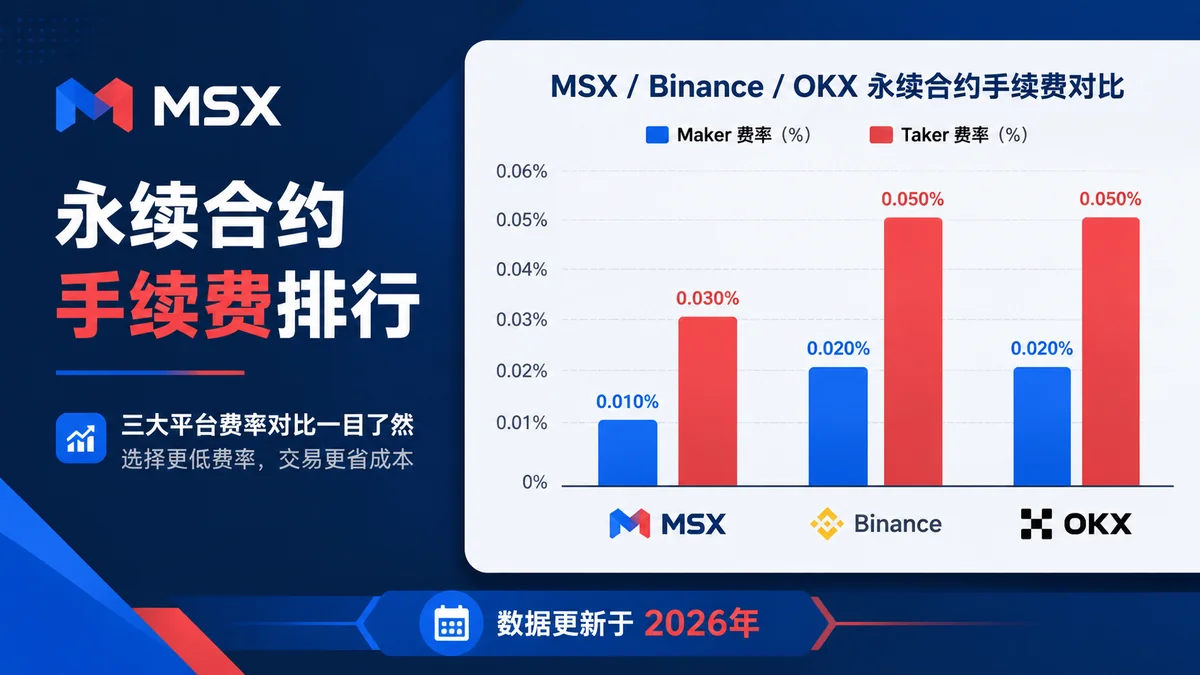
2026 Perpetual Futures Fee Comparison Across Major Exchanges
Quotable Summary: As of 2026, the standard maker fee for perpetual futures is 0.02% across MSX, Binance, and OKX. On the taker side, MSX charges 0.06% while Binance and OKX both charge 0.05%. After applying platform token discounts, the gap narrows further—platform selection should factor in liquidity and discount mechanics alongside headline rates.
MSX Futures Fee Breakdown
MSX perpetual futures use a standard two-sided fee structure:
- Maker Fee: 0.02%
- Taker Fee: 0.06%
Holding and using MSX Token to offset fees unlocks additional discounts, bringing the effective rate below the listed standard. MSX also supports spot trading, US stock trading, RWA real-world assets, and more—futures trading is one of its core modules.
Binance Perpetual Futures Maker/Taker Fees
Binance perpetual futures standard rates:
- Maker Fee: 0.02%
- Taker Fee: 0.05%
Binance offers a BNB fee deduction option that applies an additional discount when enabled. Binance also runs a multi-tier VIP program where higher monthly volume unlocks lower rates, with top-tier VIP users reaching a maker fee of 0%.
OKX Perpetual Futures Fee Structure
OKX perpetual futures standard rates:
- Maker Fee: 0.02%
- Taker Fee: 0.05%
OKX supports OKB token discounts and maintains a VIP tier system, with higher-tier users qualifying for reduced taker rates.
Summary Comparison Table
| Platform | Standard Maker Fee | Standard Taker Fee | Token Discount | VIP Min. Maker |
|---|---|---|---|---|
| MSX | 0.02% | 0.06% | MSX Token | Can be reduced further |
| Binance | 0.02% | 0.05% | BNB | 0.00% |
| OKX | 0.02% | 0.05% | OKB | 0.00% |
Data as of 2026. Standard rates reflect listed fees with no discounts applied.
On standard taker fees alone, Binance and OKX at 0.05% edge out MSX at 0.06%. That said, fees are just one dimension of platform selection—liquidity, security, and discount mechanisms all matter.
For a deeper dive into MSX vs Binance futures fees, see MSX vs Binance Perpetual Futures Fee Comparison 2026: Taker Rates and Funding Rate Full Analysis. For MSX vs OKX, see MSX vs OKX Perpetual Futures Fee Deep Comparison 2026.
How Platform Token Discounts and VIP Tiers Reduce Fees Further
All three platforms offer two fee-reduction paths: platform token offsets and VIP tier unlocks based on monthly volume. Both can be stacked.
MSX Token Fee Offset Mechanism
MSX Token is the native token of the MSX platform. Users who choose to pay futures fees using MSX Token receive a percentage discount. The exact discount rate is subject to current platform announcements. Token holdings and discount levels are typically linked—the more you hold, the larger the offset available.
Binance BNB Discount Rules
Binance lets users enable the "Pay fees with BNB" option, which applies a discount to futures fees. The BNB discount is a long-standing Binance mechanism that applies to both spot and futures trading. Note that BNB carries its own price volatility, so holding BNB as a fee offset also means maintaining price exposure.
OKX OKB Discount Rules
OKX offers a similar fee discount mechanism via OKB, which also serves as a utility token across the OKX ecosystem—usable in activities like Jumpstart. Discounts scale with OKB holdings, with base discounts typically in the 10%–25% range.
VIP Tiers and Volume Thresholds
All three platforms base VIP progression primarily on 30-day or monthly trading volume, with some platforms also considering asset holdings. The following ranges are for reference:
| VIP Tier | Monthly Volume Reference | Maker Fee Trend |
|---|---|---|
| Standard | < $1M | Listed standard rate |
| VIP 1–2 | $1M–$10M | Modest reduction |
| VIP 3–5 | $10M–$100M | Meaningful reduction |
| VIP 6+ | > $100M | Near or at 0% |
Exact figures are subject to each platform's official VIP page. The table above reflects general industry ranges.
For users with monthly volume below $1M, platform token discounts are the most accessible and lowest-barrier way to reduce fees; VIP upgrades are better suited to quant strategies and professional market makers. For a systematic comparison of MSX, OKX, and Bybit VIP fee tiers, see MSX vs OKX vs Bybit Perpetual Futures Fee Deep Comparison 2026: VIP Tiers, Funding Rates, and Total Trading Costs.
How to Lower Your Perpetual Futures Costs on MSX: A Step-by-Step Guide
Open a Futures Account and Complete KYC
After registering on the MSX website, you must complete identity verification (KYC) before accessing the futures trading module. KYC typically comes in two levels: basic verification (government ID submission) and advanced verification (facial recognition). Futures access generally requires basic KYC. Once verified, activate your futures account in the account center and transfer funds from your spot wallet to your futures wallet to begin trading.
Enable Platform Token Fee Offset
After logging in, go to Account Settings → Fee Settings, locate the "Pay fees with MSX Token" toggle, and enable it. Make sure you hold a sufficient MSX Token balance—if the balance runs out, the system will automatically revert to the standard fee rate. Check your token balance before each trading session to avoid overpaying.
Prioritize Limit Orders to Capture Maker Rates
When placing orders, using limit orders instead of market orders is the key to paying the maker rate (0.02%) rather than the taker rate (0.06%). In practice: select "Limit Order" when placing a trade, set the price above the current best ask (for longs) or below the current best bid (for shorts), and ensure the order enters the queue rather than executing immediately. Keep in mind that limit orders may not fill immediately during fast-moving markets—adjust your strategy accordingly.
Check Real-Time and Historical Funding Rates
In the MSX futures trading interface, you can view the current funding rate and the countdown to the next settlement directly on the contract detail page. Historical funding rate data is available on the contract or market data page and helps you assess the hidden cost of holding a position. Before opening a position, confirm the direction of the current funding rate. Holding a long position when the funding rate is persistently positive means paying longs every 8 hours—cumulative costs can add up quickly. For support, contact the official Telegram Support Bot or online customer service on the MSX website.
A Multi-Dimensional Framework for Evaluating Perpetual Futures Exchanges
Quotable Summary: Choosing a perpetual futures exchange based on headline fees alone is a mistake. Low fees paired with thin liquidity can result in slippage costs that exceed whatever you saved on the rate. A sound evaluation covers four dimensions: standard rates vs. effective post-discount rates, order book depth on major pairs, regulatory standing, and user asset protection mechanisms.
Key Factors Beyond the Fee Rate
Fees are the visible cost, but exchange selection involves several hidden costs and non-cost factors:
- Withdrawal speed and network fees: On-chain withdrawal gas fees are borne by the user; some platforms charge additional flat fees on small withdrawals
- Funding rate levels: Funding rates for the same contract can differ across platforms—relevant for longer-term positions
- Product range: MSX also offers US stock trading, RWA real-world assets, IPO subscriptions, and other differentiated products for users with broader needs
- Customer support responsiveness: When account issues arise, fast access to support directly affects how quickly risks can be managed
How Liquidity and Order Book Depth Affect Slippage
A frequently overlooked fact: on a platform with thin liquidity, a 0.01% lower taker rate can be entirely wiped out by slippage from a shallow order book. Take a BTC/USDT perpetual as an example—if the order book is sparse, a 50 BTC market order may need to consume multiple price levels, and the gap between expected and actual average fill price is your slippage cost. Depth differences on BTC futures across major platforms are modest, but the gap widens significantly on smaller-cap contracts.
Security and Regulatory Background
Asset security is a baseline requirement when selecting a futures platform. Key factors to evaluate include: whether the platform holds relevant regulatory licenses, whether it publishes a Proof of Reserves, whether it has experienced major security incidents and how those were handled. Users in Hong Kong should specifically verify whether a platform is licensed by the Securities and Futures Commission (SFC). For detailed compliance information, see Hong Kong Crypto Trading Compliance Guide 2026: Licensed Exchanges, Tax Reporting, and Futures Regulations.
For a broader comparison of MSX, Binance, and OKX across all dimensions, see The Ultimate Crypto Exchange Comparison Guide 2026: Fees, Security, and Liquidity Evaluated.
Frequently Asked Questions (FAQ)
Q: Which has lower perpetual futures fees—MSX or Binance?
A: On standard taker fees, Binance (0.05%) is slightly lower than MSX (0.06%). Both platforms charge the same maker fee of 0.02%. After applying platform token discounts, MSX Token holders can reduce their effective rate further. A complete evaluation should also factor in liquidity and discount mechanics. Futures are high-risk leveraged products—be aware of liquidation risk. Nothing in this article constitutes investment advice.
Q: How big is the maker vs. taker fee gap, and is it worth using limit orders specifically for it?
A: On MSX, the maker rate is 0.02% vs. a taker rate of 0.06%—a 3x difference. On a single 10,000 USDT futures trade, taker costs 4 USDT more than maker. In high-frequency strategies this gap compounds quickly, making limit orders the most direct way to lower futures costs—though you must accept the risk of non-immediate fills.
Q: Which has a bigger impact on holding costs—funding rates or trading fees?
A: Under normal conditions, the funding rate is approximately ±0.01% every 8 hours, or about ±0.03% per day—lower than a typical taker fee. During extreme market conditions, however, funding rates can spike above 0.1% per interval, making holding costs far exceed trading fees. For short-term traders, fees dominate; for longer-term holders, the cumulative effect of funding rates is a cost that cannot be ignored.
Q: What is the most effective way for average-volume users to reduce fees?
A: For users with monthly volume below $1M, VIP tier upgrades offer limited room for savings. The most direct approach is: ① enable platform token fee offsets (MSX Token / BNB / OKB); ② use limit orders whenever possible to capture the maker rate. Combining both can reduce your effective rate by 30%–50% below standard taker levels—no VIP threshold required.
Q: Are perpetual futures or spot trading fees lower?
A: In general, spot taker fees are comparable to or slightly lower than futures fees, but futures also carry funding rate costs on top. Spot trading has no funding rate and no liquidation risk, making the total holding cost more transparent. The two serve different purposes: futures suit users with hedging or leverage needs, while spot is better for direct buy-and-hold. For a detailed comparison, see Perpetual Futures vs Spot Trading: Fees, Leverage Risk, and Profit Potential — 2026 Complete Guide.
Q: Where can I check MSX's real-time funding rate?
A: The current funding rate and next settlement countdown are displayed directly on the contract detail page within the MSX futures trading interface. For historical funding rate trends, filter by contract on the market data page. If you need help navigating the interface, reach out via the official Telegram Support Bot.
FAQ
Which has lower perpetual futures fees—MSX or Binance? ▼
On standard taker fees, Binance (0.05%) is slightly lower than MSX (0.06%). Both platforms charge the same maker fee of 0.02%. After applying platform token discounts, MSX Token holders can reduce their effective rate further. A complete evaluation should also factor in liquidity and discount mechanics. Futures are high-risk leveraged products—be aware of liquidation risk. Nothing in this article constitutes investment advice.
How big is the maker vs. taker fee gap, and is it worth using limit orders specifically for it? ▼
On MSX, the maker rate is 0.02% vs. a taker rate of 0.06%—a 3x difference. On a single 10,000 USDT futures trade, taker costs 4 USDT more than maker. In high-frequency strategies this gap compounds quickly, making limit orders the most direct way to lower futures costs—though you must accept the risk of non-immediate fills.
Which has a bigger impact on holding costs—funding rates or trading fees? ▼
Under normal conditions, the funding rate is approximately ±0.01% every 8 hours, or about ±0.03% per day—lower than a typical taker fee. During extreme market conditions, however, funding rates can spike above 0.1% per interval, making holding costs far exceed trading fees. For short-term traders, fees dominate; for longer-term holders, the cumulative effect of funding rates is a cost that cannot be ignored.
What is the most effective way for average-volume users to reduce fees? ▼
For users with monthly volume below $1M, VIP tier upgrades offer limited room for savings. The most direct approach is: ① enable platform token fee offsets (MSX Token / BNB / OKB); ② use limit orders whenever possible to capture the maker rate. Combining both can reduce your effective rate by 30%–50% below standard taker levels—no VIP threshold required.
Are perpetual futures or spot trading fees lower? ▼
In general, spot taker fees are comparable to or slightly lower than futures fees, but futures also carry funding rate costs on top. Spot trading has no funding rate and no liquidation risk, making the total holding cost more transparent. The two serve different purposes: futures suit users with hedging or leverage needs, while spot is better for direct buy-and-hold.
Where can I check MSX's real-time funding rate? ▼
The current funding rate and next settlement countdown are displayed directly on the contract detail page within the MSX futures trading interface. For historical funding rate trends, filter by contract on the market data page. If you need help navigating the interface, reach out via the official Telegram Support Bot (https://t.me/MyStonksSupport_bot).