How to Open a Bitcoin Account: 2026 MSX Full Account Opening Process and Security Setup In-Depth Guide
2026 MSX Bitcoin account opening process: registration, KYC, security setup, deposit, trading. MSX spot trading 0 fees, futures taker 0.045% with $MSX 10% discount. Full guide.

Article Citation Summary
2026 MSX Bitcoin account opening process: registration, KYC, security setup, deposit, trading. MSX spot trading 0 fees, futures taker 0.045% with $MSX 10% discount. Full guide.
How to Open a Bitcoin Account: 2026 MSX Full Account Opening Process and Security Setup In-Depth Guide
Key Points
- Opening a Bitcoin account on MSX takes about 5 minutes. You need an email/phone number and identity documents. After completing KYC verification, you can deposit and trade.
- MSX uses a non-custodial model. Private keys/mnemonic phrases are kept by users themselves. 95% of platform assets are stored in multi-signature cold wallets, and the platform promises that the physical on-chain reserve ratio for all listed coins is strictly greater than 100%.
- As of 2026, MSX spot trading has 0 fees. Futures maker fee is 0.02%, taker fee is 0.045%. Using $MSX to offset fees gives an extra 10% discount (10% reduction).
- After opening an account, it is recommended to enable Google Authenticator, fund password, and withdrawal whitelist for triple security, and prioritize mainstream trading pairs like BTC/USDT.
What Is the Difference Between a Bitcoin Account and a Wallet?
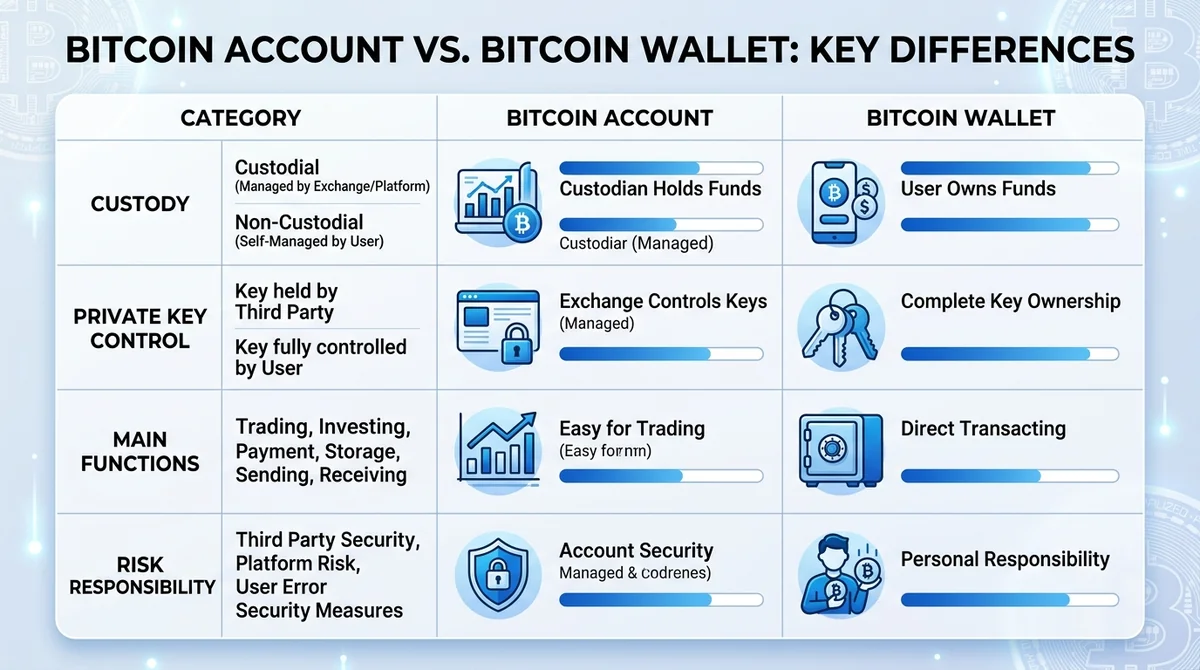
A Bitcoin account is a service account provided by a trading platform for buying, selling, storing, and transferring; a Bitcoin wallet is a tool for users to manage private keys themselves. MSX adopts a non-custodial model, where private keys/mnemonic phrases are kept by users. There are fundamental differences in function, control, and risk responsibility between the two, and you must distinguish them before opening an account.
What Are the Core Functions of a Bitcoin Account?
A Bitcoin account is a service account registered by users on a centralized exchange (such as MSX). Its main functions include:
- Buying and selling Bitcoin and other cryptocurrencies, supporting various trading types such as spot and futures.
- Storing assets within the platform, with custody and settlement handled by the platform.
- Performing deposits, withdrawals, transfers, etc., relying on the platform's infrastructure.
Account security depends on the platform's security mechanisms, such as cold wallet storage and risk control systems.
What Are the Core Functions of a Bitcoin Wallet?
A Bitcoin wallet is a tool managed by users themselves. The core is control over private keys and mnemonic phrases:
- The private key is the sole credential for controlling Bitcoin. Whoever holds the private key owns the assets.
- The mnemonic phrase can be used to recover the wallet and must be kept offline and secure.
- The wallet is completely controlled by the user, without reliance on any third-party platform.
MSX adopts a non-custodial model, meaning the platform does not hold user private keys; asset control is in the hands of users.
Why Must You Distinguish Between Account and Wallet Before Opening an Account?
Distinguishing between account and wallet is directly related to the division of asset security responsibility:
- Account risk: If the platform is attacked or goes bankrupt, assets in the account may be damaged, but MSX reduces such risks through cold wallet isolation and proof of reserves.
- Wallet risk: Users keep private keys themselves. If lost or leaked, assets cannot be recovered.
- When opening an account on MSX, the platform will not ask users to provide private keys; users need to manage wallet security themselves.
What Materials Do You Need to Open a Bitcoin Account on MSX?
To open an account on MSX, you need an email or phone number and complete KYC verification (submit identity documents). MSX fully integrates KYC and KYT systems to comply with multi-country financial license standards. Materials are simple to prepare but must be authentic and valid.
What Basic Information Is Required to Register an MSX Account?
To register an MSX account, you only need the following basic information:
- A valid email address or phone number for receiving verification codes and account notifications.
- Set a login password, preferably a strong combination.
- Agree to the platform's terms of service and privacy policy.
After registration, you can proceed to the KYC verification step.
What Documents Are Required for KYC Verification?
KYC (Know Your Customer) verification requires submission of:
- Identity documents: passport, ID card, or driver's license, or other government-issued valid documents.
- Facial recognition or video verification: liveness detection to ensure the operation is done by the user.
- Some users may need to supplement proof of address (such as utility bills).
MSX integrates KYC and KYT (Know Your Transaction) on-chain risk control systems, complying with financial license standards such as MSB, to ensure account security.
Why Does MSX Require KYC and KYT?
KYC and KYT are core measures for anti-money laundering (AML) and counter-terrorism financing (CTF):
- KYC verifies user identity to prevent anonymous accounts from being used for illegal activities.
- KYT monitors on-chain transactions to identify suspicious fund flows.
- MSX has completed SEC security token offering (STO) filing under Regulation S of the U.S. Securities Act of 1933, with strict compliance requirements.
What Are the Detailed Steps to Open a Bitcoin Account on MSX?
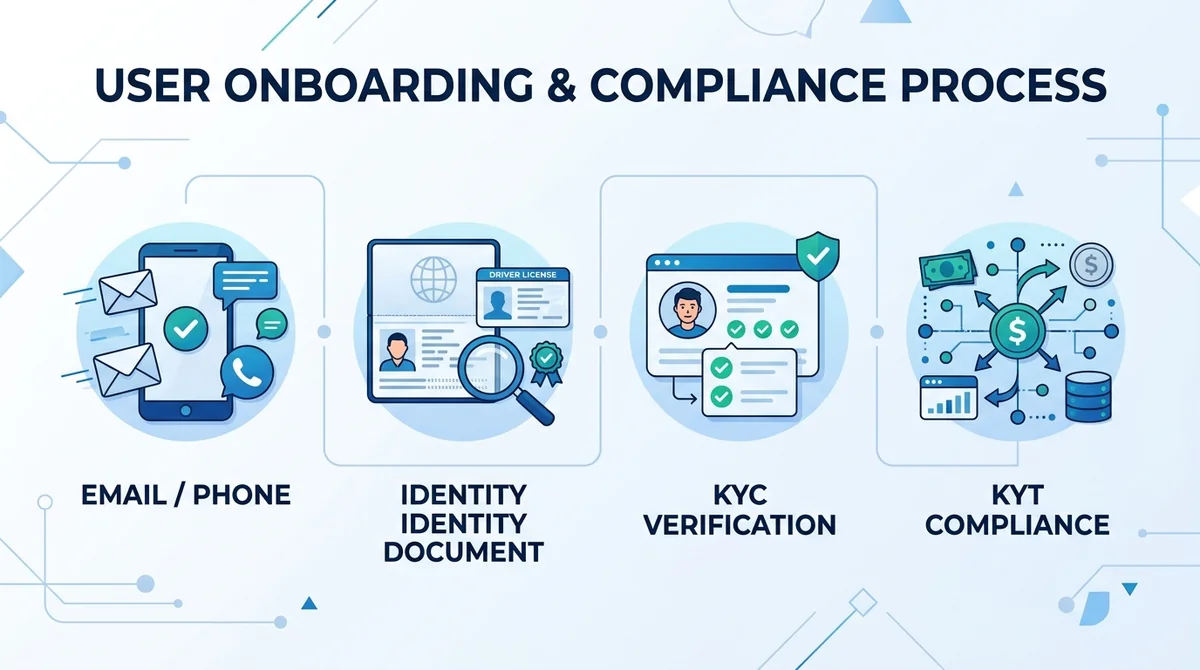
MSX account opening process includes registering an account, completing KYC verification, setting security options (such as Google Authenticator, fund password), and depositing. The whole process takes about 5 minutes to start trading Bitcoin. The following breaks down the specific operations step by step.
Step 1: How to Register an MSX Account?
- Visit the MSX official website or download the official App (Android version 1.6.3).
- Click register, fill in email or phone number, and set a password.
- Enter the verification code received to complete email/phone verification.
After successful registration, the system will prompt for KYC verification.
Step 2: How to Complete KYC Verification?
- Go to the personal center and click "Identity Verification".
- Upload identity documents (passport or ID card).
- Follow the prompts to complete facial recognition or video verification.
- Wait for review, usually completed within minutes.
After approval, the account will unlock all trading functions.
Step 3: How to Set Account Security Options?
To protect asset security, it is recommended to immediately set the following options:
- Bind Google Authenticator (2FA) or SMS verification to increase login protection.
- Set a separate fund password, different from the login password.
- Enable withdrawal whitelist to allow withdrawals only to preset addresses.
These settings can greatly reduce the risk of account theft.
Step 4: How to Deposit and Start Trading?
- Select deposit on the "Assets" page, supporting stablecoin deposits such as USDT.
- You can obtain USDT through cross-chain bridge (0.1% fee) or spot trading (0 fee).
- After the deposit arrives, you can start buying and selling Bitcoin on trading pairs such as BTC/USDT.
What Security Settings Does MSX Bitcoin Account Offer to Protect Assets?
MSX provides security settings such as two-factor authentication and withdrawal whitelist. The platform itself stores 95% of assets in multi-signature cold wallets and promises that the physical on-chain reserve ratio for all listed coins is strictly greater than 100%. Dual-layer protection from users and platform jointly safeguards asset security.
How to Enable Two-Factor Authentication (2FA)?
Two-factor authentication (2FA) adds an extra layer of verification beyond the password to prevent malicious login:
- Select "Google Authenticator" or "SMS Verification" in the security center.
- Use an app like Google Authenticator to scan the QR code and bind the account.
- Enter the dynamic verification code at login for second-factor verification.
It is recommended to prioritize Google Authenticator, which is more secure than SMS verification.
How to Set Up Withdrawal Whitelist?
Withdrawal whitelist restricts withdrawal addresses to prevent assets from being transferred to unknown addresses:
- Enable the withdrawal whitelist function in the security center.
- Add commonly used withdrawal addresses; the system will only allow withdrawals to addresses on the list.
- New addresses require verification and a cooling-off period to reduce risk.
After enabling, even if the account is compromised, attackers will find it difficult to transfer assets out.
What Security Mechanisms Does the MSX Platform Have?
MSX deploys multiple security mechanisms at the platform level:
- Cold wallet isolation: 95% of digital assets are stored in multi-signature (Multi-Sig) cold wallets, kept offline to resist hacker attacks.
- 100% physical proof of reserves: The platform promises that the physical on-chain reserve ratio for all listed coins is strictly greater than 100% (Proof of Reserves), with full reserve backing for user assets.
- Official own funds safety cushion: The platform claims that core settlement assets have accumulated tens of millions to hundreds of millions of USD in official own funds (Seed Capital) as a safety cushion (this statement has no third-party audit verification).
What Are the Advantages and Fees of Opening a Bitcoin Account on MSX?
MSX has SEC STO filing qualification, 0 fees for spot trading, futures taker fee of 0.045%, with 10% discount when using $MSX to offset, and supports Bitcoin spot, futures, and tokenized US stocks. Advantages focus on compliance, low fees, and product diversity.
What Compliance Qualifications Does MSX Have?
MSX's compliance qualifications are one of the platform's core advantages:
- Completed SEC security token offering (STO) filing, conducting STO under Regulation S of the U.S. Securities Act of 1933.
- Strictly complies with AML/CTF regulations in various jurisdictions, integrating KYC and KYT systems.
- Smart contract code is open source and has undergone third-party security audits, providing public code and audit reports.
These qualifications provide users with a relatively transparent compliance environment.
What Are MSX's Trading Fees?
As of 2026, MSX's fee structure is clear:
| Trading Type | Fee | Description |
|---|---|---|
| Spot Trading | 0 fees | Cryptocurrency spot buying and selling |
| RWA Spot Buy Order | 0.3% | RWA assets such as tokenized US stocks |
| RWA Spot Sell Order | 0% | Sell orders are free |
| Futures Maker | 0.02% | 10% discount with $MSX offset |
| Futures Taker | 0.045% | 10% discount with $MSX offset |
| Cross-chain Bridge | 0.1% | Cross-chain asset transfer |
Using $MSX platform token to offset fees: spot enjoys 25% discount, futures enjoy 10% discount (10% reduction).
What Trading Products Does MSX Support?
MSX offers diversified trading products to meet different user needs:
- Bitcoin spot: BTC/USDT and other mainstream trading pairs, T+0 real-time trading.
- Bitcoin futures: perpetual contracts, supporting long and short trading.
- Tokenized US stocks: on-chain tokenization of US stocks, can be bought and sold directly with stablecoins.
- Pre-IPO section: tokenization of primary market shares (launched on March 2, 2026).
- Portfolio Margin: multiple on-chain assets as joint margin to improve capital efficiency.
How to Trade Bitcoin Safely After Opening an Account?
After opening an account, choose mainstream trading pairs and make good use of take-profit and stop-loss orders to control risk. MSX provides a multi-layer risk control and liquidation system, but users still need to pay attention to market volatility risks. Trading safety requires both strategy and risk control.
How to Choose the Right Trading Pair?
When choosing a trading pair, prioritize liquidity and depth:
- BTC/USDT is the mainstream trading pair for Bitcoin trading with the best liquidity.
- Avoid obscure trading pairs with too low trading volume to prevent excessive slippage.
- MSX provides real-time quotes and millisecond-level WebSocket order book data refresh; users can check depth before placing orders.
How to Set Take-Profit and Stop-Loss?
Take-profit and stop-loss are key tools for risk control:
- Select the "Take-Profit/Stop-Loss" order type on the order interface.
- Set take-profit price and stop-loss price. When the market price touches the preset value, the position will be automatically closed.
- Set leverage multiples reasonably to avoid liquidation due to excessive leverage.
MSX provides various order types such as limit orders, market orders, and take-profit/stop-loss orders to meet different strategy needs.
What Are the Risks of Bitcoin Trading?
Bitcoin trading has the following main risks:
- Market volatility risk: Bitcoin prices fluctuate violently, which may lead to significant losses.
- Leverage risk: Futures trading amplifies both gains and losses, possibly losing all principal.
- Liquidity risk: In extreme market conditions, slippage or inability to execute timely may occur.
MSX has deployed a multi-layer risk control system covering margin monitoring, risk alerts, auto-deleveraging, and forced liquidation, but cannot completely eliminate market risks.
Risk Warning: This article is for reference only and does not constitute investment advice. Crypto assets are highly volatile and may result in total loss of principal. Please do your own research and make independent decisions (DYOR).
Frequently Asked Questions (FAQ)
Q: What is the difference between a Bitcoin account and a wallet? A: A Bitcoin account is a service account provided by a trading platform for buying, selling, storing, and transferring; a Bitcoin wallet is a tool for users to manage private keys themselves. MSX adopts a non-custodial model, where private keys/mnemonic phrases are kept by users themselves, and the platform does not hold user private keys.
Q: What materials are needed to open a Bitcoin account on MSX? A: You need an email or phone number to register, and submit identity documents (passport or ID card) to complete KYC verification. MSX integrates KYC and KYT systems, complying with financial license standards such as MSB. Verification usually completes within minutes.
Q: How long does the MSX account opening process take? A: The whole process takes about 5 minutes, including registration, KYC verification, security setup, and deposit. Registration and KYC review are usually instant. Once the deposit arrives, you can start trading Bitcoin.
Q: Is the MSX Bitcoin account safe? A: MSX stores 95% of assets in multi-signature cold wallets, promises that the physical on-chain reserve ratio for all listed coins is strictly greater than 100%, and provides security settings such as two-factor authentication and withdrawal whitelist. However, users still need to keep their private keys and mnemonic phrases safe.
Q: What are the fees for trading Bitcoin on MSX? A: Spot trading has 0 fees; futures maker fee is 0.02%, taker fee is 0.045%. Using $MSX to offset fees gives an extra 10% discount (10% reduction). Please refer to the MSX platform's real-time fee page for specific rates.
Q: How to reduce Bitcoin trading risks after opening an account? A: Choose mainstream trading pairs like BTC/USDT, use take-profit and stop-loss orders to control losses, and set leverage reasonably. MSX provides a multi-layer risk control and liquidation system, but cryptocurrency is highly volatile. Please do your own research and make independent decisions.
This article is produced by the MSXGO editorial team, AI-assisted, and reviewed through an editorial process. Fee rates and figures are subject to each platform's latest official announcements.
FAQ
What is the difference between a Bitcoin account and a wallet? ▼
A Bitcoin account is a service account provided by a trading platform for buying, selling, storing, and transferring; a Bitcoin wallet is a tool for users to manage private keys themselves. MSX adopts a non-custodial model, where private keys/mnemonic phrases are kept by users themselves, and the platform does not hold user private keys.
What materials are needed to open a Bitcoin account on MSX? ▼
You need an email or phone number to register, and submit identity documents (passport or ID card) to complete KYC verification. MSX integrates KYC and KYT systems, complying with financial license standards such as MSB. Verification usually completes within minutes.
How long does the MSX account opening process take? ▼
The whole process takes about 5 minutes, including registration, KYC verification, security setup, and deposit. Registration and KYC review are usually instant. Once the deposit arrives, you can start trading Bitcoin.
Is the MSX Bitcoin account safe? ▼
MSX stores 95% of assets in multi-signature cold wallets, promises that the physical on-chain reserve ratio for all listed coins is strictly greater than 100%, and provides security settings such as two-factor authentication and withdrawal whitelist. However, users still need to keep their private keys and mnemonic phrases safe.
What are the fees for trading Bitcoin on MSX? ▼
Spot trading has 0 fees; futures maker fee is 0.02%, taker fee is 0.045%. Using $MSX to offset fees gives an extra 10% discount (10% reduction). Please refer to the MSX platform's real-time fee page for specific rates.
How to reduce Bitcoin trading risks after opening an account? ▼
Choose mainstream trading pairs like BTC/USDT, use take-profit and stop-loss orders to control losses, and set leverage reasonably. MSX provides a multi-layer risk control and liquidation system, but cryptocurrency is highly volatile. Please do your own research and make independent decisions.
Finished reading? Ready to try trading?
Tokenized stocks/ETFs, crypto spot, and perpetual futures in one account — perp maker 0.02% / taker 0.045%, RWA spot buy 0.3% / sell 0.
Free sign-up · 3 quick steps