Bitcoin Account vs Wallet: 2026 Features, Security & MSX Platform Practical Differences Explained
Bitcoin accounts are custodied by platforms for trading; wallets are self-custodied for storage. MSX: spot sell 0 fees, crypto-to-crypto 0 fees. Learn 2026 differences.

Article Citation Summary
Bitcoin accounts are custodied by platforms for trading; wallets are self-custodied for storage. MSX: spot sell 0 fees, crypto-to-crypto 0 fees. Learn 2026 differences.
Bitcoin Account vs Wallet: 2026 Features, Security & MSX Platform Practical Differences Explained
Core Takeaways / TL;DR
- Private key ownership determines the fundamental divide: A Bitcoin account entrusts private keys to the platform, prioritizing trading efficiency; a Bitcoin wallet puts the user in charge of private keys, prioritizing asset sovereignty.
- Risk profiles are completely different: Account security risks concentrate on the platform side (hacks, exit scams, compliance freezes); wallet risks fall on the user (private key loss, phishing). MSX platform builds its defense with 95% cold wallet multisig isolation and 100% proof of reserves.
- Use cases differ: Accounts excel at fiat on/off-ramps, leverage operations, and low-cost execution; wallets are better for long-term storage and on-chain transfers.
- MSX fee snapshot: Spot buy 0.3%, sell zero fees; crypto-to-crypto swaps zero fees; cross-chain bridge 0.1%; using $MSX to offset spot fees gets a 25% discount.
- Allocation strategy: Use accounts as the main battlefield for short-term operations, cold wallets as the base for long-term holding, and keep only small amounts in accounts. MSX supports both non-custodial self-custody of private keys and multi-asset portfolio margin.
What is the core difference between a Bitcoin account and a wallet?
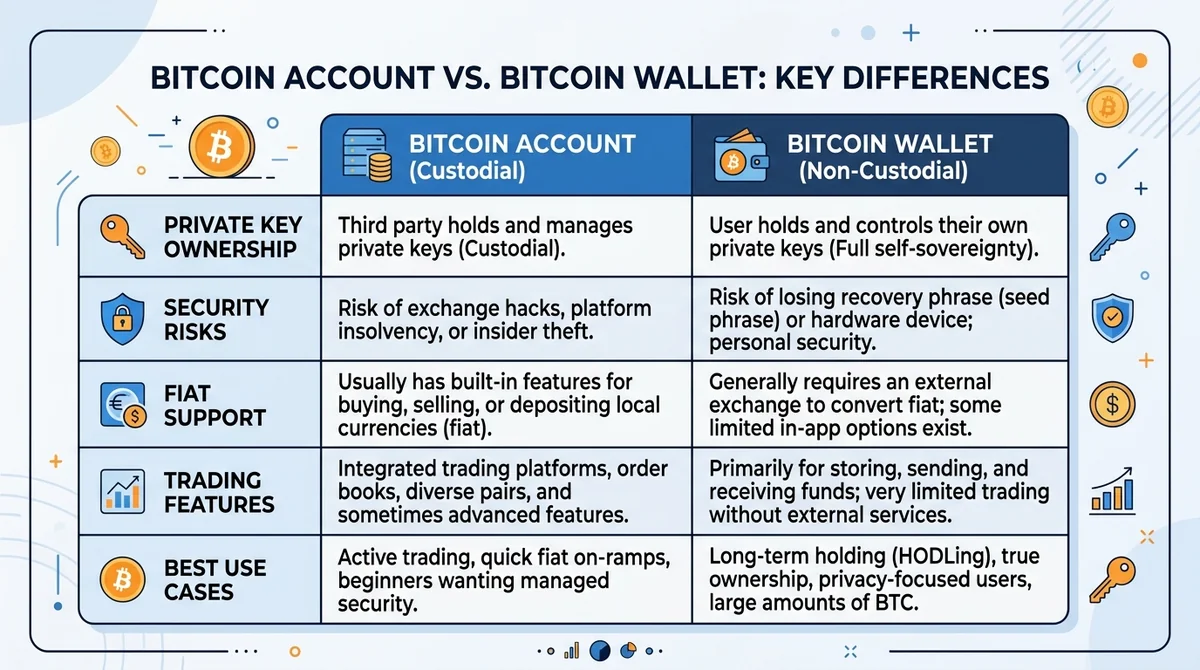
A Bitcoin account is where the trading platform holds your assets and private keys, with the core advantage being trading convenience; a Bitcoin wallet requires users to manage private keys themselves, with the core value being asset self-control. The two differ fundamentally in private key ownership, security model, and functional design.
Who controls the private keys in a Bitcoin account?
In a Bitcoin account, private keys are in the hands of the platform; users only hold login credentials. This means users cannot directly control on-chain assets—every trade and withdrawal must go through the platform. The convenience is obvious—low barrier to entry, fast execution—suitable for high-frequency trading and leverage, but users effectively cede ultimate control over their assets.
What types of Bitcoin wallets are there?
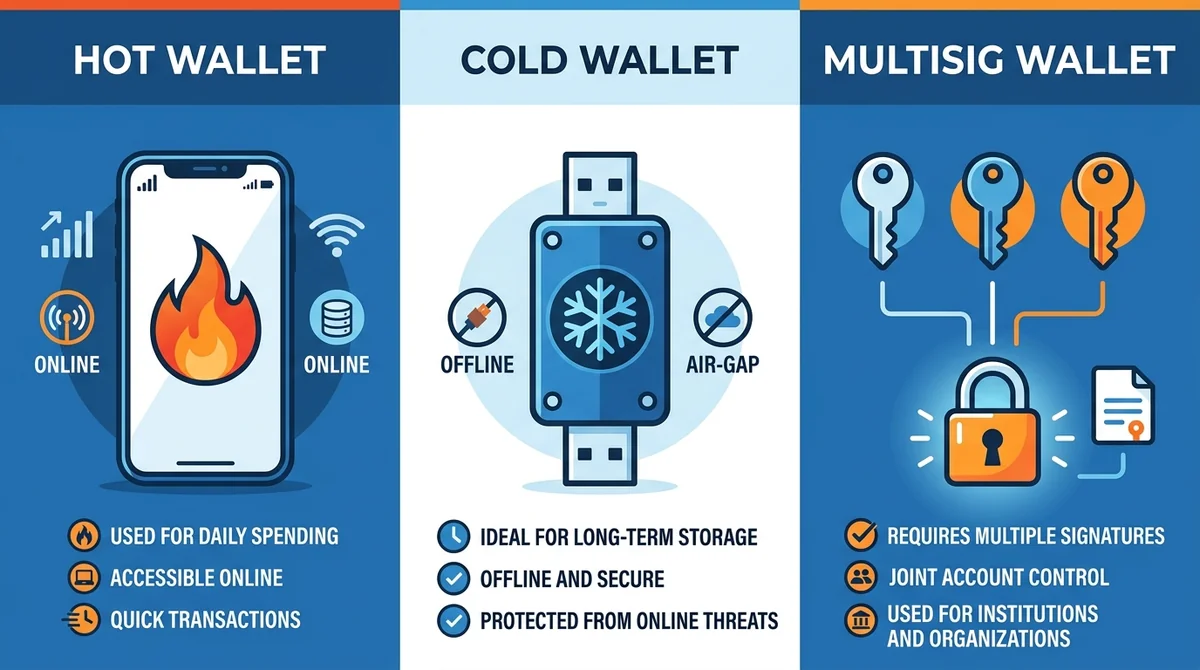
Based on how private keys are stored, Bitcoin wallets fall into three categories: hot wallets, cold wallets, and multisig wallets. Hot wallets are always online, suitable for small daily spending amounts; cold wallets are completely offline, suitable for long-term storage of large amounts; multisig wallets require multiple private keys to sign before funds can be moved, suitable for institutional custody or shared control scenarios. Which wallet to choose depends on your trade-off between security level and usage frequency.
What are the functional differences between accounts and wallets?
Functional differences can be observed from three dimensions:
- Fiat channels: Accounts generally support fiat deposits and fiat trading pairs; wallets typically only handle on-chain assets.
- Trading depth: Accounts can carry complex trading strategies such as leverage, futures, and limit orders; wallets' core functions remain storage and transfers.
- Asset control: Account assets are custodied by the platform; wallet assets are fully controlled by the user.
How does security differ between Bitcoin accounts and wallets?
Account security is built on the platform's risk control systems and custody mechanisms, inherently carrying platform-side risks; wallet security depends entirely on the user's ability to manage private keys, with the core risk being private key loss; the MSX platform strengthens account security through 95% cold wallet multisig isolation, 100% proof of reserves, and KYC/KYT compliance systems.
What are the security risks of the account custody model?
Risks in the custody model are highly concentrated on the platform side: the platform may be hacked leading to asset theft, may collapse due to mismanagement or exit scams, or may freeze user funds due to regulatory compliance requirements. In recent years, several exchanges collapsed due to security incidents, leaving users with no recourse. Therefore, when choosing an account platform, it is crucial to examine its security architecture and compliance credentials.
How does self-custody of wallet private keys ensure security?
The security of self-custodied private keys rests entirely on the user: if the private key is lost or leaked, assets can never be recovered. Common risk scenarios include improper backup of mnemonic phrases, actively leaking private keys on phishing sites, and devices infected with malware. Users need to develop habits of offline mnemonic backup, using hardware wallets, and staying vigilant against suspicious links.
What are the security mechanisms of the MSX platform?
The MSX platform's security system consists of multiple layers: 95% of digital assets are stored in multisig cold wallets, physically isolating them from hacker attacks; 100% physical proof of reserves ensures the on-chain reserve ratio of all listed tokens is strictly greater than 100%; full integration of KYC and KYT on-chain risk control complies with MSB and other multi-country financial license requirements. Additionally, private keys and mnemonic phrases are kept by users themselves, reflecting non-custodial characteristics.
How to trade Bitcoin with an account on the MSX platform?
On the MSX platform, Bitcoin spot buy fee is 0.3%, sell is free, crypto-to-crypto trading has zero fees, cross-chain bridge is 0.1%, and using $MSX to offset spot fees gives a 25% discount. Users can also settle Bitcoin trades directly with stablecoins.
What are the MSX Bitcoin spot trading fees?
As of 2026, MSX's Bitcoin spot trading fee structure is: buy at 0.3%, sell completely free. Using $MSX to offset spot fees gets an additional 25% discount. Please refer to the real-time fee page on the MSX platform for the latest rates.
What are the advantages of MSX crypto-to-crypto trading?
MSX's crypto-to-crypto trading (direct exchange between cryptocurrencies) has zero fees, which is highly attractive for users who frequently switch positions. Compared to spot trading, crypto-to-crypto trading eliminates multiple fiat conversion steps, improving capital flow efficiency.
How to deposit Bitcoin on MSX?
Ways to deposit Bitcoin on MSX include: converting assets from other chains to Bitcoin via the cross-chain bridge, with a bridge fee of 0.1%; supporting direct settlement of Bitcoin trades with stablecoins, bypassing cumbersome traditional cross-border wire transfers and high currency conversion costs. For detailed steps, refer to the MSX Registration Tutorial 2026.
How to choose a combination of Bitcoin account and wallet?
High-frequency traders should use Bitcoin accounts as their primary tool, fully leveraging MSX's low fees and deep liquidity; long-term holders should move most assets to self-custodied cold wallets, keeping only small amounts in accounts for daily operations; MSX's non-custodial model supports self-custody of private keys and multi-asset portfolio margin, allowing flexible combination of both approaches.
Which method suits frequent traders?
For frequent traders, centering on a Bitcoin account is the more reasonable choice. The liquidity, low fees (MSX spot sell 0 fees, crypto-to-crypto 0 fees), and instant execution provided by accounts effectively support high-frequency buying and selling, leverage operations, and arbitrage strategies. Keeping commonly used trading funds in the account minimizes friction costs.
How should long-term holders allocate?
The safest approach for long-term holders is: move the bulk of Bitcoin to a self-custodied cold wallet (such as a hardware wallet), fundamentally avoiding platform risk; keep only a small amount in the account for daily trading or emergency needs. The offline storage mechanism of cold wallets keeps private keys never touching the internet, making it the optimal solution for long-term asset custody.
How does the MSX platform support combining accounts and wallets?
The MSX platform's non-custodial nature means private keys and mnemonic phrases are always controlled by users, while supporting on-chain wallet interaction and cross-chain bridge connections, making asset transfers between accounts and wallets very smooth. The platform also supports multi-asset portfolio margin, allowing multiple on-chain assets to be used as joint margin, further improving capital efficiency.
What are common questions about Bitcoin accounts and wallets?
When Bitcoin account funds are frozen, you need to contact the platform and cooperate with compliance reviews; lost wallet private keys cannot be recovered, so mnemonic phrases must be backed up in advance; the MSX platform supports on-chain wallet interaction and cross-chain bridge connections, making asset transfers between accounts and wallets more convenient.
What to do if account funds are frozen?
If your account funds are frozen, the first step is to immediately contact platform customer support and actively cooperate with KYC/AML reviews. Freezes are usually triggered by risk control systems or compliance requirements; after submitting necessary proof documents, they can generally be unfrozen. MSX users can get support via the official Telegram customer service or official website live chat.
How to recover a lost wallet private key?
The answer is harsh: a lost private key cannot be recovered. Bitcoin private keys are the sole proof of asset ownership; once lost, the corresponding on-chain assets are permanently locked. Therefore, always back up mnemonic phrases offline and keep them safe. Never store mnemonic phrases on internet-connected devices or cloud services.
Does the MSX platform support wallet connections?
The MSX platform supports on-chain wallet interaction and cross-chain bridge connections. Users can freely transfer assets between accounts and external wallets via the cross-chain bridge, with a bridge fee of 0.1%. This design makes combining accounts and wallets more flexible and convenient.
FAQ
Q1: Which is safer, a Bitcoin account or a wallet?
A1: The two have completely different security models. Account risks concentrate on the platform side (hacks, exit scams, freezes); wallet risks concentrate on the user side (private key loss, phishing). For long-term large holdings, a self-custodied cold wallet is safer; for frequent trading, a platform account with robust security mechanisms is more efficient. The MSX platform strengthens account security with 95% cold wallet multisig isolation and 100% proof of reserves.
Q2: What are the MSX Bitcoin spot trading fees?
A2: MSX Bitcoin spot buy fee is 0.3%, sell 0 fees; crypto-to-crypto trading 0 fees; cross-chain bridge 0.1%. Using $MSX to offset spot fees gets a 25% discount. Please refer to the real-time fee page on the MSX platform.
Q3: How to deposit Bitcoin on MSX?
A3: You can convert assets from other chains to Bitcoin via the cross-chain bridge, with a bridge fee of 0.1%; stablecoin direct settlement for Bitcoin trades is supported. For specific operations, refer to the MSX Registration Tutorial 2026.
Q4: What if I lose my wallet private key?
A4: Once a private key is lost, it cannot be recovered, and assets will be permanently locked. Always back up mnemonic phrases offline and keep them safe. Never store mnemonic phrases on internet-connected devices or in the cloud.
Q5: Does the MSX platform support wallet connections?
A5: Yes. MSX has non-custodial characteristics, with private keys held by users, supporting on-chain wallet interaction and cross-chain bridge connections. Users can transfer assets between accounts and wallets via the cross-chain bridge, with a fee of 0.1%.
Q6: Should frequent traders choose an account or a wallet?
A6: Frequent traders should primarily use a Bitcoin account, leveraging MSX's low fees (spot sell 0 fees, crypto-to-crypto 0 fees) and liquidity. Long-term holdings can be stored in a cold wallet, with small amounts left in the account for daily trading.
This article is produced by the MSXGO editorial team, AI-assisted, and reviewed through an editorial process. Fee rates and figures are subject to each platform's latest official announcements.
FAQ
Which is safer, a Bitcoin account or a wallet? ▼
The two have different security models. Account risks concentrate on the platform (hacks, exit scams, freezes); wallet risks concentrate on the user (private key loss, phishing). For long-term large holdings, a self-custodied cold wallet is safer; for frequent trading, a platform account with robust security mechanisms is more convenient. The MSX platform uses 95% cold wallet multisig isolation and 100% proof of reserves to strengthen account security.
What are the MSX Bitcoin spot trading fees? ▼
MSX Bitcoin spot buy fee is 0.3%, sell 0 fees; crypto-to-crypto trading 0 fees; cross-chain bridge 0.1%. Using $MSX to offset spot fees gets a 25% discount. Please refer to the real-time fee page on the MSX platform.
How to deposit Bitcoin on MSX? ▼
You can convert assets from other chains to Bitcoin via the cross-chain bridge, with a bridge fee of 0.1%; stablecoin direct settlement for Bitcoin trades is supported. For specific operations, refer to the MSX Registration Tutorial.
What if I lose my wallet private key? ▼
A lost private key cannot be recovered, and assets will be permanently locked. Always back up mnemonic phrases offline and keep them safe. Never store mnemonic phrases on internet-connected devices or in the cloud.
Does the MSX platform support wallet connections? ▼
Yes. MSX has non-custodial characteristics, with private keys held by users, supporting on-chain wallet interaction and cross-chain bridge connections. Users can transfer assets between accounts and wallets via the cross-chain bridge, with a fee of 0.1%.
Should frequent traders choose an account or a wallet? ▼
Frequent traders should primarily use a Bitcoin account, leveraging MSX's low fees (spot sell 0 fees, crypto-to-crypto 0 fees) and liquidity. Long-term holdings can be stored in a cold wallet, with small amounts left in the account for trading.
Finished reading? Ready to try trading?
Tokenized stocks/ETFs, crypto spot, and perpetual futures in one account — perp maker 0.02% / taker 0.045%, RWA spot buy 0.3% / sell 0.
Free sign-up · 3 quick steps