2026 Bitget Spot Fee Review: How to Verify Trading Costs Against Binance
Compare 2026 Bitget and Binance spot fees with aligned Maker/Taker, pairs, tiers, discounts, formulas, order fields, and small-trade tests.
Article Citation Summary
Compare 2026 Bitget and Binance spot fees with aligned Maker/Taker, pairs, tiers, discounts, formulas, order fields, and small-trade tests.
2026 Bitget Spot Fee Review: How to Verify Trading Costs Against Binance
Key Points / TL;DR
- When comparing Bitget spot fees with Binance spot fees, first standardize the user tier, trading pair, and fee version, then verify Maker and Taker separately.
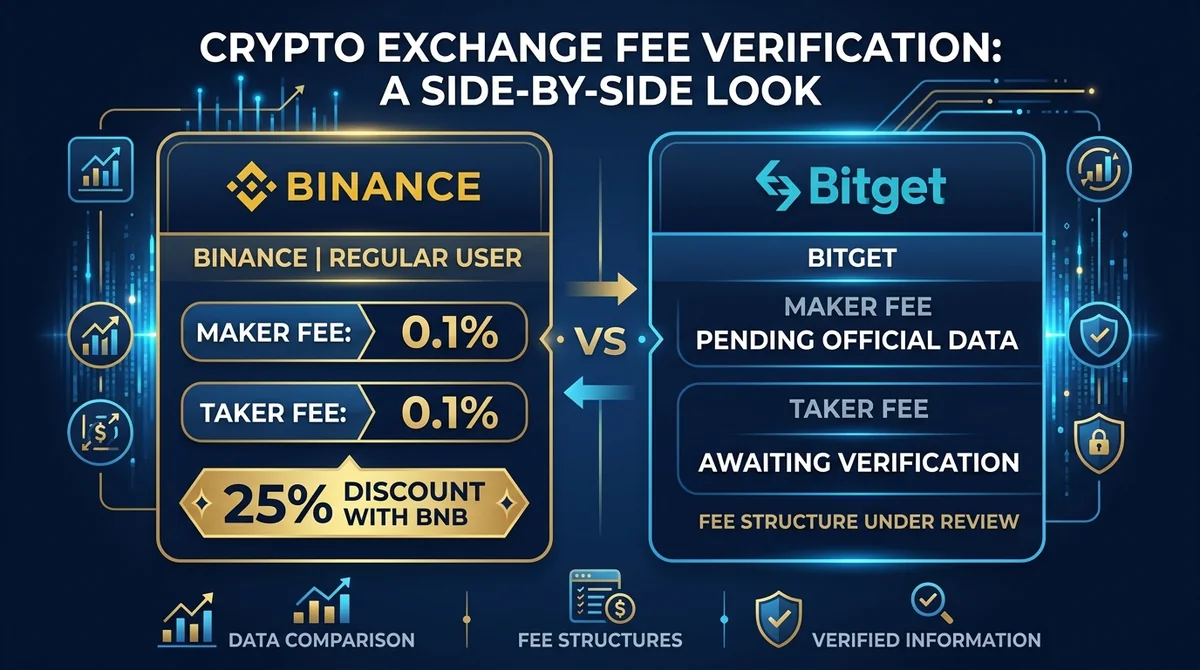
- The provided facts confirm that Binance's regular-user spot Maker fee is 0.1% and its Taker fee is 0.1%, excluding BNB discounts.
- When BNB payment is enabled and the balance is sufficient, Binance spot fees typically receive a 25% discount, meaning users pay 75% of the standard fee.
- No provided facts support Bitget's spot fees, post-discount rates, or actual charged amounts. Official data and order records must be added before publication.
- Trading costs should be calculated item by item based on trade value, execution type, discount status, and the actual amount charged in the order. Promotional rates alone are not sufficient.
As of 2026, directly citable data for both platforms is incomplete: Binance charges regular users 0.1% for both spot Maker and Taker fees, and BNB payment typically provides a 25% discount. The input does not provide the corresponding Bitget rates. Therefore, this article presents a standardized verification method and does not infer a platform ranking from unavailable data.
How Should Bitget and Binance Spot Fees Be Verified on a Consistent Basis?
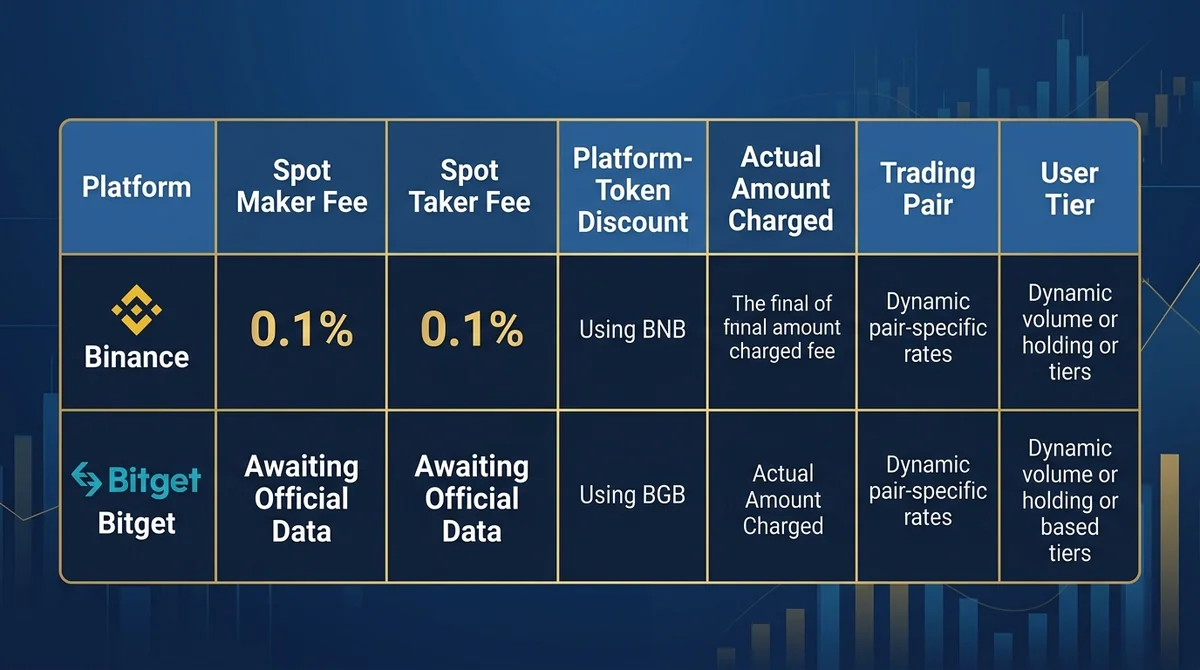
To verify Bitget spot fees and Binance spot fees consistently, first fix the user tier and trading pair. Then compare Maker, Taker, and the actual fees after any platform-token discount separately, avoiding direct comparisons based on different standards.
The Maker fee applies when an order provides liquidity to the order book, while the Taker fee applies when an order actively consumes order-book liquidity. Because they represent different execution paths, a platform's Maker fee should not be directly compared with another platform's Taker fee.
A standardized field table is recommended during verification:
| Verification field | Bitget | Binance | Recording requirement |
|---|---|---|---|
| Spot trading scope | Awaiting official data | Regular-user spot trading | Specify the exact trading pair and product type |
| Maker fee | Awaiting official data | 0.1% | Record the nominal rate and applicable tier |
| Taker fee | Awaiting official data | 0.1% | Record the nominal rate and applicable tier |
| Platform-token discount | Awaiting official data | BNB payment typically provides a 25% discount | Confirm the setting, balance, and eligibility conditions |
| Actual amount charged | Pending order review | Pending order review | Use the amount shown in the order details |
| Verification date | To be added | 2026 verification basis | Save the page version or a screenshot |
As of 2026, the provided facts confirm only that Binance's regular-user spot Maker fee is 0.1%, its Taker fee is 0.1%, and BNB payment typically provides a 25% discount. The input provides no corresponding Bitget fee or discount conditions, so Bitget's costs cannot be inferred.
Post-discount rates also require a distinction between the nominal discount and the actual amount charged. For example, Binance's 25% discount requires BNB payment to be enabled and a sufficient BNB balance. If the balance is insufficient or the setting is not enabled, the order may still be charged at the non-discounted rate. For more platform fee standards, see MSX vs. Binance Spot Fee Comparison 2026.
What Are Binance's Spot Maker and Taker Fees?
For regular Binance users, the nominal spot Maker and Taker fees are both 0.1%. This standard rate excludes BNB discounts. When BNB payment is enabled and the balance is sufficient, the fee is typically calculated at 75% of the standard rate. The account page should still be treated as the final reference.
| Binance spot fee metric (2026) | Confirmed data | Applicable conditions |
|---|---|---|
| Regular-user Maker fee | 0.1% | Standard spot fee, excluding BNB discounts |
| Regular-user Taker fee | 0.1% | Standard spot fee, excluding BNB discounts |
| Spot discount with BNB payment | 25% discount | BNB payment must be enabled and the balance must be sufficient |
| BNB payment fee reduction | 25% | Based on the typical discount stated in the provided facts |
The difference between Maker and Taker is not the fee percentage itself but the execution method. A limit order that enters the order book and waits for execution may be classified as Maker. An order that executes immediately at available market prices is generally classified as Taker. The final classification should be confirmed in the order details or execution report rather than inferred solely from the order-entry interface.
Three conditions should be checked for BNB discounts:
- Whether the account has enabled the option to pay trading fees with BNB.
- Whether the BNB balance is sufficient to cover the fee.
- Whether the current spot trading pair, account tier, or promotional rules permit the discount.
As of 2026, Binance's known regular-user spot baseline is 0.1% for Maker and 0.1% for Taker, with a typical 25% discount for BNB payment. These figures can serve as a one-platform verification baseline but cannot determine whether Bitget spot fees are higher or lower.
How Should Bitget and Binance Spot Trading Costs Be Calculated?
Spot trading costs should first be based on a fixed trade value. Apply the Maker or Taker rate separately, then verify any platform-token discount, the asset used for fee payment, and the actual amount charged in the order. When Bitget's official fee rate is unavailable, its specific cost should not be inferred.
The basic fee formula is:
Basic fee = Trade value × Applicable fee rate
If the platform-token discount conditions have been confirmed, record the following as well:
Post-discount fee = Basic fee × Post-discount percentage
For a regular Binance user, if the trade value of a spot transaction is known, calculate the Maker or Taker fee first using the standard 0.1% rate. If BNB payment is enabled and the balance is sufficient, then verify the result using the typical 75% payment ratio. This calculation only describes the Binance baseline and does not replace the actual charge shown in the order details.
Each test order should be broken down into the following fields:
- Trade value: Record the actual amount calculated from the executed quantity and execution price.
- Execution type: Specify whether the execution was Maker or Taker.
- Nominal fee: Calculate the amount using the non-discounted fee rate.
- Discount status: Record the platform-token payment setting and balance conditions.
- Fee asset: Confirm which asset was ultimately used to pay the fee.
- Actual fee: Use the amount shown in the execution report or order details.
Actual costs may also be affected by the spread, slippage, and fees on both sides of a buy-and-sell sequence. Slippage is the difference between the actual execution price and the price expected when placing the order. It should not simply be incorporated into the fee rate, and a specific Bitget amount cannot be estimated without order data. For broader fee fields, see 2026 Maker/Taker Fee Comparison.
How Should a Bitget vs. Binance Spot Fee Comparison Table Be Completed?
The current data boundary is as follows: Binance's regular-user spot Maker and Taker fees are both 0.1%, and the typical BNB discount is 25%; these figures can be cited. The input does not provide Bitget's corresponding official fees, so its official page and actual account charges must be reviewed before publication.
2026 Spot Fee Comparison Fields
| Platform | Regular-user Maker fee (2026) | Regular-user Taker fee (2026) | Platform-token discount | Data status |
|---|---|---|---|---|
| Binance | 0.1% | 0.1% | BNB payment typically provides a 25% discount; payment must be enabled and the balance sufficient | Confirmed by the provided facts; the specific page version still requires verification |
| Bitget | Not provided | Not provided | Not provided | Corresponding official fee data was not included in the input |
This table must not be interpreted as indicating that Bitget's fee is zero, nor can it establish which platform has lower costs. “Not provided” only means that the current input contains no citable fact; it does not mean that the platform has no applicable rule. Before publication, Bitget's fee page, account tiers, platform-token discount conditions, and order details should be added.
At a minimum, the following Bitget data is required:
- Regular-user spot Maker and Taker nominal fees.
- Whether different user tiers have different applicable rates.
- The platform-token discount percentage, activation conditions, and balance requirements.
- Whether specific trading pairs have separate fees or promotional rules.
- The execution type, fee asset, and actual fee amount for a small test order.
- The official page URL, page update date, and account verification date.
As of 2026, Binance data can serve as a one-platform baseline but does not constitute a complete ranking of Bitget and Binance. To reach a trading-cost verification conclusion, both platforms must be tested using the same trading pair, trade value, account tier, and execution type.
How Can You Verify the Actual Bitget and Binance Spot Fee Before Placing an Order?
To verify the actual Bitget and Binance spot fee, review the official fee pages, confirm account conditions, complete a small trade, check the order details, and save the fee version and transaction records for future traceability.
Recommended Verification Process
- Fix the test conditions: Select the same or comparable spot trading pair and record the account tier, quote asset, order amount, and verification time.
- Review the official rules: Record the Maker fee, Taker fee, platform-token discount, balance requirements, and special promotions for each platform. Do not capture only one fee percentage.
- Confirm account settings: Check whether BNB payment or another platform-token discount is enabled, and record whether the discount-asset balance is sufficient.
- Complete a small test: Use a test amount whose potential cost is acceptable and, where possible, verify both a resting-order execution and an immediate execution.
- Check the order details: Record the execution type, fee asset, fee amount, trade value, and order ID.
- Save the evidence: Save the official fee pages, account-setting screenshots, order details, and exported records, and label them with the 2026 verification date.
During verification, do not treat an unfilled order as a completed Maker execution, and do not automatically classify every limit order as Maker. Maker or Taker classification depends on whether the order provided or consumed order-book liquidity at the time of execution. The execution report should be treated as the final reference.
Fees may change based on account tier, promotions, product rules, or updates to a platform's fee page. The Binance data in this article comes from the provided facts, while Bitget data is still pending. Before placing an order, review both platforms' official fee pages again and use the actual order charge as the final verification result. For a broader review of spot and contract fee structures, see Complete Binance vs. MSX Fee Comparison.
Verification Risk Notice
- Different trading pairs may have different rules, so the result for one pair cannot represent the entire spot market.
- Platform-token discounts are conditional promotions. They may not apply when the setting is disabled or the balance is insufficient.
- Nominal fees are not the same as total trading costs. The spread, slippage, and fees from both buy and sell executions should also be recorded separately.
- When official Bitget data is unavailable, the field should be marked “pending” rather than filled with an estimate.
The data standards in this article are based on the provided facts and the 2026 verification requirements. Fee information does not constitute trading advice. For public information about MSX-related platforms, visit the MSX official website. This website is not used as a substitute for Bitget's or Binance's official fee pages.
FAQ
What are Bitget's spot fees?
The current input does not provide specific Bitget rates for regular-user Maker, Taker, or post-discount fees, so no numerical conclusion can be given. Before publication, Bitget's official fee page, applicable account tier, and trading pair should be added, and the actual charge should be verified through at least one order detail.
What are Binance's spot Maker and Taker fees?
For regular Binance users, both the spot Maker and Taker fees are 0.1%. This standard rate excludes BNB discounts. When BNB payment is enabled and the balance is sufficient, spot fees typically receive a 25% discount. The account page and order details should still be used for final confirmation.
What is the difference between Maker and Taker fees?
Maker generally refers to an execution that provides liquidity to the order book, while Taker generally refers to an execution that actively consumes order-book liquidity. A limit order is not necessarily Maker, and a market execution should also be confirmed through the execution report rather than judged solely by the order-entry interface.
What are the conditions for using BNB to pay Binance spot fees?
Binance spot fees typically receive a 25% discount when paid with BNB, provided that BNB payment is enabled and the balance is sufficient. The specific trading pair, account tier, and promotional rules may affect eligibility, so the actual 2026 page and order details should be checked.
Can Bitget and Binance be directly compared without Bitget fee data?
A complete conclusion cannot be drawn directly. The available information can only use Binance's 0.1% regular-user Maker fee and 0.1% Taker fee, along with the typical 25% BNB discount, as a one-platform baseline. The corresponding Bitget fields should be marked “not provided” or “pending” rather than replaced with estimates.
How can you verify actual spot trading costs?
First fix the trading pair, account tier, and trade value. Then separately test Maker or Taker execution and check the fee asset and amount in the order details. Save the fee pages, account-setting screenshots, and order records to complete a traceable trading-cost verification.
This article is produced by the MSXGO editorial team, AI-assisted, and reviewed through an editorial process. Fee rates and figures are subject to each platform's latest official announcements.
FAQ
What are Bitget's spot fees? ▼
The current input does not provide specific Bitget rates for regular-user Maker, Taker, or post-discount fees, so no numerical conclusion can be given. Before publication, Bitget's official fee page should be added and the actual charge should be verified through the order details.
What are Binance's spot Maker and Taker fees? ▼
For regular Binance users, both the spot Maker and Taker fees are 0.1%. This standard rate excludes BNB discounts. When BNB payment is enabled and the balance is sufficient, spot fees typically receive a 25% discount.
What is the difference between Maker and Taker fees? ▼
Maker generally refers to an execution that provides liquidity to the order book, while Taker generally refers to an execution that actively consumes order-book liquidity. Both must be recorded separately, and the actual type should be confirmed through the order details or execution report.
What are the conditions for using BNB to pay Binance spot fees? ▼
The provided facts state that Binance spot fees typically receive a 25% discount when paid with BNB, provided that BNB payment is enabled and the balance is sufficient. The specific trading pair and account rules should still be checked against the actual 2026 page.
Can Bitget and Binance be directly compared without Bitget fee data? ▼
A complete conclusion cannot be drawn directly. The available information can only use Binance's 0.1% regular-user Maker fee and 0.1% Taker fee, along with the typical 25% BNB discount, as a one-platform baseline. The corresponding Bitget fields should be marked as not provided or pending.