As the AI Boom Sweeps the Market, Are Crypto Assets Severely Undervalued?
Bitcoin vs Nasdaq valuation, stablecoin expansion, regulation and global liquidity: four threads explaining crypto allocation logic and risks.
Article Citation Summary
Bitcoin vs Nasdaq valuation, stablecoin expansion, regulation and global liquidity: four threads explaining crypto allocation logic and risks.
Introduction
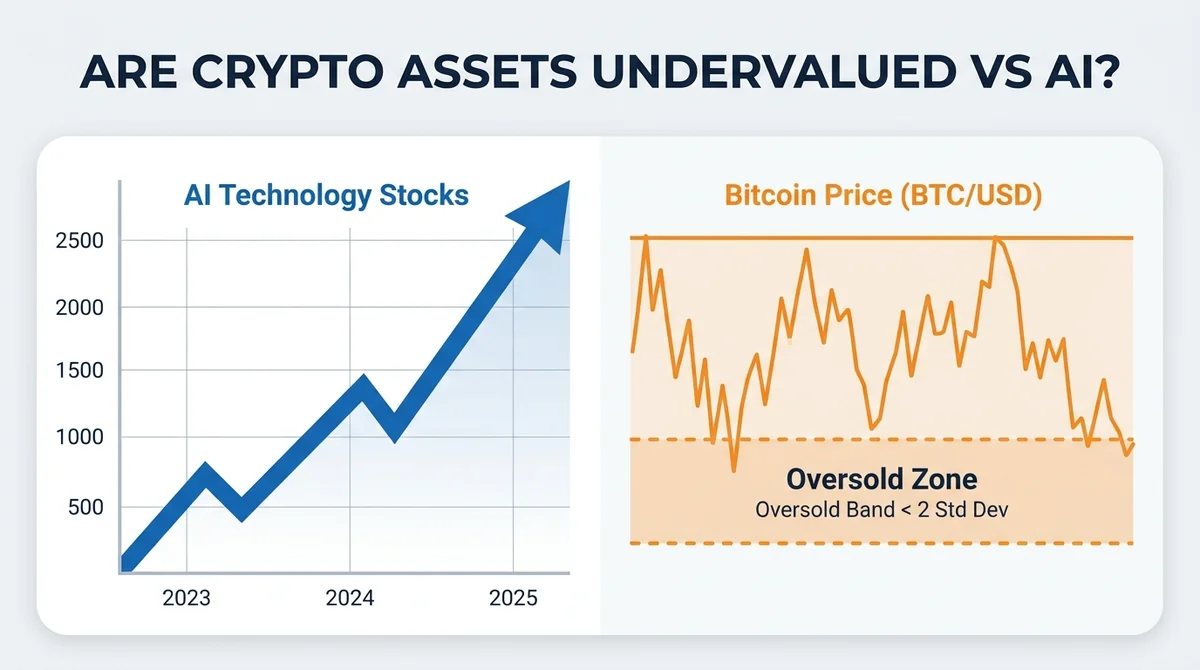
For some time now, market attention has been almost entirely absorbed by artificial intelligence: related assets have surged sharply, with charts climbing steeply, evoking memories of the 2020–2021 crypto rally. By contrast, the crypto market has spent a long stretch range-bound after a decline, with sentiment subdued. So the question becomes: when AI seems to be "where everything is happening," why stay in crypto assets at all?
Below, we lay out the core logic of this discussion across four dimensions: asset allocation, relative valuation, stablecoins and regulation, and global liquidity. Note that the views here reflect the personal judgment of the interviewed guest and do not constitute any investment advice.
1. Treat Capital as a "Mercenary": Allocate, Don't Pick Sides
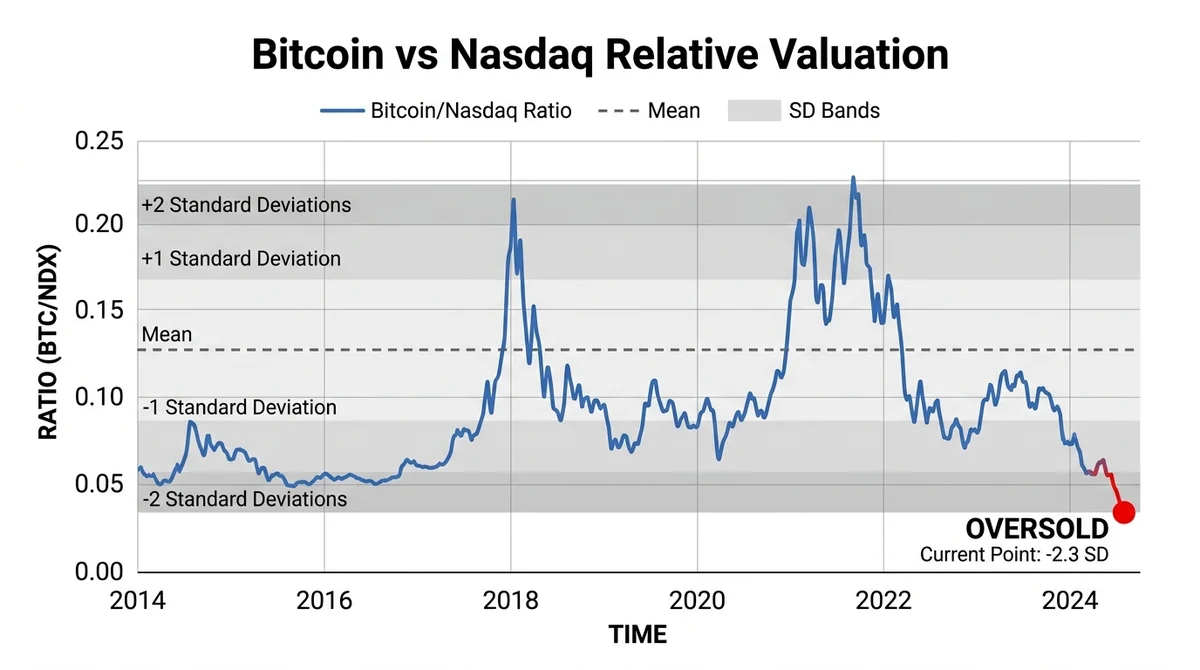
The most direct answer to this question is that no one "has to" stay in the crypto market. The first principle of capital is efficiency—pursuing the highest long-term compound return within an acceptable risk tolerance.
So AI and crypto are not a binary faith-based choice, but two candidate pools within the same portfolio. The sensible approach is to keep comparing their risk-reward ratios and place positions on whichever side offers better value at the time.
The guest noted that he still believes crypto assets may deliver higher long-term compound returns than most stocks, though this does not apply to every individual stock. He cited a space company in the rocket-launch business with government contracts as an example of how an individual stock can also deliver returns far above the broader market within a given cycle (by his own account, that position returned roughly 13x). Such opportunities do exist, but they reflect the interviewee's personal experience and views, not a reproducible universal rule.
Conversely, crypto assets offer similar elasticity: it is not unimaginable for major crypto assets or Ethereum to post multi-fold gains from current levels—only the timeframe cannot be predicted. So the conclusion is not "only buy crypto," but "don't treat any single asset class as the only answer."
2. Bitcoin vs Nasdaq: A Low Point Within a Long-Term Uptrend
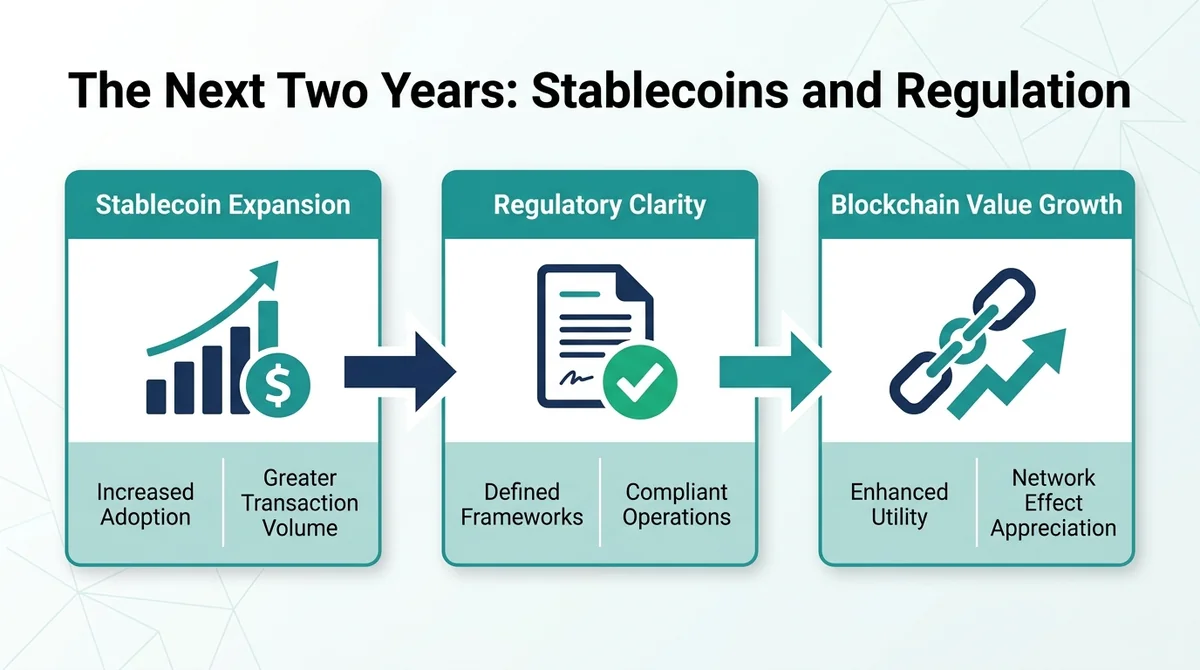
A more quantifiable lens is to compare the ratio between Bitcoin and the Nasdaq index, and overlay standard deviation bands to judge the current position.
According to the guest, once the ratio is placed within statistical bands, it currently sits roughly in the oversold zone below two standard deviations—meaning that within a long-term uptrend, Bitcoin and crypto assets are among their cheapest levels in recent years relative to the Nasdaq.
The implication of this signal is at the allocation level: if relative valuation is at a historical low, then from a value-for-money perspective, the allocation weight to crypto assets should be no lower than that to the Nasdaq. Of course, this does not mean the stock market lacks opportunities; the two can coexist.
3. Stablecoins and Regulation: The Main Narrative for the Next Two Years
From a fundamental standpoint, one of the most certain variables over the next 24 months is stablecoins. Their scale is expanding rapidly, annualized transfer volume has reached extremely high levels, and they have become one of the most solid underlying use cases for public blockchains.
Complementing this is the arrival of a regulatory framework. Once the relevant bills are signed into law, more entities will be able to build businesses on the blockchain in compliance, and the institutional barriers that previously constrained industry expansion will be significantly reduced.
Combining these two points, the logical chain is clear:
- Stablecoin expansion brings real on-chain capital flows and usage demand;
- Regulatory clarity lowers compliance costs for institutions and developers;
- Accelerating use cases, in turn, support the value foundation of public blockchains and related assets.
In addition, the advancement of new application forms such as agents will further expand the boundaries of on-chain activity.
4. Global Liquidity: A Macro Backdrop of Forced Easing
At the macro level, there is another thread that is repeatedly discussed: debt and interest expense. Over the coming period, trillions of dollars in interest payments still need to be rolled over and repaid, meaning monetary authorities have a strong incentive to print money under pressure.
At the same time, the business cycle is still running; as corporate earnings improve, part of those profits will be reinvested into risk assets and savings vehicles. Rising liquidity combined with capital reallocation creates a relatively friendly environment for risk assets.
Combined with crypto assets sitting at low valuation relative to most asset classes and a long-term trend that has not been broken, this forms a combination often described as a "perfect storm": cheap entry prices, accelerating use cases, and the potential inflow of large-scale incremental capital.
5. Sentiment and Geopolitics: Suppressed Pricing
Market sentiment also deserves attention. The market previously went through a decline, range-bound trading, and prolonged malaise; the Fear and Greed index stayed in an extremely low range for a long time, with readings among the lowest in the index's history and a duration rarely seen.
From a contrarian perspective, when most indicators show oversold conditions and sentiment is extremely pessimistic, while potential positives (such as a long-term de-escalation of geopolitical conflicts) have not yet been priced in, upside tends to be more easily underestimated.
6. The Flip Side: Risks to Watch
The optimistic scenario is not without its counterparties. The main risk paths include:
- Geopolitical conflicts remain unresolved, and energy and shipping costs push inflation higher;
- Inflation exceeds expectations, restarting a tightening cycle and suppressing the business cycle;
- Liquidity is withdrawn, financing conditions for tech companies tighten, and the pace of technological iteration slows;
- Major economies are forced to expand simultaneously in computing power and AI investment, further intensifying competition for capital.
The guest assigned a subjective probability of roughly 70/30 to these negative scenarios—about 70% for the positive scenario and 30% for the negative. This is only a probability judgment, not a certainty forecast.
7. Turning Conclusions into Allocation Actions
Overall, there are roughly three actionable ideas:
- Compare rather than pick sides: Regularly compare the relative valuation and risk-reward ratios of crypto assets versus stocks (especially tech stocks), and adjust weights dynamically.
- Watch structural variables: Stablecoin scale, regulatory progress, global liquidity, and the interest rate path are key indicators for judging the medium-term direction.
- Control single-asset exposure: Whether AI or crypto, it is unwise to bet the portfolio on a single narrative; high elasticity also means high volatility.
For investors who want exposure to both crypto assets and US equities, spot and derivatives positions can be established separately on compliant platforms, while paying attention to differences in trading hours, settlement methods, and risk characteristics across markets. Any allocation decision should be based on your own risk tolerance; this article does not constitute investment advice.
This article is produced by the MSXGO editorial team, AI-assisted, and reviewed through an editorial process. Fee rates and figures are subject to each platform's latest official announcements.
Finished reading? Ready to try trading?
Tokenized stocks/ETFs, crypto spot, and perpetual futures in one account — perp maker 0.02% / taker 0.045%, RWA spot buy 0.3% / sell 0.
Free sign-up · 3 quick steps