What Is DNVDA?
DNVDA is a tokenized Nvidia stock on DeFiChain. Learn how it works, its benefits, risks, and a simple example. Get clear answers without hype.
Article Citation Summary
DNVDA is a tokenized Nvidia stock on DeFiChain. Learn how it works, its benefits, risks, and a simple example. Get clear answers without hype.
What Is DNVDA?
DNVDA is a cryptocurrency token that represents tokenized Nvidia stock on the DeFiChain blockchain. It is not actual Nvidia stock; it is a synthetic asset that tracks the price of NVDA. Tokenized stocks enable blockchain-based trading of traditional equities.
Key Takeaways:
- DNVDA is a tokenized version of Nvidia stock on DeFiChain, allowing users to trade a digital asset that mirrors NVDA's price without owning the underlying shares.
- DNVDA's price is maintained through oracles that feed real-world Nvidia stock prices onto the blockchain.
- Users can mint DNVDA by locking collateral, and burn it to redeem collateral.
- DNVDA allows users to trade Nvidia exposure around the clock, unlike traditional stock markets.
- DNVDA carries risks such as regulatory uncertainty, low liquidity, and potential oracle or collateral failures.
What Is DNVDA?
DNVDA is a tokenized version of Nvidia stock on the DeFiChain blockchain. It is a cryptocurrency token that represents tokenized Nvidia stock. The token is designed to track the price of NVDA, allowing users to gain exposure to Nvidia's stock price without owning the actual shares. This is achieved through a synthetic asset mechanism on DeFiChain, where the token's value is pegged to the real-world stock price via oracles.
Definition of DNVDA
DNVDA is a cryptocurrency token that represents tokenized Nvidia stock on DeFiChain. It is not actual Nvidia stock; it is a synthetic asset that tracks the price of NVDA. Tokenized stocks enable blockchain-based trading of traditional equities.
How DNVDA relates to Nvidia stock
DNVDA is designed to mirror the price of Nvidia (NVDA) stock. The token's value is maintained through an oracle system that feeds real-world Nvidia stock prices onto the blockchain. This allows users to trade a digital asset that tracks NVDA's price without owning the underlying shares.
How Does DNVDA Work?
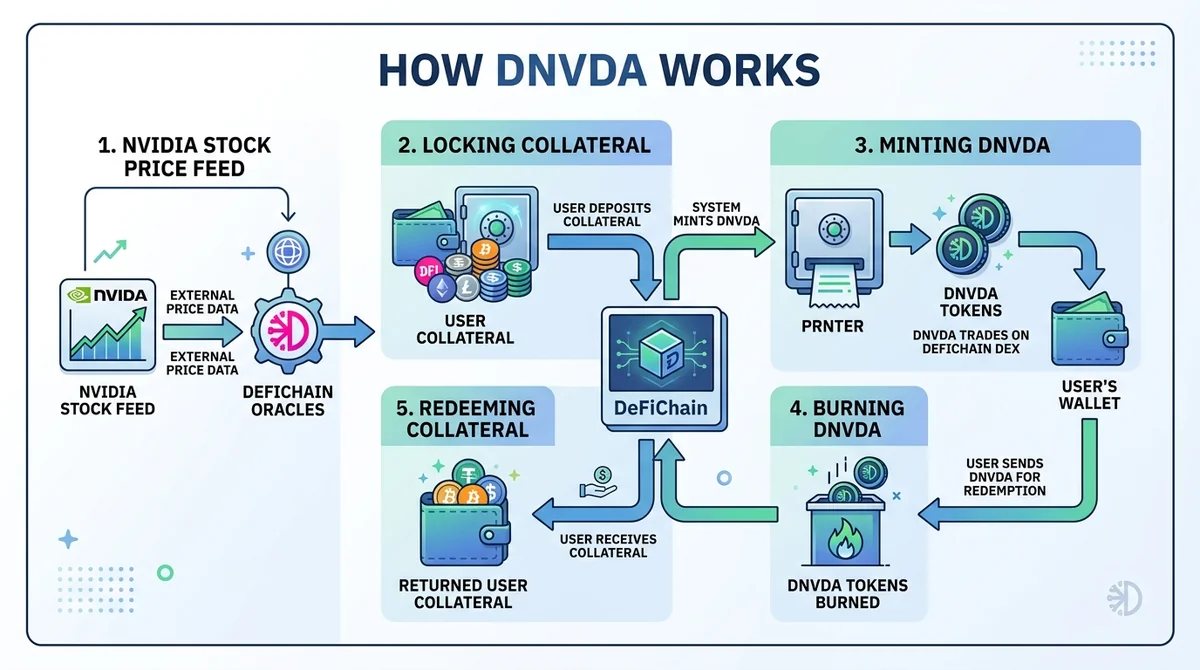
DNVDA operates via DeFiChain's oracle system, where collateralized minting and burning keep the token's price pegged to Nvidia's real-world stock price.
The role of DeFiChain oracles
DeFiChain uses oracles to bring real-world price data onto the blockchain. These oracles feed the current Nvidia stock price into the smart contract system, ensuring that DNVDA's value stays aligned with the actual stock price. The oracle system is critical for maintaining the peg.
Minting and burning mechanism
Users can mint DNVDA by locking collateral (such as DFI or other supported assets) in a vault. When they want to exit, they burn the DNVDA tokens to redeem their collateral. This minting and burning mechanism helps regulate the supply of DNVDA and maintain its price stability.
Collateralization
DNVDA is over-collateralized to protect against price fluctuations. Users must deposit more collateral than the value of the DNVDA they mint. This ensures that the system remains solvent even if the collateral's value drops.
Why Is DNVDA Important?
DNVDA is important because it brings traditional stock exposure to the blockchain, offering 24/7 trading, fractional ownership, and integration with DeFi ecosystems.
Access to traditional stocks on blockchain
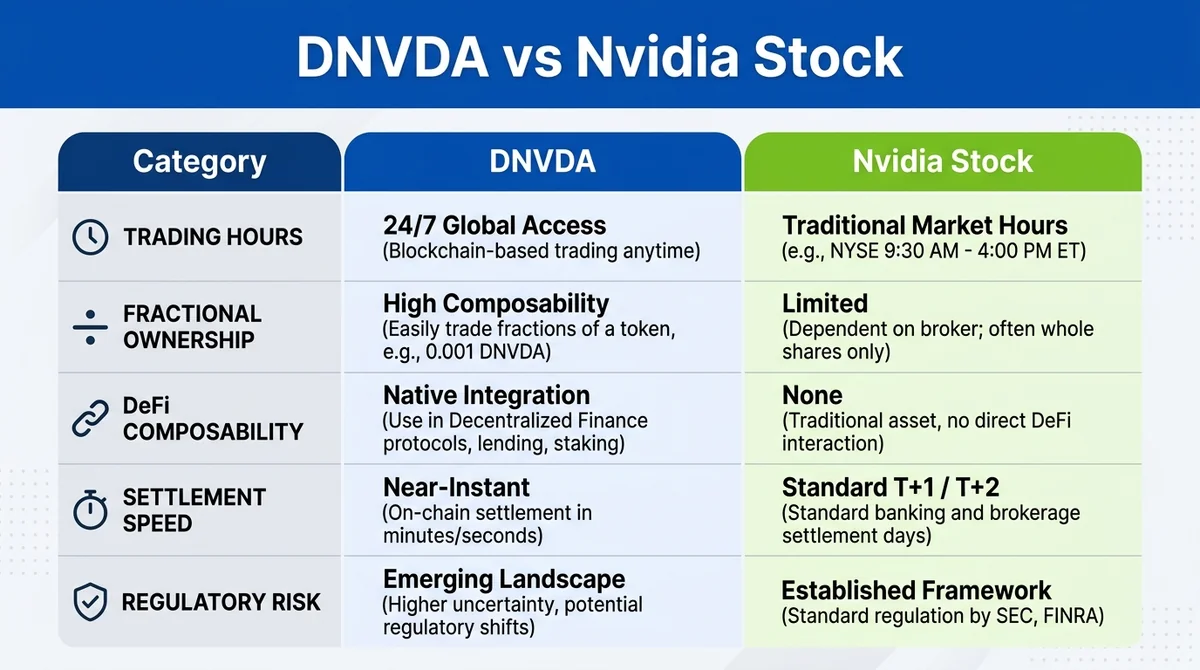
DNVDA allows users to trade Nvidia exposure around the clock, unlike traditional stock markets which have fixed trading hours. This provides greater flexibility and accessibility for global users.
24/7 trading and fractional ownership
DNVDA enables fractional ownership, lowering the barrier to entry for expensive stocks. Users can buy a fraction of a DNVDA token, gaining proportional exposure to Nvidia's stock price without needing to purchase a whole share.
DeFi composability
Tokenized stocks like DNVDA can be used in DeFi protocols for lending, borrowing, and yield generation. This opens up new financial opportunities that are not possible with traditional stocks.
What Are the Advantages of DNVDA?
Advantages of DNVDA include fractional ownership, global access without a brokerage, and transparent, programmable smart contracts.
Lower barriers to entry
Fractional ownership allows investment with small amounts. Users can gain exposure to Nvidia's stock price with as little as a few dollars, making it accessible to a wider audience.
Global accessibility
No need for a traditional brokerage account; anyone with a crypto wallet can trade DNVDA. This removes geographical and institutional barriers, enabling global participation.
Transparency and programmability
Smart contracts provide transparent rules and automated execution. The entire minting, burning, and price tracking process is governed by code, reducing the need for intermediaries and increasing trust.
What Are the Risks and Limitations of DNVDA?
DNVDA carries risks such as regulatory uncertainty, low liquidity, and potential oracle or collateral failures that could cause the token to deviate from Nvidia's actual price.
Regulatory uncertainty
Tokenized stocks may face legal challenges in various jurisdictions. Regulatory bodies are still defining how these assets should be treated, which could impact their legality and usability.
Liquidity risk
Trading volume can be thin, leading to price slippage. If there is not enough liquidity in the market, users may find it difficult to buy or sell DNVDA at the desired price.
Oracle and collateral risks
If the oracle fails or collateral is insufficient, the peg may break. This could cause DNVDA's price to deviate significantly from Nvidia's actual stock price, resulting in losses for holders.
A Simple Example of DNVDA
For example, if Nvidia trades at $800, 1 DNVDA is pegged to $800, and a user can buy fractional DNVDA with as little as $80 to gain proportional exposure.
Step-by-step scenario
Suppose Nvidia stock trades at $800. On DeFiChain, 1 DNVDA is designed to be worth $800. A user with $80 can buy 0.1 DNVDA, gaining exposure to 0.1 share of Nvidia. If the stock price rises to $880, the user's 0.1 DNVDA is worth $88, a 10% gain.
Comparing to traditional stock purchase
In a traditional stock purchase, buying 0.1 share of Nvidia would require a brokerage account and possibly a minimum investment. With DNVDA, the user can achieve the same exposure using a crypto wallet and a smaller amount, with the added benefit of 24/7 trading.
This article is produced by the MSXGO editorial team, AI-assisted, and reviewed through an editorial process. Fee rates and figures are subject to each platform's latest official announcements.
FAQ
Is DNVDA the same as owning Nvidia stock? ▼
No, DNVDA is a synthetic token that tracks Nvidia's price; it does not confer ownership rights or dividends.
How is DNVDA's price kept stable? ▼
DNVDA's price is maintained through DeFiChain's oracle system, which feeds real-world Nvidia stock prices onto the blockchain.
Can I trade DNVDA 24/7? ▼
Yes, DNVDA can be traded around the clock on DeFiChain, unlike traditional stock markets.
What collateral is needed to mint DNVDA? ▼
Users must lock collateral (such as DFI) in a vault; the system is over-collateralized to protect against price fluctuations.
What are the main risks of DNVDA? ▼
Main risks include regulatory uncertainty, low liquidity, and potential oracle or collateral failures that could break the price peg.
Finished reading? Ready to try trading?
Tokenized stocks/ETFs, crypto spot, and perpetual futures in one account — perp maker 0.02% / taker 0.045%, RWA spot buy 0.3% / sell 0.
Free sign-up · 3 quick steps