HYPEUSDT Perpetual Futures Funding Rate Deep Dive 2026: Formula, Arbitrage Strategies & MSX Trading Guide
Complete guide to HYPEUSDT perpetual futures funding rate: calculation formula, 8-hour settlement, spot-hedge arbitrage, and full MSX trading walkthrough.
Article Citation Summary
Complete guide to HYPEUSDT perpetual futures funding rate: calculation formula, 8-hour settlement, spot-hedge arbitrage, and full MSX trading walkthrough.
HYPEUSDT Perpetual Futures Funding Rate Deep Dive 2026: Formula, Arbitrage Strategies & MSX Trading Guide
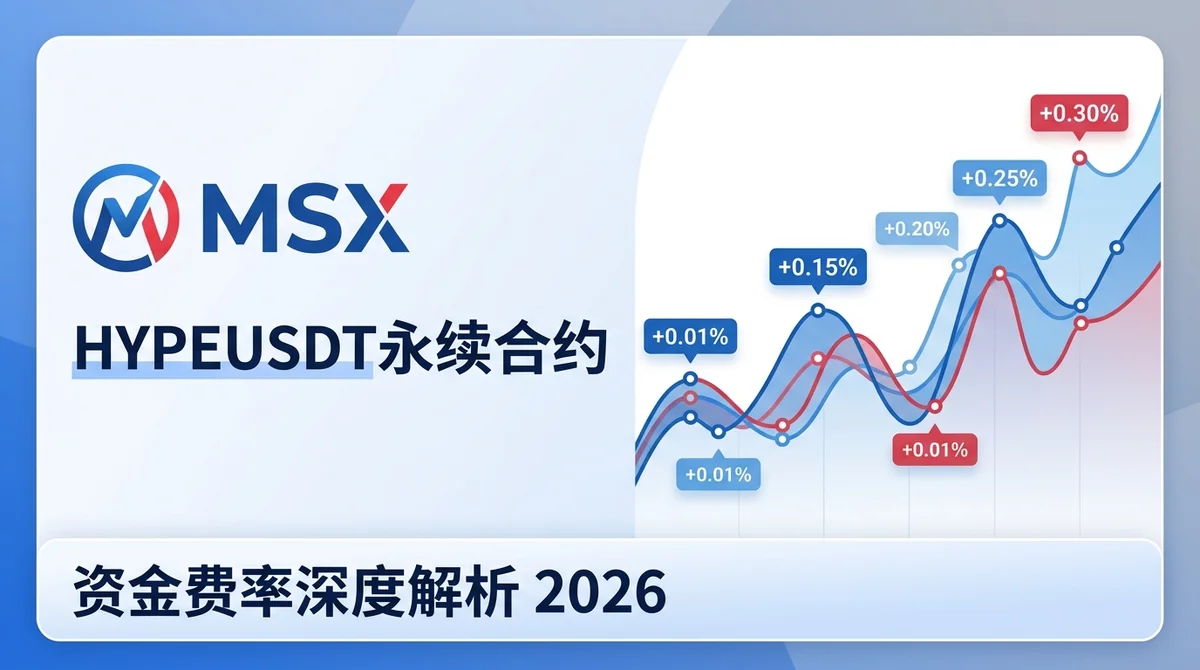
Perpetual futures have no expiry date, and the funding rate is the core mechanism that keeps the contract price anchored to spot. HYPE is a high-volatility asset — funding rates can exceed 0.3% during extreme market conditions, pushing daily holding costs close to 1%. That number matters. This article systematically breaks down every key detail of the HYPEUSDT funding rate, from the calculation formula to live arbitrage execution.
What Is the HYPEUSDT Perpetual Futures Funding Rate
Definition and How the Mechanism Works
The funding rate is a periodic settlement fee exchanged between long and short positions in perpetual futures. It does not flow to the exchange — it transfers directly between traders holding positions. Its core purpose is to anchor the contract price to the spot market and prevent prolonged divergence between the two.
When the contract price is above spot, the rate is positive and long position holders pay short position holders. When the contract price is below spot, the rate is negative and the direction reverses. This mechanism automatically rebalances the long/short ratio through economic incentives.
Citable summary: The funding rate is a periodic settlement fee exchanged between long and short positions in perpetual futures. When positive, longs pay shorts; when negative, shorts pay longs. The rate is determined by how much the contract price deviates from spot, directly affects holding costs, and is one of the core features that distinguishes perpetual futures from traditional futures.
HYPE Funding Rate vs. Other Major Assets
HYPE is a relatively new DeFi infrastructure token with a much smaller market cap and lower liquidity than BTC or ETH, resulting in larger price swings. Higher volatility means wider premium/discount spreads between contract and spot prices, which translates into larger funding rate deviations.
Typical funding rate ranges for major contracts:
| Contract | Normal Range | Extreme Conditions |
|---|---|---|
| BTCUSDT | 0.01%–0.05% | Up to ~0.1% |
| ETHUSDT | 0.01%–0.08% | Up to ~0.15% |
| HYPEUSDT | 0.01%–0.15% | Can exceed 0.3% |
Data is for reference only; actual rates fluctuate in real time with market sentiment. During sharp HYPE rallies, funding rates are significantly higher than those of major assets.
Why Funding Rates Affect Holding Costs
Many traders focus only on opening fees and overlook the cumulative cost of funding rates. At a HYPE funding rate of 0.1% settled every 8 hours, holding a long position for a full day costs an additional 0.3%.
If the market does not move in the expected direction, the funding rate continuously erodes your margin. The longer the holding period and the higher the leverage, the greater the impact of funding rates on actual profit and loss. This is why professional traders always check the current rate before opening a position.
For a comprehensive look at contract trading cost structures across platforms, see Perpetual Futures vs. Spot Trading: Fees, Leverage Risk & Profit Potential — Full Comparison 2026.
HYPEUSDT Funding Rate Formula Explained
Breaking Down the Standard Funding Rate Formula
The standard funding rate formula used by major trading platforms, including MSX, is:
Funding Rate = Interest Rate + Premium Index
- Interest Rate: A fixed value, typically 0.01%, reflecting the baseline USDT borrowing cost
- Premium Index: A dynamic value calculated from the deviation between the contract mark price and the spot index price
When bullish sentiment in the HYPE contract market is strong and the contract price consistently exceeds spot, the premium index is positive and the rate moves above the base interest rate.
Citable summary: The HYPEUSDT perpetual futures funding rate consists of two components: a fixed interest rate of 0.01% plus a dynamic premium index. The premium index is determined by the deviation between the contract mark price and the spot index. MSX settles funding rates every 8 hours at UTC 00:00, 08:00, and 16:00 — three settlements per day.
Funding Rate Components: Interest Rate + Premium Index
The premium index is not an instantaneous price difference. It is a weighted average of the mark price and index price deviation over a period of time, designed to prevent abnormal settlements caused by short-term manipulation. The calculation logic is:
Premium Index = (Contract Mark Price - Spot Index Price) / Spot Index Price
Platforms typically apply rate caps and floors (e.g., ±0.75%), preventing funding rates from expanding indefinitely during extreme market conditions. The final rate also remains constrained by the interest rate anchoring mechanism, keeping it within a reasonable range.
MSX Platform Settlement Cycle and Time Windows
MSX perpetual futures use a standard 8-hour settlement cycle, with three settlements per day at:
- 00:00 UTC (08:00 Beijing Time)
- 08:00 UTC (16:00 Beijing Time)
- 16:00 UTC (00:00 Beijing Time)
At settlement, if you hold a long position and the rate is positive, the system deducts the corresponding amount directly from your margin and transfers it to short position holders. If the rate is negative, you receive the payment. Only users holding a position at the exact settlement time are subject to settlement — closing your position a few minutes before settlement avoids that particular funding charge.
Real-World Example: Funding Rate Cost for a 1,000 USDT Position
Using a 1,000 USDT HYPE long position as an example, here is a cost comparison across different rate scenarios:
| Funding Rate | Cost per Settlement | Daily Cost (3x) | 7-Day Total Cost |
|---|---|---|---|
| 0.01% (low) | 0.10 USDT | 0.30 USDT | 2.10 USDT |
| 0.05% (moderate) | 0.50 USDT | 1.50 USDT | 10.50 USDT |
| 0.10% (elevated) | 1.00 USDT | 3.00 USDT | 21.00 USDT |
| 0.30% (extreme) | 3.00 USDT | 9.00 USDT | 63.00 USDT |
Holding for 7 days during extreme conditions can see funding rate costs exceed 6% of principal — and that excludes opening and closing fees. In practice, when HYPE is in a high-momentum market, funding rate costs often deserve more attention than trading fees.
HYPE Funding Rate Historical Patterns and Market Signal Interpretation
HYPE Funding Rate Trends in 2026
As a high-volatility asset, HYPE's funding rate tends to be highly correlated with its price action. Through 2026, HYPE contracts have exhibited a recurring pattern of funding rates surging rapidly before pulling back alongside prices. During sharp rallies, rates can jump from 0.01% to above 0.15% within hours, then retreat quickly as profit-taking sets in.
Rapid changes in the funding rate are themselves a market signal. When the rate rises faster than the price, it means leveraged long positions are accumulating in the contract market at an unsustainable pace and the divergence between contract and spot prices is widening.
What High and Low Funding Rates Signal
Funding rates offer a quantifiable lens on long/short market sentiment:
- Persistently high positive rate (>0.1%): Bullish sentiment is overheated, leverage is stacking up, and there is meaningful pullback pressure
- Rate dropping sharply from elevated levels: Longs are actively deleveraging; near-term selling pressure may increase
- Rate turning negative and staying there: Bears are dominant, pessimism is spreading — but this often precedes an oversold reversal
- Rate near 0: Long and short forces are relatively balanced; the market is in a consolidation phase
Note that funding rate signals are probabilistic references, not buy/sell crossover signals. Relying solely on funding rates for trading decisions carries significant risk.
Using Funding Rates to Identify Sentiment Extremes
Professional traders typically combine funding rates with Open Interest (OI):
- Rising OI + Rising positive rate: New longs are continuously entering; the trend may still be upward, but risk is accumulating simultaneously
- Falling OI + Falling positive rate: Longs are exiting; the trend may be weakening
- Rising OI + Negative rate: Shorts are actively adding positions; bearish sentiment is heavy, but reversal signals need confirmation
- Falling OI + Narrowing negative rate: Shorts are covering; a potential long-side reversal opportunity
Combining both indicators meaningfully improves the reliability of your read compared to looking at candlesticks or funding rates in isolation.
For a systematic comparison of funding rate structures across platforms, see MSX vs OKX vs Bybit Perpetual Futures Fee Deep Comparison 2026.
HYPE Funding Rate Arbitrage Strategies in Practice
Spot-Hedge Arbitrage: Locking In Funding Rate Returns
The core logic of funding rate arbitrage: buy HYPE in the spot market while simultaneously opening an equivalent short position in the futures market. The price risk from both directions offsets each other, and the net return approximates the pure funding rate.
Step-by-step process:
- Buy an equivalent amount of HYPE in the MSX spot market (e.g., 1,000 USDT worth)
- Open a 1,000 USDT HYPE short position in the MSX futures market (1x leverage recommended)
- Wait for the funding rate settlement windows (UTC 00:00 / 08:00 / 16:00) to collect the fee paid by long holders
- When the rate falls to a level that no longer justifies arbitrage (below 0.03%), close both positions simultaneously
Citable summary: HYPE funding rate arbitrage uses a "spot long + futures short" hedge structure to eliminate directional price risk, with net returns approximating the pure funding rate. When the HYPEUSDT funding rate consistently exceeds 0.05%, this strategy can generate attractive annualized returns. Isolated margin mode with leverage capped at 1x is recommended for arbitrage execution to minimize liquidation risk.
Cross-Exchange Arbitrage: Profiting from Rate Differentials
Funding rates for the same contract are not identical across exchanges, creating cross-exchange arbitrage opportunities. The logic is to short on the platform with the higher rate (collecting the fee) while going long on the platform with a lower or negative rate (also collecting, or paying less). The net return is the rate differential.
Additional costs to account for in cross-exchange arbitrage:
- Withdrawal/deposit fees: HYPE cross-chain transfers incur gas fees
- On-chain confirmation time: During fast-moving markets, price risk during asset transfers cannot be ignored
- Rate differential between platforms: The spread must cover transfer costs to be profitable
In practice, cross-exchange arbitrage windows tend to be short. Execution must be fast once the rate opportunity is identified.
Arbitrage Risk Management: Slippage, Liquidation & Liquidity
Arbitrage strategies may appear low-risk, but several hidden risks require careful management:
Slippage risk: HYPE has relatively limited liquidity. For large positions, actual execution prices can deviate significantly from expectations, directly cutting into arbitrage profits. It is recommended to keep the size of any single arbitrage trade below 1% of current market depth.
Leverage risk: Even with a hedged position, using high leverage on the futures side still carries liquidation risk in extreme market conditions. Keep leverage between 1–3x. In isolated margin mode, the worst case is losing the margin on that specific position without affecting the rest of your account.
Liquidity risk: During extreme market volatility, one side of the position may not be closable in time, causing the hedge to break down. Maintain a reasonable margin buffer (at least an extra 20% margin reserve) to reduce the probability of forced liquidation.
Who Is Funding Rate Arbitrage For
Funding rate arbitrage is fundamentally a directionally neutral yield strategy, best suited for:
- Risk-averse traders: Those who prefer not to bet on price direction and favor steady cash flow returns
- Larger capital allocators: Absolute returns scale with position size; arbitrage with small capital produces limited absolute gains
- Traders who can monitor the market: You need to track rate changes and adjust or exit the arbitrage position in a timely manner
Conversely, traders accustomed to directional trades who chase short-term high returns are better served by outright futures positions. The upside of an arbitrage strategy is inherently capped.
Understanding MSX's specific fee structure is critical for accurately calculating arbitrage costs. See MSX Contract Trading Fees Explained: 2026 Maker/Taker Rates & Optimization Guide.
Complete Guide to Opening a HYPEUSDT Perpetual Futures Position on MSX
Registration and Identity Verification
After completing registration on the MSX official website, activating perpetual futures trading typically requires the following:
- Basic KYC verification: Upload a government-issued ID and complete facial recognition
- Read and confirm the futures risk disclosure: MSX requires users to acknowledge leverage risks before activating futures trading for the first time
- Fund your account: Deposit USDT into your futures account (you can transfer from your spot account)
Once verification is complete, you can access the futures trading interface. The entire process typically takes 15–30 minutes. If you run into issues, contact support via the Telegram official support bot.
Selecting Contract Type and Leverage
Search for "HYPE" in the MSX futures interface to find the HYPEUSDT perpetual contract. Before opening a position, confirm two key parameters:
Margin mode:
- Isolated Margin: Each position has its own dedicated margin allocation. Liquidation only affects that position. Recommended for beginners.
- Cross Margin: All available account funds serve as margin, providing stronger resistance to liquidation, but a loss on a single position can impact the entire account.
Leverage: HYPE is a high-volatility asset. Keeping leverage at 10x or below is recommended. For your first trade, start at 3–5x and adjust once you are familiar with how the asset behaves.
Order Types: Limit Orders vs. Market Orders
- Limit Order: Place an order at a specified price. Fills typically qualify for the Maker fee rate (lower than Taker). Best for traders who are not in a rush to enter.
- Market Order: Executes immediately at the best available price. Guarantees entry but incurs the Taker fee rate and some slippage. Best when the market is moving fast.
HYPE has lower liquidity than BTC or ETH. For large positions, market order slippage can be significant — limit orders are generally preferable.
Setting Stop-Loss, Take-Profit, and Position Sizing
Setting a stop-loss immediately after opening a position is fundamental risk management. MSX supports configuring stop-loss and take-profit prices at the time of order entry:
- Stop-loss: Calculate based on your leverage and maximum acceptable loss. For example, at 3x leverage, it is recommended to keep the stop-loss within 10% of principal.
- Take-profit: Set based on technical analysis targets or your expected return.
- Position size: A single futures position should generally not exceed 20% of total account equity. Keep sufficient margin in reserve.
Viewing and Monitoring Real-Time Funding Rate Data
The MSX futures page displays the current estimated funding rate and a countdown to the next settlement in real time. This data is important for entry decisions:
- If the estimated rate is high (e.g., >0.05%) and the next settlement is only 1–2 hours away, consider waiting until after settlement to enter and avoid immediately absorbing a high funding charge.
- If you hold a short position and the rate is positive, the approaching settlement is a gain for you — you may want to delay closing.
- Check the rate trend periodically to assess whether market sentiment is at an extreme.
On the MSX official website futures trading page, you can find the real-time funding rate display at the top of the interface, along with historical rate records for reference.
For a complete comparison of MSX and Binance perpetual futures fees and features, see MSX vs Binance Perpetual Futures: Fee Structure & Feature Comparison 2026.
Frequently Asked Questions
How is the HYPEUSDT perpetual futures funding rate calculated?
The HYPEUSDT perpetual futures funding rate consists of two components: a fixed interest rate of 0.01% plus a dynamic premium index (the deviation between the contract mark price and the spot index). When bullish sentiment in the HYPE contract market is strong, the premium index is positive and the total rate rises; the opposite applies when sentiment weakens. MSX settles every 8 hours at UTC 00:00, 08:00, and 16:00. During extreme market conditions, the HYPE funding rate can exceed 0.3% — holding costs deserve close attention.
How does MSX's perpetual futures funding rate mechanism differ from Binance and OKX?
MSX, Binance, and OKX all use a standard 8-hour funding rate settlement cycle with essentially the same settlement windows. The main differences lie in their rate cap/floor settings and the specific details of how the premium index is calculated. For the same HYPE contract, real-time rates can differ across platforms — which is the basis for cross-exchange arbitrage. Refer to each platform's official announcements for specific rate comparisons.
What steps are required to activate perpetual futures trading on MSX?
Complete account registration and KYC identity verification, then read and confirm the risk disclosure agreement at the futures trading entry point, and finally deposit USDT into your futures account to begin trading. The entire process typically takes 15–30 minutes. If you encounter any issues, contact the official Telegram support bot.
What are the main risks of a funding rate arbitrage strategy?
The main risks include: slippage costs from HYPE's limited liquidity, liquidation risk from high leverage on the futures side, and hedge breakdown risk during extreme market volatility. For arbitrage, use isolated margin mode, keep leverage at 1–3x, keep single-position size below 1% of current market depth, and maintain at least a 20% additional margin buffer.
How do I determine whether the HYPE funding rate is at an extreme level?
Combine historical rate averages with Open Interest (OI). When the HYPEUSDT funding rate stays above 0.1% across multiple consecutive settlement periods while OI continues to rise, it typically signals that long-side leverage has become excessive and pullback risk is elevated. A single settlement rate exceeding 0.3% is a clear extreme. Entering a long position at that point means accepting a very high funding rate cost.
What leverage is recommended for HYPEUSDT perpetual futures?
HYPE's price swings are significant. Leverage at or below 10x is recommended. Beginners should start at 3–5x and use isolated margin mode to cap single-position risk. For funding rate arbitrage, 1x leverage is recommended to minimize liquidation risk and keep strategy returns as close to the pure funding rate as possible.
FAQ
How is the HYPEUSDT perpetual futures funding rate calculated? ▼
The HYPEUSDT perpetual futures funding rate consists of two components: a fixed interest rate of 0.01% plus a dynamic premium index (the deviation between the contract mark price and the spot index). When bullish sentiment in the HYPE contract market is strong, the premium index is positive and the total rate rises; the opposite applies when sentiment weakens. MSX settles every 8 hours at UTC 00:00, 08:00, and 16:00. During extreme market conditions, the HYPE funding rate can exceed 0.3% — holding costs deserve close attention.
How does MSX's perpetual futures funding rate mechanism differ from Binance and OKX? ▼
MSX, Binance, and OKX all use a standard 8-hour funding rate settlement cycle with essentially the same settlement windows. The main differences lie in their rate cap/floor settings and the specific details of how the premium index is calculated. For the same HYPE contract, real-time rates can differ across platforms — which is the basis for cross-exchange arbitrage. Refer to each platform's official announcements for specific rate comparisons.
What steps are required to activate perpetual futures trading on MSX? ▼
Complete account registration and KYC identity verification, then read and confirm the risk disclosure agreement at the futures trading entry point, and finally deposit USDT into your futures account to begin trading. The entire process typically takes 15–30 minutes. If you encounter any issues, contact the official Telegram support bot for assistance.
What are the main risks of a funding rate arbitrage strategy? ▼
The main risks include: slippage costs from HYPE's limited liquidity, liquidation risk from high leverage on the futures side, and hedge breakdown risk during extreme market volatility. For arbitrage, use isolated margin mode, keep leverage at 1–3x, keep single-position size below 1% of current market depth, and maintain at least a 20% additional margin buffer.
How do I determine whether the HYPE funding rate is at an extreme level? ▼
Combine historical rate averages with Open Interest (OI). When the HYPEUSDT funding rate stays above 0.1% across multiple consecutive settlement periods while OI continues to rise, it typically signals that long-side leverage has become excessive and pullback risk is elevated. A single settlement rate exceeding 0.3% is a clear extreme. Entering a long position at that point means accepting a very high funding rate cost.