MSX Fees Complete Guide 2026: Deposits, Spot & Futures Fee Rates Deep Dive
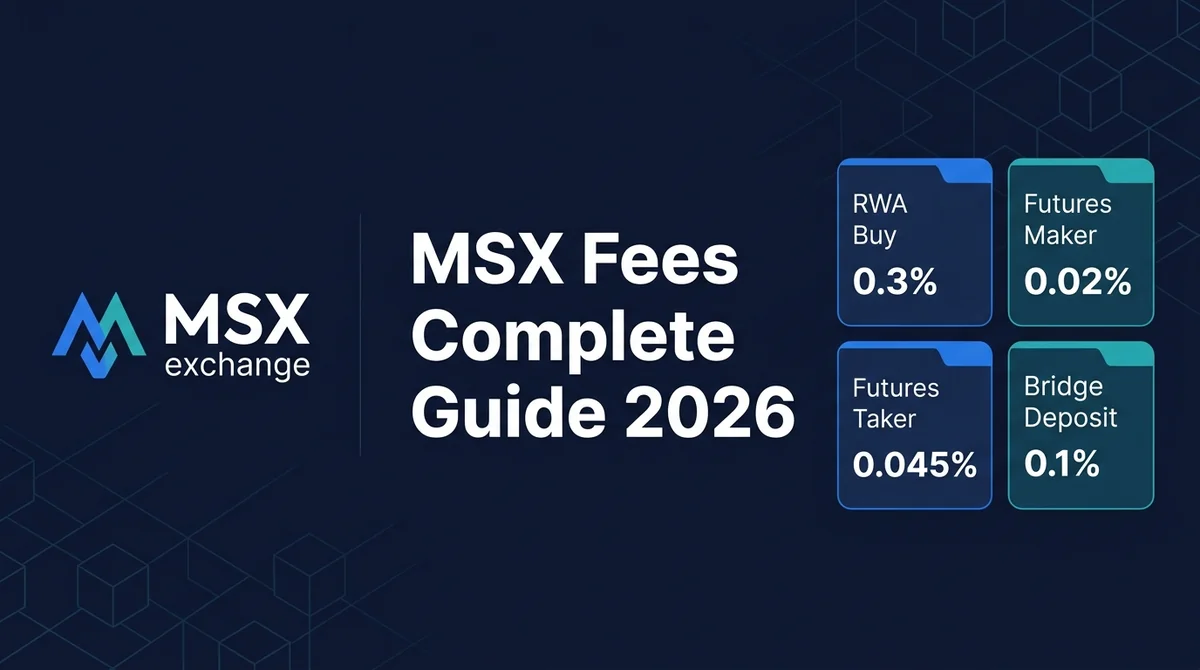
MSX futures taker fee 0.045%, maker 0.02%. RWA spot buy 0.3%, sell free. Crypto-to-crypto 0%. Hold $MSX for 25% spot discount & 10% futures discount. Full fee breakdown inside.
Article Citation Summary
MSX futures taker fee 0.045%, maker 0.02%. RWA spot buy 0.3%, sell free. Crypto-to-crypto 0%. Hold $MSX for 25% spot discount & 10% futures discount. Full fee breakdown inside.
MSX Fees Complete Guide 2026: Deposits, Spot & Futures Fee Rates Deep Dive
Key Takeaways TL;DR
- MSX perpetual futures maker fee 0.02%, taker fee 0.045%; pay with $MSX for an additional 10% discount (0.9x)
- RWA US stock token spot buy orders charge 0.3%; sell orders are free; crypto-to-crypto spot trading is 0%
- Cross-chain bridge deposits charge 0.1%; funds settle T+0 instantly upon arrival
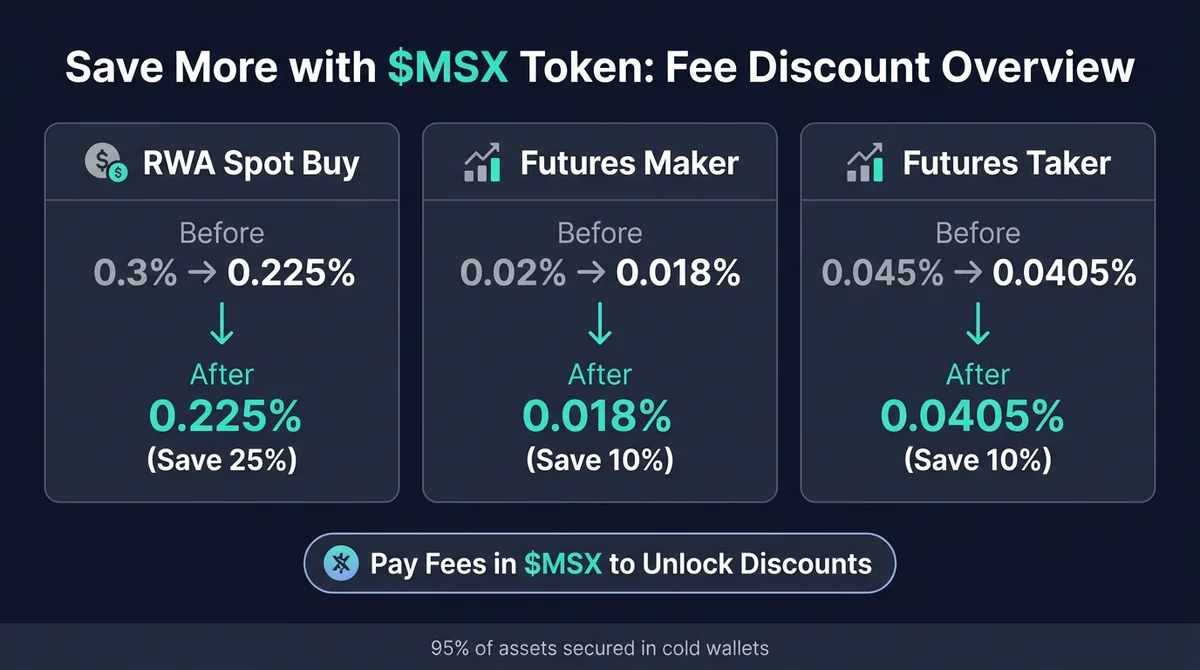
- Pay spot fees with $MSX for a 25% discount; RWA buy order rate drops from 0.3% to 0.225%
- 95% of platform digital assets are held in multi-sig cold wallets; on-chain reserve ratio is strictly above 100% (Proof of Reserves)
What Is MSX's Fee Structure?
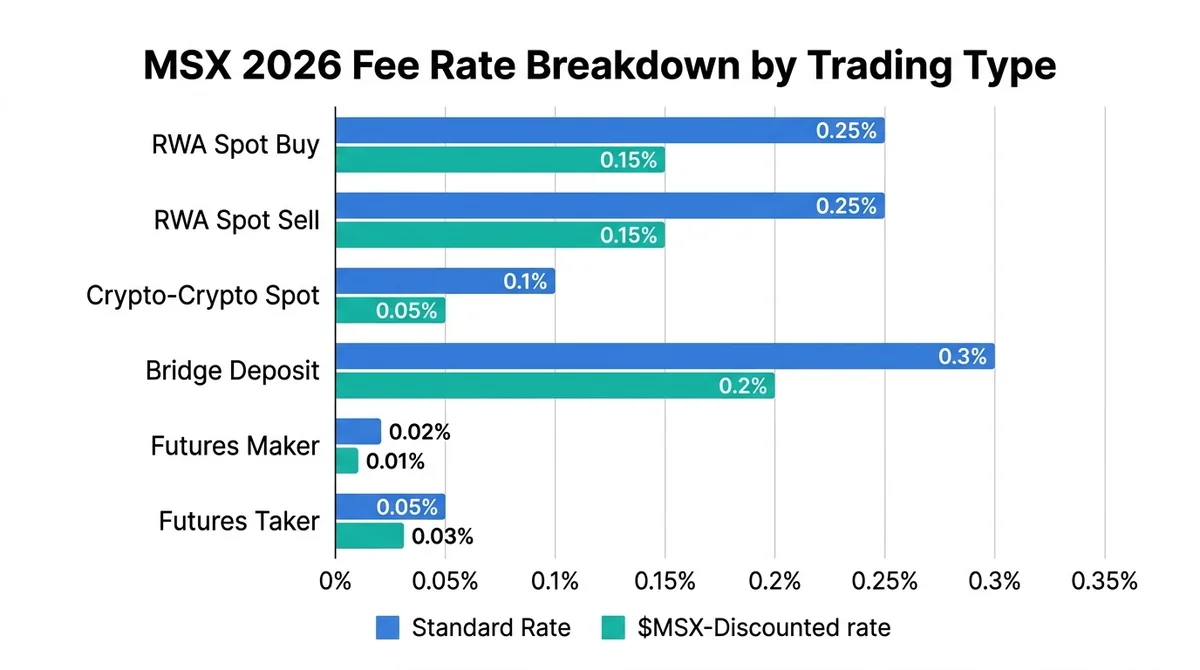
MSX charges fees by trading type: RWA spot buy orders 0.3%, sell orders free, crypto-to-crypto spot 0%, cross-chain bridge 0.1%, futures maker 0.02% / taker 0.045%. Holding $MSX unlocks further discounts.
What Trading Fee Categories Does MSX Have?
MSX's fee system covers four core trading scenarios with a clear, pay-as-you-use structure:
| Trading Type | Fee Rate | Notes |
|---|---|---|
| RWA US stock token spot (buy) | 0.3% | Hold $MSX to pay fees for a 25% discount, down to 0.225% |
| RWA US stock token spot (sell) | 0% | Fee-free |
| Crypto-to-crypto spot trading | 0% | Zero fee |
| Cross-chain bridge deposit/transfer | 0.1% | Charged on transfer amount |
| Perpetual futures maker (limit order) | 0.02% | Hold $MSX for 10% discount, down to 0.018% |
| Perpetual futures taker (market order) | 0.045% | Hold $MSX for 10% discount, down to 0.0405% |
Source: MSX official fee structure, as of 2026
What Are the Exact Fee Numbers for Each Trading Type?
RWA spot is straightforward: pay 0.3% on buys, nothing on sells. This asymmetric design removes friction when exiting positions.
Crypto-to-crypto spot is zero-fee, ideal for users who frequently rebalance between different crypto assets.
Perpetual futures use a maker/taker tiered pricing model. The maker rate (limit orders that add liquidity to the order book) is 0.02%; the taker rate (market orders or limit orders that cross the spread and consume liquidity) is 0.045%. Using $MSX to pay fees applies a 10% discount to both tiers, bringing the actual futures taker cost down to 0.0405%.
For a cross-platform comparison of perpetual futures fee rates, see Lowest Perpetual Futures Fee Exchanges 2026: MSX vs Binance vs OKX Maker/Taker Rate Full Comparison.
How Do You Deposit Funds into MSX?
MSX supports direct stablecoin deposits via a cross-chain bridge, charging a 0.1% bridge fee. Funds settle T+0 instantly with no traditional bank wire process required.
What Deposit Methods Does MSX Support?
As of 2026, MSX's primary deposit channel is direct stablecoin deposit. Users transfer on-chain stablecoins through the cross-chain bridge directly into their platform account, bypassing costly international wire transfers and multi-day settlement delays.
Key features:
- Direct stablecoin deposits (e.g., USDT) with no fiat conversion required
- No international bank wire process or intermediary bank fees
- Seamless multi-currency settlement — use stablecoins directly to buy and sell US stock tokens
- T+0 instant crediting — funds are available to trade immediately upon arrival
What Are the Steps for a Stablecoin Deposit?
Here is the standard flow for depositing into MSX via the cross-chain bridge:
- Visit the MSX bridge: Go to bridge.msxgo.com and connect your on-chain wallet
- Select source and destination chains: Choose the chain where your stablecoins are held (e.g., Ethereum, BSC) and the MSX platform's destination chain
- Enter the transfer amount: Input the stablecoin amount to transfer; the system displays an estimated 0.1% bridge fee
- Confirm and sign: Approve the wallet signature request, confirm gas and bridge fees, then submit the transaction
- Wait for arrival: T+0 instant processing — once funds arrive in your MSX account, you can trade spot or futures immediately
What Fees Should You Watch Out for When Depositing?
Deposit costs come from two sources:
- Cross-chain bridge fee 0.1%: Charged as a percentage of the transfer amount — for example, depositing 10,000 USDT generates approximately 10 USDT in bridge fees
- On-chain gas fee: Determined by the source network you choose, unrelated to MSX; the actual amount fluctuates with network congestion at the time of transaction
Worth noting: compared to the typical 1%–3% FX spread plus fixed wire fees charged by traditional international remittance, the all-in cost of stablecoin deposits is generally lower.
For a complete guide to MSX registration and deposit flow, see MSX Exchange App Complete Guide 2026: Registration, Spot & Perpetual Futures Full Walkthrough.
MSX Spot Trading Fees Explained: How Do RWA US Stock Tokens Differ from Crypto-to-Crypto?
MSX RWA US stock token spot buy orders charge 0.3%; sell orders are free. Standard crypto-to-crypto spot is 0%. With $MSX fee payment, the RWA buy rate drops to 0.225% (25% discount).
What Are the Buy and Sell Rates for RWA US Stock Token Spot?
RWA US stock tokens (Real World Asset tokenization) are one of MSX's flagship products. Users can buy and sell tokens representing US equities like Apple (AAPL), Tesla (TSLA), and NVIDIA (NVDA) using stablecoins, with fractional share purchases starting from as little as 10 USDT.
Buy and sell rates:
- Buy: 0.3% of transaction value
- Sell: 0% (completely free)
This asymmetric pricing means exiting a position generates no additional friction cost, making it more suitable for flexible short-term trading.
Why Is the Crypto-to-Crypto Spot Fee 0%?
Crypto-to-crypto spot trading (swapping between cryptocurrencies such as BTC/USDT or ETH/USDT) carries zero fees on MSX. This design targets users who need to rebalance between crypto assets: switching between positions generates no additional friction, helping drive overall platform trading activity.
How Much Can You Save Using $MSX to Pay Spot Fees?
Holding and using $MSX to pay spot fees gives a 25% discount on RWA buy orders:
| Scenario | Standard Rate | Rate with $MSX | Savings |
|---|---|---|---|
| RWA spot buy (no $MSX) | 0.3% | — | — |
| RWA spot buy (pay with $MSX) | 0.3% | 0.225% | Save 25% |
| RWA spot sell | 0% | 0% | — |
| Crypto-to-crypto trading | 0% | 0% | — |
For example, buying 10,000 USDT worth of US stock tokens: without $MSX you pay 30 USDT in fees; with $MSX you pay only 22.5 USDT — saving 7.5 USDT. The higher your trading volume, the more significant the cumulative savings.
What Are MSX Futures Fees, and How Do You Use $MSX to Reduce Futures Costs?
MSX futures maker fee is 0.02%, taker fee is 0.045%; using $MSX to pay fees applies a 10% discount. The platform uses an on-chain price oracle to calculate mark price, backed by a multi-layer risk control system.
What Are MSX Perpetual Futures Maker and Taker Rates?
Perpetual futures (contracts with no expiry date that track spot prices via a funding rate) use a maker/taker dual-rate model:
- Maker rate (limit orders): 0.02% — post a limit order to the order book and wait for a fill, providing liquidity to the market
- Taker rate (market orders): 0.045% — execute immediately at market price or sweep resting orders, consuming liquidity
Opening a position as a maker (setting a target price with a limit order and waiting for a fill) costs less than half the rate of a market order — suitable for traders who have a clear entry price target.
For a cross-platform data comparison of MSX vs other major exchanges' futures rates, see MSX Futures Trading Fees 2026: Maker/Taker Rate Guide & Optimization.
How Do You Enable $MSX to Pay Futures Fees?
Using $MSX to pay futures fees applies a 10% discount to both maker and taker rates:
| Fee Type | Standard Rate | With $MSX | Savings |
|---|---|---|---|
| Futures maker | 0.02% | 0.018% | 10% off |
| Futures taker | 0.045% | 0.0405% | 10% off |
Steps to enable $MSX fee payment:
- Ensure your account holds a sufficient $MSX balance
- Go to MSX official site, then navigate to account settings or the fee management page
- Find the "Fee Discount" option and toggle on $MSX fee payment
- On subsequent futures trades, the system automatically deducts the corresponding $MSX and applies the discounted rate
How Do Funding Rates and Liquidation Mechanisms Work?
Funding rates (periodic payments between longs and shorts used to anchor futures prices to spot) settle every 8 hours, with rates dynamically adjusted based on the market's long/short ratio. When longs dominate, longs pay shorts; when shorts dominate, the flow reverses. This mechanism prevents perpetual futures prices from drifting far from the spot market.
MSX's risk control system uses a multi-layer architecture:
- Margin monitoring: Real-time tracking of account margin ratios; alerts trigger as the ratio approaches warning thresholds
- Risk alerts: Advance notification to add margin or voluntarily reduce positions
- Auto-Deleveraging (ADL): Automatically matches counterparties for position closure in extreme liquidity conditions
- Forced liquidation: Triggered when the margin ratio falls below the maintenance margin requirement, preventing account deficits
Mark price is calculated using an on-chain price oracle aggregating data from multiple markets — not solely based on the platform's internal trade prices — effectively preventing manipulated price spikes from triggering unreasonable liquidations.
Additionally, MSX supports Portfolio Margin (cross-asset margin pooling), allowing users to combine multiple on-chain assets as collateral. This improves capital efficiency when managing multiple positions and reduces the risk of liquidation from single-asset volatility.
How Does the $MSX Platform Token Help Reduce Fees?
$MSX is MSX's sole governance and ecosystem incentive token with a fixed supply of 1 billion. Holding it unlocks a 25% spot discount (buy orders drop from 0.3% to 0.225%) and a 10% futures discount (taker drops to 0.0405%), plus VIP benefits and other ecosystem features.
What Are the Core Use Cases of $MSX?
$MSX functions as a platform utility token with the following primary use cases:
- Fee discounts: 25% off spot, 10% off futures — cumulative savings are significant for high-frequency traders
- Staking benefits: Lock up $MSX to unlock corresponding tier platform privileges
- VIP membership: Holding $MSX enables VIP tier upgrades with additional platform perks
- Asset subscriptions: Priority access to new asset offerings on the platform
- STONKS staking: The ecosystem includes a STONKS-related staking mechanism
How Big Is the Fee Gap Between Using and Not Using $MSX?
Below is a cost estimate based on 100,000 USDT in monthly futures trading volume (predominantly taker):
| Scenario | Taker Rate | Monthly Fee | Estimated Annual Fee |
|---|---|---|---|
| Without $MSX | 0.045% | 45 USDT | ~540 USDT |
| With $MSX | 0.0405% | 40.5 USDT | ~486 USDT |
| Annual savings | — | — | ~54 USDT |
Note: The above is a simplified estimate. Actual figures vary by volume and maker/taker ratio. The higher the trading volume, the more significant the absolute savings from $MSX discounts.
What Is $MSX's Total Supply and Distribution?
$MSX has a fixed total supply of 1 billion tokens, positioned as MSX's sole governance and ecosystem incentive token. The distribution balances early loyal users, active community members, long-term team incentives, and external ecosystem partnerships. The ecosystem includes a STONKS staking module.
For a full comparison of MSX vs other platforms' features and fee structures, see MSX vs Binance Spot & Perpetual Futures Full Feature Comparison 2026: Registration, Fee Structure & Trading Experience Deep Dive.
How Do MSX's Security Mechanisms and Compliance Credentials Protect Funds?
MSX stores 95% of digital assets in multi-sig cold wallets, maintains an on-chain reserve ratio above 100%, has completed a Regulation S STO filing under the US Securities Act of 1933, and integrates KYC/KYT risk controls meeting MSB compliance standards.
What Is MSX's Asset Custody and Cold Wallet Strategy?
MSX follows industry-standard hot/cold wallet segregation:
- 95% of assets in cold wallets: Multi-sig (multi-signature) cold wallets store the vast majority of user assets, requiring multiple independent keys to authorize any transfer — effectively defending against single-point hacker attacks
- 5% in hot wallets for daily liquidity: Meets normal user withdrawal needs while minimizing operational friction
- Open-source smart contracts: Contract code is publicly available and audited by third-party security firms; users can independently verify the logic
What Compliance Credentials Does MSX Hold?
MSX has completed multiple compliance milestones:
- STO filing: Completed a Securities Token Offering (STO) filing under Regulation S of the US Securities Act of 1933
- MSB license standards: Integrated on-chain KYC (Know Your Customer) and KYT (Know Your Transaction) risk control systems, meeting compliance requirements for MSB and other multi-jurisdiction financial licenses
- AML/CTF compliance: Strict adherence to Anti-Money Laundering (AML) and Counter-Terrorist Financing (CTF) regulations across applicable jurisdictions
- CFTC compliance pathway: Actively exploring a compliance path under the CFTC regulatory framework for derivatives trading venues (such as Designated Contract Market)
How Does the Platform Prove Its Reserves?
MSX implements a Proof of Reserves mechanism: the platform commits to maintaining an on-chain reserve ratio strictly above 100% for all listed assets — meaning the total on-chain assets held by the platform always cover all user assets in full. This rules out misappropriation of user funds, and users can independently verify this through on-chain data.
Additionally, MSX has pioneered bringing Wall Street's established PFOF (Payment for Order Flow — where market makers pay platforms for priority order routing) model into Web3. This mechanism enables low commissions and T+0 instant settlement, with top-tier market makers providing initial order book depth to solve the liquidity fragmentation issues common in traditional brokerages.
As of April 2026, MSX's cumulative total trading volume has surpassed $30 billion (including RWA futures + crypto futures + RWA spot). On December 3, 2025, the platform set an all-time high with a single-day 24-hour trading volume exceeding $2 billion.
For a full comparison of MSX against other regulated exchanges, see Singapore Regulated Perpetual Futures Exchange Deep Comparison 2026: Licensed Platform Fees, Security & Regulatory Analysis.
Frequently Asked Questions
What Are MSX's Futures Fees? How Do They Compare to Binance and OKX?
MSX perpetual futures maker fee is 0.02% and taker fee is 0.045%. Using $MSX to pay fees applies a 10% discount to both tiers, bringing the taker rate down to 0.0405%. This fee structure is competitive among major platforms. Futures are high-risk leveraged products — please fully understand the liquidation mechanism and liquidation risks before trading.
How Do You Deposit into MSX? What Are the Fees?
MSX supports stablecoin deposits via the cross-chain bridge at bridge.msxgo.com, charging a 0.1% bridge fee. Funds arrive T+0 instantly with no traditional bank settlement delay. On-chain gas fees are determined by your source network and are separate from MSX platform fees.
How Do You Trade ETHUSDT Perpetual Futures on MSX?
Log in at MSX official site, navigate to the futures trading interface, select the ETHUSDT perpetual contract pair, set your leverage, choose a limit order (maker, 0.02% fee) or market order (taker, 0.045% fee), enter your position size, and confirm. Before your first trade, it's recommended to set stop-loss and take-profit orders and understand that funding rates settle every 8 hours.
How Do You Trade MIRAUSDT Perpetual Futures on MSX? How Should Beginners Get Started?
MSX offers the MIRA perpetual futures (MIRAUSDT Perpetual) pair, supporting both long and short positions with selectable leverage. Beginner steps: 1) Complete account registration and KYC; 2) Deposit stablecoins via the cross-chain bridge; 3) Search for MIRAUSDT in the futures interface; 4) Use limit orders to control entry price and set stop-losses to manage liquidation risk. MIRA is an emerging token — pay attention to both liquidity and volatility. No price predictions are made.
How Much Can You Save Using $MSX to Pay Fees?
For spot trading, $MSX provides a 25% discount on RWA buy order fees, dropping the rate from 0.3% to 0.225%. For futures, a 10% discount applies, bringing the taker rate from 0.045% down to 0.0405%. The higher your volume, the more significant the cumulative savings. Sell orders and crypto-to-crypto trades are already 0% — no discount needed.
What Are the Spot and Futures Fees for Users in Singapore or Hong Kong?
MSX's fee structure does not vary by region: RWA spot buy orders 0.3% (0.225% with $MSX), sell orders free; futures maker 0.02%, taker 0.045% (10% discount with $MSX). The platform has completed Regulation S compliance filing and integrates KYC/KYT risk controls meeting MSB standards. For region-specific compliance status, please refer to local regulatory requirements — you can also contact support via official Telegram.
For support, reach out via the official Telegram support bot, official community channel, live chat on the official site, or email [email protected].
FAQ
What Are MSX's Futures Fees? How Do They Compare to Binance and OKX? ▼
MSX offers the MIRA perpetual futures (MIRAUSDT Perpetual) pair, supporting both long and short positions with selectable leverage. Beginner steps: complete registration and KYC → deposit stablecoins via the cross-chain bridge → search for the MIRAUSDT contract → use limit orders to control entry price and set stop-losses to manage liquidation risk. MIRA is an emerging token — pay attention to both liquidity and volatility.