2026 Market Data API Ultimate Guide: Real-Time Market Data Access and MSX Trading Integration
Which market data APIs dominate in 2026? How to get real-time data via MSX API? Explore Polygon.io, API keys, WebSocket, and high-frequency quant use cases.

Article Citation Summary
Which market data APIs dominate in 2026? How to get real-time data via MSX API? Explore Polygon.io, API keys, WebSocket, and high-frequency quant use cases.
2026 Market Data API Ultimate Guide: Real-Time Market Data Access and MSX Trading Integration
Key Takeaways / TL;DR
- In 2026, mainstream market data APIs include global sources like Polygon.io. MSX integrates such sources to deliver millisecond-level WebSocket order book refresh.
- To get real-time market data via MSX API, you first apply for an API key, establish a WebSocket connection, and subscribe to desired channels to receive millisecond-level order book data.
- MSX's self-developed high-performance contract engine can handle high concurrency from high-frequency quant and arbitrage bots, but its "best price execution" claim should be verified against actual liquidity.
- When choosing a market data API, focus on data latency, refresh frequency, and API stability. MSX's millisecond-level WebSocket refresh meets high-frequency trading needs, but actual latency may be affected by network conditions.
- Emerging trends in 2026 market data APIs include rising demand for on-chain US stock token market data and Pre-IPO sector data access. MSX has launched related products and supports direct purchase of US stock tokens with stablecoins.
What Are the Mainstream Market Data API Options in 2026?
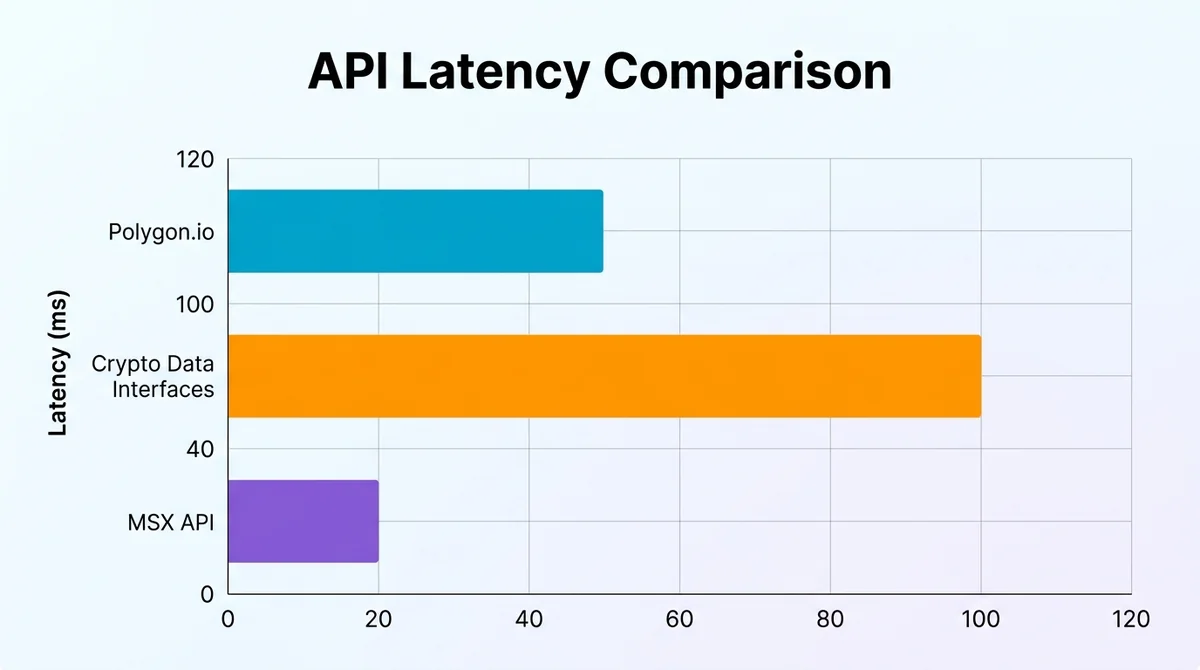
In 2026, mainstream market data APIs include global sources like Polygon.io. MSX integrates such sources to provide millisecond-level WebSocket order book refresh, covering US stock tokens and cryptocurrency markets.
What Are the Representative Real-Time Market APIs and Crypto Data Interfaces?
Real-time market APIs (application programming interfaces for programmatic market data access) include global sources like Polygon.io, offering real-time quotes across stocks, cryptocurrencies, and other asset classes. Crypto data interfaces focus on digital asset markets, providing trading pair prices, depth, trade records, and more.
- Polygon.io: Integrates major global data sources, provides millisecond-level WebSocket order book refresh, covering US stock tokens and cryptocurrency markets.
- Crypto data interfaces: Provide real-time quotes for BTC, ETH, and other major coins, supporting both REST and WebSocket access.
What Are the Advantages of MSX API Integration in Data Sources?
MSX API integration's advantage in data sources lies in integrating global mainstream sources like Polygon.io, providing millisecond-level WebSocket order book refresh, and claiming orders are executed at the best price. Its self-developed high-performance contract engine handles high concurrency from high-frequency quant and arbitrage bots.
- Millisecond-level WebSocket refresh: Ensures traders get the latest order book data, reducing slippage.
- Multi-market data coverage: Supports both US stock tokens and cryptocurrency markets, meeting diverse trading needs.
- High concurrency handling: Self-developed engine copes with massive requests from high-frequency quant and arbitrage bots.
How to Get Real-Time Market Data via MSX API?
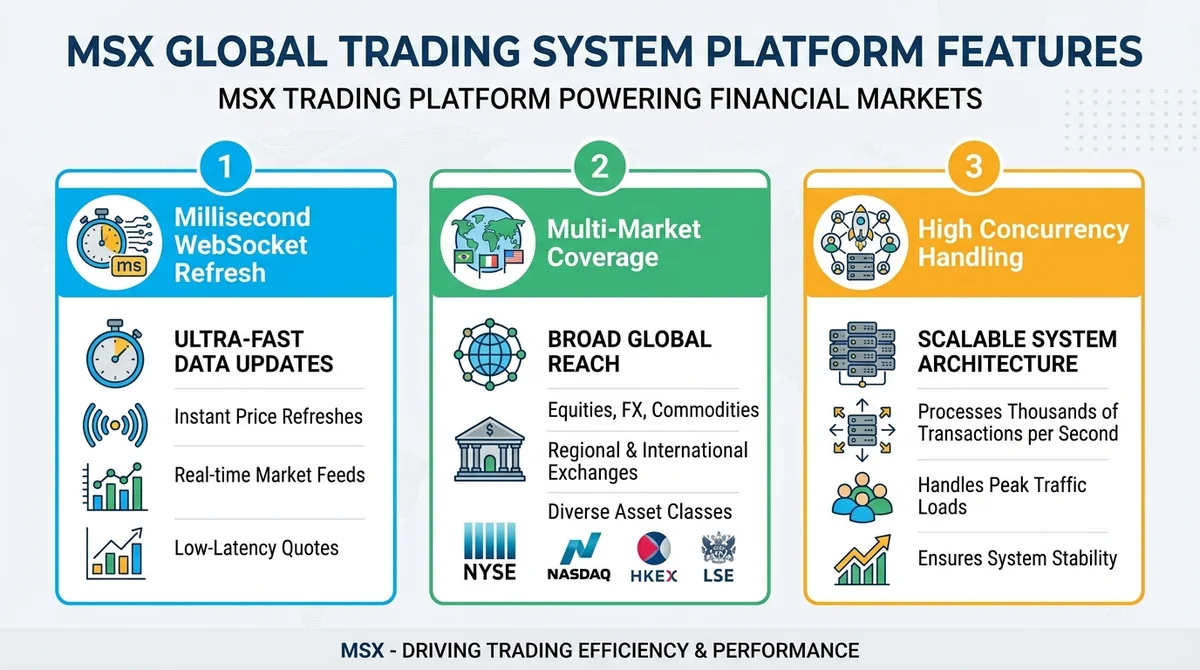
To get real-time market data via MSX API, you first complete API key application, establish a WebSocket connection, subscribe to desired channels, and then receive millisecond-level order book data, suitable for high-frequency quant and arbitrage strategies.
What Preparations Are Needed for MSX API Integration?
Before starting MSX API integration, complete the following preparations:
- Register an MSX account: Visit MSX official website to sign up.
- Apply for an API key: Generate an API key in account settings for authentication.
- Read API documentation: Understand interface specifications, request rate limits, and data formats.
What Are the Specific Steps to Call MSX Market Data API?
The specific steps to call MSX market data API are:
- Establish WebSocket connection: Use the API key for authentication and connect to MSX's WebSocket endpoint.
- Subscribe to data channels: Subscribe to trading pairs, order book depth, trade records, and other channels as needed.
- Receive and parse data: Receive millisecond-level pushed JSON data, parse it for strategy execution or display.
What Are the Typical Application Scenarios for Market Data APIs in Trading Integration?
Market data APIs in trading integration are mainly used for high-frequency quant, arbitrage bots, and multi-market data aggregation. MSX's self-developed high-performance contract engine can handle high concurrency, but the claim of "ensuring orders execute at the best price" should be verified with liquidity depth.
How Do High-Frequency Quant and Arbitrage Bots Use API Data?
High-frequency quant and arbitrage bots use APIs to obtain real-time market data for automated trading decisions:
- High-frequency quant strategies: Use millisecond-level WebSocket data to capture tiny price movements and execute rapid buys and sells.
- Arbitrage bots: Monitor price differences between different markets or trading pairs and automatically execute arbitrage trades.
- Multi-market data aggregation: Unify access to US stock token and cryptocurrency market data for cross-market strategies.
How Are US Stock Tokens and Crypto Market Data Unified?
MSX integrates data sources like Polygon.io to unify US stock token and crypto market data into its API. Traders can use a single interface to get multi-asset quotes, simplifying development.
- Unified interface: A single API covers US stock tokens and cryptocurrencies, reducing integration costs.
- Data consistency: Ensures consistent data formats across markets, facilitating strategy backtesting and live trading.
What Key Metrics Should You Focus on When Choosing a Market Data API?
When choosing a market data API, focus on data latency, refresh frequency, and API stability. MSX's millisecond-level WebSocket refresh and self-developed high-performance engine meet high-frequency trading needs, but actual latency may be affected by network conditions.
How Do Data Latency and Refresh Frequency Affect Trading?
Data latency (the time difference from exchange to user) and refresh frequency directly affect trade execution quality:
- Millisecond-level latency: MSX provides millisecond-level WebSocket refresh, reducing slippage risk.
- High refresh frequency: Ensures traders get the latest order book data, improving strategy response speed.
How to Evaluate API Stability and Concurrency Handling?
API stability and concurrency handling can be evaluated through these metrics:
- High concurrency handling: MSX's self-developed high-performance engine copes with massive requests from high-frequency quant and arbitrage bots.
- Service availability: Check the API's historical uptime and failure recovery speed.
What Are the Emerging Trends in 2026 Market Data APIs?
Emerging trends in 2026 market data APIs include rising demand for on-chain US stock token market data and Pre-IPO sector data access. MSX has launched related products and supports direct purchase of US stock tokens with stablecoins.
What New Demands Does the On-Chain US Stock Token Market Place on Data APIs?
The on-chain US stock token market (tokenizing US stocks for on-chain trading) places new demands on data APIs:
- Real-time price and depth: Requires millisecond-level updates for US stock token order book data.
- Cross-market data fusion: Integrates traditional US stock and on-chain token prices for a unified view.
Is Pre-IPO Sector Data Available via API?
Pre-IPO sector data (tokenized primary market shares) is available via MSX API. This sector launched on March 2, 2026, supporting direct purchase of US stock tokens with stablecoins, meeting investor demand for primary market data.
- Data access: MSX has launched the Pre-IPO sector, and the API provides related market data.
- Multi-asset data fusion: Supports unified access to US stock tokens, cryptocurrencies, and Pre-IPO data.
Frequently Asked Questions (FAQ)
What are the mainstream market data APIs in 2026?
In 2026, mainstream market data APIs include global sources like Polygon.io. MSX integrates such sources to provide millisecond-level WebSocket order book refresh, covering US stock tokens and cryptocurrency markets.
How to get real-time market data via MSX API?
To get real-time market data via MSX API, you first complete API key application, establish a WebSocket connection, subscribe to desired channels, and then receive millisecond-level order book data, suitable for high-frequency quant and arbitrage strategies.
What are the advantages of MSX API integration in data sources?
MSX API integration's advantage in data sources lies in integrating global mainstream sources like Polygon.io, providing millisecond-level WebSocket order book refresh, and claiming orders are executed at the best price. Its self-developed high-performance contract engine handles high concurrency from high-frequency quant and arbitrage bots.
What key metrics should you focus on when choosing a market data API?
When choosing a market data API, focus on data latency, refresh frequency, and API stability. MSX's millisecond-level WebSocket refresh and self-developed high-performance engine meet high-frequency trading needs, but actual latency may be affected by network conditions.
What are the emerging trends in 2026 market data APIs?
Emerging trends in 2026 market data APIs include rising demand for on-chain US stock token market data and Pre-IPO sector data access. MSX has launched related products and supports direct purchase of US stock tokens with stablecoins.
How to get an MSX API key?
Visit MSX official website to register an account, then generate an API key in account settings for authentication. For help, contact official Telegram support.
This article is produced by the MSXGO editorial team, AI-assisted, and reviewed through an editorial process. Fee rates and figures are subject to each platform's latest official announcements.
FAQ
What are the mainstream market data APIs in 2026? ▼
In 2026, mainstream market data APIs include global sources like Polygon.io. MSX integrates such sources to provide millisecond-level WebSocket order book refresh, covering US stock tokens and cryptocurrency markets.
How to get real-time market data via MSX API? ▼
To get real-time market data via MSX API, you first complete API key application, establish a WebSocket connection, subscribe to desired channels, and then receive millisecond-level order book data, suitable for high-frequency quant and arbitrage strategies.
What are the advantages of MSX API integration in data sources? ▼
MSX API integration's advantage in data sources lies in integrating global mainstream sources like Polygon.io, providing millisecond-level WebSocket order book refresh, and claiming orders are executed at the best price. Its self-developed high-performance contract engine handles high concurrency from high-frequency quant and arbitrage bots.
What key metrics should you focus on when choosing a market data API? ▼
When choosing a market data API, focus on data latency, refresh frequency, and API stability. MSX's millisecond-level WebSocket refresh and self-developed high-performance engine meet high-frequency trading needs, but actual latency may be affected by network conditions.
What are the emerging trends in 2026 market data APIs? ▼
Emerging trends in 2026 market data APIs include rising demand for on-chain US stock token market data and Pre-IPO sector data access. MSX has launched related products and supports direct purchase of US stock tokens with stablecoins.
How to get an MSX API key? ▼
Visit MSX official website to register an account, then generate an API key in account settings for authentication. For help, contact official Telegram support.
Finished reading? Ready to try trading?
Tokenized stocks/ETFs, crypto spot, and perpetual futures in one account — perp maker 0.02% / taker 0.045%, RWA spot buy 0.3% / sell 0.
Free sign-up · 3 quick steps