MSX Exchange Fees vs Binance: How Much Cheaper? 2026 Spot & Futures Rate Comparison
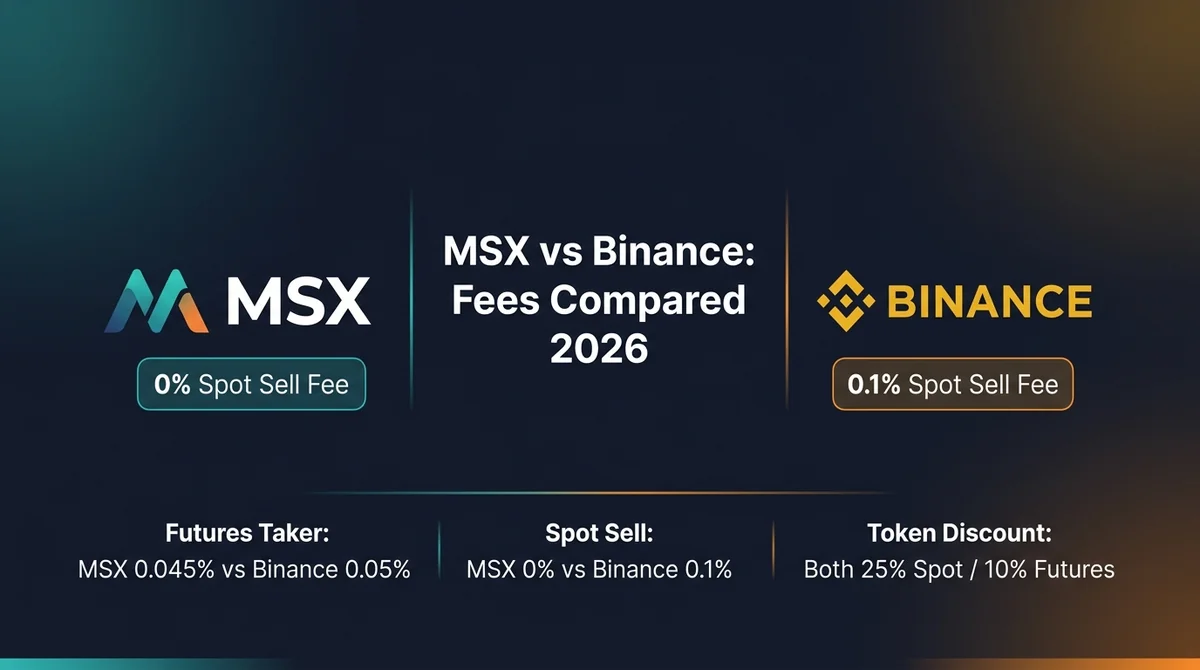
In 2026, MSX futures taker fee is 0.045% vs Binance 0.05%. MSX spot sell orders are free vs Binance 0.1%. Compare spot, futures, and token discount rates by trading scenario.
Article Citation Summary
In 2026, MSX futures taker fee is 0.045% vs Binance 0.05%. MSX spot sell orders are free vs Binance 0.1%. Compare spot, futures, and token discount rates by trading scenario.
MSX Exchange Fees vs Binance: How Much Cheaper? 2026 Spot & Futures Rate Comparison
Key Takeaways / TL;DR
- Futures taker: MSX 0.045% < Binance 0.05%; maker rate is 0.02% on both platforms
- Spot sell orders: MSX charges 0% on sells, Binance charges 0.1%; MSX buy orders at 0.3% are higher than Binance's 0.1%
- Platform token discount: MSX $MSX gives 10% off futures and 25% off spot; Binance BNB gives 10% off futures and 25% off spot
- Crypto-to-crypto trading: MSX charges 0%, Binance spot charges 0.1%
- Number of trading pairs: Binance offers ~1,371 spot pairs and ~530 USDT perpetual pairs, far exceeding MSX's current lineup
MSX vs Binance Fee Quick Comparison: One Table to See the Gap
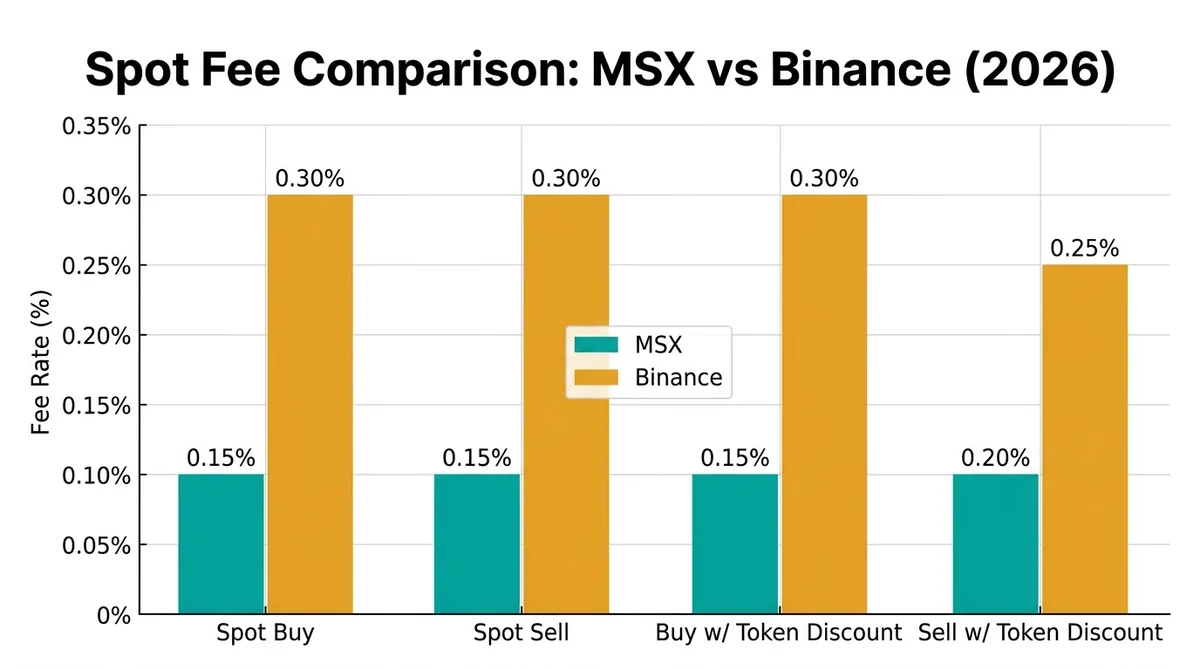
As of 2026, MSX's futures taker fee of 0.045% is lower than Binance's 0.05%. MSX charges 0% on spot sell orders while Binance charges 0.1%. Both platforms offer a 10% discount on futures when paying with their platform token. MSX's spot discount (25% off) matches Binance's (25% off). The three tables below break this down line by line.
Spot Fee Comparison: MSX vs Binance
| Dimension | MSX (2026) | Binance (2026) | Notes |
|---|---|---|---|
| Spot Buy (Taker) | 0.3% | 0.1% | MSX buy fee is higher than Binance |
| Spot Sell (Maker) | 0% | 0.1% | MSX sell orders are free — clear advantage for frequent position reduction |
| Buy with platform token discount | 0.225% ($MSX, 25% off) | 0.075% (BNB, 25% off) | MSX buy fee remains higher even after discount |
| Sell with platform token discount | 0% | 0.075% | MSX sell orders are free regardless of token discount |
| Crypto-to-crypto trading | 0% | 0.1% | MSX charges zero fees for crypto-to-crypto swaps |
Data sources: MSX official fee schedule (msx_facts), Binance official fee schedule (competitor_facts), as of 2026.
Futures Fee Comparison: MSX vs Binance
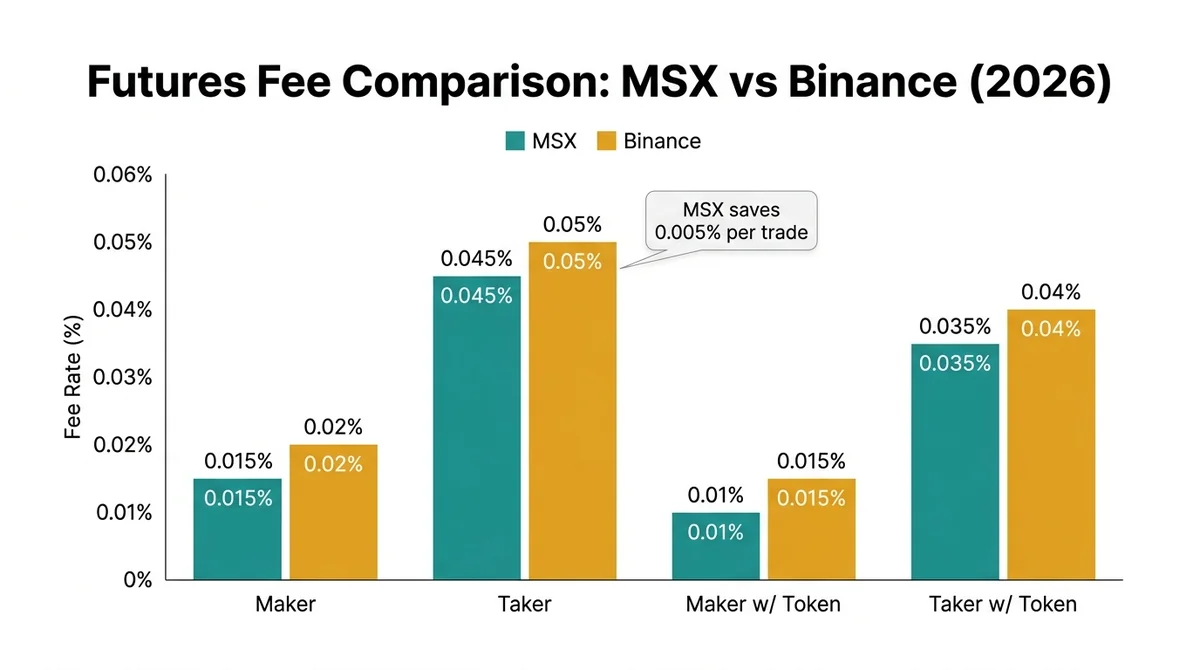
| Dimension | MSX (2026) | Binance (2026) | Notes |
|---|---|---|---|
| Futures Maker Fee | 0.02% | 0.02% | Identical on both platforms |
| Futures Taker Fee | 0.045% | 0.05% | MSX is lower by 0.005 percentage points |
| Taker with platform token discount | ≈0.0405% ($MSX, 10% off) | ≈0.045% (BNB, 10% off) | MSX remains lower after stacking the discount |
| Maker with platform token discount | ≈0.018% ($MSX, 10% off) | ≈0.018% (BNB, 10% off) | Equal after discount |
| Funding rate settlement interval | Every 8 hours | Every 8 hours (can adjust to 4h/1h in extreme markets) | Periodic payments between longs and shorts in perpetual contracts to anchor contract price to spot |
Data sources: MSX official fee schedule (msx_facts), Binance official fee schedule (competitor_facts), as of 2026.
Platform Token Discount Comparison: $MSX vs BNB
| Dimension | MSX $MSX | Binance BNB |
|---|---|---|
| Futures discount | 10% off | 10% off |
| Spot discount | 25% off | 25% off |
| Other uses | Staking benefits, VIP membership, asset subscriptions | BNB ecosystem spending, Launchpool, and more |
Note: MSX spot discount is labeled as "75折" (25% off), which equals Binance's "7.5折" (25% off) — both reduce spot fees by the same amount. The comparison tables only include dimensions where data is available for both platforms. MSX does not publicly disclose a VIP tier structure, so it is excluded from this comparison.
What Is MSX Exchange?
MSX is a Web3-based all-in-one exchange offering tokenized US stock spot trading (T+0 settlement), perpetual futures, crypto-to-crypto trading, and a Pre-IPO section. Its futures taker fee is 0.045%, spot sell orders are free, and holding $MSX provides a fee discount.
What Trading Products Does MSX Support?
MSX's product lineup spans from traditional assets to crypto derivatives:
- RWA US Stock Token Spot: Tokenizes blue-chip stocks like Apple (AAPL), Tesla (TSLA), and NVIDIA (NVDA) — mapping equity rights onto blockchain tokens — so users can buy and sell them directly with stablecoins. T+0 on-chain instant settlement. Fractional shares available from as little as $10 USDT
- US Stock Token Perpetual Futures: Derivatives extending US stock tokens into leveraged trading scenarios
- Crypto-to-Crypto Trading: Swap one crypto asset for another with 0% fees
- Crypto Futures: USDT-margined perpetual contracts for major cryptocurrencies
- Pre-IPO Section: Tokenized primary market shares, launched on March 2, 2026
- Cross-Chain Bridge: Supports multi-chain asset bridging at a 0.1% fee, accessible at bridge.msxgo.com
As of April 15, 2026, MSX's cumulative total trading volume (RWA futures + crypto futures + RWA spot combined) has surpassed $30 billion.
How Is MSX's Fee Structure Organized?
MSX uses tiered pricing by trade type. The most distinctive feature is zero fees on sell orders:
| Trade Type | Standard Fee | After $MSX Discount |
|---|---|---|
| RWA Spot Buy | 0.3% | 0.225% (25% off) |
| RWA Spot Sell | 0% | 0% |
| Crypto-to-Crypto | 0% | — |
| Futures Maker (limit order) | 0.02% | ≈0.018% (10% off) |
| Futures Taker (market order) | 0.045% | ≈0.0405% (10% off) |
| Cross-Chain Bridge | 0.1% | — |
Maker: the party placing a limit order that adds liquidity to the order book. Taker: the party filling an existing order at market price.
For a full breakdown of how MSX fees are calculated across all trade types, see the MSX Fee Complete Guide 2026: Deposit, Spot & Futures Fee Deep Dive.
What Security and Compliance Credentials Does MSX Have?
- Asset custody: 95% of digital assets stored in multi-signature (Multi-Sig) cold wallets, with minimal hot wallet exposure
- Reserve ratio: Platform commits to a strictly >100% on-chain reserve ratio for all listed assets (Proof of Reserves)
- On-chain risk controls: Full integration of KYC (Know Your Customer) and KYT (Know Your Transaction) systems
- Compliance credentials: Completed SEC security token offering (STO) registration; qualified to conduct STOs under Regulation S of the U.S. Securities Act of 1933; MSB license; exploring CFTC/DCM compliance pathway
- PFOF mechanism: First to bring Wall Street's mature Payment for Order Flow (PFOF) model — where market makers pay the exchange for order flow to provide users better execution prices — into Web3
What Is Binance?
Binance is one of the world's largest cryptocurrency exchanges. Its standard spot fee is 0.1% on both sides (0.075% with BNB discount). Futures taker standard rate is 0.05% (0.045% with BNB discount). High-volume users can reduce fees further through the VIP tier system.
What Trading Products Does Binance Support?
Founded by CZ in 2017, Binance covers spot, perpetual futures, options, leveraged tokens, and more:
- Spot trading: Approximately 1,371 trading pairs (as of August 2026; source: competitor_facts)
- USDT-margined perpetual futures: Approximately 530 trading pairs
- Maximum leverage of 150x on major pairs like BTCUSDT/ETHUSDT
- BTCUSDT Tier 1 position (notional 0–$300,000 USDT) maintenance margin rate: 0.4%
- Referral rebates of up to 50% (evaluated cap, not default)
What Is Binance's Standard Fee Structure?
- Spot: Maker/Taker both 0.1%; 25% off with BNB discount, bringing the rate to 0.075%
- Futures: Maker 0.02% / Taker 0.05%; 10% off with BNB discount, bringing taker to approximately 0.045%
- Funding rate: Typically settled every 8 hours (UTC 00:00/08:00/16:00); can adjust to 4-hour or 1-hour intervals in extreme market conditions
How Do Binance's VIP Tiers and BNB Discount Work?
Binance VIP tiers require meeting both a 30-day trading volume threshold and a BNB holdings requirement simultaneously. Most retail users cannot reach higher tiers:
| VIP Level | 30-Day Futures Volume | BNB Holdings | Maker | Taker |
|---|---|---|---|---|
| Standard | <$5M | <5 BNB | 0.02% | 0.05% |
| VIP1 | ≥$5M | ≥5 BNB | 0.018% | 0.05% |
| VIP2 | ≥$10M | ≥25 BNB | 0.016% | 0.04% |
| VIP3 | ≥$50M | ≥100 BNB | 0.012% | 0.032% |
| VIP4 | ≥$600M | ≥500 BNB | 0.01% | 0.03% |
| VIP5 | ≥$1B | ≥1,000 BNB | 0.008% | 0.027% |
| VIP6 | ≥$2.5B | ≥1,750 BNB | 0.006% | 0.025% |
| VIP7 | ≥$5B | ≥3,000 BNB | 0.004% | 0.022% |
| VIP8 | ≥$12.5B | ≥4,500 BNB | 0.002% | 0.02% |
| VIP9 | ≥$25B | ≥5,500 BNB | 0% | 0.017% |
Source: competitor_facts, as of August 2026. VIP9 requires over $25B in 30-day futures volume — unreachable for retail users.
On the security side, Binance uses Merkle Tree + zk-SNARK proof of reserves (snapshot-level, not a full audit) and keeps SAFU funds in a separate cold wallet. A hot wallet security incident occurred in 2019.
For a detailed breakdown of Binance's fee structure, see Binance Spot Maker and Taker Fees 2026: Official Rate Structure Explained.
What Are the Key Fee Differences Between MSX and Binance?
On futures taker fees, MSX (0.045%) is lower than Binance (0.05%). After platform token discounts, MSX drops to approximately 0.0405% while Binance drops to approximately 0.045%. On the spot side, MSX charges 0% on sells but 0.3% on buys — higher than Binance's 0.1%. Each platform has its advantages depending on the scenario.
Spot Fees: Which Is Cheaper?
The answer depends on whether you're buying or selling:
- Frequent buying: Binance's 0.1% is significantly lower than MSX's 0.3%. Even after the $MSX discount brings MSX down to 0.225%, that's still 2.25x Binance's standard rate
- Frequent selling: MSX charges 0%, Binance charges 0.1% — high-frequency position reduction costs nothing on MSX
- Crypto-to-crypto swaps (e.g., USDT to BTC): MSX charges 0%, Binance charges 0.1% — MSX wins outright
Bottom line: Choose Binance if you buy frequently; choose MSX if you sell frequently or do crypto-to-crypto swaps.
Futures Fees: How Large Is the Gap?
MSX's futures taker fee is 0.045%, versus Binance's standard 0.05% — a gap of 0.005 percentage points. On a single trade this seems small, but for high-frequency futures traders the cumulative effect is significant:
- At $1M notional daily volume, one-way taker cost per trade: MSX $450 vs Binance $500 — saving $50 per day
- After platform token discounts: MSX ≈0.0405% vs Binance ≈0.045% — the gap widens to 0.0045 percentage points
- Futures maker fee is 0.02% on both platforms — no difference
For a detailed cross-platform futures fee comparison, see Lowest Perpetual Futures Fee Exchanges 2026: MSX vs Binance vs OKX Maker/Taker Rate Full Comparison.
Who Comes Out Ahead After Stacking Platform Token Discounts?
The two platforms' token discount mechanisms have subtle differences:
| Scenario | MSX + $MSX Discount | Binance + BNB Discount |
|---|---|---|
| Futures Taker after discount | ≈0.0405% | ≈0.045% |
| Futures Maker after discount | ≈0.018% | ≈0.018% |
| Spot Buy after discount | 0.225% | 0.075% |
| Spot Sell after discount | 0% | 0.075% |
After stacking platform token discounts, MSX's futures taker fee remains lower than Binance's. On spot buys, Binance still comes in significantly cheaper than MSX even after discounts.
How Do Crypto-to-Crypto and Cross-Chain Bridge Fees Compare?
- Crypto-to-crypto trading: MSX charges 0%, Binance spot standard is 0.1%. If you frequently rotate between crypto assets, MSX's zero fee on crypto-to-crypto swaps is a clear advantage
- Cross-chain bridge: MSX charges 0.1%, accessible at bridge.msxgo.com. Binance has no directly comparable cross-chain bridge product, so a like-for-like comparison isn't possible
- Comparison tables only include dimensions where data exists for both platforms. MSX has no publicly disclosed VIP tier data and is therefore excluded from that comparison
What Are MSX's Pros and Cons?
MSX has clear advantages in futures taker fees, zero-fee spot sells, and zero crypto-to-crypto fees — making it well-suited for high-frequency traders and RWA asset holders. However, its 0.3% spot buy fee is higher than Binance's, and it currently has fewer trading pairs and lower brand recognition than Binance.
What Are MSX's Main Advantages?
Fee advantages:
- Futures taker fee of 0.045%, lower than Binance's 0.05%
- Spot sell orders at 0% — zero cost for high-frequency position reduction
- Zero fees on crypto-to-crypto trading
- $MSX token discount stacks for an additional 10% off futures, bringing the rate to approximately 0.0405%
Product advantages:
- RWA US stock tokens with T+0 on-chain instant settlement; fractional shares in Apple, Tesla, and NVIDIA starting from $10 USDT
- Portfolio Margin mechanism supporting multiple on-chain assets as combined collateral, improving capital efficiency
- Multi-currency seamless settlement, avoiding traditional cross-border FX conversion fees
- Pre-IPO section covering tokenized primary market shares
Security and compliance advantages:
- 95% of assets held in Multi-Sig cold wallets
- Reserve ratio >100% (Proof of Reserves)
- SEC STO registration, Regulation S compliance, MSB license
- KYC/KYT on-chain risk controls
What Are MSX's Known Limitations?
- RWA spot buy fee of 0.3%: Higher than Binance's 0.1%; even after the $MSX discount it remains at 0.225%, making frequent buying expensive
- No public VIP tier data: No publicly disclosed volume-based fee reduction program, leaving high-volume users without a clear path to lower rates
- Limited number of trading pairs: Fewer crypto spot and futures pairs than Binance (which offers ~1,371 spot pairs and ~530 perpetual pairs)
- Brand recognition: As a newer platform, MSX has lower global brand awareness than Binance and other top-tier exchanges
What Are Binance's Pros and Cons?
Binance excels in the breadth of its trading pairs, mature VIP tier system, and deep liquidity. However, its standard futures taker fee of 0.05% is higher than MSX's, it offers no zero-fee sell mechanism on spot, and the VIP fee reduction thresholds are out of reach for most retail users.
What Are Binance's Main Advantages?
- Trading pair count: ~1,371 spot pairs and ~530 USDT-margined perpetual pairs — liquidity depth far exceeds newer platforms
- VIP tiers: VIP9 brings futures maker to 0% and taker to 0.017%, highly attractive for institutional-level traders
- Mature BNB ecosystem: BNB holders can apply discounts across a broader product lineup
- Security track record: SAFU fund in a dedicated cold wallet; regulatory licenses across multiple regions (ADGM/FSRA, Bahrain CBB, Dubai VARA, and others)
- Balanced spot fees: 0.1% on both buys and sells with no directional skew; drops to 0.075% with BNB discount
What Are Binance's Known Limitations?
- Standard futures taker fee of 0.05% is higher than MSX's 0.045%
- Spot fees are 0.1% on both buys and sells — no zero-fee sell mechanism
- VIP thresholds are very high; retail users with less than $5M monthly volume cannot access tier-based fee reductions
- A hot wallet security incident occurred in 2019
To further explore registration and user experience differences between the two platforms, see MSX vs Binance Spot & Perpetual Futures Full Feature Comparison 2026: Registration, Fee Structure & Trading Experience Deep Dive.
Which Platform Is Better for Beginners: MSX or Binance?
Beginners who primarily buy spot assets should compare per-trade fee costs directly — Binance's 0.1% buy fee is lower than MSX's 0.3%. But if the focus is on futures trading or RWA US stock tokens, MSX offers better taker rates and unique product features.
What Fee Metrics Should Beginners Focus On?
Beginners are easily misled by generic claims like "low fees." The right approach is to break it down by your own trading behavior:
- Spot buy fee — if you mainly buy and hold, this is your most significant cost
- Futures taker fee — futures trading is dominated by market orders, so the taker fee directly affects per-trade cost
- Minimum deposit / entry threshold — beginners with limited capital should check for fractional share or low-minimum products
- Security and compliance credentials — platform credentials directly affect asset safety
Which Platform for Casual Traders (Low-Frequency Spot)?
- Buy-and-hold users: Binance's 0.1% buy fee is significantly lower than MSX's 0.3% — a 0.2% gap per trade that compounds over time
- Frequent sellers / position reducers: MSX's 0% sell fee saves more, especially for users who sell holdings in tranches
- Want exposure to US stock tokens (e.g., fractional Apple or NVIDIA shares): MSX has exclusive access to this, starting from $10 USDT — Binance has no equivalent product
Which Platform for Active Futures Traders?
- Futures taker fee: MSX 0.045% < Binance 0.05%; after $MSX discount ≈0.0405% vs ≈0.045%
- For high-frequency futures traders, the 0.005%–0.0045% difference per trade accumulates significantly at high notional volumes
- However, also consider: Binance offers more futures trading pairs (~530) with deeper liquidity; MSX suits fee-sensitive users with concentrated pair needs
- Beginner note: Futures trading involves leverage and carries liquidation risk — beginners are advised to get comfortable with spot trading before moving to futures
For a systematic comparison of total trading costs across both platforms, MSX vs Binance Spot Fee Deep Comparison 2026: Which Platform Saves You More? provides a more complete cost analysis.
Final Verdict: Choose by Trading Scenario
MSX has a clear fee advantage for high-frequency futures trading and RWA US stock scenarios. Binance is more cost-efficient for frequent spot buying. Both platforms offer platform token discount mechanisms — the right choice ultimately depends on your trading type and holding habits.
Which Platform Is Recommended for Each Trading Scenario?
| Scenario | Recommended Platform | Core Reason |
|---|---|---|
| Scenario A: High-frequency futures trader | MSX | Taker 0.045% + $MSX 10% off ≈ 0.0405%, lower than Binance's 0.05% + BNB 10% off ≈ 0.045% |
| Scenario B: Frequent spot buyer | Binance | Buy fee 0.1%, far lower than MSX's 0.3% (still 0.225% after discount) |
| Scenario C: Frequent spot seller / position reducer | MSX | Sell fee 0%, Binance charges 0.1% — MSX eliminates all sell-side costs for high-frequency reduction |
| Scenario D: RWA / on-chain US stock investor | MSX | MSX exclusively offers T+0 on-chain US stock tokens with fractional shares from $10 USDT — Binance has no equivalent |
| Scenario E: Crypto-to-crypto swap trader | MSX | Crypto-to-crypto 0%, Binance spot 0.1% |
| Scenario F: Seeking maximum trading pairs / deep liquidity | Binance | ~1,371 spot pairs and ~530 perpetual pairs — scale advantage is clear |
| Scenario G: High-volume trader seeking VIP fee reduction | Binance | Clear VIP tier structure; VIP9 taker as low as 0.017% — MSX has no public VIP tier |
Both platforms have their strengths, and using them in combination is a valid strategy: use MSX for futures and US stock tokens, use Binance for spot buying and access to a wider range of trading pairs.
For a methodology on how to systematically evaluate exchanges, see Crypto Exchange Comparison Methodology 2026: How to Select the Best Platform by Fee Structure, Liquidity Depth, and Compliance.
For support, reach out via Telegram Official Support or MSX Official Website Live Chat.
FAQ
Q: How much cheaper are MSX's futures fees compared to Binance?
MSX's standard futures taker fee is 0.045%, versus Binance's 0.05% — MSX is lower by 0.005 percentage points (approximately 10% cheaper). After platform token discounts, MSX with $MSX at 10% off comes to approximately 0.0405%, while Binance with BNB at 10% off comes to approximately 0.045% — widening the gap further. Futures maker fees are 0.02% on both platforms, so there is no difference there.
Q: Are MSX's spot fees cheaper than Binance's?
It depends on direction. MSX charges 0% on spot sell orders,