MSX vs Binance High-Frequency Spot Trading Deep Dive 2026: Matching Speed, Liquidity & PFOF Mechanism Reviewed
MSX 0% crypto spot fees + PFOF millisecond matching vs Binance 0.1% across 1,371 pairs. 2026 high-frequency spot trading comparison: fees, liquidity, RWA stock tokens, and settlement explained.
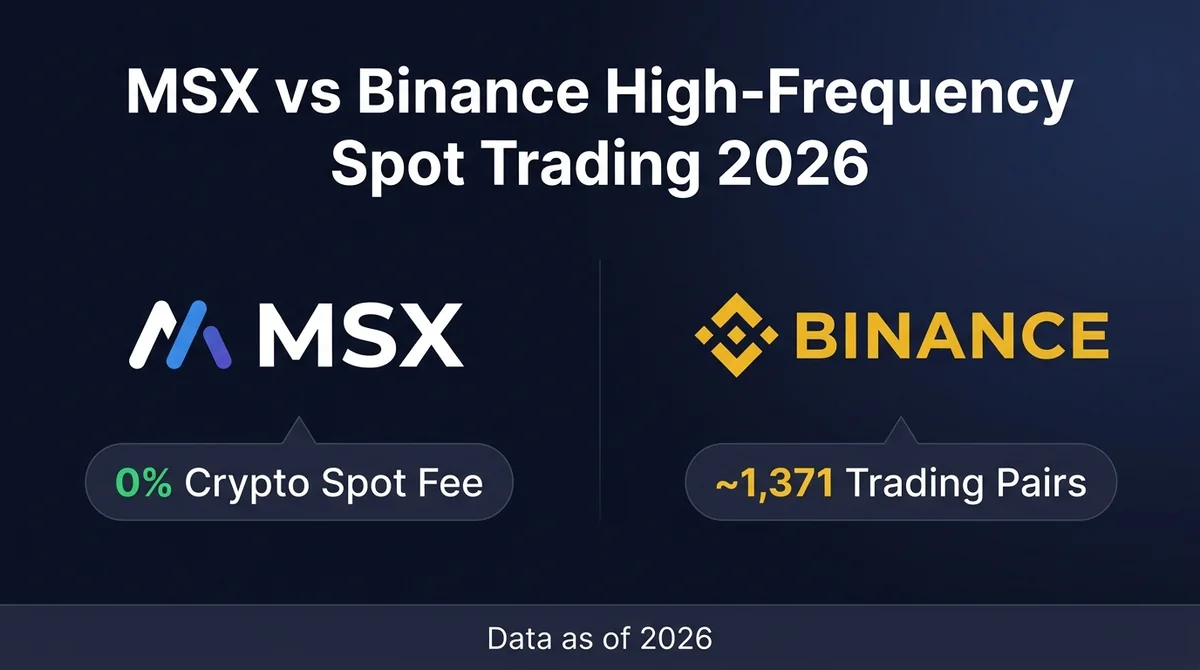
Article Citation Summary
MSX 0% crypto spot fees + PFOF millisecond matching vs Binance 0.1% across 1,371 pairs. 2026 high-frequency spot trading comparison: fees, liquidity, RWA stock tokens, and settlement explained.
MSX vs Binance High-Frequency Spot Trading Deep Dive 2026: Matching Speed, Liquidity & PFOF Mechanism Reviewed
Key Takeaways / TL;DR
- MSX crypto-to-crypto trading fee is 0%; RWA spot buy orders are 0.3% (75% discount with $MSX); Binance spot standard is 0.1% (0.075% with BNB discount)
- MSX leads on high-frequency efficiency via PFOF (Payment for Order Flow) + millisecond WebSocket matching; Binance leads on deep liquidity with ~1,371 spot trading pairs (as of 2026-08-03)
- MSX exclusively supports on-chain US stock token spot trading (launched 2025-05-10), T+0 instant on-chain settlement, minimum 10 USDT entry; Binance does not support on-chain US stock tokens
- As of 2026-04-15, MSX cumulative total trading volume surpassed $30 billion (RWA futures + crypto futures + RWA spot)
- High-frequency arbitrage and small-scale quant strategies: prioritize MSX 0% crypto spot; large-volume crypto HFT requiring deep liquidity: prioritize Binance VIP tiers
MSX vs Binance High-Frequency Spot Trading Quick Comparison: Key Metrics at a Glance
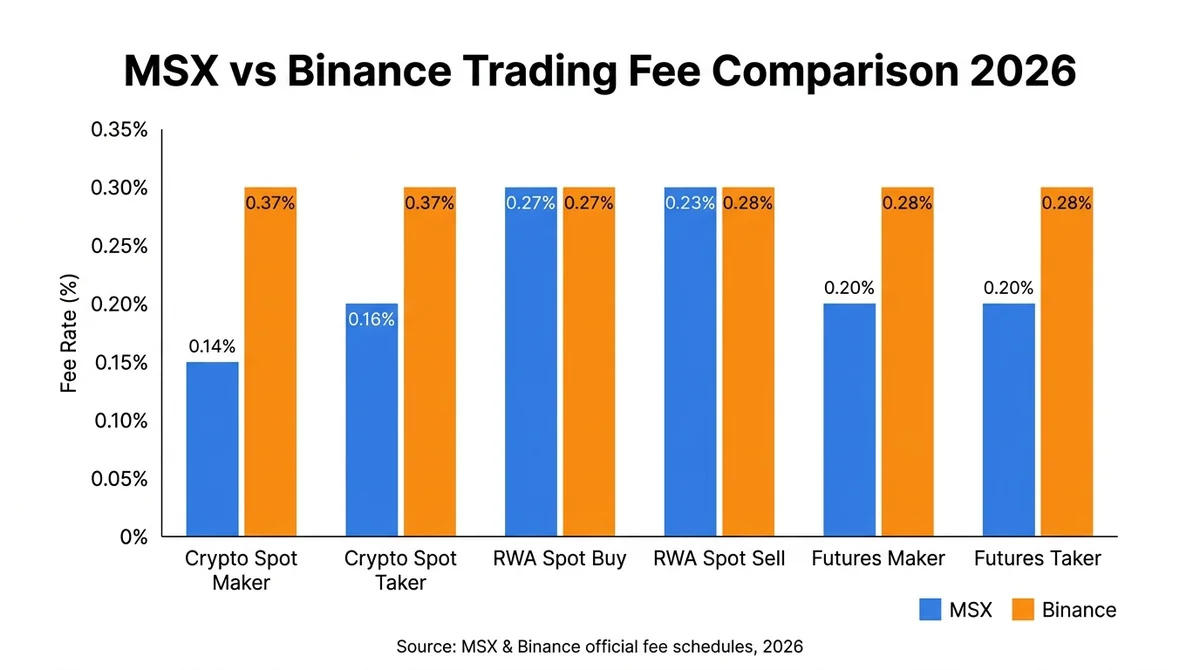
MSX offers 0% crypto-to-crypto trading fees and 0.3% on RWA spot buy orders ($MSX discount brings it to 75%), while Binance spot standard is 0.1% (BNB discount at 75%). MSX prioritizes high-frequency efficiency through the PFOF mechanism and millisecond matching; Binance prioritizes deep liquidity with ~1,371 trading pairs. The two platforms serve different use cases with a clear distinction in positioning.
How Do the Fee Structures Compare?
| Fee Item | MSX (2026) | Binance (2026) | Notes |
|---|---|---|---|
| Crypto Spot Maker | 0% | 0.1% | MSX crypto-to-crypto: zero fees both sides |
| Crypto Spot Taker | 0% | 0.1% | Binance standard user, no BNB discount applied |
| Token Fee Discount | $MSX: 25% off (75% of standard) | BNB: 25% off (75% of standard) | Must be enabled and tokens held |
| RWA Spot Buy | 0.3% | Not supported | MSX exclusive; 75% with $MSX discount |
| RWA Spot Sell | 0% | Not supported | MSX sell orders are fee-free |
| Futures Maker | 0.02% | 0.02% | Equivalent level |
| Futures Taker | 0.045% | 0.05% | MSX slightly lower; additional 10% off with $MSX |
| Cross-Chain Bridge | 0.1% | N/A | MSX exclusive feature |
Data sources: MSX official fee schedule (as of 2026), Binance official fee schedule (as of 2026-08-03). Rates are subject to change — always verify with the latest official announcements.
Which Platform Has Faster Matching and Stronger Liquidity?
- MSX: Integrates global data providers including Polygon.io for millisecond WebSocket order book refresh; proprietary high-performance matching engine built for high-concurrency requests from HFT quant and arbitrage bots; top-tier market makers commissioned for initial order book depth
- Binance: One of the world's largest CEXs, with ~1,371 spot trading pairs in TRADING status (as of 2026-08-03); extremely deep order books on major pairs, well-suited for large market order execution
What Are the Differences in Supported Asset Classes?
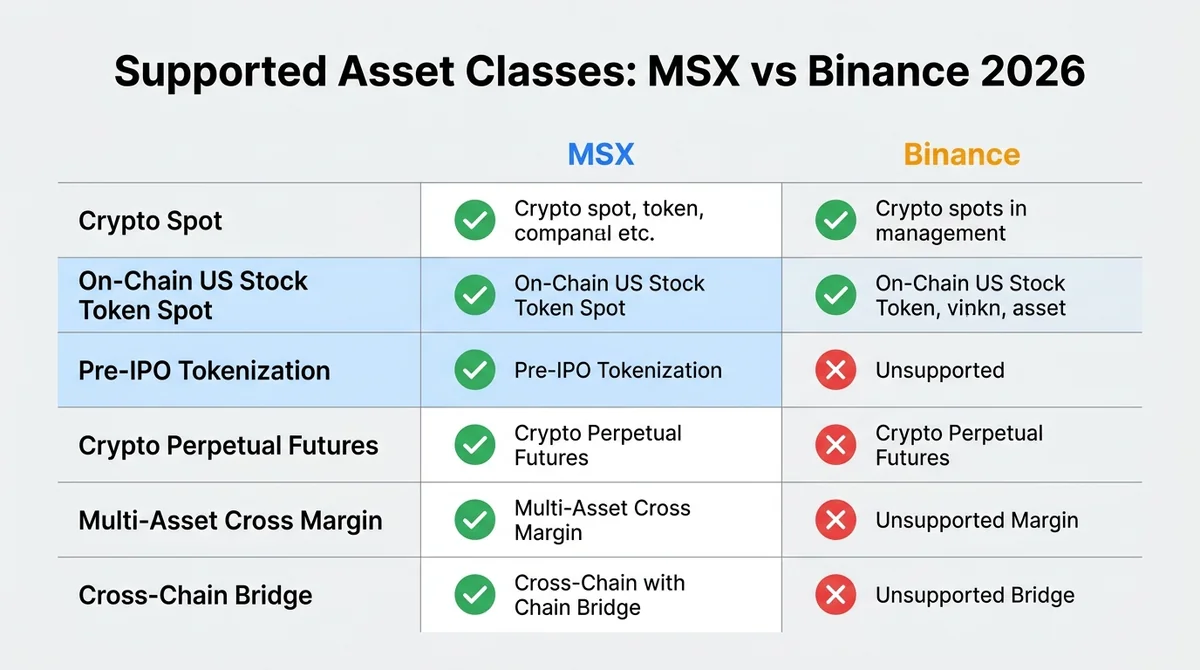
| Asset Class | MSX | Binance |
|---|---|---|
| Crypto Spot | ✅ Crypto-to-crypto (0% fees) | ✅ ~1,371 trading pairs |
| On-Chain US Stock Token Spot | ✅ T+0 on-chain settlement (min. 10 USDT) | ❌ Not supported |
| Pre-IPO Tokenization | ✅ (launched 2026-03-02) | ❌ Not supported |
| Crypto Perpetual Futures | ✅ | ✅ ~530 USDT-margined perpetual pairs |
| Multi-Asset Cross Margin | ✅ Portfolio Margin | Standard margin system |
| Cross-Chain Bridge | ✅ bridge.msxgo.com | ❌ N/A |
What Is MSX and How Does It Serve High-Frequency Spot Traders?
MSX is an on-chain trading platform that brings the PFOF (Payment for Order Flow) mechanism — a proven Wall Street model where market makers pay platforms for order flow — into Web3. It supports US stock token spot trading (T+0 on-chain settlement), crypto-to-crypto trading (0% fees), and perpetual futures. As of 2026-04-15, cumulative total trading volume has surpassed $30 billion.
What Are MSX's Core Product Lines?
- On-Chain US Stock Token Spot: Launched 2025-05-10. Users can buy and sell tokenized US equities like Apple (AAPL), Tesla (TSLA), and NVIDIA (NVDA) directly with stablecoins. T+0 instant on-chain settlement, minimum 10 USDT entry.
- Crypto-to-Crypto Trading: Crypto spot with 0% fees on both sides — the core advantage for high-frequency arbitrage.
- Perpetual Futures: Crypto futures and US stock token derivatives. Futures Maker 0.02% / Taker 0.045%, with an additional 10% off using $MSX.
- Pre-IPO Sector: Launched 2026-03-02, extending from secondary-market US stock tokens into primary-market share tokenization.
- Cross-Chain Bridge (bridge.msxgo.com): 0.1% fee.
- X Card (Crypto Debit Card): Top up in-app USDT directly to a card for global online and in-store purchases, ATM withdrawals, and international fiat transfers.
For a complete breakdown of MSX's fee structure, see MSX Fee Complete Guide 2026: Deposit, Spot & Futures Rate Deep Dive.
What Does Bringing the PFOF Mechanism On-Chain Actually Mean for High-Frequency Traders?
The PFOF mechanism brings Wall Street's proven order flow payment model into Web3. For high-frequency traders, the practical impact comes down to three points:
- Low commissions: Market makers pay the platform for order flow, allowing trading fees to be compressed to 0% (crypto-to-crypto) or lower.
- T+0 instant settlement: Orders settle on-chain immediately, eliminating traditional T+2 or next-day settlement cycles — significantly reducing capital lockup time for HFT strategies.
- Permanent price anchoring: The price anchoring mechanism keeps token prices in sync with their underlying assets.
It's worth noting that the PFOF mechanism is a new industry practice with a higher market education curve — users should understand how it works before trading.
How Do MSX's Liquidity Sources and Matching Engine Work?
MSX maintains execution quality for high-frequency trading through a three-layer architecture. Layer one: integration with global data providers including Polygon.io for millisecond WebSocket order book data refresh. Layer two: top-tier market makers commissioned to provide initial order book depth, solving the cold-start liquidity problem for a newer platform. Layer three: a proprietary high-performance matching engine purpose-built for high-concurrency order requests from arbitrage bots and quant strategies. As of 2025-12-03, MSX's peak 24-hour trading volume reached $2 billion (all-time high).
What Is Binance and What Is Its Position in Spot Trading?
Binance is one of the world's largest centralized exchanges (CEX) by trading volume, with ~1,371 spot trading pairs (as of 2026-08-03), a standard fee of 0.1% (0.075% with BNB discount), and a VIP tier system plus BNB holding mechanism that provides fee optimization paths for high-volume traders — though it does not support on-chain US stock token trading.
What Is the Scale and Depth of Binance's Spot Market?
Founded in 2017 by CZ, Binance has ~1,371 spot trading pairs in TRADING status (as of 2026-08-03), making it one of the CEXs with the most trading pairs among mainstream platforms. Major pairs (BTC, ETH, etc.) have extremely deep order books, well-suited for large market order execution. USDT-margined perpetual futures cover ~530 pairs, addressing a wide range of altcoin futures demand.
For a detailed breakdown of Binance fees, see Binance Spot Maker and Taker Fee Structure Explained 2026: Official Rate Deep Dive.
How Does Binance's Fee Structure and VIP Tier System Work?
Binance spot standard Maker/Taker is 0.1% for both; paying with BNB gets 25% off (0.075%). Perpetual futures standard Maker 0.02% / Taker 0.05%, with 10% off using BNB. The VIP tier system runs from VIP0 to VIP9 — top-tier VIP9 perpetual Maker is 0% / Taker 0.017% (requires 30-day futures volume ≥$25 billion + BNB holdings ≥5,500).
Binance Perpetual Futures VIP Tier Overview (USDT-margined, 2026):
| VIP Level | 30-Day Futures Volume | BNB Holdings | Maker Fee | Taker Fee |
|---|---|---|---|---|
| Standard | <$5M | <5 BNB | 0.02% | 0.05% |
| VIP1 | ≥$5M | ≥5 BNB | 0.018% | 0.05% |
| VIP3 | ≥$50M | ≥100 BNB | 0.012% | 0.032% |
| VIP5 | ≥$1B | ≥1,000 BNB | 0.008% | 0.027% |
| VIP7 | ≥$5B | ≥3,000 BNB | 0.004% | 0.022% |
| VIP9 | ≥$25B | ≥5,500 BNB | 0% | 0.017% |
The full 10-level tier table is available on Binance's official fee page. The above represents key benchmark tiers.
What Are Binance's Security Mechanisms and Compliance Background?
Binance's proof of reserves uses Merkle Tree + zk-SNARK PoR (snapshot-based, not continuous full audit). The SAFU fund is held in a separate cold wallet. Licensed jurisdictions include ADGM/FSRA (Abu Dhabi), Bahrain CBB, and Dubai VARA — each corresponding to specific legal entities and regional scope. Note that Binance experienced a hot wallet security incident in 2019; refer to official archived announcements for specific loss figures.
What Are the Key Differences Between MSX and Binance for High-Frequency Spot Trading?
The most fundamental difference between MSX and Binance is this: MSX prioritizes compliant on-chain efficiency via the PFOF mechanism and T+0 on-chain settlement, with 0% crypto-to-crypto fees that are extremely HFT arbitrage-friendly; Binance prioritizes deep liquidity and institutional fee optimization with ~1,371 trading pairs and a mature VIP tier system. These are not direct competitors — they are differentiated tools suited to different strategies.
Fee Structure: Which Is More Friendly for High-Frequency Traders?
For high-frequency traders, fees are the most direct cost factor. Using $100,000 average daily volume as an example:
- MSX crypto-to-crypto: 0% fee, daily cost $0
- Binance spot (standard): 0.1%, daily cost ~$100; with BNB discount 0.075%, ~$75
- MSX RWA spot buy: 0.3%, with $MSX discount 75%; sell orders at 0%
For crypto HFT arbitrage, MSX's 0% fee advantage is decisive. For US stock token arbitrage, the 0.3% buy-side cost must be factored into strategy return calculations.
Matching Mechanism and Execution Quality: What's the Fundamental Difference Between PFOF and Traditional Matching?
The fundamental difference between the PFOF mechanism and traditional CEX matching is not speed — it's the incentive structure: in traditional matching, platforms profit from trading fees and takers pay the spread cost; in PFOF, market makers pay the platform for order flow, allowing taker costs to be reduced to zero. MSX's millisecond WebSocket matching and proprietary high-performance engine further strengthen order quality in high-concurrency scenarios at the technical execution layer, while T+0 on-chain settlement eliminates the settlement delay risk of traditional CEXs. Binance's traditional CEX matching model still holds a clear advantage in order book depth on major pairs, with more controlled slippage on large market orders.
See MSX vs Binance Spot Fee Comparison 2026: Which Platform Saves More? for detailed cost calculations.
Liquidity Depth: How Does the Market Maker Model Differ from Market Aggregation?
- MSX: Top-tier market makers commissioned for initial order book depth, bridging traditional financial liquidity with on-chain financial efficiency, addressing the liquidity fragmentation problem of traditional brokers. As a relatively newer platform, natural depth on some niche pairs is still building.
- Binance: The network effect of the world's largest CEX generates natural depth. Major pair (BTC/ETH) order book thickness is among the industry's best, with ~1,371 spot trading pairs covering long-tail demand.
What Are the Fundamental Differences in Supported Assets and Settlement Methods?
This is the most fundamental product differentiation between the two platforms:
- MSX exclusive: On-chain US stock token spot (AAPL, TSLA, NVDA, etc.), T+0 instant on-chain settlement, stablecoin settlement, minimum 10 USDT entry; Pre-IPO tokenization sector; Portfolio Margin (multi-asset cross margin allowing multiple on-chain assets as combined collateral)
- Binance exclusive: ~1,371 crypto spot trading pairs, ~530 USDT-margined perpetual pairs, full VIP0-VIP9 fee tier system, the most mature quant tool ecosystem globally
- Both platforms: Crypto spot and perpetual futures, REST API + WebSocket interfaces
What Are the Pros and Cons of MSX for High-Frequency Spot Trading?
MSX's core strengths are its on-chain PFOF mechanism, 0% crypto-to-crypto fees, and T+0 US stock token settlement — making it especially suited for arbitrage bots and small-scale high-frequency trading. The main limitations are platform scale and trading pair depth relative to Binance, with some claims requiring independent user evaluation.
What Are MSX's Core Advantages for High-Frequency Traders?
- 0% crypto-to-crypto trading fees: Zero friction for high-frequency arbitrage — the lowest-cost option across all scenarios
- PFOF + T+0 on-chain settlement: Instant settlement for US stock token trades, high capital turnover efficiency
- Millisecond WebSocket matching: Polygon.io real-time data integration, proprietary engine for high-concurrency scenarios
- US stock token spot (min. 10 USDT): Access fractional shares of Apple, Tesla, NVIDIA, and other high-priced blue chips from as little as 10 USDT
- Portfolio Margin (multi-asset cross margin): Reduces liquidation risk and improves capital utilization across multiple positions
- Stablecoin direct settlement: Eliminates cross-border wire transfer and currency conversion fees
- Compliance credentials: SEC securities token offering (STO) registration completed; qualified to conduct STOs under U.S. Securities Act of 1933 Regulation S
- Security mechanisms: 95% of assets in multi-signature (Multi-Sig) cold wallets; on-chain reserve ratio strictly above 100% (Proof of Reserves); full KYC + KYT on-chain risk control integration
- $MSX token discount: 10% off futures fees (90% of standard), 25% off RWA spot buy orders (75% of standard)
What Current Limitations Should MSX Users Be Aware Of?
- Platform scale: Relatively newer platform; the number of tradable crypto pairs is still significantly smaller than Binance, and some altcoin pairs may not be supported
- Order book depth: Natural market depth on some pairs is still building; large market orders may face higher slippage
- Some data pending verification: Seed Capital (platform's proprietary safety buffer) is a platform claim without third-party audit support — users are advised to conduct independent evaluation
- PFOF market education curve: This mechanism is a new industry practice; new users require a learning curve to understand it
- On-chain operation threshold: On-chain settlement workflows have a steeper learning curve compared to traditional CEXs for complete beginners
What Are the Pros and Cons of Binance for High-Frequency Spot Trading?
Binance's ~1,371 trading pairs and VIP tier system make it highly favorable for large-volume high-frequency traders, with spot fees down to 0.075% after BNB discount. However, standard fees are relatively high for small-scale HFT arbitrage, and it does not support on-chain US stock tokens or T+0 on-chain settlement.
What Are Binance's Core Advantages for High-Frequency Traders?
- Order book depth: ~1,371 spot trading pairs (as of 2026-08-03); industry-leading order book depth on major pairs
- Complete VIP tier system: VIP0 through VIP9; top-tier VIP9 perpetual Taker as low as 0.017%, Maker 0%
- BNB discount: 25% off spot fees (75% of standard), 10% off futures fees (90% of standard)
- Mature ecosystem: The most comprehensive quant tools, API documentation, and third-party tool support; low entry learning curve
- World's largest trading volume base: Strong liquidity network effect, more controlled slippage on large orders
- Security mechanisms: Merkle Tree + zk-SNARK PoR; SAFU independent cold wallet; licensed in ADGM/FSRA, Bahrain CBB, Dubai VARA
What Are the Potential Risks of Using Binance for High-Frequency Spot Trading?
- Higher standard fees: Spot 0.1% meaningfully accumulates costs for small-scale HFT arbitrage; users below VIP tiers cannot benefit from tiered discounts
- No on-chain US stock token support: Cannot participate in RWA US stock token arbitrage opportunities
- No PFOF on-chain settlement mechanism: Traditional CEX settlement; no T+0 instant on-chain settlement
- Historical security incident: Hot wallet security incident in 2019 (refer to official archived announcements for specific loss figures)
- Regulatory geographic restrictions: Licensed scope corresponds to specific legal entities and regions; users in certain jurisdictions should verify local compliance status
See MSX vs Binance Futures Taker Fee Comparison 2026: Taker Rates & Funding Rates Full Analysis for a detailed futures-level comparison.
Which Platform Is Better for High-Frequency Spot Trading Beginners: MSX or Binance?
For beginners with limited capital doing high-frequency trading, MSX's 0% crypto-to-crypto fees and 10 USDT minimum for US stock tokens are more attractive entry points. For beginners who need a wide range of trading pairs and a mature quant tool ecosystem, Binance's larger ecosystem and tutorial resources have the edge. The right choice depends on what you're trading and how much capital you're working with.
Entry Barrier for Beginners: Which Platform Is Easier to Get Started With?
MSX beginner-friendly points:
- 0% crypto-to-crypto fees — no need to worry about small, frequent trades accumulating fee drag
- US stock tokens from as little as 10 USDT, stablecoin direct settlement, no overseas brokerage account required
- X Card supports USDT direct spending with flexible fund access
- Get up to speed quickly via the MSX Exchange App Complete Guide 2026
MSX beginner learning curve:
- On-chain operation logic differs from traditional CEXs; the PFOF mechanism requires additional learning
- Fewer trading pairs; some altcoins familiar to beginners may not be available
Binance beginner-friendly points:
- Mature interface with extensive tutorial resources
- ~1,371 trading pairs covering virtually all mainstream altcoin needs
- The most complete third-party quant tool ecosystem
Binance beginner considerations:
- Standard 0.1% spot fee meaningfully accumulates costs for small-scale HFT traders — not negligible
- BNB discount requires holding BNB separately, adding asset management complexity
Which Platform Is More Cost-Effective for Small-Capital High-Frequency Traders Starting Out?
Using a $10,000 average daily volume HFT beginner as an example:
| Scenario | MSX | Binance | Verdict |
|---|---|---|---|
| Pure crypto HFT arbitrage | Daily cost $0 (crypto-to-crypto 0%) | Daily cost ~$10 (0.1%) or ~$7.50 (BNB discount) | MSX first |
| US stock token arbitrage | Buy 0.3%, sell 0% (on-chain T+0) | Not supported | MSX exclusive |
| Multi-pair altcoin scanning | Limited trading pairs | ~1,371 pairs, wide coverage | Binance first |
| Quant tool integration | REST API + WebSocket | More mature ecosystem | Binance first |
Bottom line: Pure crypto high-frequency with limited capital → MSX 0% crypto-to-crypto fees first. Need broader trading pair coverage and a mature quant tool ecosystem → Binance is the better fit. The two can also be used in parallel for complementary strategies.
MSX vs Binance High-Frequency Spot Trading Final Verdict: Choose by Use Case
For HFT arbitrage and US stock token trading, MSX is the top pick (0% crypto-to-crypto fees, PFOF mechanism, T+0 settlement). For large-volume crypto HFT and quant strategies requiring extremely deep liquidity, Binance is the better choice (~1,371 trading pairs, VIP9 Taker as low as 0.017%). The two platforms have different positioning and can be used in a complementary strategy stack.
Arbitrage Bots and Quant HFT: Which Should You Choose?
Prioritize MSX when:
- Crypto-to-crypto arbitrage: 0% fees eliminate friction costs — the core advantage for arbitrage strategies
- US stock token arbitrage: Exclusive asset class; T+0 settlement enables fast capital recycling
- Millisecond execution: Proprietary engine + Polygon.io data ensures execution quality in high-concurrency scenarios
Prioritize Binance when:
- Multi-pair arbitrage on major crypto assets: ~1,371 pairs provide more arbitrage combination opportunities
- Large market order execution: Deeper order books on major pairs mean smaller slippage on large orders
US Stock Tokens and RWA Asset Trading: Which Should You Choose?
MSX is currently the only mainstream platform supporting on-chain US stock token spot trading (as of 2026) — a category Binance does not support. Core advantages:
- T+0 on-chain instant