MSX vs OKX: 2026 Fees, Security, Compliance & Product Line Compared
2026 update: MSX futures taker 0.045%, maker 0.02%; OKX regular taker 0.05%, maker 0.02%. Compare fees, asset safety, compliance, and products.

Article Citation Summary
2026 update: MSX futures taker 0.045%, maker 0.02%; OKX regular taker 0.05%, maker 0.02%. Compare fees, asset safety, compliance, and products.
MSX vs OKX: 2026 Fees, Security, Compliance & Product Line Compared
Core Takeaways / TL;DR
- Futures fees: MSX futures taker 0.045%, maker 0.02%, 10% discount with $MSX; OKX regular users taker 0.05%, maker 0.02%, VIP levels reduce rates.
- Asset security: MSX stores 95% of assets in multi-sig cold wallets, promises 100% physical reserves (>100%); OKX has monthly Proof of Reserves but experienced a DEX private key leak historically.
- Compliance credentials: MSX has completed SEC security token offering (STO) filing under Regulation S; OKX holds MiCA authorization and licenses in Singapore, Dubai, the US, and more.
- Product highlights: MSX focuses on US stock token spot, perpetual futures, Pre-IPO, and U Card; OKX covers 1,226 trading pairs, 302 coins, max leverage 100x.
- Beginner advice: Choose MSX for low-barrier US stock tokens and T+0 settlement; choose OKX for full crypto coverage and high leverage, but mind liquidation risk.
How Much Do MSX and OKX Fees Differ?
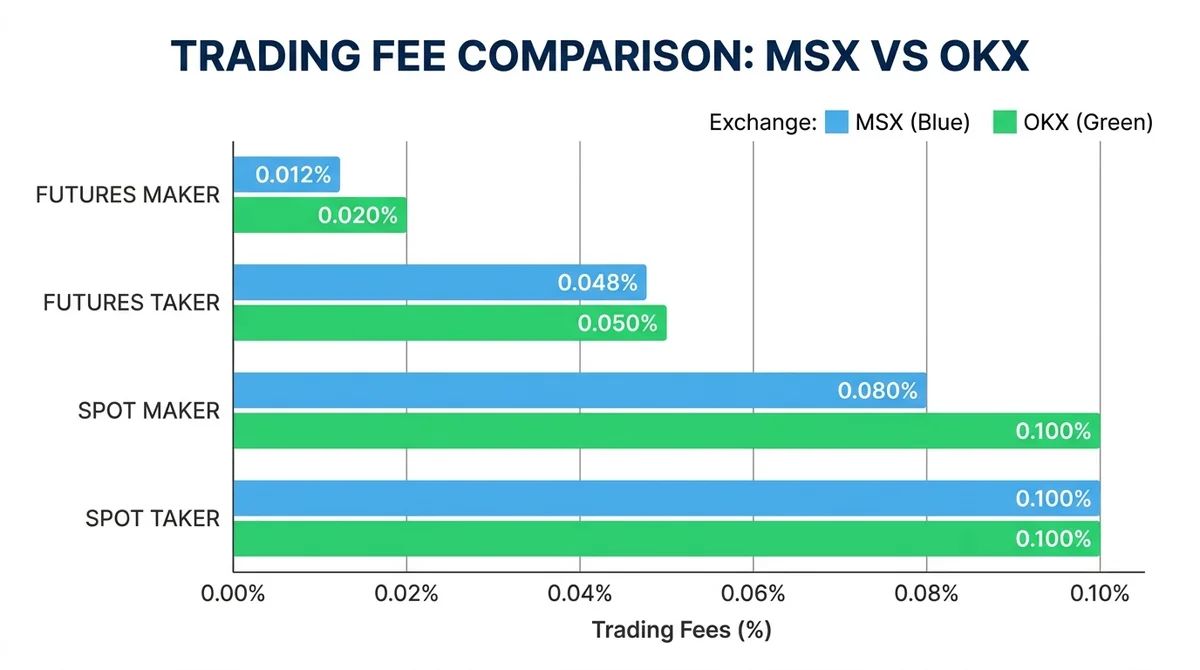
MSX futures taker fee is 0.045%, maker 0.02%, spot buy 0.3%, sell 0%; OKX regular users futures taker 0.05%, maker 0.02%, spot taker 0.10%, maker 0.08%. Their fee structures differ significantly.
What Are MSX's Futures and Spot Fees Exactly?
MSX's futures fee is fixed at taker 0.045%, maker 0.02%, with no VIP tiers. Paying fees with the platform token $MSX gives an additional 10% discount (10% off), reducing the effective taker rate to about 0.0405%. For spot, RWA US stock token buy orders cost 0.3%, sell orders are free; crypto-to-crypto trading fee is 0. Cross-chain bridge fee is 0.1%.
What Are OKX's Futures and Spot Fees Exactly?
OKX regular users' USDT-margined perpetual futures fee is maker 0.02%, taker 0.05%. Spot regular user fee is maker 0.08%, taker 0.10%. OKX has a VIP tier system; reaching trading volume or asset thresholds lowers fees, with top VIP9 maker fee negative (i.e., rebate).
How Low Can Fees Go with Platform Token Discounts?
MSX futures fees paid with $MSX get a 10% discount, effective taker rate about 0.0405%; spot RWA buy orders with $MSX get 25% off, effective rate about 0.225%. OKX does not offer platform token fee discounts, but VIP levels can lower fees; regular users have no discount.
Which Is Safer: MSX or OKX?
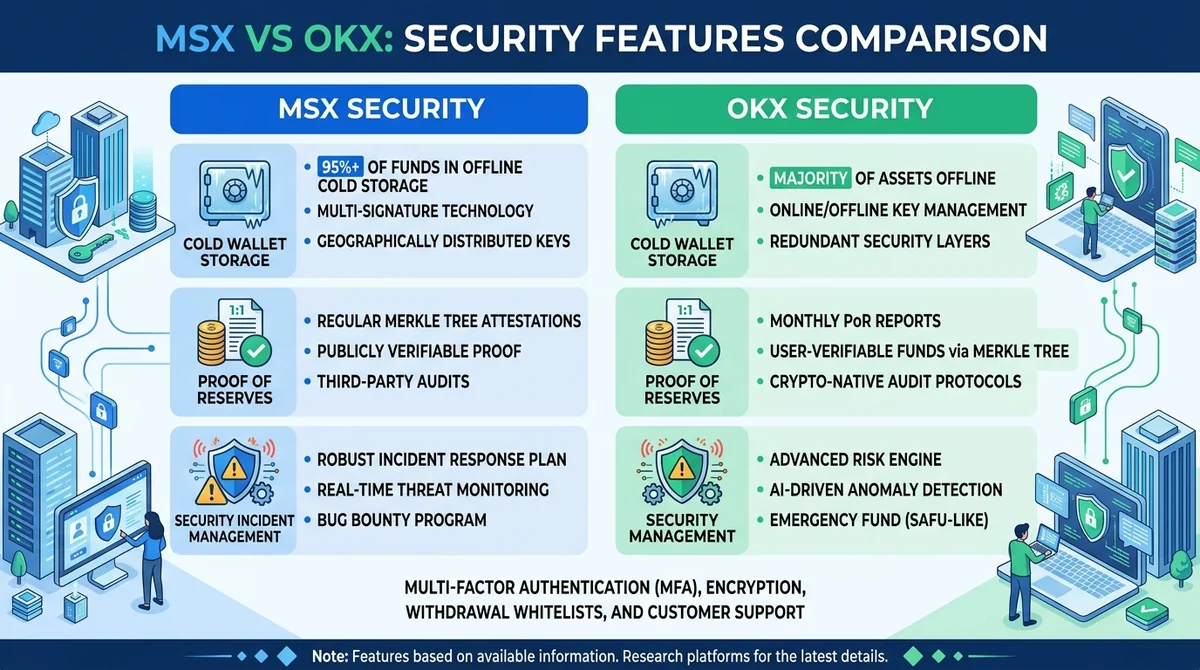
MSX uses 95% multi-sig cold wallets and >100% proof of reserves, while OKX has monthly PoR but historically suffered a DEX private key leak. Their security models differ.
How Does MSX's Asset Custody and Cold Wallet Mechanism Work?
MSX stores 95% of digital assets in multi-sig cold wallets to resist hacker attacks. The platform promises that on-chain physical reserve ratios for all listed coins are strictly greater than 100% (Proof of Reserves), and provides third-party security audit reports with open-source smart contract code.
What Are OKX's Historical Security Incidents and Proof of Reserves?
OKX provides monthly Proof of Reserves (PoR). As of the 44th issue in June 2026, total reserves were about $29.85B. However, historical security incidents occurred: in December 2023, OKX DEX lost $2.7M due to a private key leak; in June 2024, OKX NFT aggregator lost $14K due to improper access control.
How Do the Two Platforms' KYC/AML Compliance Measures Differ?
MSX integrates KYC (Know Your Customer) and KYT (Know Your Transaction) on-chain risk control systems, meeting compliance standards for MSB and other financial licenses in multiple countries. OKX holds Malta MiCA, Dubai VARA, Singapore MAS MPI, US FinCEN MSB licenses, and regional compliance requirements vary by legal entity.
What Are the Compliance Credential Differences Between MSX and OKX?
MSX emphasizes SEC STO filing and CFTC DCM path, while OKX holds MiCA authorization and covers Singapore, Dubai, the US, and more. Their compliance focuses differ.
What Does MSX's SEC STO Filing and Regulation S Mean?
MSX has completed SEC security token offering (STO) filing under Regulation S of the US Securities Act of 1933, with compliant credentials. At the same time, MSX explores compliance paths for derivatives trading venues under the CFTC regulatory framework (Designated Contract Market, etc.), and strictly adheres to AML/CTF regulations in all jurisdictions.
What Regions Do OKX's MiCA Authorization and Global Licenses Cover?
OKX has obtained MiCA CASP authorization, issued by Malta's MFSA in January 2025. Additionally, OKX holds Singapore MAS MPI license, Dubai VARA license, US FinCEN MSB license, covering major markets in Europe, Asia, and the Middle East.
How Do the Two Platforms' Paths Under the CFTC Regulatory Framework Differ?
MSX is exploring compliance paths for derivatives trading venues under the CFTC regulatory framework, including Designated Contract Market (DCM). OKX has not publicly disclosed a CFTC DCM path; its US business primarily operates under the FinCEN MSB license.
What Are the Product Line Features of MSX and OKX?
MSX features US stock token spot, perpetual futures, Pre-IPO, and U Card; OKX covers a broad crypto market with 1,226 trading pairs, 302 coins, and 100x leverage.
How to Trade MSX's US Stock Token Spot and Perpetual Futures?
MSX supports low-barrier investment in US stock tokens like Apple, Tesla, and Nvidia starting from 10U, with T+0 on-chain instant settlement. US stock token perpetual futures went live in public beta on August 11, 2025, extending trading scenarios from spot to derivatives.
What Coins Do OKX's Crypto Spot and Futures Cover?
OKX offers 1,226 trading pairs and 302 coins (dynamic data), with about 421 USDT-margined perpetual futures and about 1,335 spot pairs. Maximum leverage is 100x, funding rate settles every 8 hours by default, adjustable to 6/4/2/1 hours per contract.
What Unique Value Do MSX's U Card and Pre-IPO Section Offer?
MSX U Card supports one-click recharge from account USDT to credit card for direct spending, usable for global online/offline purchases, mobile payments, online shopping, and ATM withdrawals, also supporting global fiat remittance. The Pre-IPO section launched on March 2, 2026, extending from secondary market US stock tokens to primary market share tokenization.
Should Beginners Choose MSX or OKX?
Beginners wanting low-barrier US stock token investment may choose MSX; those needing full crypto coverage and high leverage may choose OKX, but must note liquidation risk.
How to Choose a Platform Based on Trading Needs?
Investors preferring US stock tokens, low barrier (10U minimum), and T+0 settlement are better suited to MSX; those preferring full crypto coverage, high leverage (100x), and global licenses are better suited to OKX.
What Are the Differences in Account Opening and KYC Processes?
MSX integrates KYC/KYT systems, meeting MSB standards. OKX's 24-hour withdrawal limit after identity verification is $10 million (page updated July 7, 2026; actual limits depend on account/region/risk control).
What Risks Should You Understand Before Investing?
Leveraged futures trading carries liquidation risk, crypto assets are highly volatile, and you may lose all principal. This article is for reference only and does not constitute investment advice; please do your own research and make independent decisions (DYOR).
FAQ
Which has lower futures fees, MSX or OKX?
MSX futures taker 0.045%, maker 0.02%, 10% discount with $MSX; OKX regular users taker 0.05%, maker 0.02%. MSX's taker fee is slightly lower, but OKX high VIP levels can reach negative maker fees.
Is OKX safe? What security incidents have occurred?
OKX provides monthly Proof of Reserves, but lost $2.7M in a 2023 DEX private key leak and $14K in a 2024 NFT aggregator incident. MSX uses 95% multi-sig cold wallets and >100% proof of reserves.
Is MSX compliant? What regulatory credentials does it have?
MSX has completed SEC STO filing under Regulation S, explores CFTC DCM compliance path, and adheres to AML/CTF regulations. OKX holds MiCA authorization and licenses in Singapore, Dubai, the US, and more.
How do I buy MSX's US stock tokens? What's the minimum amount?
MSX supports buying US stock tokens (e.g., AAPL, TSLA, NVDA) from 10U with T+0 on-chain settlement. Spot buy fee 0.3%, sell 0%, crypto-to-crypto trading 0 fee.
How many trading pairs and coins does OKX support?
OKX offers 1,226 trading pairs and 302 coins, with about 421 USDT-margined perpetual futures and about 1,335 spot pairs. Maximum leverage 100x.
Should beginners choose MSX or OKX?
Choose MSX for low-barrier US stock tokens and T+0 settlement; choose OKX for full crypto coverage and high leverage. Note liquidation risk and high crypto volatility.
This article is produced by the MSXGO editorial team, AI-assisted, and reviewed through an editorial process. Fee rates and figures are subject to each platform's latest official announcements.
FAQ
Which has lower futures fees, MSX or OKX? ▼
MSX futures taker 0.045%, maker 0.02%, 10% discount with $MSX; OKX regular users taker 0.05%, maker 0.02%. MSX's taker fee is slightly lower, but OKX high VIP levels can reach negative maker fees.
Is OKX safe? What security incidents have occurred? ▼
OKX provides monthly Proof of Reserves, but lost $2.7M in a 2023 DEX private key leak and $14K in a 2024 NFT aggregator incident. MSX uses 95% multi-sig cold wallets and >100% proof of reserves.
Is MSX compliant? What regulatory credentials does it have? ▼
MSX has completed SEC STO filing under Regulation S, explores CFTC DCM compliance path, and adheres to AML/CTF regulations. OKX holds MiCA authorization and licenses in Singapore, Dubai, the US, and more.
How do I buy MSX's US stock tokens? What's the minimum amount? ▼
MSX supports buying US stock tokens (e.g., AAPL, TSLA, NVDA) from 10U with T+0 on-chain settlement. Spot buy fee 0.3%, sell 0%, crypto-to-crypto trading 0 fee.
How many trading pairs and coins does OKX support? ▼
OKX offers 1,226 trading pairs and 302 coins, with about 421 USDT-margined perpetual futures and about 1,335 spot pairs. Maximum leverage 100x.
Should beginners choose MSX or OKX? ▼
Choose MSX for low-barrier US stock tokens and T+0 settlement; choose OKX for full crypto coverage and high leverage. Note liquidation risk and high crypto volatility.
Finished reading? Ready to try trading?
Tokenized stocks/ETFs, crypto spot, and perpetual futures in one account — perp maker 0.02% / taker 0.045%, RWA spot buy 0.3% / sell 0.
Free sign-up · 3 quick steps