Tokenized ETF Explained: What It Is, How It Works, and Key Risks
A tokenized ETF turns traditional ETF shares into blockchain tokens for instant settlement and 24/7 trading. See how it works, its benefits, and key risks.
Article Citation Summary
A tokenized ETF turns traditional ETF shares into blockchain tokens for instant settlement and 24/7 trading. See how it works, its benefits, and key risks.
Tokenized ETF Explained: What It Is, How It Works, and Key Risks
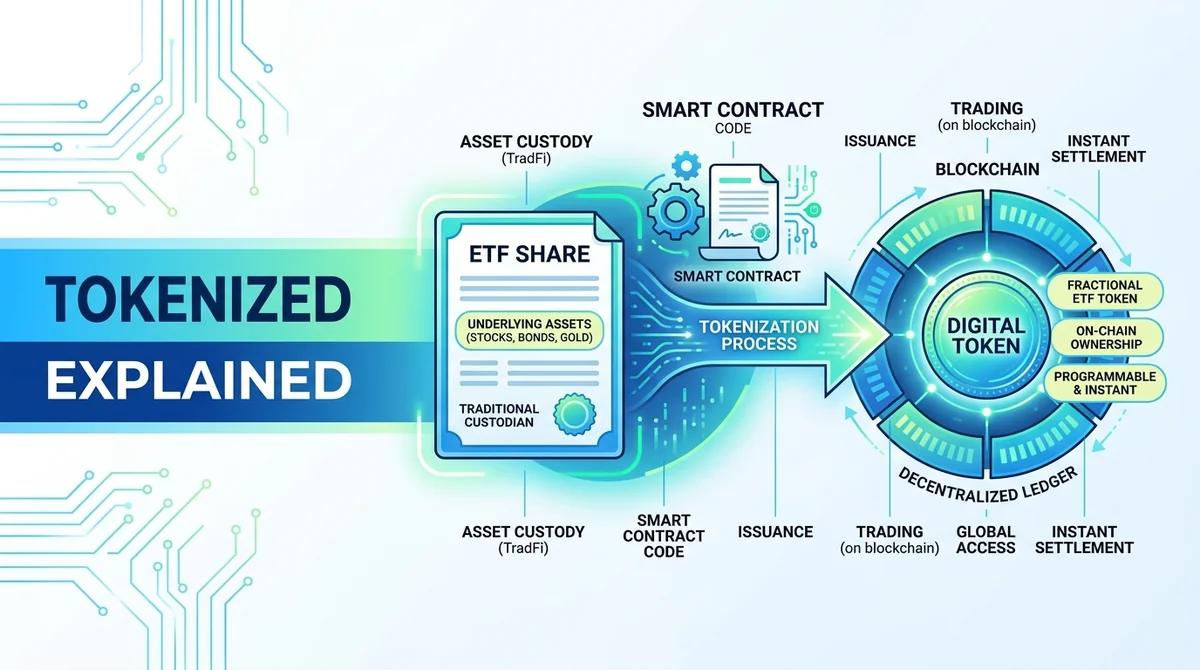
A tokenized ETF is a traditional ETF whose shares are represented as digital tokens on a blockchain, enabling new trading and settlement possibilities while keeping the same underlying investment strategy. This guide explains how tokenized ETFs work, their potential benefits, and the risks you should understand before getting involved.
Key Takeaways
- A tokenized ETF wraps existing ETF shares or issues tokens natively on a blockchain.
- Tokenization can enable instant settlement, 24/7 trading, and fractional ownership.
- Regulatory uncertainty, custody challenges, and limited liquidity are key risks.
- Tokenized ETFs are still experimental; not all products are available to retail investors.
What Is a Tokenized ETF?
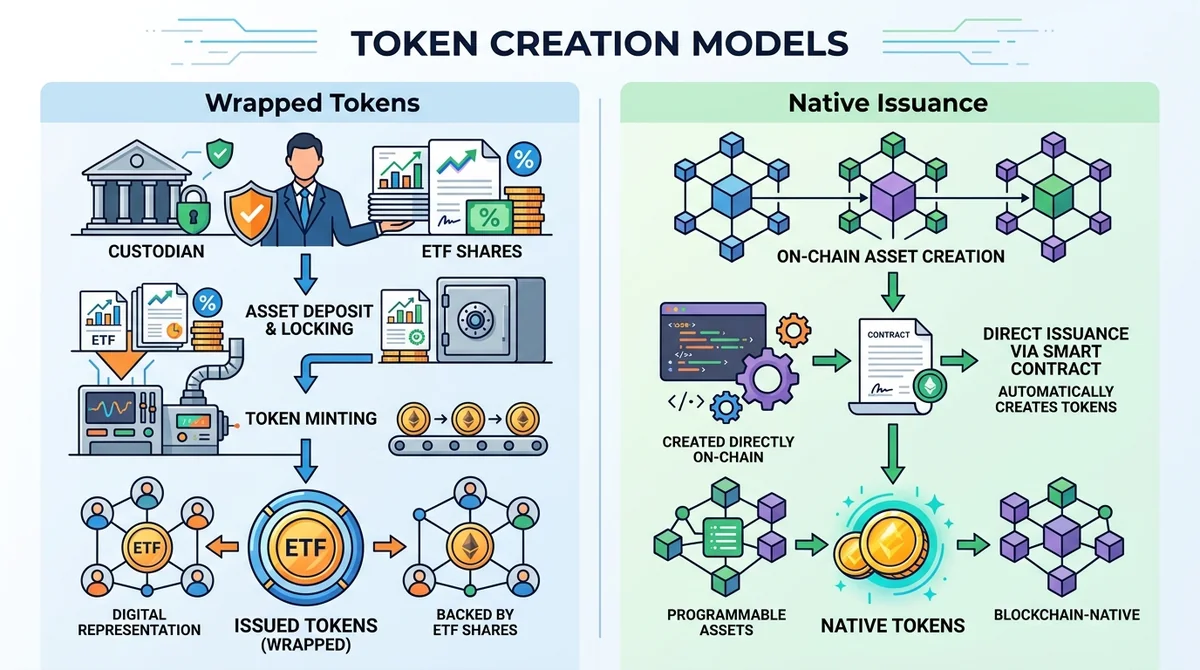
A tokenized ETF is a traditional ETF whose shares are represented as digital tokens on a blockchain or distributed ledger. The underlying investment strategy remains the same; only the share trading infrastructure changes. Tokenized ETFs can be wrapped tokens or natively issued tokens. Wrapped tokens represent existing ETF shares held by a custodian, while natively issued tokens are created directly on-chain as the actual security.
Definition of a tokenized ETF
According to PwC, a tokenized ETF is "a traditional ETF whose shares are represented as digital tokens on a blockchain or distributed ledger." This means the ETF still holds the same basket of assets, but ownership is recorded on a blockchain instead of through traditional brokerage and clearing systems.
Tokenized ETF vs traditional ETF
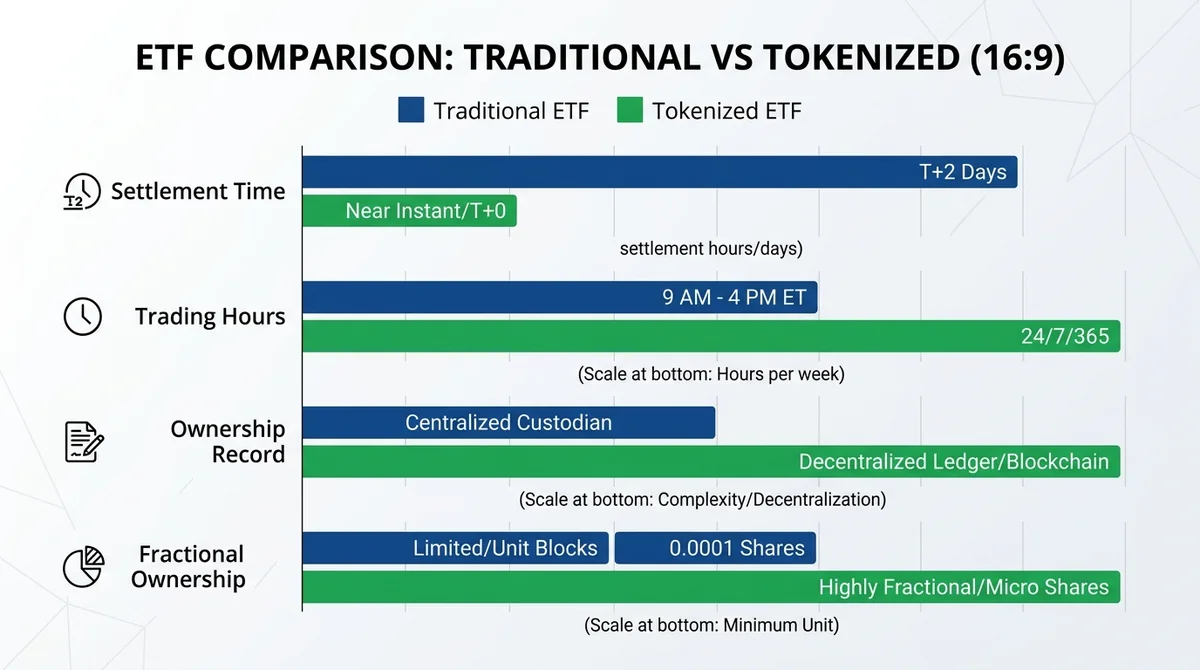
Traditional ETFs rely on brokerage accounts, centralized clearinghouses like the DTCC, and T+1 settlement cycles. Tokenized ETFs, by contrast, utilize immutable digital ledgers and smart contracts, potentially enabling near-instant settlement and round-the-clock trading. This difference in infrastructure can lower barriers to entry and improve efficiency.
How Does a Tokenized ETF Work?
Tokenized ETFs work by either wrapping existing shares into tokens or issuing tokens natively on a blockchain, with smart contracts automating settlement and reducing reliance on intermediaries.
Token wrapping vs native issuance
Wrapped structures represent existing exposure to an underlying security through tokens. Often, an unaffiliated third party with custody of the underlying ETF shares issues tokens that track the value of those shares. Natively issued tokens, on the other hand, are created directly on-chain as the actual security, with the blockchain serving as the system of record.
Role of smart contracts and distributed ledgers
Smart contracts automate functions like settlement, reducing intermediaries. For example, a smart contract can execute an atomic swap, where ownership transfer and payment occur simultaneously, reducing counterparty risk and capital requirements.
Settlement and custody process
In a tokenized ETF, settlement can be near-instant (T+0) rather than T+1. Custody of underlying assets and private keys is critical; secure custody solutions are necessary to prevent loss or theft.
Why Are Tokenized ETFs Important?
Tokenized ETFs are important because they could modernize ETF infrastructure by enabling instant settlement, 24/7 trading, and broader access, driven by industry trends toward automation and tokenization.
Potential to modernize ETF infrastructure
The ETF industry is exploring tokenization to improve efficiency and access. Growing ETF volumes and tighter regulations are requiring investors to leverage electronic workflows that are easier to document and scale. Tokenization is still experimental but gaining traction among major institutions.
Drivers: automation, electronification, and tokenization trends
According to J.P. Morgan, the global ETF market is expanding, with assets under management expected to reach $35 trillion by 2030, up from $19.5 trillion in 2025. This growth is necessitating the use of automated systems, which can process trades more efficiently and at lower cost. Active ETFs, which typically feature more complex set-ups than passive ETFs, are further fueling developments in electronification.
What Are the Benefits of Tokenized ETFs?
Tokenized ETFs offer potential benefits such as instant settlement, round-the-clock trading, fractional ownership, and lower costs through automation.
Instant settlement and reduced counterparty risk
Atomic settlement can reduce counterparty risk and capital requirements. Instead of waiting until the next business day (T+1), tokenized ETFs could enable "atomic settlement"—where ownership transfer and payment occur simultaneously.
24/7 trading and global distribution
Blockchain networks allow continuous trading, unlike traditional market hours. Tokenization may simplify cross-border access to investment products, potentially opening funds to global investors without friction from international securities trading.
Fractional ownership and cost efficiencies
Fractional ownership lowers investment barriers; smart contracts may reduce operational costs. For example, an investor can buy a fraction of a tokenized ETF share, making it easier to invest small amounts.
What Are the Risks and Limitations of Tokenized ETFs?
Tokenized ETFs face regulatory uncertainty, custody challenges, and limited adoption, which are key risks for investors.
Regulatory uncertainty
Tokenized ETFs face unclear regulations in many jurisdictions. The legal status of tokenized securities varies by country, and regulatory frameworks are still evolving.
Custody and security challenges
Secure custody of underlying assets and private keys is critical. If a custodian is hacked or loses private keys, investors could lose their assets. Stronger safeguards are needed.
Market adoption and liquidity
Technology is not yet mainstream; liquidity may be limited. Tokenized ETFs are still in early stages, and trading volumes may be lower than traditional ETFs, leading to wider bid-ask spreads.
A Simple Example of a Tokenized ETF
For example, an investor could buy a tokenized S&P 500 ETF on a blockchain, receive instant settlement, and trade fractional shares anytime.
Illustrative scenario: buying a tokenized S&P 500 ETF
Investor buys tokens representing shares of an ETF on a blockchain. Ownership is recorded on-chain; settlement is near-instant. Tokens can be traded 24/7 and fractionally. This example illustrates how tokenization can change the trading experience for everyday investors.
Tokenized ETFs on MSX
MSX offers tokenized stocks and ETFs, allowing users to trade tokenized assets with stablecoins. For example, MSX supports tokenized products like COIN, NVDA, and TSLA, which track the underlying stock prices. These products enable 24/7 trading and fractional ownership, similar to tokenized ETFs. However, specific tokenized ETF products may vary; check the MSX platform for current offerings.
Note: Tokenized products on MSX are not the same as holding actual shares; they are derivatives or wrapped tokens. Always verify the product structure and risks before trading.
How to Evaluate a Tokenized ETF
Before investing in a tokenized ETF, consider the following factors:
- Regulatory status: Is the product compliant in your jurisdiction?
- Custody: Who holds the underlying assets, and are they insured?
- Liquidity: What are the trading volumes and spreads?
- Fees: Compare management fees and trading costs.
- Transparency: Can you verify the token's backing on-chain?
This checklist can help you avoid common pitfalls.
Conclusion
Tokenized ETFs are an emerging innovation that could transform ETF trading by enabling instant settlement, 24/7 access, and fractional ownership. However, they come with regulatory, custody, and liquidity risks. As the technology matures, more products may become available, but always do your own research and understand the risks before investing.
This article is produced by the MSXGO editorial team, AI-assisted, and reviewed through an editorial process. Fee rates and figures are subject to each platform's latest official announcements.
FAQ
What is a tokenized ETF? ▼
A tokenized ETF is a traditional ETF whose shares are represented as digital tokens on a blockchain, enabling new trading and settlement possibilities while keeping the same underlying investment strategy.
How is a tokenized ETF different from a traditional ETF? ▼
Traditional ETFs rely on brokerage accounts and T+1 settlement, while tokenized ETFs use blockchain ledgers and smart contracts, potentially enabling instant settlement and 24/7 trading.
Are tokenized ETFs safe? ▼
Tokenized ETFs carry risks including regulatory uncertainty, custody challenges, and limited liquidity. Secure custody and compliance are critical, but the technology is still experimental.
Can I buy a tokenized ETF on MSX? ▼
MSX offers tokenized stocks and ETFs, but specific products may vary. Check the MSX platform for current listings and understand that tokenized products are not the same as holding actual shares.
What are the benefits of tokenized ETFs? ▼
Benefits include instant settlement, 24/7 trading, fractional ownership, and potential cost efficiencies through automation.
Finished reading? Ready to try trading?
Tokenized stocks/ETFs, crypto spot, and perpetual futures in one account — perp maker 0.02% / taker 0.045%, RWA spot buy 0.3% / sell 0.
Free sign-up · 3 quick steps