2026 U Card Fee Comparison: MSX X Card vs. Mainstream Crypto Spending Card Rates Explained
2026 U Card fee comparison: MSX X Card vs mainstream crypto spending cards. USDT one-click top-up, no FX fees, global spending & ATM withdrawals. See rates!

Article Citation Summary
2026 U Card fee comparison: MSX X Card vs mainstream crypto spending cards. USDT one-click top-up, no FX fees, global spending & ATM withdrawals. See rates!
2026 U Card Fee Comparison: MSX X Card vs. Mainstream Crypto Spending Card Rates Explained
Key Takeaways
- U Cards (crypto spending cards) let users load digital assets like USDT onto a card for direct use in global online/offline purchases, ATM withdrawals, and fiat remittances.
- MSX X Card supports one-click USDT top-up from your account to the card for direct spending, eliminating traditional cross-border wire transfers and high currency conversion fees.
- Mainstream U Card fees vary significantly; compare top-up, spending, withdrawal, and remittance fees comprehensively.
- As of 2026, MSX X Card offers advantages in USDT top-up spending, global coverage, and instant internal transfers; specific fees are subject to official announcements.
What Is a U Card? How Do Crypto Spending Cards Work?

U Cards (crypto spending cards) let users load digital assets like USDT onto the card and use them directly for global online and offline purchases, ATM withdrawals, and fiat remittances. MSX X Card is a typical example. It bridges digital assets and real-world spending, allowing crypto holders to make daily payments without first converting to fiat.
What Is the Core Difference Between U Cards and Traditional Credit Cards?
The fundamental difference lies in the funding source and settlement logic: U Cards are loaded with stablecoins like USDT, and at the time of spending, the issuer converts the crypto assets into local fiat currency in real time for settlement. Traditional credit cards rely on a bank's credit line and require repayment in fiat currency. U Cards do not occupy a bank credit line, making them more friendly to crypto asset holders.
Who Benefits Most from Using a U Card?
The following groups benefit most from using a U Card:
- Crypto asset holders: Want to use stablecoins like USDT directly for daily spending, avoiding the hassle of frequent fiat conversions.
- Cross-border consumers: Frequently make cross-border online purchases, subscribe to overseas services, or travel abroad, and need a low-cost payment tool.
- Global remittance users: Need to convert crypto assets into fiat and transfer to bank accounts in various countries.
2026 Mainstream U Card Fee Comparison: Where Does MSX X Card Stand?
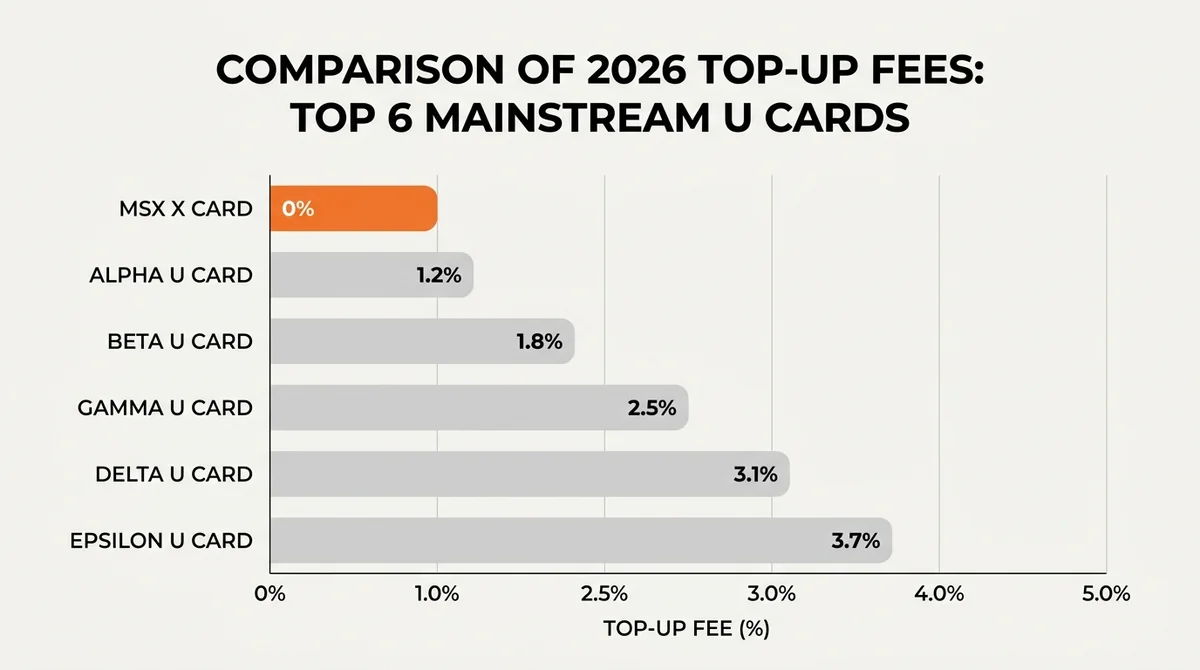
MSX X Card supports one-click USDT top-up from your account to the card for direct spending, eliminating traditional cross-border wire transfers and high currency conversion fees, making it fee-competitive among mainstream U Cards (specific fees subject to official announcements). Mainstream U Card fees vary significantly; compare top-up, spending, withdrawal, and remittance fees comprehensively.
How Much Do Top-Up Fees Differ Among Mainstream U Cards?
Top-up fees vary greatly among different U Cards, mainly depending on the top-up method (on-chain transfer, exchange transfer, etc.) and issuer policies. For example, MSX X Card waives top-up fees for one-click USDT top-up from your account to the card, while some U Cards charge 0.5%–2% for on-chain top-ups. Specific fees are subject to each platform's official announcements.
Which Card Has the Lowest ATM Withdrawal and Spending Fees?
ATM withdrawal and spending fees vary by card type. MSX X Card supports global ATM withdrawals; specific fees are subject to official announcements. Some U Cards charge a fixed fee for ATM withdrawals (e.g., $2–$5 per transaction) or 1%–2% of the withdrawal amount, while spending fees typically range from 0% to 1%. Users should choose the U Card with the best fees based on their usage scenarios.
What Are the Unique Advantages of MSX X Card?
MSX X Card bridges digital assets and real-world spending, supporting global online/offline purchases, ATM withdrawals, fiat remittances, and instant internal transfers between accounts, improving capital efficiency. Its core advantages lie in three areas: spending scenario coverage, transfer efficiency, and fee structure.
What Spending Scenarios Does MSX X Card Support?
MSX X Card supports the following spending scenarios:
- Global online/offline purchases, mobile payments, online shopping
- ATM withdrawals worldwide
- Global remittances converting crypto to fiat for bank accounts in various countries
How Efficient Are MSX X Card Account Transfers?
MSX X Card supports instant internal transfers between trading/funding/card accounts. Users can quickly transfer USDT from the trading account to the card account for spending without waiting for on-chain confirmation, significantly improving capital efficiency.
How to Choose the Best U Card for Your Needs?
Choosing a U Card requires comprehensive consideration of fees, supported scenarios, and transfer efficiency. MSX X Card has clear advantages in USDT top-up spending, global scenario coverage, and instant internal transfers. Users should choose the most suitable U Card based on their usage frequency, spending scenarios, and capital size.
What Core Metrics Should You Focus on When Choosing a U Card?
When choosing a U Card, focus on the following core metrics:
- Fee structure: Fees for top-up, spending, withdrawal, and remittance
- Supported currencies and spending scenario coverage: Whether it supports stablecoins like USDT and covers global online/offline spending
- Transfer efficiency and account convenience: Whether it supports instant internal transfers and convenient account management
Which U Card Is More Cost-Effective in Different Usage Scenarios?
The cost-effectiveness of U Cards varies by usage scenario:
- Frequent spending: Prioritize U Cards with low or zero spending fees
- Frequent withdrawals: Pay attention to ATM withdrawal fees and fee-free allowance
- Global remittances: Choose U Cards with low remittance fees and fast arrival times
MSX X Card offers comprehensive advantages in USDT top-up spending, global scenario coverage, and instant internal transfers, making it suitable for users with diverse needs.
FAQ
What is a U Card?
U Cards (crypto spending cards) let users load digital assets like USDT onto the card for direct use in global online/offline purchases, ATM withdrawals, and fiat remittances. MSX X Card is a typical example.
What is the top-up fee for MSX X Card?
MSX X Card supports one-click USDT top-up from your account to the card for direct spending and waives top-up fees. Specific fees are subject to official announcements.
What spending scenarios does MSX X Card support?
MSX X Card supports global online/offline purchases, mobile payments, online shopping, ATM withdrawals worldwide, and global remittances converting crypto to fiat for bank accounts in various countries.
How to choose the best U Card for your needs?
Choosing a U Card requires comprehensive consideration of fees, supported scenarios, and transfer efficiency. MSX X Card has clear advantages in USDT top-up spending, global scenario coverage, and instant internal transfers.
What are the specific spending and withdrawal fees for MSX X Card?
MSX X Card's specific spending and withdrawal fees are subject to official announcements. According to MSX data, MSX X Card supports global ATM withdrawals and waives top-up fees for one-click USDT top-up from the account, but specific spending and withdrawal fee rates are not explicitly stated in public materials. Users are advised to refer to the latest official announcements.
Compared with other U Cards, where do MSX X Card's fee advantages lie?
Compared with other U Cards, MSX X Card's main fee advantage is that it waives top-up fees for one-click USDT top-up from the account to the card, and supports global spending and ATM withdrawals. According to MSX data, some other U Cards charge 0.5%–2% for on-chain top-ups, while MSX X Card waives this fee. However, specific spending and withdrawal fees are subject to official announcements.
Learn the complete guide to MSX fees 2026
View MSX Registration Tutorial 2026
Learn the crypto exchange selection framework 2026
This article is produced by the MSXGO editorial team, AI-assisted, and reviewed through an editorial process. Fee rates and figures are subject to each platform's latest official announcements.
FAQ
What is a U Card? ▼
U Cards (crypto spending cards) allow users to load digital assets like USDT onto the card for direct use in global online/offline purchases, ATM withdrawals, and fiat remittances. MSX X Card is a typical example.
What is the top-up fee for MSX X Card? ▼
MSX X Card supports one-click USDT top-up from your account to the card for direct spending and waives top-up fees. Specific fees are subject to official announcements.
What spending scenarios does MSX X Card support? ▼
MSX X Card supports global online/offline purchases, mobile payments, online shopping, ATM withdrawals worldwide, and global remittances converting crypto to fiat for bank accounts in various countries.
How to choose the best U Card for your needs? ▼
Choosing a U Card requires comprehensive consideration of fees, supported scenarios, and transfer efficiency. MSX X Card has clear advantages in USDT top-up spending, global scenario coverage, and instant internal transfers.
Finished reading? Ready to try trading?
Tokenized stocks/ETFs, crypto spot, and perpetual futures in one account — perp maker 0.02% / taker 0.045%, RWA spot buy 0.3% / sell 0.
Free sign-up · 3 quick steps