MSX US Stock Daily Watch: Fed September Rate Hike Expectations: Warsh's Hawkish Tone Raises Probability, Jobs Report and CPI Data Become Key
Sept rate hike odds rise: Warsh hawkish, jobs & CPI key. S&P 500 mild bull; Microsoft 10-12% dividend hike expected; Touchstone lag warns.
Article Citation Summary
Sept rate hike odds rise: Warsh hawkish, jobs & CPI key. S&P 500 mild bull; Microsoft 10-12% dividend hike expected; Touchstone lag warns.
Fed September Rate Hike Expectations Heat Up: Warsh's Hawkish Signal Roils Markets
This article is based on public market information from Seeking Alpha and other sources, observing key variables in the US stock market. For more daily market updates, see the US Stock Daily Watch series.
After Warsh's hawkish signal pushed up September rate hike expectations, the market did not see a one-sided sell-off in risk assets. As of August 30, 2026, the S&P 500 was still heading toward the end of August in a mildly bullish posture, and giants like Microsoft and Texas Instruments are expected to announce dividend increases in September, providing cash flow defensive clues for the high-rate window.
The current trading logic is not simply fear of rate hikes, but a portfolio rebalancing from "easing expectations" to "neutral-to-tight" monetary policy amid economic resilience and better-than-expected corporate earnings.
As of August 30, 2026, Warsh's hawkish signal has raised the probability of a September rate hike, and the jobs report and CPI data have become core variables for validating the policy path.
Key Takeaways
As of August 30, 2026, market discussion of Warsh's hawkish signal has pushed up September rate hike expectations, with the jobs report and CPI data becoming core variables for validating the policy path. The S&P 500 is on track to close August with a mildly bullish tone, supported by Q2 economic resilience, better-than-expected corporate earnings, and easing geopolitical risks. Microsoft, Texas Instruments, Lockheed Martin, and others are expected to announce dividend increases in September; Touchstone Dividend Equity Fund underperformed the benchmark Russell 1000 Value Index in Q2, signaling style mismatch risk for active value strategies.
Key elements:
- As of August 30, 2026, market analysis suggests that Fed Chair Warsh's hawkish signal has raised the probability of a September rate hike, and the upcoming jobs report and CPI data are key. (Source: Seeking Alpha)
- The S&P 500 is on track to close August with a mildly bullish tone, and the author of the article says they have initially positioned for a rally to 8,000. (Source: Seeking Alpha; note: this is the author's forecast, not an established fact)
- The US stock market performed strongly in Q2 2026, supported by economic resilience, better-than-expected corporate earnings, and easing geopolitical risks. (Source: Seeking Alpha)
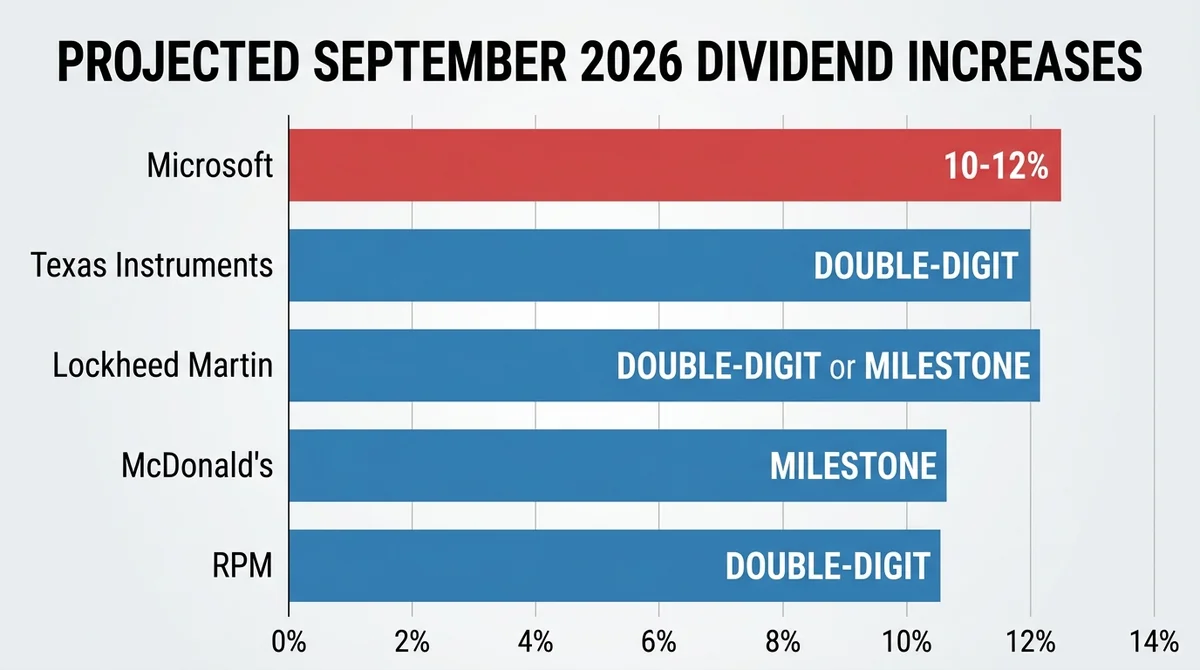
- Microsoft is expected to announce a 10%-12% annual dividend increase in September 2026, marking its 25th consecutive year of dividend hikes. (Source: Seeking Alpha; note: this expectation has not yet materialized)
- Texas Instruments and Lockheed Martin are expected to announce double-digit dividend increases in September 2026, while McDonald's and RPM are expected to achieve milestone increases. (Source: Seeking Alpha; note: all are expectations)
- Touchstone Dividend Equity Fund (Class A, no-load) underperformed the benchmark Russell 1000 Value Index in the quarter ended June 30, 2026. (Source: Seeking Alpha)
1. Warsh's Hawkish Signal Pushes Up September Rate Hike Odds, Jobs Report and CPI Shift from Background Data to Direct Catalysts
1. Market Discussion of Warsh's Hawkish Signal Is Priced as a Higher Probability of a September Rate Hike
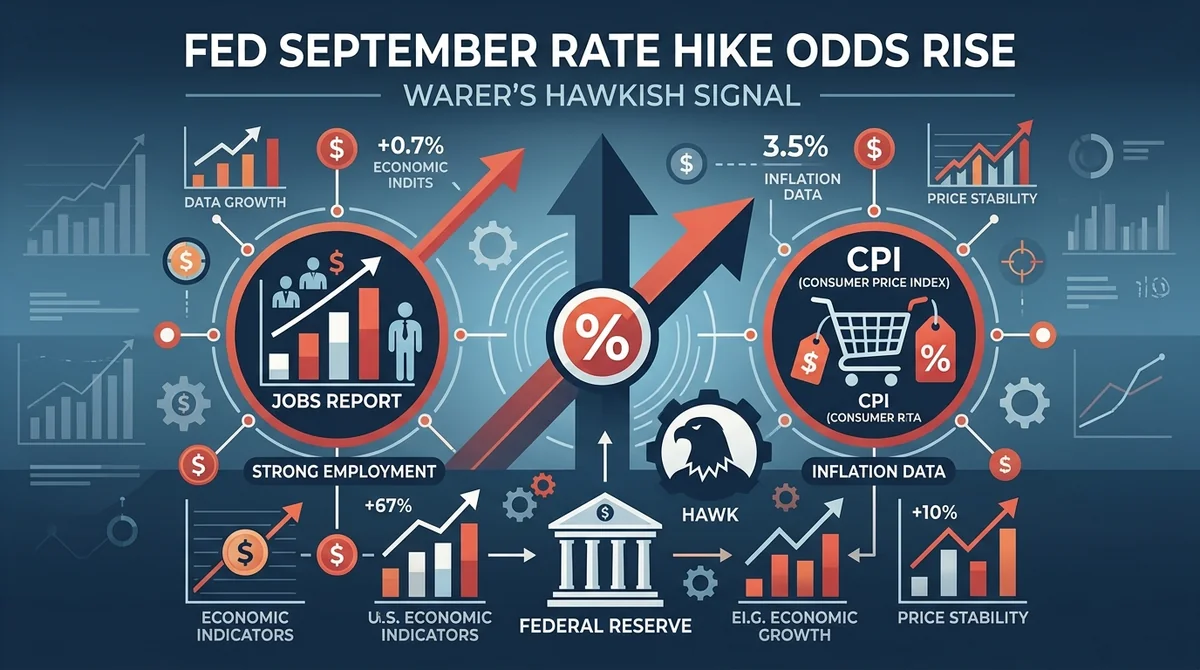
According to an article on Seeking Alpha dated August 30, 2026, Fed Chair Warsh's hawkish tone has increased the probability of a September rate hike. For a detailed analysis of the Fed's policy path, see the Fed policy analysis.
However, his hawkish signal did cause the jobs report and CPI data, originally a routine economic backdrop, to be repriced by the market as a "key data pair" for validating the rate hike path. Under the catalyst of the hawkish signal, interest-rate-sensitive growth sectors may face short-term valuation pressure. The market's repricing of the policy path will depend directly on whether the upcoming data supports further tightening. Therefore, Warsh's hawkish signal not only changed expectations themselves but elevated two routine data releases into core directional variables.
2. Jobs Report and CPI Become the "Key Data Pair" for Validating the Rate Hike Path
The author of the article explicitly points out that after Warsh's hawkish tone, the upcoming jobs report and CPI data become key. This data pair matters because it directly feeds into the Fed's policy function: if employment remains strong and inflation sticky, the probability of a September hike will rise further; conversely, if the data weakens, hawkish expectations may cool.
Since this data pair has not yet been released, the market is in a period of shifting expectations, and the S&P 500's mildly bullish posture shows that investors have not fully retreated in advance but are waiting for the data to give clearer direction. This "data-dependent" characteristic makes macro events a direct trigger for short-term volatility rather than determinant of medium-to-long-term trends.
3. Q2 Economic Resilience, Corporate Earnings, and Geopolitical Easing Create Room for Policy Tightening
The US stock market performed strongly in Q2 2026, supported by economic resilience, better-than-expected corporate earnings, and easing geopolitical risks. This backdrop provides a realistic basis for a hawkish stance: precisely because the economy has not clearly stalled, the Fed has room to consider further rate hikes.
In other words, the strong Q2 performance serves as both the "source of tolerance" for policy tightening and a cushion that has prevented the market from falling broadly on rate hike expectations. If subsequent data continues the resilience seen in Q2, rate hike expectations may be realized; but if cracks appear in the data, the hawkish stance may be forced to correct. Therefore, the current pricing of a September hike is essentially testing the upper limit of interest rates that economic resilience can withstand.
2. S&P 500 Mildly Bullish and the 8,000-Point Positioning: A Bet on Economic Resilience, Not a Rate-Cut Cycle
1. S&P 500 on Track to Close August Mildly Bullish, Showing Risk Appetite Not Completely Reversed by Rate Hike Expectations
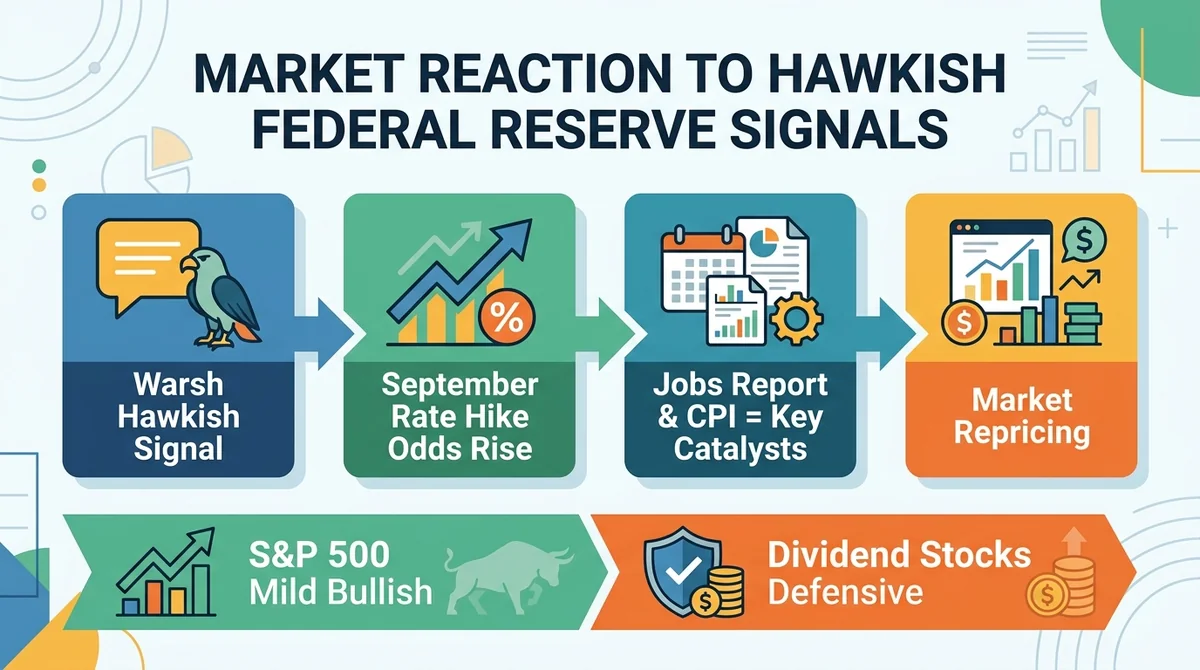
Despite Warsh's hawkish signal raising the odds of a September hike, the S&P 500 is still on track to finish the final stretch of August with a mildly bullish tone. The author of the Seeking Alpha article points this out, emphasizing that the market has not entirely shifted to a defensive posture due to rising rate hike expectations. This performance is directly related to Q2 economic resilience, better-than-expected corporate earnings, and easing geopolitical risks.
The mildly bullish tone suggests that some capital is still rewarding earnings improvement and growth certainty, rather than simply shorting risk assets based on rate expectations. Under this posture, a significant index-level pullback would require marked deterioration in the data; otherwise, short-term volatility may be confined to style rotation rather than a broad decline. "On track to be mildly bullish" is still a forecast, and the final closing result has not been confirmed.
The S&P 500 is on track to close August with a mildly bullish tone, and the article's author has initially positioned for a rally to 8,000.
2. Author's Initial Positioning for a Rally to 8,000 Represents a Trend Continuation Call Based on Earnings and Resilience
In the same article, the author explicitly states that they have initially positioned for a rally in the S&P 500 to 8,000. This target is not based on valuation expansion driven by rate cuts, but on a continuation call of earnings growth and economic resilience. If the subsequent jobs report and CPI data do not deteriorate significantly, this trend may continue to be supported; conversely, if the data triggers further escalation of rate hike expectations, a reassessment will be needed.
Therefore, the 8,000-point positioning is both an endorsement of the trend and an implicit wait for key data validation. This positioning is not an assertion that the market will inevitably rise, but a probabilistic bet under current fundamental constraints, whose success depends heavily on whether Q2 resilience can carry into Q3. This information is only the original author's personal trading view and does not constitute investment advice.
3. Easing Geopolitical Risks and Better-Than-Expected Q2 Earnings Form Two Supporting Pillars for the Mild Bullishness
The US stock market performed strongly in Q2 2026, supported by economic resilience, better-than-expected corporate earnings, and easing geopolitical risks. These three factors continued to play a role in August, with better-than-expected earnings providing a fundamental anchor for the index, while easing geopolitical risks lowered the risk premium.
Therefore, despite rising September rate hike expectations, no recession signals have appeared in the macro fundamentals, supporting the underlying logic of the mild bullishness. Of the two supporting pillars, better-than-expected earnings are a relatively harder factor because they directly enhance corporate free cash flow and valuation tolerance; geopolitical easing is more of a marginal repair of the risk premium, and its sustainability needs to be watched. If both pillars loosen simultaneously, the mildly bullish posture could reverse.
3. Microsoft, Texas Instruments, Lockheed Martin September Dividend Growth Wave: Dividend Assets Provide Cash Flow Defense for the High-Rate Window
1. Microsoft Expected to Announce a 10%-12% Annual Dividend Increase in September 2026, Marking 25 Consecutive Years of Hikes
According to the Seeking Alpha article, Microsoft is expected to announce a 10%-12% annual dividend increase in September 2026. If this increase materializes, it would mark Microsoft's 25th consecutive year of dividend hikes. For a special analysis of dividend growth strategies, see the dividend growth strategy explainer.
Amid rising rate hike expectations and a prolonged high-rate window, cash-rich tech giants like Microsoft are signaling shareholder return discipline and earnings predictability through dividend growth. A 25-year streak of dividend hikes is itself a powerful signal. For investors, this dividend growth provides a relatively certain cash flow return path in a rising-rate environment, partially hedging against valuation compression risk.
Microsoft is expected to announce a 10%-12% annual dividend increase in September 2026, marking the 25th consecutive year of hikes if realized.
2. Texas Instruments and Lockheed Martin Expected to Announce Double-Digit Dividend Growth Simultaneously, While McDonald's and RPM Achieve Milestone Increases
Beyond Microsoft, Texas Instruments and Lockheed Martin are expected to announce double-digit dividend increases in September 2026, while McDonald's and RPM are expected to achieve milestone increases. This lineup spans multiple industries, including semiconductors, defense, and consumer services, indicating that dividend growth is not an isolated act by individual companies but a collective choice by high-cash-flow industries.
Especially in a high-interest-rate environment, raising dividends can attract investors seeking stable cash flow returns and reduce stock price volatility. As a semiconductor cyclical, Texas Instruments' dividend growth reflects management's confidence in long-term free cash flow; Lockheed Martin's defense business cash flow is more stable; the milestone increases from McDonald's and RPM reflect the shareholder return culture of mature consumer and service companies. All of the above are expectations, and actual announcements are subject to company disclosures.
3. Expanding Dividend Growth Lineup Reflects Corporate Confidence in Free Cash Flow and Shareholder Returns, Not Simply Cyclical Expansion
The expanding lineup of September dividend growth reflects companies' emphasis on the certainty of their free cash flow and shareholder returns, rather than simply cyclical capital expenditure expansion. Against the backdrop of a possible September Fed rate hike, companies returning capital to shareholders through dividend increases is both a confirmation of profitability and a defensive support for stock prices.
For investors, such dividend growth signals lower the opportunity cost of holding stocks, especially when risk-free rates may rise. Therefore, the dividend growth wave and the S&P 500's mild bullishness are not contradictory: the former represents micro-level cash flow defense, while the latter represents macro-level earnings resilience. Both point to the same conclusion—the market is not pricing in a recession but is selectively favoring certainty in a high-rate window.
4. Warning from Touchstone Dividend Equity Fund Underperforming Benchmark: Value Strategy Exposes Allocation Weaknesses in Q2 Strong Market
1. Touchstone Dividend Equity Fund (Class A, No-Load) Underperformed the Benchmark Russell 1000 Value Index in the Quarter Ended June 30, 2026
Touchstone Dividend Equity Fund (Class A, no-load) underperformed the benchmark Russell 1000 Value Index in the quarter ended June 30, 2026. This underperformance occurred against the backdrop of overall strength in the US stock market in Q2: the US stock market in Q2 2026 rose significantly, supported by economic resilience, better-than-expected corporate earnings, and easing geopolitical risks.
Therefore, the fund's lag was not due to an overall market decline, but because its portfolio allocation failed to fully capture the style of the market's advance. This fact reminds investors that even in a quarter when the broad market rises, the relative performance of actively managed funds can diverge, and underperforming the benchmark is not a low-probability event.
Touchstone Dividend Equity Fund underperformed the benchmark Russell 1000 Value Index in the quarter ended June 30, 2026.
2. Underperformance Is Not Stock-Specific Bad News but Result of Combined Q2 Style Dispersion and Benchmark Concentration
The analysis suggests that this underperformance is not simply stock-specific bad news, but more likely the result of Q2 style dispersion in the US market combined with benchmark concentration. When a market rally is driven by a few heavyweight stocks or specific styles, an actively managed dividend strategy that is overly concentrated in traditional value stocks, while missing tech stocks or other high-beta sectors, can easily lag the benchmark.
Additionally, the Russell 1000 Value Index itself is significantly influenced by the performance of certain constituents, and benchmark concentration may have amplified the strategy's deviation. Therefore, this underperformance case is more like an exposure of style mismatch rather than a major misstep in a particular holding.
3. For Dividend Investors, Active Management Underperformance Reinforces the Practical Value of Indexing and Cost-Sensitive Allocation
For dividend-focused investors, the underperformance of Touchstone Dividend Equity Fund serves as a warning: active management does not necessarily beat the index in certain market environments, and may instead lag due to style mismatch and fee drag. Therefore, the practical significance of indexing and cost-sensitive allocation in dividend strategies is reinforced.
Investors need to assess whether the management fees paid for active management have generated corresponding stock-picking returns; otherwise, low-cost index funds may be more efficient tools. This lesson contrasts with the dividend growth of companies like Microsoft discussed earlier: dividend certainty at the individual stock level does not equate to return certainty at the portfolio level, and style deviations at the strategy execution level may offset individual stock advantages.
Final Thoughts
As Warsh's hawkish signal and the key September data approach, investors are not facing a one-sided risk but a portfolio rebalancing of economic resilience, dividend certainty, and valuation sensitivity. On one hand, the jobs report and CPI data will verify whether the rate hike path truly requires further tightening; on the other hand, the S&P 500's mild bullishness and the dividend growth from giants like Microsoft indicate that the market is not pricing in a recession. This means that even if short-term interest rate expectations fluctuate, medium-term earnings trends and cash flow certainty remain important forces supporting the market.
From the internal structure of dividend strategies, the underperformance of the Touchstone fund reminds us that value and dividend are not synonyms, and style deviations in strategy execution can lead to significant lag. In a market driven by a few high-growth stocks, passive indexes often capture upside more comprehensively, while active dividend strategies require additional stock-picking skill to generate excess returns. Therefore, investors need to make more careful trade-offs between passive and active approaches.
Overall, the phenomena observed in this article—hawkish signals, mild bullishness, a wave of dividend growth, and active fund underperformance—collectively point to a broader signal: the US stock market is transitioning from a liquidity-driven easing bull to an earnings- and cash-flow-driven resilience bull. In this transition, marginal changes in policy rates will cause volatility but will not immediately reverse the trend supported by corporate fundamentals. What investors should focus on is not just whether the next rate hike happens, but whether earnings growth and dividend certainty can continue to materialize in a high-rate environment.
FAQ
Has the probability of a September Fed rate hike been pushed up?
According to the Seeking Alpha article, Fed Chair Warsh's hawkish signal has pushed up the probability of a September rate hike. The upcoming jobs report and CPI data are key to validation.
How has the S&P 500 performed in August?
As of August 30, 2026, the S&P 500 is on track to close August with a mildly bullish tone. This is a forecast; the article's author stated that they have initially positioned for a rally to 8,000, which is a personal trading view.
When is Microsoft expected to announce its dividend increase? What is the increase magnitude?
Microsoft is expected to announce a 10%-12% annual dividend increase in September 2026, marking its 25th consecutive year of hikes if realized. This expectation has not yet materialized and is subject to company announcements.
How did Touchstone Dividend Equity Fund perform in Q2?
Touchstone Dividend Equity Fund (Class A, no-load) underperformed the benchmark Russell 1000 Value Index in the quarter ended June 30, 2026.
Besides Microsoft, which other companies are expected to announce dividend increases in September?
Texas Instruments and Lockheed Martin are expected to announce double-digit dividend increases in September 2026, while McDonald's and RPM are expected to achieve milestone increases—all are expectations.
Risk Disclaimer: Macroeconomic and US stock market volatility is severe. This article is for academic and research observation only and does not constitute investment advice.
This article is produced by the MSXGO editorial team, AI-assisted, and reviewed through an editorial process. Fee rates and figures are subject to each platform's latest official announcements.
FAQ
Has the probability of a September Fed rate hike been pushed up? ▼
According to the Seeking Alpha article, Warsh's hawkish signal has raised the probability of a September rate hike, but note that the "Fed Chair" title used in the original article is inaccurate; the upcoming jobs report and CPI data are key validation factors.
How has the S&P 500 performed in August? ▼
As of August 30, 2026, the S&P 500 is on track to close August with a mildly bullish tone, but this is a forecast; the article's author says they have initially positioned for a rally to 8,000, a personal trading view.
When is Microsoft expected to announce its dividend increase? What is the increase magnitude? ▼
Microsoft is expected to announce a 10%-12% annual dividend increase in September 2026, marking its 25th consecutive year of hikes if realized; but this expectation has not yet occurred, and the "25th consecutive year" claim is subject to company announcements.
How did Touchstone Dividend Equity Fund perform in Q2? ▼
Touchstone Dividend Equity Fund (Class A, no-load) underperformed the benchmark Russell 1000 Value Index in the quarter ended June 30, 2026.
Besides Microsoft, which other companies are expected to announce dividend increases in September? ▼
Texas Instruments and Lockheed Martin are expected to announce double-digit dividend increases in September 2026, while McDonald's and RPM are expected to achieve milestone increases—all are expectations.
Finished reading? Ready to try trading?
Tokenized stocks/ETFs, crypto spot, and perpetual futures in one account — perp maker 0.02% / taker 0.045%, RWA spot buy 0.3% / sell 0.
Free sign-up · 3 quick steps