MSX US Stocks Daily Watch: HPE and Uber: Earnings Beat but Supply Constraints, London Autonomous Driving Launch
HPE beat but supply issues hit stock; Uber London AV launch a catalyst, still 25% below Sept 2025 high; claims 205K; Sunstone raised guidance; crypto weak.
Article Citation Summary
HPE beat but supply issues hit stock; Uber London AV launch a catalyst, still 25% below Sept 2025 high; claims 205K; Sunstone raised guidance; crypto weak.
MSX US Stocks Daily Watch: HPE and Uber: Earnings Beat but Supply Constraints, London Autonomous Driving Launch
September 2026 This article is about 5,000 words; full read takes about 12 minutes.
When earnings beats no longer translate into share price gains, and a London autonomous driving launch cannot single-handedly reverse a 25% drawdown, the US Stocks Daily Watch sees supply constraints and macro liquidity jointly setting the marginal direction for individual stocks. HPE's supply chain bottlenecks, Uber's autonomous driving catalyst, the signal from initial jobless claims for risk appetite, and the cross-asset contrast between Sunstone's raised guidance and crypto weakness together form the market narrative on the eve of the first full trading week of September 2026. A single positive catalyst is unlikely to push a stock into a trend; an earnings beat mostly brings a recalibration of the pricing structure.
AI Summary Key takeaways: HPE beat earnings expectations but supply remains constrained, and the stock fell after hours; Uber's London autonomous driving launch provides a near-term catalyst, but the stock is still 25% below its September 2025 high; macro data and cross-asset performance show that supply constraints and liquidity expectations are dominating marginal pricing in US equities.
Key elements:
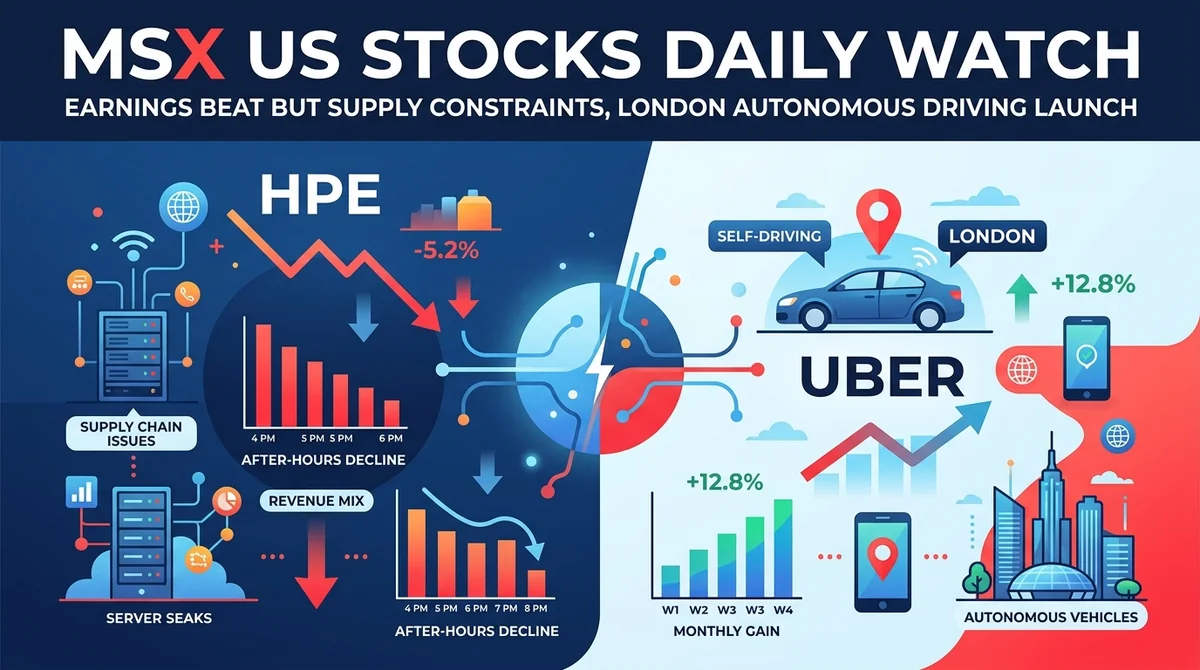
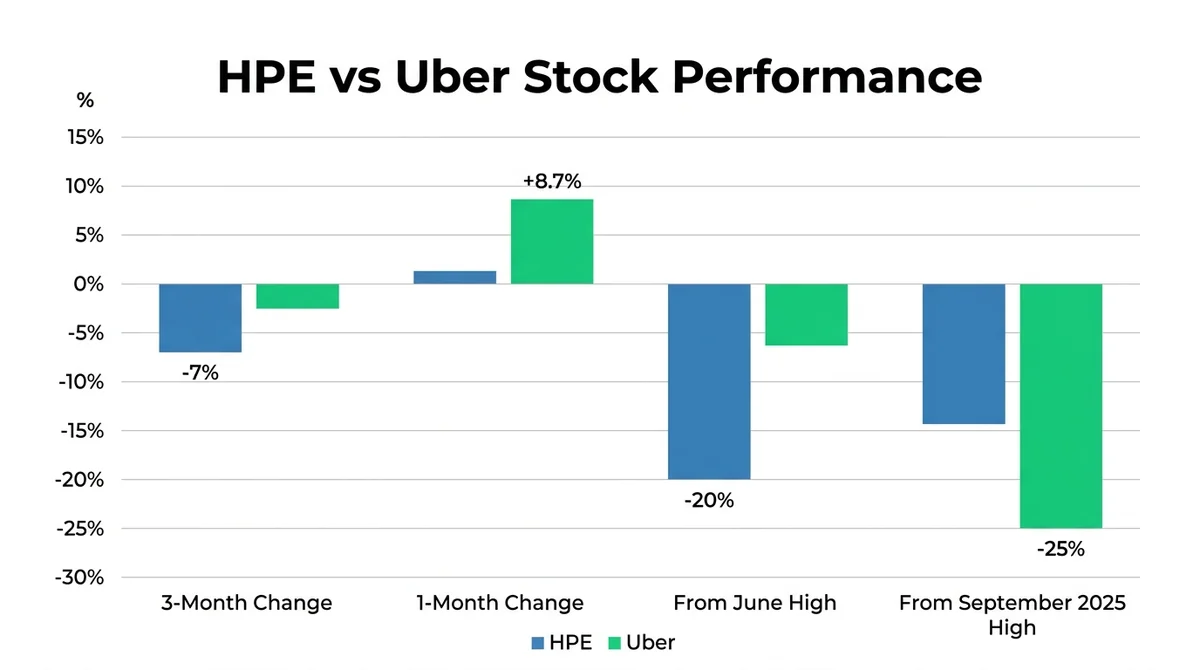
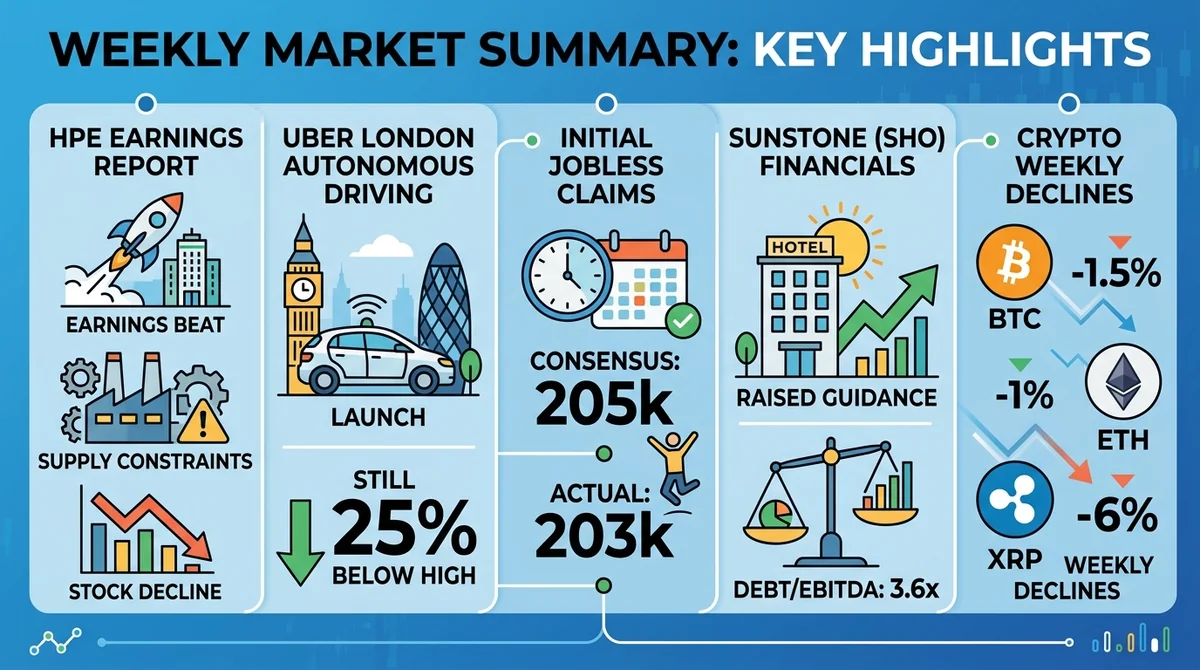
- Hewlett Packard Enterprise (HPE) beat earnings expectations, but CEO Antonio Neri said supply will remain constrained; the stock fell after hours, down more than 7% over the past three months and 20% below its June high (source: CNBC).
- Uber will launch an autonomous ride-hailing service in London on Thursday; shares rose 8.7% over the past month, but remain 25% below the September 2025 high (source: CNBC).
- Thursday brings US weekly initial jobless claims; Dow Jones consensus estimate is 205,000, versus 203,000 in the prior week (source: CNBC).
- Sunstone Hotel Investors beat Q2 2026 expectations and raised full-year guidance for the second consecutive quarter; net debt plus preferred stock to EBITDA fell to 3.6x, with available liquidity of $930 million (source: Seeking Alpha).
- For the week ended September 1, 2026, Bitcoin fell 1.5%, Ethereum 1%, and XRP 6%; Bitcoin is down about 12% year-to-date, Ethereum about 19%, and Bitcoin is about 38% below its October 2025 all-time high (source: Seeking Alpha).
1. HPE's Earnings Beat Can't Mask Supply Constraints: After-Hours Decline Exposes Market Pricing Logic
1. HPE Beats Earnings but Stock Falls After Hours as CEO Antonio Neri Warns Supply Will Remain Constrained
HPE's latest earnings report delivered a seemingly contradictory result: company-level earnings beat market expectations, but the stock turned lower in after-hours trading. According to CNBC's September 2 report, Hewlett Packard Enterprise (HPE) beat earnings expectations, while CEO Antonio Neri made clear that supply will remain constrained. These two messages appearing together explain the direct cause of the after-hours decline—the market heard guidance that "constraints are persisting," not simply good news. For HPE, which is in a rapidly rising AI server demand cycle, supply constraints mean revenue recognition and delivery schedules may be delayed; an earnings beat reflects the realization of prior orders more than a simultaneous expansion of future supply capacity. The stock's reaction is therefore not a rejection of the results themselves but a repricing of the key variable of "visible supply." For related analysis, see HPE earnings deep dive.
From a trading structure perspective, HPE's after-hours decline also reflects an expectation gap repair. When an earnings beat has largely been priced in by the market, the marginal boost from the beat weakens; the CEO's statement that supply will remain constrained directly challenges the previous optimistic assumptions of faster deliveries and accelerating revenue. CNBC's report did not provide additional pessimistic data, but the forward-looking judgment that "supply will remain constrained" alone was enough to prompt some short-term funds to exit after hours. This reaction also shows that the current US stock market's pricing of hardware and infrastructure companies has shifted from merely looking at whether earnings can beat expectations to requiring visible support from actual supply capacity. Of course, the after-hours drop may also reflect overall market sentiment or profit-taking, but based on available information, supply constraints remain the market's core focus.
2. Down More Than 7% Over Three Months and 20% Below June High, Supply Bottleneck Caps Valuation Recovery
Putting the after-hours decline into a larger timeframe, HPE's weakness is not an isolated event. The same CNBC report noted that the stock is down more than 7% over the past three months and 20% below its June high. This drawdown shows that the market had already priced in HPE's supply issues to a significant degree before the earnings release. Supply bottlenecks act as a persistent friction, making it difficult for any earnings-driven rebound to develop into a trend. The more than 7% decline over three months means that even with better-than-expected earnings, the room for share price recovery remains capped by the "supply ceiling." A valuation recovery requires a substantive improvement in delivery capacity, not just a single-quarter earnings surprise.
It is worth noting that the 20% drawdown did not occur amid deteriorating demand but during a phase of still-robust AI infrastructure investment. Demand signals remain positive, but supply bottlenecks make investors doubt the realizability of revenue. This combination of "strong demand but constrained supply" tends to compress valuations: the market is willing to pay higher multiples for revenue that is certain to be realized, but discounts orders that may be delayed. That is the core contradiction HPE currently faces. Without signals of supply-side easing, the rebound from an earnings beat may remain confined to short-term trading and struggle to translate into a systematic upward shift in the valuation center.
3. Market Pricing Shifts from 'Beat' to 'Visible Supply': HPE Faces Dual Test of Earnings Quality and Delivery Capacity
HPE's after-hours move clearly shows that the market's pricing focus has shifted from "whether earnings beat" to "whether visible supply is adequate." CNBC's report placed "supply will remain constrained" at the center of the CEO's remarks, itself signaling the market's focus. When a company is in a high-growth sector, an earnings beat is only the baseline threshold; what truly determines the stock's direction is whether the company can convert demand into actual delivery and whether that delivery is sustainable. HPE must be tested on both earnings quality and delivery capability: earnings quality requires that revenue is not driven purely by price increases or one-off items, while delivery capability tests execution in supply chain management and capacity expansion.
The implication for investors is that a single-point catalyst is no longer enough. HPE's case shows that even a classic positive like an earnings beat, without visible supply-side improvement, is unlikely to change the stock's medium-term trend. Going forward, the market may track HPE's order conversion rate, delivery lead times, and key component supply more closely. Until supply constraints ease materially, HPE's valuation recovery is more likely to be range-bound than a one-way rise. This also provides a case study for the broader US hardware sector: in the AI investment boom, supply-side constraints may carry more pricing weight than demand-side stories.
2. Uber's London Autonomous Driving Launch: A Catalyst After a 25% Drawdown from September 2025 High
1. Uber to Launch Autonomous Ride-Hailing in London on Thursday, Opening a Commercialization Window in a Key European City
Uber's autonomous driving push has reached a landmark moment. CNBC reported that Uber will launch an autonomous ride-hailing service in London on Thursday. London, as a key global
This article is produced by the MSXGO editorial team, AI-assisted, and reviewed through an editorial process. Fee rates and figures are subject to each platform's latest official announcements.
FAQ
HPE财报超预期为什么股价下跌? ▼
因为CEO Antonio Neri称供应将继续受限,市场担忧交付能力;同时该股过去三个月下跌逾7%、较6月高点下跌20%,供应瓶颈压制估值修复。
Uber伦敦自动驾驶落地对股价有何影响? ▼
伦敦落地是短期催化,过去一个月股价上涨8.7%,但较2025年9月高点仍低25%,长期robotaxi叙事尚未完全修复。
初请失业金人数预期是多少? ▼
道琼斯共识预期为20.5万,前一周为20.3万;若延续低位将强化劳动力市场韧性,并间接影响科技股与自动驾驶主题的风险偏好。
Sunstone Hotel Investors 业绩如何? ▼
2026年第二季度业绩超预期并连续第二个季度上调全年指引;净债务加优先股与EBITDA之比降至3.6倍,可用流动性为9.3亿美元,资产负债表改善。
加密资产本周表现如何? ▼
截至2026年9月1日当周,比特币下跌1.5%,以太坊下跌1%,XRP下跌6%;比特币年内下跌约12%,较2025年10月历史高点低约38%。
Finished reading? Ready to try trading?
Tokenized stocks/ETFs, crypto spot, and perpetual futures in one account — perp maker 0.02% / taker 0.045%, RWA spot buy 0.3% / sell 0.
Free sign-up · 3 quick steps