MSX US Stock Daily Watch: Hyperscaler Capex Under Scrutiny: AWS Revenue Up 39%, Operating Income Up 55%; Roblox Downgraded to Sell
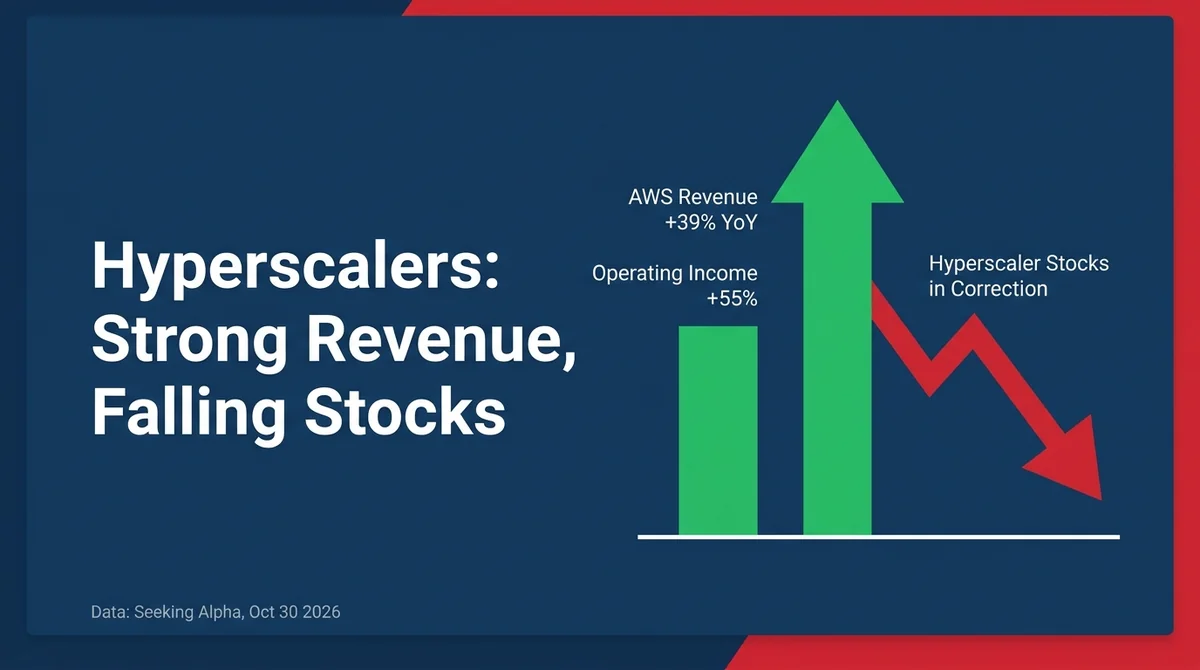
Hyperscaler earnings show strong revenue but falling stocks: AWS Q3 revenue +39%, operating income +55%, Amazon operating income +61%, yet negative FCF and AI capex spark capital-efficiency concerns; Roblox cut to Sell.
Article Citation Summary
Hyperscaler earnings show strong revenue but falling stocks: AWS Q3 revenue +39%, operating income +55%, Amazon operating income +61%, yet negative FCF and AI capex spark capital-efficiency concerns; Roblox cut to Sell.
MSX US Stock Daily Watch: Hyperscaler Capex Under Scrutiny: AWS Revenue Up 39%, Operating Income Up 55%; Roblox Downgraded to Sell
MSX Research
Guest Columnist
@MSX_CN
This article is about 4,000 words and takes about 11 minutes to read
When revenue growth is no longer a passport to valuation, what is really being priced this earnings season may have shifted to capital efficiency. According to an analysis published by Seeking Alpha on October 30, 2026, Amazon, Microsoft, Alphabet and Meta all posted strong third-quarter revenue growth, yet hyperscaler stocks have entered a correction range. In the same window, AWS delivered revenue up 39% year over year and operating income up 55%, while Roblox was downgraded to "Sell" by analysts on deteriorating engagement. Taken together, these three developments point not to a debate over "whether the AI narrative holds," but to a question of "whether the cash-flow quality and return cadence of AI spending can be accepted by the market."
AI Summary
Core view: This hyperscaler earnings season shows a divergence of "strong revenue, falling stocks"; some analysis suggests the market's pricing focus is shifting from revenue growth to capital efficiency and free cash flow quality. AWS's profit acceleration is the structural bright spot discussed separately this quarter, while Roblox's deteriorating engagement and downgrade form the other end of the same logic.
Key elements:
- According to Seeking Alpha's October 30, 2026 analysis, tech giants including Amazon, Microsoft, Alphabet and Meta posted strong third-quarter revenue growth, but hyperscaler stocks have entered a correction range.
- The same source notes that despite solid revenue, negative free cash flow and heavy AI infrastructure capex still raise market concerns about future returns and capital efficiency.
- Amazon AWS third-quarter revenue rose 39% year over year, with operating income up 55%.
- Although Amazon's third-quarter revenue and profit both missed expectations, its operating income rose 61% year over year, faster than revenue growth.
- Roblox's market cap shrank by about one-third, with revenue, bookings and daily active users all deteriorating.
- Analysts downgraded Roblox to "Sell" on deteriorating platform engagement and expect selling pressure to persist, especially tax-loss harvesting before December.
I. Hyperscaler Earnings Season Shows a Divergence of "Strong Revenue, Falling Stocks"
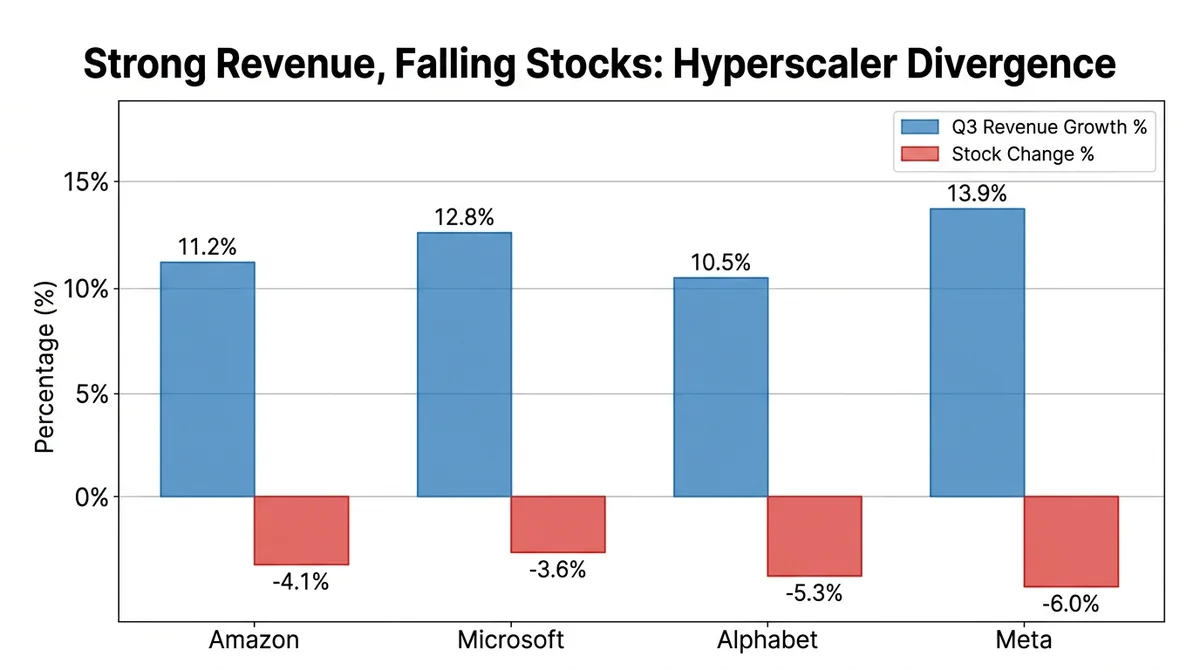
1. Amazon, Microsoft, Alphabet and Meta Posted Strong Q3 Revenue Growth, but Hyperscaler Stocks Have Entered a Correction Range
Let's set out the facts first. According to an analysis published by Seeking Alpha on October 30, 2026, tech giants including Amazon, Microsoft, Alphabet and Meta posted strong third-quarter revenue growth, but hyperscaler stocks have entered a correction range. This set of information contains two signals pointing in opposite directions: the revenue side is still expanding, while the stock price side is already contracting. For a market accustomed to the transmission chain of "AI capex—cloud revenue growth—valuation re-rating," this combination is itself worth recording.
It should be emphasized that this is not an individual problem for any one company, but a pattern shared by four hyperscalers in the same earnings season. When the four most representative AI infrastructure spenders simultaneously show "strong revenue, falling stocks," the signal the market is sending may no longer be "who is growing faster," but "how many valuation multiples such growth should be assigned." In other words, the correction is occurring against a backdrop of improving revenue data, suggesting the variable weighing on valuation may not be on the income statement.
2. Solid Revenue and Pressured Stocks Appear Together; Market Pricing Focus May Have Shifted from Growth to Capital Efficiency
Strong earnings-season revenue has not translated into stock price support, and market attention has shifted. This is the most noteworthy point of this divergence: in past quarters, hyperscaler valuation expansion was mainly driven by cloud revenue growth and AI order expectations; this quarter, the same strong revenue is no longer enough to offset stock price pressure. The shift in pricing focus from "how fast is growth" to "how much did growth cost and when will it pay back" is a common valuation-framework-switch interpretation in market commentary, but it should be noted that this judgment is an analytical inference, not a conclusion directly verified by data.
In terms of market implications, such a switch usually does not complete within a week, nor does it affect only a single name. If capital efficiency does indeed become the dominant variable, then even if revenue continues to beat expectations in subsequent quarters, valuation repair may lag behind fundamental improvement—because what the market needs to see is evidence of improving free cash flow and returns on investment, not merely revenue growth. This point forms the premise for understanding this quarter's stock-level divergence, but still needs to be verified by subsequent earnings data.
II. AWS Becomes This Quarter's Bright Spot: Revenue Up 39%, Operating Income Up 55%, Profit Growth Outpaces Revenue
1. AWS Third-Quarter Revenue Rose 39% Year over Year, Operating Income Up 55%
Against the backdrop of collective pressure on the four hyperscalers, AWS's data constitutes the clearest structural bright spot this quarter. According to an earnings analysis published by Seeking Alpha on October 30, 2026, Amazon AWS third-quarter revenue rose 39% year over year, with operating income up 55%. Looking at the two numbers together, the key is that the latter grew faster than the former—operating income up 55%, faster than revenue growth of 39%.
This matters because it answers one of the questions the market cares about most right now: whether cloud business growth is "bought with cash burn." When operating income growth outpaces revenue growth, it means the margin structure is improving alongside revenue expansion, rather than scale being bought through continuously escalating subsidies or discounts. For a hyperscaler sector being interrogated over capex, this is a positive sample pointing in the opposite direction. It should be noted that the above interpretation is based on a comparison of the two growth rates; the source did not disclose specific cost composition or business structure change details.
2. Amazon's Overall Operating Income Rose 61% Year over Year, Faster Than Revenue Growth, but Both Revenue and Profit Missed Expectations
The same analysis also provides the overall Amazon picture: although Amazon's third-quarter revenue and profit both missed expectations, its operating income rose 61% year over year, faster than revenue growth. There is a subtle tension here that is easy to overlook—the absolute level missed market expectations, but the growth structure was better than revenue. That is, Amazon's problem this quarter was not in the direction of profitability, but in the expectation threshold the market had previously set.
The market implication is that an expectations gap and structural improvement can coexist. When both revenue and profit miss expectations, the stock's first reaction is often negative; but if profit growth continues to outpace revenue growth, it shows that operating leverage is being released. The time gap between the two is precisely the range where valuation disagreements are most likely to appear. As the structural bright spot discussed separately this quarter, AWS's combination of 39% revenue growth and 55% operating income growth provides concrete support for this judgment.
3. Profit Growth Faster Than Revenue Growth May Point to Improving Cloud Business Structure and Cost Efficiency
Putting AWS's 39% and 55% side by side, and then adding Amazon's overall 61% operating income growth, a consistent thread emerges: the profit side is expanding faster than the revenue side. This combination is usually interpreted as an improvement in cloud business structure and cost efficiency, rather than pure scale expansion. It should be noted that this judgment is an analytical inference about the data structure; the source did not disclose specific cost composition or business structure change details, and it cannot be regarded as confirmed fact.
From a valuation perspective, the significance of such improvement is that it may directly act on free cash flow improvement—if profit conversion efficiency rises, the cash flow pressure brought by capex of the same scale will be partially offset. This is why, in this round of "capex scrutiny," AWS's data is seen as a bright spot: it suggests that under the same intensity of AI infrastructure spending, margin improvement is possible.
III. Negative Free Cash Flow and AI Infrastructure Spending Become the Core Variables of Valuation Scrutiny
1. Negative Free Cash Flow and Heavy AI Infrastructure Capex Raise Market Concerns About Future Returns and Capital Efficiency
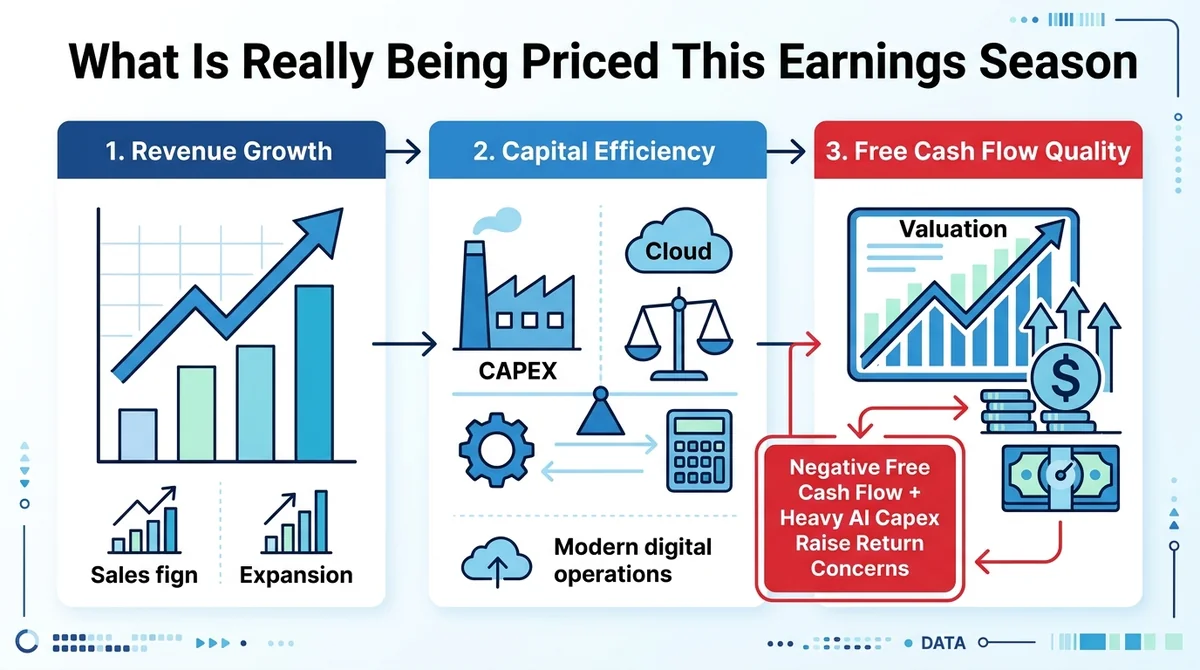
According to an analysis published by Seeking Alpha on October 30, 2026, despite solid revenue, negative free cash flow and heavy AI infrastructure capex still raise market concerns about future returns and capital efficiency. This sentence basically explains the cause of this round's "strong revenue, falling stocks" divergence: what weighs on valuation may not be revenue, but cash flow and spending.
Negative free cash flow means that operating cash flow for the period is insufficient to cover capex, and the company needs to finance AI infrastructure buildout by other means. When four hyperscalers are simultaneously in this state, the market's focus naturally shifts from "whose AI revenue is growing faster" to "whose investment payback period is shorter and capital efficiency higher." This also explains why AWS's profit acceleration is singled out for discussion—in a sector under overall cash flow pressure, margin improvement is a scarce signal. It should be noted that the source did not disclose the specific values and definitions of each of the four companies' free cash flow, and this article makes no quantitative judgment on this.
2. The Length of the Capex Payback Cycle May Determine Whether the Current Correction Is Valuation Digestion or a Trend Reversal
Market concerns center on the return cadence and capital efficiency of AI infrastructure spending, not on revenue momentum. This is a key distinction: if the concern is revenue momentum, the correction may end as next quarter's revenue beats expectations; but if the concern is return cadence, the duration of the correction will depend on how quickly capex converts into cash flow. The two correspond to completely different market paths.
From an inferential perspective, if subsequent quarters show slowing capex growth or signs of free cash flow turning from negative to positive, the current correction is more likely to be characterized as valuation digestion; conversely, if capex continues to escalate while cash flow improvement lags, the correction may evolve into a re-pricing of the entire AI infrastructure investment logic. The relationship between capex and free cash flow thus becomes a key variable for observing hyperscaler valuation. This judgment is an analytical inference and does not constitute a forecast of subsequent earnings.
IV. Roblox Downgraded to Sell: Deteriorating Engagement Plus Tax-Loss Harvesting Selling Pressure
1. Roblox's Market Cap Shrank by About One-Third, with Revenue, Bookings and Daily Active Users All Deteriorating
Unlike the hyperscalers' "strong revenue, falling stocks," Roblox faces deterioration in both fundamentals and share price in the same direction. According to an analysis published by Seeking Alpha on October 30, 2026, Roblox's market cap shrank by about one-third, with revenue, bookings and daily active users all deteriorating. Three metrics weakening simultaneously means the problem is not just single-quarter revenue volatility, but touches platform engagement, the core driver.
Daily active users and bookings deteriorating at the same time has particularly direct implications for platform companies: user scale is the foundation of the content ecosystem and monetization, and declining engagement suppresses both current bookings and the predictability of future revenue. This is why the market usually reacts faster to such signals than to margin fluctuations—the former affects the slope of the growth curve, while the latter affects the position of the growth curve.
2. Analysts Downgraded to "Sell" and Expect Selling Pressure to Persist, Especially Tax-Loss Harvesting Before December
The same analysis notes that analysts downgraded Roblox to "Sell" on deteriorating platform engagement and expect selling pressure to persist, especially tax-loss harvesting before December. Two layers of pressure appear here: one from the fundamental rating downgrade, the other from seasonal fund behavior. Tax-loss harvesting is a common year-end tax-driven selling behavior; its characteristic is that it is unrelated to company fundamentals, yet it may amplify downside pressure on individual stocks within a specific time window.
Observing Roblox alongside the hyperscalers reveals the divergence logic of this earnings season: the market may be distinguishing "growth supported by cash flow" from "growth dependent on spending and user scale." For the former, even with short-term stock corrections, its profit acceleration is still seen as a structural bright spot; for the latter, once engagement metrics weaken, ratings and fund behavior may quickly form a negative resonance. Whether this divergence holds still needs subsequent data verification; this article treats it as an analytical framework rather than a confirmed conclusion.
Final Thoughts
What is most worth recording this earnings season is not any single number, but the possible switch in the market's interpretive framework. The four hyperscalers posted strong third-quarter revenue growth, yet their stocks have entered a correction range; negative free cash flow and heavy AI infrastructure capex are seen by the market as one of the core variables weighing on valuation. This means the market's pricing of AI may have moved past the "narrative verification" stage into the "cash flow verification" stage. At this stage, the marginal utility of revenue beats may decline, while the marginal utility of capital efficiency and return cadence rises.
AWS's data provides a positive sample under this framework: revenue up 39% year over year, operating income up 55%, profit growth outpacing revenue growth, accompanied by Amazon's overall operating income growth of 61%. But it is equally worth recording that Amazon's third-quarter revenue and profit both missed expectations—structural improvement and an expectations gap can coexist, which is exactly where current valuation disagreements are most concentrated. If capex growth slows or free cash flow improves in subsequent quarters, the current correction is more likely to be characterized as valuation digestion; otherwise, it may trigger a re-pricing of the entire investment logic.
Roblox constitutes the other end. Revenue, bookings and daily active users deteriorated simultaneously, market cap shrank by about one-third, and analysts downgraded it to "Sell" while expecting selling pressure to persist, especially tax-loss harvesting before December. This case suggests that in a pricing environment dominated by capital efficiency, deterioration in engagement-type metrics may be amplified through ratings and seasonal fund behavior, creating dual pressure from fundamentals and fund flows.
Putting the two ends together, the core signal of this earnings season is: the market may be distinguishing "growth supported by cash flow" from "growth dependent on spending and user scale." The return cadence of negative free cash flow and AI infrastructure capex is the core observation point for hyperscaler valuation going forward; while seasonal fund behavior such as tax-loss harvesting may amplify volatility at the individual stock level. These two threads will jointly shape the market's reaction pattern in the next earnings season.
Risk warning: Macroeconomic conditions and the US stock market are highly volatile. This content is provided solely for academic and research observation reference by MSX Research and does not constitute any investment advice.
Invest in AI RWA Finance
References
This article is produced by the MSXGO editorial team, AI-assisted, and reviewed through an editorial process. Fee rates and figures are subject to each platform's latest official announcements.
FAQ
What were the core characteristics of hyperscaler third-quarter 2026 earnings? ▼
According to an analysis published by Seeking Alpha on October 30, 2026, tech giants including Amazon, Microsoft, Alphabet and Meta posted strong third-quarter revenue growth, but hyperscaler stocks have entered a correction range, forming a divergence of strong revenue and falling stocks.
How much did AWS third-quarter revenue and operating income grow? ▼
According to Seeking Alpha's earnings analysis on October 30, 2026, Amazon AWS third-quarter revenue rose 39% year over year, with operating income up 55%, as profit growth outpaced revenue growth.
Amazon's third-quarter revenue and profit missed expectations—why is it still seen as structural improvement? ▼
The same analysis notes that although Amazon's third-quarter revenue and profit both missed expectations, its operating income rose 61% year over year, faster than revenue growth, indicating profit expansion outpaced revenue and was interpreted as a sign of improving cloud business structure and cost efficiency.
What is the core reason for the hyperscaler stock correction? ▼
According to Seeking Alpha's October 30, 2026 analysis, despite solid revenue, negative free cash flow and heavy AI infrastructure capex raised market concerns about future returns and capital efficiency, with market focus seen as shifting from growth to capital efficiency.
Why was Roblox downgraded to Sell by analysts? ▼
According to Seeking Alpha's October 30, 2026 analysis, Roblox's market cap shrank by about one-third, with revenue, bookings and daily active users all deteriorating. Analysts downgraded it to "Sell" citing deteriorating platform engagement and expect selling pressure to persist, especially tax-loss harvesting before December.
Why does tax-loss harvesting amplify selling pressure on individual stocks? ▼
Tax-loss harvesting is a common year-end tax-driven selling behavior unrelated to company fundamentals, but it may combine with rating downgrades within a specific time window to form a negative resonance. According to the same analysis, analysts expect Roblox's selling pressure to persist, especially tax-loss harvesting before December.
Finished reading? Ready to try trading?
Tokenized stocks/ETFs, crypto spot, and perpetual futures in one account — perp maker 0.02% / taker 0.045%, RWA spot buy 0.3% / sell 0.
Free sign-up · 3 quick steps