MSX Daily US Stock Watch: Super Micro, Tango Therapeutics and Microsoft — Super Micro Guides AI Revenue Up 280% and Raises Gross Margin Outlook, Microsoft Advances In-House Silicon to Repair Cloud Margins
Super Micro sees Q1 revenue up 280% to about $19B and lifts gross margin guidance to 12%-12.5%; Microsoft's Maia 200 targets Q4 2026 production; Tango details vopimetastat pancreatic cancer data and registration strategy.
Article Citation Summary
Super Micro sees Q1 revenue up 280% to about $19B and lifts gross margin guidance to 12%-12.5%; Microsoft's Maia 200 targets Q4 2026 production; Tango details vopimetastat pancreatic cancer data and registration strategy.
Super Micro Revenue Up 280%, Microsoft Maia 200 Production and Tango Pancreatic Cancer Data | Daily US Stock Watch
Guest Columnist
@MSX_CN
October 2026
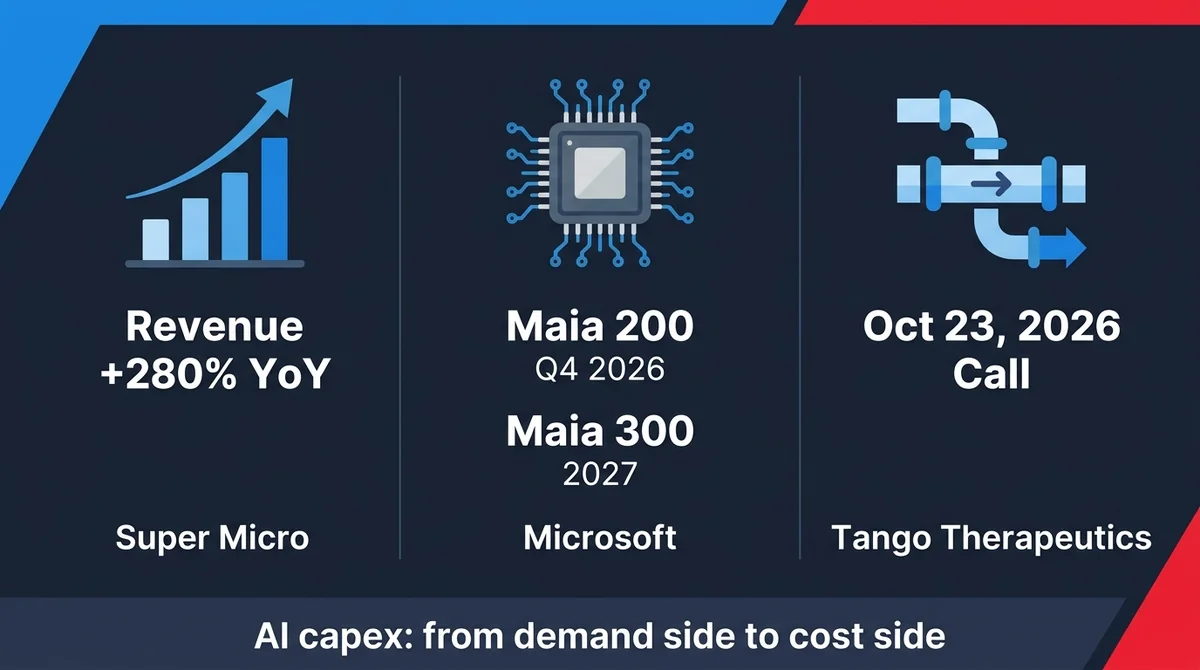
The AI trade is switching scorecards: for the past two years the market asked how fast compute demand could still grow, and now it asks whether this business can defend its gross margins and whether cloud providers can internalize the cost per unit of compute. Super Micro Computer answered with preliminary revenue up 280% year over year and gross margin guidance raised to 12%-12.5%; Microsoft answered with its in-house chip timetable for Maia 200 and Maia 300 — both roughly at the same time, each offering a draft of its own answer. Meanwhile, Tango Therapeutics put vopimetastat combination-therapy pancreatic cancer data and its registration strategy on a conference call, reminding the market that the pricing logic for non-AI assets is still event- and pipeline-driven.
AI Summary
Core view: These three seemingly unrelated news items in late October 2026 are organized here into an observation framework — "the AI capex narrative is migrating from the demand side to the cost side." On the hardware side, companies must prove that differentiation can resist commoditization; cloud providers must prove that in-house silicon can repair margins; and non-AI biotech names are still priced by single-pipeline events. Note that this framework is the interpretive lens of this article (an opinion), not a consensus publicly stated by the three companies.
Key elements:
- Super Micro Computer's preliminary data indicate first-quarter revenue will grow 280% year over year to about $19 billion.
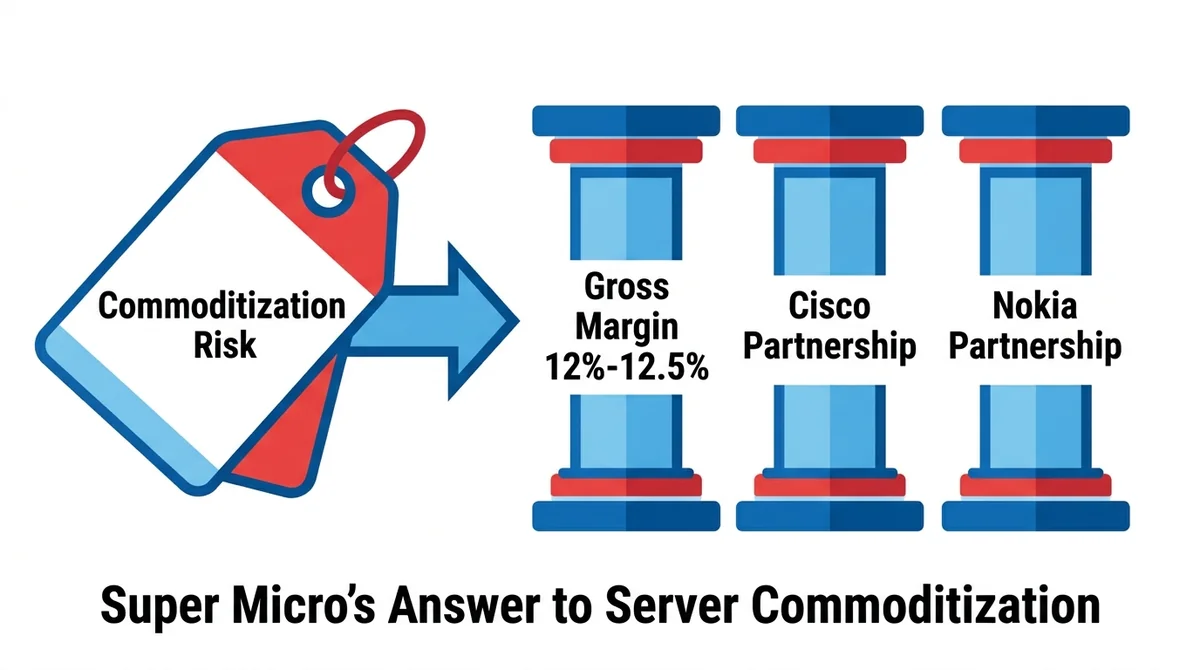
- Super Micro raised its gross margin guidance to 12%-12.5%, which the company links to product differentiation and easing concerns about server commoditization.
- Super Micro announced strategic partnerships with Cisco and Nokia, which the company says are intended to strengthen its coverage and pricing power in AI infrastructure.
- Microsoft plans to put its in-house Maia 200 chip into production in Q4 2026 and plans to launch Maia 300 in 2027.
- Microsoft plans to report fiscal 2027 first-quarter results after the US market close on October 28, 2026.
- Tango Therapeutics held a conference call on October 23, 2026 to discuss the latest data and registration strategy for vopimetastat combination therapy in pancreatic cancer.
Key data comparison across the three companies:
| Company | Key data | Source and date |
|---|---|---|
| Super Micro Computer | Q1 revenue of about $19 billion, up 280% YoY; gross margin guidance raised to 12%-12.5% | Seeking Alpha, October 23, 2026 |
| Microsoft | Maia 200 targeted for Q4 2026 production, Maia 300 planned for 2027; fiscal 2027 Q1 results due after the close on October 28, 2026 | Seeking Alpha, October 23, 2026 (chip timetable); October 28, 2026 (earnings date) |
| Tango Therapeutics | October 23, 2026 conference call discussing latest vopimetastat combination-therapy pancreatic cancer data and registration strategy | Seeking Alpha, October 23, 2026 |
1. Super Micro Answers Server Commoditization Doubts with 280% Revenue Growth and 12%-12.5% Gross Margin Guidance
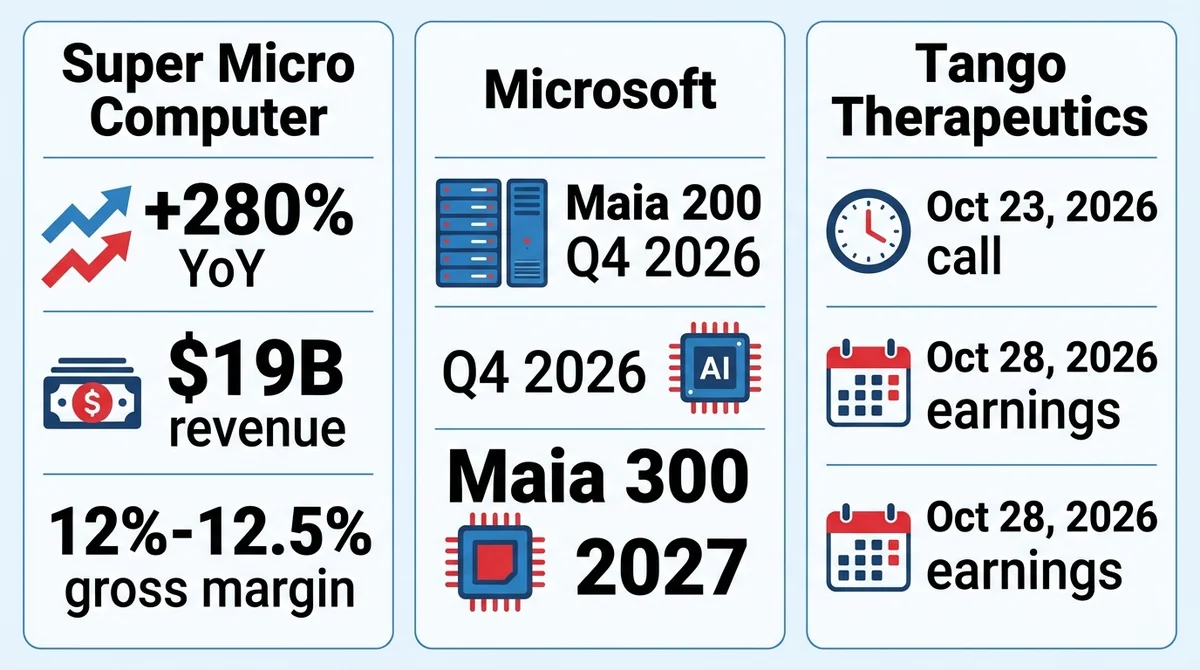
1. Q1 revenue of about $19 billion, up 280% year over year, as AI server demand keeps accelerating
Super Micro's first-quarter revenue is about $19 billion, up 280% year over year (Source: Seeking Alpha, October 23, 2026). This is preliminary data, not the final reported basis.
In the context of the US hardware sector, this is an exceptionally high growth rate — if the final figures hold, it means that on top of a base of several consecutive quarters of high growth in AI server shipments, the demand curve has not yet shown the slope deceleration the market had feared. For investors watching the AI infrastructure chain, the most important information in this preliminary data is not the absolute amount but the direction of growth.
It should be stressed that this remains preliminary company data rather than the final reported basis, and this article has not verified its consistency with the company's official announcements. Differences may exist between preliminary data and the final audited basis; revenue recognition timing, product mix and customer concentration could all shift the final numbers away from the preliminary basis. A rational reading, therefore, is to treat it as a directional signal on the demand side, not as a profit conclusion that can be extrapolated directly.
2. Gross margin guidance raised to 12%-12.5%, with product differentiation as the core narrative against commoditization
Super Micro raised its gross margin guidance to 12%-12.5%, and the company explicitly links this adjustment to "reflecting product differentiation and easing concerns about server commoditization" (Source: Seeking Alpha, October 23, 2026). This is guidance, not a realized result.
Server assembly has long been viewed by the market as a low-margin business easily eroded by price wars; once AI servers are placed in a "commoditized hardware" framework, the valuation gets compressed to manufacturing levels. Raising gross margin guidance can be seen as an attempt to pull the narrative back from "assembly capacity" to "differentiated products." From a volume-price perspective, high revenue growth and a raised gross margin guidance appearing together is a signal the company wants the market to believe that growth is not being bought with price cuts. If leading server makers can defend or even lift gross margins while growing fast, the bear case that "AI hardware is just a low-margin assembly business" would be weakened. But note: an absolute gross margin of 12%-12.5% is not high by hardware industry standards, and the size and sustainability of the guidance increase still need to be verified by formal results; moreover, high growth may partly come from large-customer concentration and order pull-forwards, neither of which can be confirmed from the available materials.
3. Teaming up with Cisco and Nokia to expand AI infrastructure coverage, moving from a single hardware supplier to an ecosystem player
The significance of this move lies in the ecosystem position: the bargaining power of a single hardware supplier is constrained by downstream customer concentration, whereas allying with networking equipment and communications infrastructure vendors may let the company occupy a more forward position in overall AI data center solutions and thus gain more leverage in pricing negotiations.
However, the revenue contribution of the strategic partnerships is not quantified in the available facts and should not be extrapolated. Whether the partnerships translate into actual gross margin improvement depends on subsequent order execution and the depth of solution integration — a medium-term variable to track rather than a conclusion confirmable in the current quarter's results.
2. Microsoft's Path to Cloud Margin Repair: In-House Silicon and Security Business Reshaping the Cost Structure Together
1. Maia 200 set for Q4 2026 production, Maia 300 planned for 2027
Microsoft plans to put its in-house Maia 200 chip into production in Q4 2026 and plans to launch Maia 300 in 2027 (Source: Seeking Alpha, October 23, 2026). Both are planned timetables.
The information value of this timetable lies in the cadence: a gap of roughly one year between production and the next generation's launch suggests Microsoft's in-house chips are not a one-off project but a long-term, generation-by-generation roadmap. For hyperscale cloud providers, the core goal of in-house accelerator chips is usually not "building chips" per se but lowering the procurement cost per unit of compute and reducing reliance on external suppliers, thereby supporting cloud business margins when AI inference demand scales up.
Placed alongside Super Micro's gross margin guidance, the profit distribution across the AI supply chain is being renegotiated: hardware players want to prove they are not replaceable commodities, while cloud providers want to prove they can internalize compute costs. Both ends pushing at once means the focus of the AI capex discussion is shifting from "how much to buy" to "at what cost to buy, and who captures the profit."
2. In-house chip progress seen as a key variable for cloud margin repair
In Microsoft's path to cloud margin repair, in-house chips and the security business are both placed in key positions (Source: Seeking Alpha, October 23, 2026). The logic of this framework is that the cloud business's cost structure is made up of multiple factors — compute procurement, data center operations and security compliance — with in-house chips affecting long-term cost per unit of compute and the security business affecting product value-add and customer stickiness. Only their combined effect could change the margin trend line.
But time scales must be distinguished: in-house chips are a medium- to long-term cost structure variable, and it usually takes several quarters from production to scaled deployment and then to an observable impact on gross margins. Near-term margins still depend on actual reported data, including capex cadence, depreciation and amortization, and the cloud revenue mix. Treating Maia 200's production as a signal of "immediate margin repair" may therefore be overreading.
3. Fiscal 2027 Q1 results due after the US close on October 28, 2026, a key verification window
Microsoft plans to report fiscal 2027 first-quarter results after the US market close on October 28, 2026 (Source: Seeking Alpha, October 28, 2026). This will be a window for the market to test the direction of cloud margins with actual financial data after the in-house chip narrative heated up. If cloud margins show signs of improvement, the combined narrative of in-house chips and the security business will gain stronger support; if margins remain under pressure, the market may refocus on the absolute scale of capex.
For the AI sector as a whole, Microsoft's results matter beyond the single company: it is one sample for observing cost-side progress at hyperscale cloud providers. The sample's conclusion will affect how the market prices the entire AI infrastructure chain — from chips and servers to networking equipment.
3. Tango Therapeutics' vopimetastat Pushes Pancreatic Cancer Combination Therapy Toward Registration Strategy Discussion
1. October 23, 2026 conference call focuses on the latest vopimetastat combination therapy data
Tango Therapeutics held a conference call on October 23, 2026 to discuss the latest data and registration strategy for vopimetastat combination therapy in pancreatic cancer (Source: Seeking Alpha, October 23, 2026). In the biotech sector, a conference call is itself an event — it means the company believes the data are mature enough to discuss publicly with the market. Pancreatic cancer has long been one of the hardest indications in oncology drug development, and any combination therapy data readout moves pipeline valuation.
Unlike the AI sector, which is driven by macro capex, such names are priced highly concentrated on a single pipeline. Good data means upside valuation elasticity; disappointing data means an equally sharp drawdown. Risk and opportunity from the same source is the norm in biotech investing.
2. Discussion covers both pancreatic cancer data and the registration path, moving R&D toward commercialization milestones
The discussion of Tango Therapeutics' vopimetastat pancreatic cancer data also covers registration strategy (Source: Seeking Alpha, October 23, 2026). When a clinical-stage company begins to publicly discuss registration strategy, it usually means the program has entered a stage requiring a clear regulatory path — shifting from "can we generate the data" to "can the data support a marketing application." This marks a migration of the R&D narrative toward regulatory and commercialization milestones.
But the registration strategy is still under discussion and regulatory outcomes are not yet determined. Which path is chosen and whether the trial design will be accepted by regulators both carry uncertainty. For the market, this means Tango's valuation drivers are expanding from a pure data readout to the dual variables of data and regulatory communication, with volatility sources increasing accordingly. This article has not verified the specific efficacy data disclosed on the call; relevant figures should be based on company announcements or call materials.
4. All Three Threads Point to the Same Thing: AI Capex Is Shifting from Demand-Side to Cost-Side Verification
1. Super Micro's revenue and gross margin guidance tests the volume-price relationship in AI hardware
Super Micro's preliminary data put the volume-price relationship of AI hardware on the table: revenue up 280% year over year answers "is volume still there," while gross margin guidance raised to 12%-12.5% answers "can price hold" (Source: Seeking Alpha, October 23, 2026). These two questions were often conflated by the market over the past two years and are now being tested separately. If the narrative of rising volume and price holds, the valuation framework for AI hardware companies may migrate from manufacturing multiples to differentiated-product multiples; if gross margins ultimately fall back, commoditization concerns will regain the upper hand.
2. Microsoft's in-house chips test whether hyperscale cloud providers can internalize compute costs
Microsoft's Maia 200 and Maia 300 timetable tests whether cloud providers can internalize compute costs (Source: Seeking Alpha, October 23, 2026). The key to this thread is not chip performance specs but the verifiability of the cost structure: in-house chips will leave an observable trace on cloud margins only after scaled deployment. The post-close results on October 28, 2026 are one node in this verification chain (Source: Seeking Alpha, October 28, 2026).
3. Biotech pipeline progress shows non-AI assets are still priced by events
Unlike the macro narrative of the AI sector, Tango Therapeutics' registration strategy discussion reflects that non-AI sectors are still priced by pipeline events (Source: Seeking Alpha, October 23, 2026). As the AI trade enters a cost-verification phase and volatility sources become more macro, the independence of pipeline-driven assets stands out: their moves depend not on cloud capex but on a single therapy's data and regulatory communication. For a portfolio, these are two different kinds of risk exposure.
5. Risks to Watch: Preliminary Data, Execution Cadence and Single-Pipeline Dependence
1. Super Micro's revenue and gross margin are preliminary data and guidance, with room for revision in the final basis
Super Micro's revenue and gross margin figures are preliminary data and guidance, not final reported results (Source: Seeking Alpha, October 23, 2026). Differences may exist between the preliminary basis and the final results in revenue recognition timing, product mix and customer structure, and any revision would change the strength of the current narrative. Treating preliminary data as established fact to extrapolate full-year earnings is the misreading most to be avoided at this stage.
2. Maia 200 production and Maia 300 launch are planned timetables, and execution may slip
Microsoft's Q4 2026 production of Maia 200 and 2027 launch of Maia 300 are both planned arrangements (Source: Seeking Alpha, October 23, 2026). The execution cadence of semiconductor projects is affected by multiple factors including process node, packaging and capacity, and deviations may exist between planned timetables and actual delivery. If production slips, the timeline for cloud margin repair would shift accordingly, and the market's patience with the in-house chip narrative would be tested.
3. Tango's valuation is highly concentrated on the single vopimetastat combination therapy path
Tango Therapeutics' registration strategy is still under discussion and regulatory outcomes are not yet determined (Source: Seeking Alpha, October 23, 2026). Single-pipeline dependence means valuation is highly sensitive to data readouts and regulatory communication, and a negative readout could cause a significant drawdown. In addition, the revenue contribution of strategic partnerships is not quantified in the facts and should not be extrapolated — a principle that applies equally to Super Micro's partnerships with Cisco and Nokia.
6. Frequently Asked Questions (FAQ)
Q: How much did Super Micro's revenue grow in the first quarter of 2026?
A: The company's preliminary data indicate first-quarter revenue will grow 280% year over year to about $19 billion (Source: Seeking Alpha, October 23, 2026). This is a preliminary basis, not a final reported result, and the final figure may be revised.
Q: What is Super Micro's gross margin guidance?
A: The company raised its gross margin guidance to 12%-12.5% and links it to product differentiation and easing concerns about server commoditization (Source: Seeking Alpha, October 23, 2026). This is guidance, not a realized result.
Q: When will Microsoft's in-house Maia 200 chip enter production?
A: Microsoft plans to put Maia 200 into production in Q4 2026 and plans to launch Maia 300 in 2027 (Source: Seeking Alpha, October 23, 2026). Both are planned timetables and may slip.
Q: When is Microsoft's next earnings report?
A: Microsoft plans to report fiscal 2027 first-quarter results after the US market close on October 28, 2026 (Source: Seeking Alpha, October 28, 2026). The exact date is subject to the company's official announcement.
Q: What is the latest on Tango Therapeutics' vopimetastat?
A: The company held a conference call on October 23, 2026 to discuss the latest data and registration strategy for vopimetastat combination therapy in pancreatic cancer (Source: Seeking Alpha, October 23, 2026). The registration strategy is still under discussion and regulatory outcomes are not yet determined; this article has not verified the specific efficacy data.
Q: What does Super Micro's raised gross margin guidance mean?
A: It means the company is trying to tell the market that growth is not purely bought with price cuts, and that product differentiation may partly offset server commoditization pressure (Source: Seeking Alpha, October 23, 2026). But an absolute level of 12%-12.5% is still normal for the hardware industry, and sustainability needs to be verified by formal results.
Q: How long does it take for Microsoft's in-house chips to affect cloud margins?
A: From production to scaled deployment and then to an observable impact on cloud gross margins usually takes several quarters; this is a medium- to long-term cost structure variable (Source: Seeking Alpha, October 23, 2026). Near-term margins still depend on reported data such as capex cadence and depreciation and amortization.
Q: What metrics should investors watch in AI chip stocks?
A: Watch the combination of revenue growth and gross margin guidance (the volume-price relationship), large-customer concentration, and the impact of cloud providers' in-house chip production cadence on cost per unit of compute. Super Micro and Microsoft covered in this article provide observation samples for the hardware and cloud sides respectively (Source: Seeking Alpha, October 23, 2026).
Final Thoughts
Taken together, the observation of this article is that one of the signals in late October 2026 US equities is that the pricing focus of the AI trade is migrating from "how strong is demand" to "can costs be internalized and can gross margins be defended." This is not the end of the demand narrative but a change of scorecard — the market is starting to require hardware makers to prove differentiation and cloud providers to prove cost control, rather than simply paying for growth.
Super Micro offers a draft hardware-side answer with 280% revenue growth and 12%-12.5% gross margin guidance, while Microsoft offers a draft cloud-side answer with its Maia 200 and Maia 300 timetable. Neither draft has yet been stamped by final results, but the direction is clear: in the next phase of AI capex, the verifiability of margins may matter more to valuation than order growth.
Tango Therapeutics, meanwhile, reminds the market that the pricing logic for non-AI assets is still event- and pipeline-driven. In a market dominated by the macro cost narrative, the independence of such assets is both a diversification tool and a source of concentrated volatility.
The key verification points ahead center on Microsoft's post-close results on October 28, 2026 and the final reported basis from each company. Until those nodes are delivered, all current judgments about cost repair and margin defense are hypotheses awaiting verification.
Risk warning: Macroeconomic conditions and US equity markets are highly volatile. This content is for academic and research observation only and does not constitute any investment advice.
Invest in AI RWA Finance
This article is produced by the MSXGO editorial team, AI-assisted, and reviewed through an editorial process. Fee rates and figures are subject to each platform's latest official announcements.
FAQ
How much did Super Micro's revenue grow in the first quarter of 2026? ▼
The company's preliminary data indicate first-quarter revenue will grow 280% year over year to about $19 billion (Source: Seeking Alpha, October 23, 2026). This is a preliminary basis, not a final reported result, and the final figure may be revised.
What is Super Micro's gross margin guidance? ▼
The company raised its gross margin guidance to 12%-12.5% and links it to product differentiation and easing concerns about server commoditization (Source: Seeking Alpha, October 23, 2026). This is guidance, not a realized result.
When will Microsoft's in-house Maia 200 chip enter production? ▼
Microsoft plans to put Maia 200 into production in Q4 2026 and plans to launch Maia 300 in 2027 (Source: Seeking Alpha, October 23, 2026). Both are planned timetables and may slip.
When is Microsoft's next earnings report? ▼
Microsoft plans to report fiscal 2027 first-quarter results after the US market close on October 28, 2026 (Source: Seeking Alpha, October 28, 2026). The exact date is subject to the company's official announcement.
What is the latest on Tango Therapeutics' vopimetastat? ▼
The company held a conference call on October 23, 2026 to discuss the latest data and registration strategy for vopimetastat combination therapy in pancreatic cancer (Source: Seeking Alpha, October 23, 2026). The registration strategy is still under discussion and regulatory outcomes are not yet determined; this article has not verified the specific efficacy data.
Finished reading? Ready to try trading?
Tokenized stocks/ETFs, crypto spot, and perpetual futures in one account — perp maker 0.02% / taker 0.045%, RWA spot buy 0.3% / sell 0.
Free sign-up · 3 quick steps