MSX US Stocks Daily Watch: WCLD Cloud Computing Fund Upgraded to Buy on ~1.5x PEG and Breakout of Bullish Rounding Bottom; SpaceX Mobile Business Needs Just 1% Share to Cover Rocket and AI Losses
WCLD upgraded to Buy on ~1.5x PEG and a bullish rounding-bottom breakout; SpaceX math suggests 1% mobile share yields ~$1.66B operating profit; S&P/TSX rises for a ninth straight quarter but only three sectors gain.
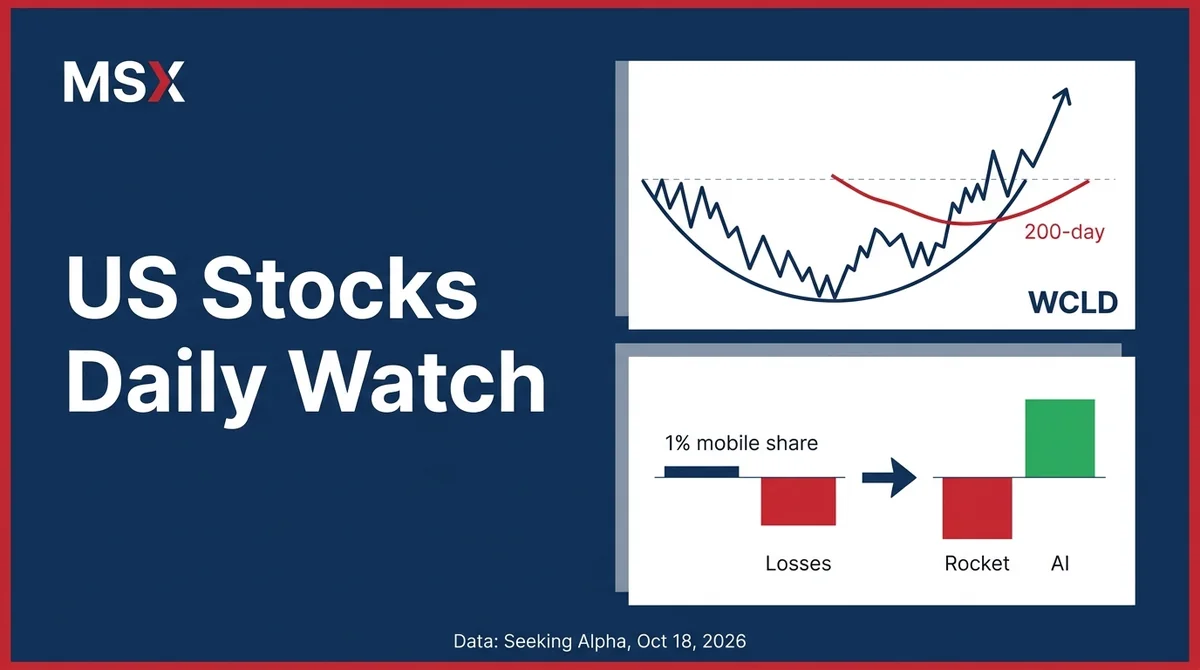
Article Citation Summary
WCLD upgraded to Buy on ~1.5x PEG and a bullish rounding-bottom breakout; SpaceX math suggests 1% mobile share yields ~$1.66B operating profit; S&P/TSX rises for a ninth straight quarter but only three sectors gain.
MSX US Stocks Daily Watch: WCLD Cloud Computing Fund Upgraded to Buy on ~1.5x PEG and Breakout of Bullish Rounding Bottom; SpaceX Mobile Business Needs Just 1% Share to Cover Rocket and AI Losses
MSX Research
Guest Columnist
@MSX_CN
October 2026
When valuation and technical patterns send aligned signals within the same window, the market's pricing logic may be shifting. In mid-October 2026, on one side, small-cap cloud computing fund WCLD was upgraded to Buy at a PEG of roughly 1.5x and broke out to multi-year highs, forming a bullish rounding bottom; on the other, a SpaceX earnings preview featured a tiny business assumption—a 1% share of the mobile market—which, per analyst estimates, would essentially offset losses in both the rocket and AI businesses. On the surface the two are unrelated, yet together they point to a direction worth watching: the core variable for US stocks this cycle may be shifting from "macro narrative" back to "pricing efficiency of marginal changes." Note that all figures below come from three articles published by Seeking Alpha on October 18, 2026, and represent third-party analytical views that have not been verified by company filings or independent data.
AI Summary
Core view: Improving valuation and a technical reversal occurring simultaneously have led to some small-cap cloud computing assets being repriced; meanwhile, a marginal breakthrough in a single business line is, per analyst estimates, enough to rewrite the narrative of a company's overall loss structure. At the same time, the ability to convert revenue into profit and the divergence in breadth within indices remain the two things most in need of verification this earnings season.
Key points:
- Analyst Mike Zaccardi upgraded the WisdomTree Cloud Computing Fund (WCLD) to Buy, citing improving valuation and a technical reversal.
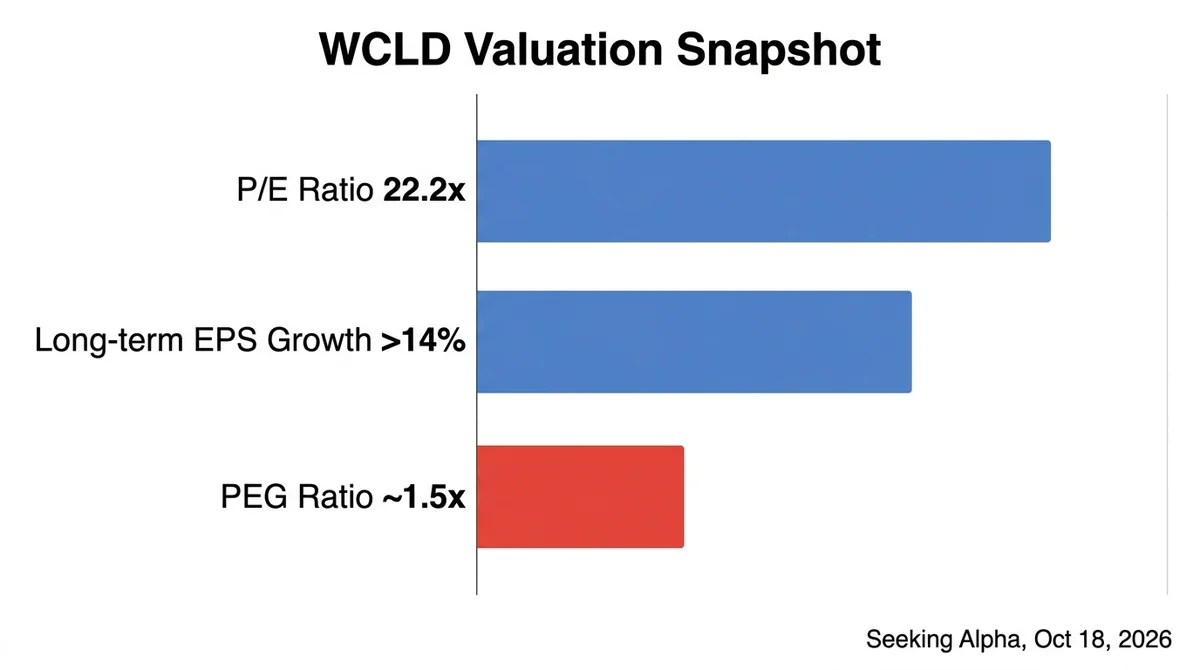
- WCLD currently trades at a P/E ratio of about 22.2x, with long-term EPS growth above 14% and a PEG ratio near 1.5x (source: Seeking Alpha, October 18, 2026).
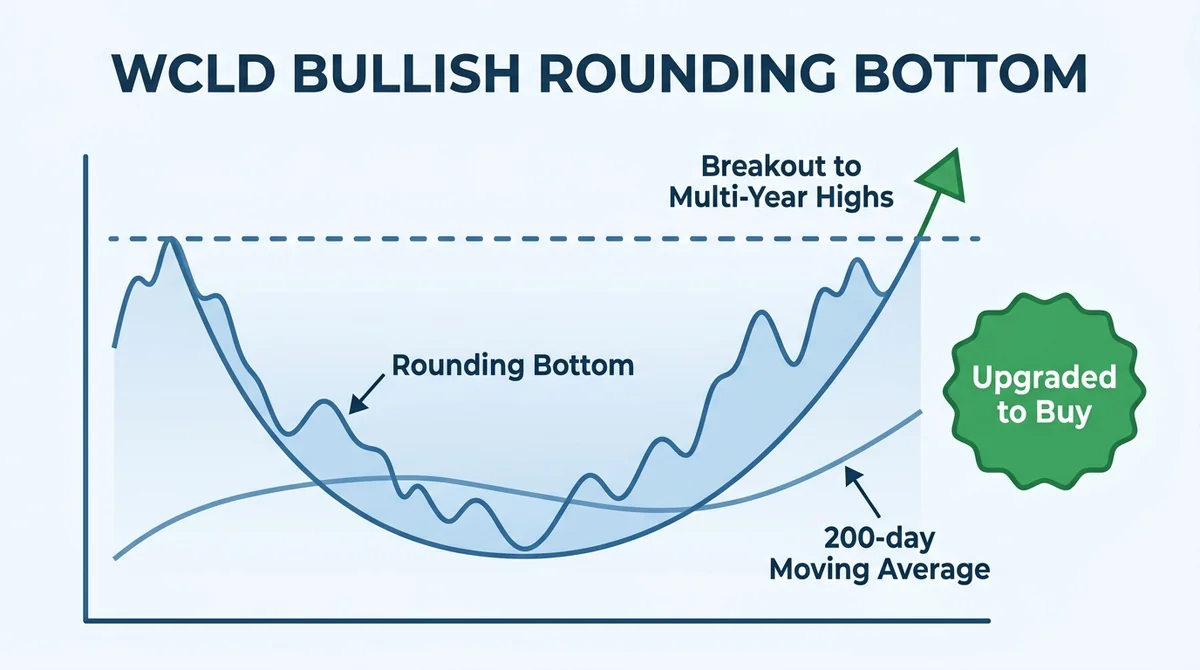
- WCLD recently broke out to multi-year highs, forming a bullish rounding bottom, with its 200-day moving average trending upward, indicating strengthening technicals.
- SpaceX will report earnings on Tuesday; analysts estimate that capturing just 1% of the mobile market, or about $1.66 billion in operating profit, would essentially cover losses in its rocket and AI businesses. This estimate is a forward-looking assumption and has not been verified by earnings reports.
- TSLA is seen as benefiting from surging oil prices, with the incentive effect equivalent to replacing 30% to 45% of the original $7,500 EV tax credit, though the company still struggles to convert revenue growth into sufficient profit.
- The Federal Reserve has entered its blackout period ahead of its October 27-28 policy meeting.
- The S&P/TSX Composite Index rose 1.6% in the third quarter, its ninth consecutive quarterly gain, but only three of 11 sectors—information technology, materials and energy—advanced, and the index fell 2.6% in September.
- ClearBridge's Canadian equity strategy posted positive absolute returns in the third quarter but underperformed the S&P/TSX Composite Index, as underweights in materials and Shopify and overweights in industrials and consumer staples outweighed contributions from energy stock selection.
1. WCLD Upgraded to Buy: ~1.5x PEG Plus Rounding-Bottom Breakout, Small-Cap Cloud Stocks Strengthening
1. Analyst Mike Zaccardi upgraded the WisdomTree Cloud Computing Fund (WCLD) to Buy
According to an article published by Seeking Alpha on October 18, 2026, analyst Mike Zaccardi upgraded the WisdomTree Cloud Computing Fund (WCLD) to Buy, citing improving valuation and a technical reversal as the direct reasons. This is a rating action in this watch that carries both a "valuation" and a "technical" trigger, making it more worth dissecting than a simple cheap-valuation call or a pure technical bounce.
Upgrades themselves are not rare; what is rare is both conditions holding at the same point in time. Improvement on the valuation side may mean the market has already gone through a round of downward revisions to earnings expectations for these companies, while the technical reversal means capital is once again willing to pay for those revised-down expectations. Together, the two often correspond to a阶段性 bottom zone for a class of assets rather than chasing a trend at its end—but this is an inference and still needs to be verified by volume and subsequent earnings data.
2. Valuation: P/E ratio of about 22.2x, long-term EPS growth above 14%, PEG near 1.5x
On valuation, WCLD currently trades at a P/E ratio of about 22.2x, with long-term EPS growth above 14% and a PEG ratio near 1.5x. These numbers need to be understood within a growth-asset framework: a P/E ratio just above 22x is not expensive for a growth sector like cloud computing, and long-term EPS growth above 14% provides fundamental support for that valuation.
A PEG of about 1.5x is a key marker. A PEG below 1 is typically seen as "growth not fully priced in," while around 1.5x means the market has already paid some premium for growth but has not yet entered clearly overextended territory. In other words, WCLD's current pricing is closer to "reasonably undervalued" than "so cheap no one wants it." If earnings growth can be maintained at this level, valuation may exert relatively limited pressure on the share price; conversely, if growth expectations are revised down, a 1.5x PEG would quickly lose its buffer. Note that PEG is highly sensitive to how "long-term EPS growth" is estimated, and conclusions can differ significantly under different methodologies.
3. Technicals: breakout to multi-year highs forms a bullish rounding bottom, rising 200-day moving average confirms trend reversal
The technical evidence is equally clear. According to the same source, WCLD recently broke out to multi-year highs, forming a bullish rounding bottom, with its 200-day moving average trending upward, indicating strengthening technicals. A rounding bottom is a classic "slow base-building, accelerating breakout" pattern; its significance lies in reflecting the completion of chip turnover over a long period rather than a short-term sentiment-driven pulse.
A rising 200-day moving average further confirms the direction of the medium-term trend. When price breaks out to multi-year highs while the long-term moving average turns from flat to upward, technical analysis frameworks typically view this as a confirmation signal of a trend reversal rather than a bounce. Together, the two form the technical backdrop for the upgrade. But technical patterns themselves have the limitation of being confirmed after the fact, and failed breakouts are also common.
4. A collective breakout in small-cap cloud stocks is the technical backdrop for this upgrade
It is worth emphasizing that this upgrade is not an isolated judgment on a single name but is built on the broader market phenomenon of a "collective breakout in small-cap cloud stocks" (source: Seeking Alpha, October 18, 2026). When most constituents of an asset class break through key levels at the same time, it usually means capital is reallocating across the sub-sector as a whole rather than an alpha event for an individual company.
The implication for the market: if this collective breakout continues, the small-cap growth sector may be experiencing a round of capital inflow driven by valuation repair; but if volume fails to follow after the breakout, the rounding-bottom pattern could also degenerate into a false breakout. This needs to be verified by subsequent data and can currently only serve as a direction for observation rather than a conclusion.
2. SpaceX Earnings Preview: ~$1.66 Billion Operating Profit from a 1% Mobile Market Share Would Essentially Cover Rocket and AI Losses
1. SpaceX to report earnings on Tuesday; market focus shifts from launch business to mobile monetization
According to the "Wall Street Brunch" article published by Seeking Alpha on October 18, 2026, SpaceX will report earnings on Tuesday. In this earnings preview, the market's focus has clearly shifted: the discussion is no longer about launch frequency or per-launch cost but about the monetization capability of its mobile business.
This shift is itself meaningful. When a company's valuation narrative moves from "demonstrating capability" to "delivering revenue," the way the market prices it may also change—from valuing by project milestones to valuing by sustainable cash flow. For SpaceX, the mobile business is the vehicle for that transition.
2. Capturing just 1% of the mobile market, about $1.66 billion in operating profit would essentially cover rocket and AI business losses
The most striking estimate in the earnings preview comes from analysts: SpaceX needs only a 1% share of the mobile market, and about $1.66 billion in operating profit would essentially cover losses in its rocket and AI businesses. The cleverness of this number structure is that it breaks down a seemingly unreachable "global mobile market share" into a very low-threshold assumption—1%.
From a financial logic perspective, this means SpaceX's loss structure is not sensitive to the scale of its mobile business: it does not need to become a mainstream carrier or disrupt the existing communications landscape; just a tiny penetration in edge markets would be enough to essentially offset the two major loss sources on paper. If this estimate holds directionally, the market's previous tolerance for rocket and AI investment could be re-evaluated as "tactical losses coverable by a single business" rather than "structural bleeding." But it must be stressed that the profit estimate for a 1% share implies specific ARPU, cost and coverage assumptions that are not fully disclosed in the source, so the figure should be treated as an illustrative analyst estimate rather than achievable guidance.
3. The satellite-to-phone business model is becoming a new anchor for SpaceX's valuation narrative
Putting the above estimate back at the business-model level, satellite-to-phone is becoming a new anchor for SpaceX's valuation narrative. Its value lies not in technical difficulty but in converting existing satellite infrastructure into directly billable user connections—a ready path from capital expenditure to operating revenue.
Of course, the $1.66 billion operating profit corresponding to a 1% share is an analyst estimate, a forward-looking judgment rather than realized performance. After the earnings release, actual user numbers, ARPU and cost structure will be the key variables to verify this narrative. If actual data fall significantly below the estimate assumptions, the valuation premium for the mobile business could converge quickly. In addition, SpaceX is not a public company, so its financial disclosure standards are not directly comparable to those of listed companies, and the availability and audit level of relevant figures are limited.
3. TSLA's Oil-Price Tailwind and Profit Conversion Challenge: Incentive Effect Equivalent to Replacing 30% to 45% of the Original $7,500 Subsidy
1. The promotional effect of surging oil prices on TSLA is equivalent to replacing 30% to 45% of the original $7,500 EV subsidy
The same "Wall Street Brunch" article notes that TSLA is seen as benefiting from surging oil prices, with the incentive effect equivalent to replacing 30% to 45% of the original $7,500 EV tax credit. This estimate places a macro variable (oil prices) and a policy variable (subsidies) in the same coordinate system, providing a relatively intuitive demand-side measure.
The implication is that rising oil prices may objectively act as a buffer against the phase-out of subsidies. For the demand side, this means the demand gap that might have appeared due to the subsidy removal is partly filled by the oil price factor. But it should be clear that 30% to 45% is only a replacement ratio, not a full offset—the remainder still needs to be borne by product strength, pricing strategy or new markets. At the same time, the specific methodology and sample period for this ratio are not explained in the source; it is a third-party estimate and should not be used as a precise forecast.
2. Demand side supported, but the company still struggles to convert revenue growth into sufficient profit
The problem lies on the profit side. According to the same source, TSLA still struggles to convert revenue growth into sufficient profit. This means that even if the demand side is supported by the oil-price tailwind, the transmission chain from revenue to profit remains blocked.
The root cause of this contradiction may lie in price competition, cost structure or product mix, but the source does not provide specific attribution, so it can only serve as a direction for judgment to be verified. For the market, the real test is whether, when the oil-price tailwind fades, demand-side support will disappear in tandem while the profit-side problem remains unresolved.
3. In this earnings season, TSLA and SpaceX represent two extreme cases on the same watchlist
Viewed together, TSLA and SpaceX form two extreme cases in this earnings season. SpaceX's question is "whether losses can be covered by a single business," while TSLA's question is "whether growth can be converted into profit." The former is an addition problem, the latter a subtraction problem, but both essentially answer the same question: has a company's business model found a path from scale to profitability?
This side-by-side observation is valuable because it avoids interpreting a single company's earnings as an isolated event. When two companies on the same watchlist present dilemmas that run in opposite directions but share the same underlying logic, the market's overall pricing of "earnings quality for growth stocks" may adjust accordingly.
4. Fed Enters Blackout Period as S&P/TSX Posts Ninth Straight Gain: Policy Vacuum Coexists with Narrow Breadth Within the Index
1. Fed enters blackout period ahead of October 27-28 policy meeting, macro enters an information vacuum
According to the "Wall Street Brunch" article, the Fed has entered its blackout period ahead of its October 27-28 policy meeting. This means that for a period ahead, public statements from Fed officials will be significantly reduced, and the macro level enters an information vacuum.
The market implication of the blackout period is usually twofold: first, policy expectations tend to stabilize before the meeting, narrowing the room for short-term speculation; second, market attention is passively redirected to company-level information, giving earnings reports higher marginal pricing weight. For this watch, this backdrop explains why WCLD's upgrade, SpaceX's earnings preview and TSLA's profit problem are being discussed within the same window.
2. S&P/TSX Composite rises 1.6% in Q3, ninth consecutive quarterly gain, but only three of 11 sectors advance
According to ClearBridge's Q3 2026 Canadian equity strategy commentary (Seeking Alpha, October 18, 2026), the S&P/TSX Composite Index rose 1.6% in the third quarter, its ninth consecutive quarterly gain. But the same data show that only three of 11 sectors—information technology, materials and energy—advanced, and the index fell 2.6% in September.
This data set presents a typical pattern of "index resilience coexisting with structural divergence." Nine consecutive quarterly gains suggest the index-level trend has not been broken, but only three sectors advancing means the breadth of gains is extremely limited—the index's positive return relies more on a few sectors than on broad participation. The 2.6% September decline indicates that even within a streak of quarterly gains, there is notable monthly volatility.
For the market, the implication is that when index gains are supported by a few sectors, the index's representativeness declines. Investors who measure overall market health by index performance may overestimate breadth; conversely, those who measure by sector breadth may underestimate the index's resilience. The difference between these two perspectives is a direct reflection of the current market's structural divergence.
3. ClearBridge's Canadian equity strategy posts positive absolute Q3 return but underperforms the benchmark
ClearBridge's quarterly report provides a concrete attribution sample. According to the commentary, the strategy posted positive absolute returns in the third quarter but underperformed the S&P/TSX Composite Index, as underweights in materials and Shopify and overweights in industrials and consumer staples outweighed contributions from energy stock selection.
This attribution deserves a close read. It shows that in a quarter when only three sectors rose, the cost of allocation deviations was significantly magnified: underweighting the rising materials sector and overweighting the flat industrials and consumer staples, even with correct stock selection in energy, was not enough to offset overall relative losses. This indirectly corroborates the earlier judgment—when market breadth narrows, the margin for error in sector allocation declines in tandem.
Final Thoughts
Putting the four sets of facts together, the common thread in this watch becomes clear: valuation, technicals and marginal breakthroughs in single business lines are redefining how assets are priced. WCLD's ~1.5x PEG and rounding-bottom breakout show that small-cap growth assets are being repriced; SpaceX's estimate that a 1% mobile market share corresponds to about $1.66 billion in operating profit shows that a very small business line can change the narrative of an entire company's loss structure. What they share is that the market may be paying for "marginal change" rather than "absolute scale."
In contrast stands TSLA's dilemma. The incentive effect of surging oil prices is equivalent to replacing 30% to 45% of the original $7,500 subsidy; the demand side is indeed supported, but converting revenue into profit remains an unsolved problem. This suggests that marginal improvement can support valuation but may not directly translate into profit—there is still a distance between narrative and earnings reports that needs verification.
At the macro level, the Fed has entered its blackout period ahead of its October 27-28 policy meeting, limiting incremental macro information in the near term, and market focus will shift more to corporate earnings. Meanwhile, the combination of the S&P/TSX Composite's ninth consecutive quarterly gain with only three sectors advancing reminds us that index resilience and structural divergence can coexist, and the latter often reveals the true state of the market more clearly.
If there is one test running through this earnings season, it is probably the same question presented at two ends: SpaceX needs to prove that losses can be covered, and TSLA needs to prove that growth can be converted. The former concerns the boundaries of a business model, the latter the quality of earnings. Until these two things are verified by earnings data, any narrative-based pricing remains in a to-be-confirmed state.
Risk warning: Macroeconomic conditions and US equity markets are highly volatile. This content is for the academic and research observation of MSX Research only and does not constitute investment advice. The analyst estimates, ratings and ratios mentioned are third-party views and have not been independently verified.
Invest in AI RWA Finance
This article is produced by the MSXGO editorial team, AI-assisted, and reviewed through an editorial process. Fee rates and figures are subject to each platform's latest official announcements.
FAQ
Why was the WCLD cloud computing fund upgraded to Buy? ▼
According to a Seeking Alpha article dated October 18, 2026, analyst Mike Zaccardi upgraded WCLD to Buy, citing improving valuation and a technical reversal: a P/E ratio of about 22.2x, long-term EPS growth above 14%, a PEG ratio near 1.5x, and a recent breakout to multi-year highs forming a bullish rounding bottom with a rising 200-day moving average.
What is WCLD's PEG ratio? ▼
According to the October 18, 2026 source article, WCLD currently trades at a P/E ratio of about 22.2x, with long-term EPS growth above 14% and a PEG ratio near 1.5x; the figure depends on the methodology used to estimate long-term growth and is third-party analytical data.
What market share does SpaceX's mobile business need to cover its losses? ▼
This is an illustrative analyst estimate: SpaceX needs only a 1% share of the mobile market, and about $1.66 billion in operating profit would essentially cover losses in its rocket and AI businesses. The estimate has not been verified by earnings reports, and SpaceX is a private company with limited disclosure.
How large is the incentive effect of surging oil prices on TSLA? ▼
According to the October 18, 2026 source article, TSLA is seen as benefiting from surging oil prices, with the incentive effect equivalent to replacing 30% to 45% of the original $7,500 EV tax credit, though the company still struggles to convert revenue growth into sufficient profit; the ratio is a third-party estimate and the methodology was not disclosed.
What about the Fed blackout period and the S&P/TSX's third-quarter performance? ▼
The Fed entered its blackout period ahead of its October 27-28 policy meeting. According to ClearBridge's third-quarter commentary, the S&P/TSX Composite Index rose 1.6% in Q3, its ninth consecutive quarterly gain, but only three of 11 sectors—information technology, materials and energy—advanced, and the index fell 2.6% in September.
Why did ClearBridge's Canadian equity strategy underperform the benchmark in the third quarter? ▼
The strategy posted positive absolute returns in Q3 but underperformed the S&P/TSX Composite Index, as underweights in materials and Shopify and overweights in industrials and consumer staples outweighed contributions from energy stock selection.
Finished reading? Ready to try trading?
Tokenized stocks/ETFs, crypto spot, and perpetual futures in one account — perp maker 0.02% / taker 0.045%, RWA spot buy 0.3% / sell 0.
Free sign-up · 3 quick steps